





Why Legal Practice Growth Matters More Than Ever
Legal practice growth is no longer optional—it’s essential for survival. With approximately 1.3 million lawyers competing across the United States, standing out and attracting clients has become the defining challenge of modern legal practice.
Key Facts About Legal Practice Growth:
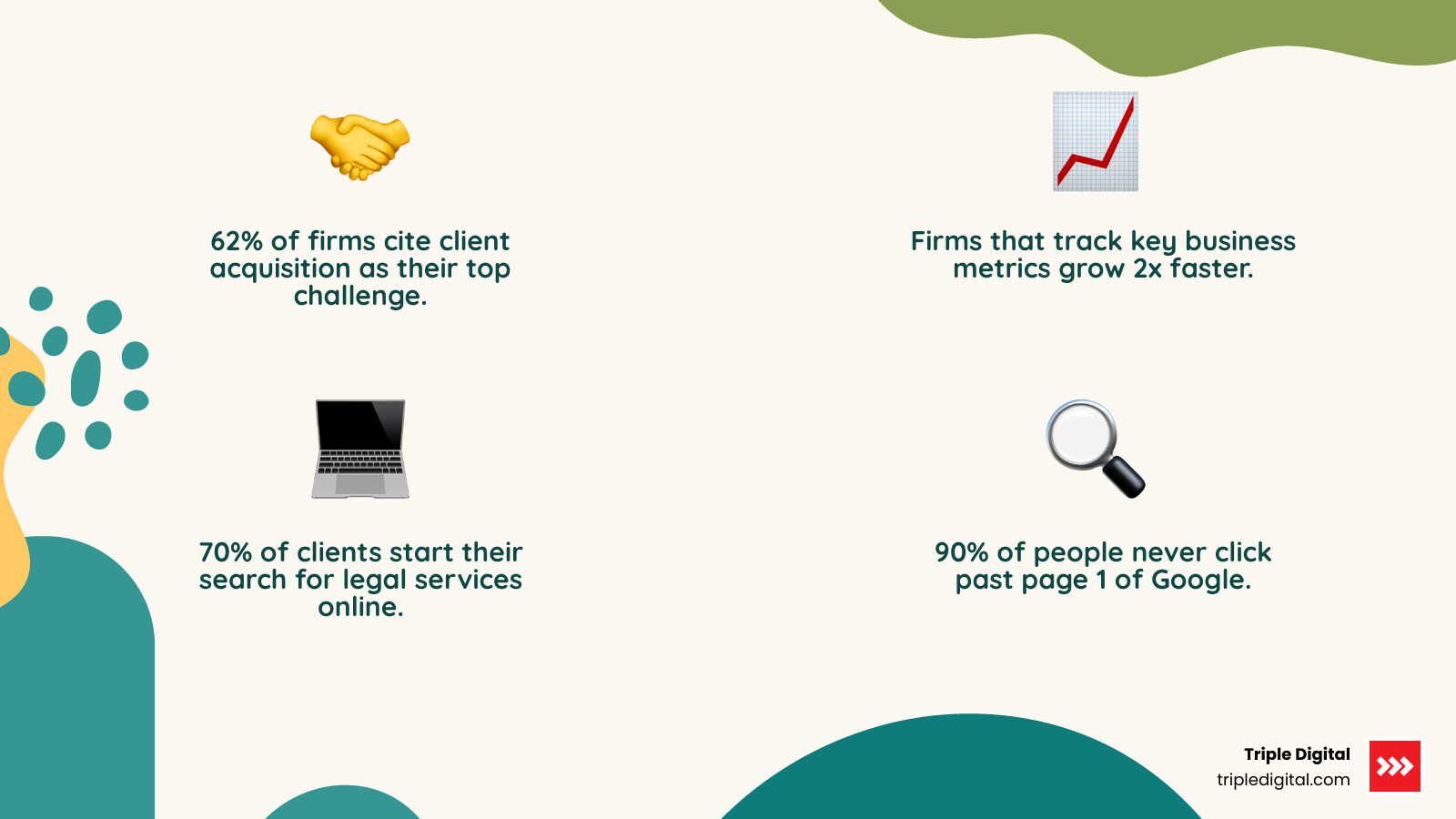
- 62% of firms cite client acquisition as their top challenge
- 74% of firms are rethinking their growth strategy for 2026
- Firms that track key business metrics grow 2x faster than those that don’t
- Job growth for lawyers projected at 8-15% between 2023-2033
- Law firm profits remain steady, but only for those who adapt
The legal industry is shifting rapidly. Traditional referral networks and “word of mouth” marketing are no longer enough. About 70% of potential clients now start their search for legal services online, and 90% never click past page 1 of Google.
Many firms remain stuck in “survival mode”—handling cases as they come in, without a clear plan for growth. But the data tells a different story: firms with intentional growth strategies, clear goals, and modern marketing systems are doubling or even tripling their client bases while their competitors struggle.
The difference isn’t luck or legal expertise alone. It’s about treating your practice like a business—with systems, metrics, and a strategic plan. Whether you’re a solo practitioner or managing a mid-sized firm, sustainable growth requires moving beyond traditional methods and embracing data-driven strategies.
This guide will show you exactly how to make that shift.
A Blueprint for Sustainable Legal Practice Growth

Building a thriving legal practice is much like constructing a magnificent building: it requires a solid blueprint, meticulous planning, and a clear vision. We’re moving beyond simply waiting for referrals and into a proactive, strategic approach to legal practice growth. This means setting a long-term vision for our firm and aligning all our resources—our people, our technology, and our marketing efforts—with those objectives. Research shows that firms with a clear business plan are 30% more likely to hit their goals. It’s no longer enough to be a great lawyer; we must also be astute business owners.
Setting the Foundation with a SWOT Analysis
Before we can chart a course for growth, we need to understand where we stand. That’s where a SWOT analysis comes in handy. It’s a simple yet powerful tool to evaluate our firm’s:
- Strengths: What do we do exceptionally well? What unique expertise or client relationships do we possess? For example, a solo practitioner might excel in personalized service delivery, often outperforming larger firms in client satisfaction.
- Weaknesses: Where do we fall short? Is our client intake process slow? Do we struggle with administrative tasks? The average small law attorney, for instance, spends less than 60% of their time on actual legal work, bogged down by non-billable tasks.
- Opportunities: What external factors can we leverage? Is there a surging demand for a specific legal service in Houston? Are new technologies emerging that can give us an edge?
- Threats: What external challenges could hinder our growth? Is new competition entering our market? Are there regulatory changes that could impact our practice areas?
By conducting a thorough SWOT analysis, we gain a competitive edge and make informed business decisions. It helps us identify areas where we can improve, capitalize on emerging trends, and mitigate potential risks.
Defining Your Goals and KPIs
Once we understand our current landscape, it’s time to set our sights on the future. Vague aspirations like “grow my firm” won’t cut it. We need to define specific, measurable, achievable, relevant, and time-bound (SMART) goals. For example, instead of “grow my firm,” a SMART goal might be “Increase revenue from biotech clients by 20% in the next 12 months.”
To track our progress toward these goals, we use Key Performance Indicators (KPIs). These are the vital signs of our firm’s health and growth. Essential KPIs for any growing law firm include:
- Revenue per lawyer: How efficiently are our legal professionals generating income?
- Client Acquisition Cost (CAC): How much does it cost us to acquire a new client?
- Client Lifetime Value (CLV): What is the total revenue we expect to generate from a client over the course of our relationship?
- Conversion Rate: The percentage of website visitors who complete a desired goal, like contacting our firm.
- Referral Rate: The percentage of new clients acquired through referrals.
We know that Firms that track key business metrics grow 2x faster than those that don’t. This isn’t just a hunch; it’s a proven fact. Tracking these metrics allows us to refine our strategies, allocate resources efficiently, and make data-driven decisions that propel our legal practice growth. For help with tracking these crucial metrics, check out our insights on Law Firm Lead Tracking.
Targeting High-Growth and Lucrative Practice Areas

The legal landscape is a dynamic beast, constantly reshaped by market evolution, technological disruption, regulatory changes, and societal shifts. This rapid change isn’t just creating new challenges; it’s opening up unprecedented opportunities for legal practice growth. The good news for aspiring and established legal professionals in the US is that job growth for lawyers is projected to increase up to 15% between 2023 and 2033. This robust outlook signals a thriving environment for specialization and expansion. You can find more details on this projection at the Projected job growth for lawyers website.
The Fastest-Growing Legal Specialties in 2025
So, where is this growth happening fastest? The legal market in 2025 is seeing several areas expanding at record speeds, driven by innovation and increasing complexity. Here are some of the most in-demand and fastest-growing legal specialties:
- Artificial Intelligence (AI) Law: This is arguably the fastest-growing area, experiencing a remarkable 79% growth in partner headcount at top firms since 2023. With 64% of Fortune 500 companies increasing legal spend on AI compliance and risk management, lawyers are navigating complex issues like algorithm transparency, intellectual property for machine-generated content, and liability for autonomous systems.
- Data Privacy & Cybersecurity: This field continues its robust growth trajectory, with partner headcount in cybersecurity practices increasing by 68% since 2022. The demand is fueled by escalating cyber threats and a burgeoning regulatory landscape, with 35 states now boasting comprehensive data privacy laws.
- Environmental, Social & Governance (ESG) Law: ESG has cemented its position as a cornerstone of corporate legal strategy, showing a 54% growth in practice since 2023. As companies face increasing pressure for sustainable and ethical operations, legal guidance on disclosure, risk management, and corporate governance is paramount.
- Renewable Energy Law: With a 47% growth in practice headcount, this area is booming. Massive investments in clean energy projects and supportive regulatory frameworks are driving demand for legal expertise in project development, regulatory compliance, and tax incentives.
- Healthcare & Telemedicine Law: Digitalization of healthcare and the permanent integration of virtual care have led to a 43% growth in this specialty. Lawyers are crucial for navigating regulatory complexities arising from telehealth services, digital health privacy, and compliance.
- Digital Assets & Blockchain Law: This high-growth area has seen a 41% increase in practice headcount. As institutional adoption of digital assets and blockchain technology matures, legal guidance on securities regulation, banking compliance, and smart contract development is in high demand.
- Climate Change & Environmental Law: Beyond ESG, this specific area has experienced 38% growth, driven by regulatory expansion, corporate commitments, and climate litigation. The SEC’s climate disclosure rule, for example, has significantly increased demand for specialized legal guidance.
- Mergers & Acquisitions (M&A) Law: Rebounding strongly from previous slowdowns, M&A law has demonstrated 36% growth. Economic stabilization and strategic consolidation are fueling activity, requiring expert dealmakers.
- Labor & Employment: BTI forecasts this as a top growth area due to an activist workforce, new regulations, and union activities.
We’re also seeing significant legal needs arising from industries like High-Tech (13 acute legal needs, from complex litigation to AI issues), Financial Services (new, complex financial products bringing new risks), Pharma (acquisitions and joint ventures), Food & Agriculture (M&A, regulatory oversight, new products), Healthcare (competitive pressures, consolidation, labor issues), and Consumer Products (litigation and claims from new products and social media).
Salary and Career Outlook in High-Demand Fields
The compensation in these high-growth areas reflects their demand and complexity. Attorneys specializing in these fields can expect premium salaries and strong career trajectories.
- AI Law: First-year associates at top firms can command salaries between $225,000-$245,000, with partners leading AI practice groups earning an average of $1.5 million to $3 million annually. The unique blend of legal and technical expertise is highly valued.
- Privacy & Cybersecurity Law: First-year associates typically start between $215,000-$235,000, while established partners at top firms can see annual compensation from $950,000-$2.2 million. Technical certifications in this field can further boost earning potential.
- ESG Law: Associates in ESG practices at leading firms often start between $180,000-$200,000, with partners earning $800,000-$1.8 million annually.
- M&A Law: With its strong rebound, first-year associates can expect $175,000-$205,000, and established partners at elite M&A firms can earn between $1 million and $5 million annually.
- Intellectual Property (IP) Law: Lawyers in this field averaged $377 per hour, one of the highest hourly rates.
These figures highlight that expertise in technology integration, regulatory complexity, energy transition, and healthcare innovation are not just trends, but pathways to lucrative and stable careers. The legal implications of AI are vast and constantly evolving, making this a critical area for ongoing development. For a deeper dive into this, explore our insights on the More on legal implications of AI.
Fueling Growth with Technology and Automation
In today’s legal world, efficiency isn’t just a buzzword; it’s a cornerstone of legal practice growth. We believe that fueling our growth means embracing technology and automation to streamline operations, reduce tedious non-billable hours, and free up our legal experts to do what they do best: practice law. After all, lawyers bill for just 2.5 hours for every 8 hours worked on average, meaning a significant portion of time is spent on administrative tasks.
The legal industry has recognized this, with law firm software spending growing by an average of 20% annually since 2013. Firms with above-average productivity tend to invest more in technology, spending 12% more on software than their less productive counterparts. Currently, 70% of law firms report using web-based software solutions, and 64% budget specifically for technology expenses. This investment pays off by automating tasks like client intake, billing, document management, and case management, which can significantly boost our team’s output and overall profitability.
The Impact of AI on Law Firm Operations
Artificial Intelligence (AI) is no longer a futuristic concept; it’s a present-day game-changer for law firms. We’re seeing its profound impact across various operations:
- Improved Legal Research: AI tools can rapidly sift through vast databases of statutes, case law, and regulations, providing lawyers with precise, relevant information in a fraction of the time.
- Automated Contract Review and Drafting: AI can analyze contracts for specific clauses, identify anomalies, and even assist in drafting standard agreements, significantly speeding up transactional work.
- Predictive Analytics: AI can analyze past case data to forecast potential outcomes, helping us make more informed strategic decisions for our clients.
- Client Intake and Management: AI-powered chatbots and virtual assistants can handle initial client inquiries, gather essential information, and even schedule consultations, ensuring no lead falls through the cracks.
While nearly 70% of law firms are still exploring AI, more than half are actively looking to implement it. Among those already using it, 31% of lawyers say they use generative AI for work-related tasks, with 45% reporting daily usage. This means AI is not just a tool for the future, but an integral part of daily practice for many.
However, leveraging AI also brings responsibilities, particularly regarding data security and compliance. As we integrate these powerful tools, we must ensure robust protocols are in place to protect sensitive client information and comply with evolving data privacy regulations. Understanding complex frameworks, like those outlined in Understanding CCPA laws, is crucial for any firm operating in the digital age. At Triple Digital, we’re at the forefront of this revolution, and you can learn more about our innovative solutions with Triple Digital’s AI Tool.
Building Your Digital Empire: Marketing and Client Acquisition
When 70% of clients start their search for legal services online, our digital presence isn’t just important—it’s paramount. Google has become the new word-of-mouth for law firms, and clients often judge us in mere seconds based on what they find online. Building a strong brand identity that resonates digitally is critical for attracting and retaining clients. To truly achieve legal practice growth, we must build a robust digital empire. For a deeper dive into establishing your firm’s online footprint, explore how we can help as your Online Presence & Digital Marketing Agency.
Dominating Search with Law Firm SEO
Search Engine Optimization (SEO) is the backbone of any successful digital strategy. It’s how we ensure our firm appears prominently when potential clients in Houston are searching for legal help. SEO involves several key components:
- Keyword Research: Identifying the specific terms and phrases our ideal clients are typing into search engines (e.g., “Houston personal injury lawyer,” “estate planning attorney near me”).
- On-page SEO: Optimizing our website content, meta titles, descriptions, and headings with these keywords to signal relevance to search engines.
- Off-page SEO: Building authority and trust through external signals, primarily high-quality backlinks from reputable websites.
- Local SEO: This is crucial for local firms. Optimizing our Google Business Profile (GMB) with accurate information, photos, and client reviews helps us appear in the “local pack” for geographically targeted searches. Businesses in the local pack haul in 44% of clicks, and law firms can see up to a 400% increase in views and a 100% increase in clicks.
- Content Marketing Strategy: Creating valuable, informative content—like blog posts between 1,000–1,500 words, published two to four times per month—that addresses client questions and establishes our firm as a thought leader. This is a long game, as Attorney SEO is incredibly competitive and it could take six to twelve months to see measurable improvements.
The bottom line? 90% of people never click past page 1 of Google search results. If we’re not visible there, we’re essentially invisible to the vast majority of potential clients. This is why a well-executed SEO strategy is non-negotiable. For more insights, check out Why SEO is Important for Attorneys.
Creating a High-Converting Website and Digital Presence
Our website is our firm’s digital storefront, marketing team, and receptionist all rolled into one. It needs to be a high-converting machine, designed to turn visitors into leads.
- User-Friendly Web Design: A good website is intuitive, easy to steer, and visually appealing. Clients equate a sloppy design with sloppy service.
- Fast Load Times: We’re impatient creatures. 47% of law firm websites fail to meet Google’s recommended load speed of under 3 seconds. A slow site frustrates visitors and can cause them to bounce to a competitor.
- Mobile Responsiveness: With 60% of clients accessing websites from their mobile devices, a clunky mobile site will drive 61% of people away. Our website must look and function flawlessly on any screen size.
- Clear Calls-to-Action (CTAs): Every page should guide visitors to the next step, whether it’s “Book Your Free Consultation,” “Get a Free Case Evaluation,” or “Talk to a Lawyer Now.”
- Social Media Marketing: With 5.41 billion people on social media globally, our next clients are undoubtedly there. Platforms like Facebook (3.07 billion users) offer massive reach, while LinkedIn is a goldmine for B2B and corporate law. Short-form videos, which see 2.5x more engagement than long-form, are excellent for showcasing our expertise and personality. In fact, 91% of businesses used video as a marketing tool in 2023.
By optimizing our website and leveraging social media, we create a powerful digital ecosystem that attracts, engages, and converts potential clients. Learn more about making your website a profit center with How Web Design Can Make Your Business More Profitable, and understand the power of social media for your firm through Law Firm Marketing With Social Media.
Frequently Asked Questions about Law Firm Growth
We often hear similar questions from law firm owners looking to expand their practices. Here are some of the most common ones, along with our expert insights:
What is the biggest challenge facing law firms today?
The biggest challenge is undoubtedly client acquisition and standing out in a crowded market. With over 1.3 million lawyers in the U.S., differentiation is key. As we’ve seen, 62% of firms cite client acquisition as their top challenge. This is compounded by managing rising operational costs and the constant need to adapt to new technologies and evolving client expectations. The legal market is shifting fast, and firms that fail to adapt risk falling behind. It’s a continuous balancing act of delivering exceptional legal services while also running a lean, efficient, and well-marketed business.
How can a small law firm compete with larger ones?
Small law firms, including solo practitioners, are mighty! They can absolutely compete and even outperform larger firms by focusing on their unique strengths:
- Niche Specialization: Instead of trying to be everything to everyone, focus on a specific area of law or a particular client demographic. This allows us to become the go-to expert in that niche, attracting clients who specifically need our specialized skills.
- Personalized Client Service: Small firms can offer a level of individualized attention and empathy that larger firms often struggle to match. Building strong relationships and providing an exceptional client experience is a powerful differentiator.
- Agility and Adaptability: We can pivot faster to market changes, adopt new technologies more quickly, and respond to client needs with greater flexibility than larger, more bureaucratic organizations.
- Leveraging Cost-Effective Digital Marketing: Modern digital marketing, especially targeted SEO and social media strategies, levels the playing field. We can reach our ideal clients online without the massive budgets of larger firms. For tactical advice, check out our Top 3 Digital SEO Strategies for Law Firms.
By focusing on these areas, small firms can build a loyal client base and carve out a significant share of the market.
How much should a law firm spend on marketing?
This is a common question without a one-size-fits-all answer, but we can provide some guidelines. Most law firms typically allocate between 2% and 15% of their annual revenue to marketing efforts. The exact percentage depends on several factors:
- Your growth objectives: Are you aiming for steady, incremental growth or rapid expansion?
- Your target audience: Who are you trying to reach, and where do they spend their time online?
- Your practice area: Some areas are more competitive and require a larger marketing investment.
- Your geographic location: Marketing in a highly competitive market like Houston might require a more substantial budget.
- Your firm’s age and revenue: Newer firms or those aiming for significant growth often invest a higher percentage.
The key is not just how much we spend, but how effectively we spend it. This means carefully calculating our Return on Investment (ROI) for every marketing initiative. The formula is simple: ROI = (Revenue Gained – Investment Cost) ÷ Investment Cost. By tracking this, we can ensure our marketing dollars are generating real cases and revenue. For a detailed breakdown of SEO costs and value, see How Much Should Lawyers Pay for SEO?.
Conclusion
The journey from a small firm to a legal empire is a marathon, not a sprint. It demands foresight, adaptability, and a relentless commitment to strategic planning. We’ve explored the critical pillars of sustainable legal practice growth: understanding our firm’s strengths and weaknesses through a SWOT analysis, defining clear goals and KPIs, strategically targeting high-growth and lucrative practice areas, using the power of technology and AI for efficiency, and dominating the digital landscape through robust marketing and client acquisition strategies.
In today’s competitive environment, simply being a good lawyer is no longer enough. We must treat our firms as businesses, embracing data-driven decisions and innovative solutions. This is where we come in. At Triple Digital, we specialize in empowering law firms, particularly in the Houston area, with a results-driven, “less fluff, more cases” approach. We leverage cutting-edge AI and data mining techniques to precisely target prospective clients, ensuring your marketing investment translates into tangible growth.
The legal market is evolving, and so should our strategies. By aligning with the insights and tools discussed in this guide, we can transform challenges into opportunities and lay the groundwork for a truly thriving legal practice. Taking the first step towards scalable growth means embracing change and strategically investing in our firm’s future.
Ready to build your legal empire? Develop your firm’s growth plan with our Digital Marketing Strategies for Law Firms today.