





Why Your Law Firm Website Needs More Than a Pretty Homepage
Legal website optimization is the process of improving your law firm’s website to rank higher in search engines, attract qualified visitors, and convert them into clients. It combines technical improvements, content strategy, and authority-building to ensure your site performs well in Google and delivers a seamless user experience.
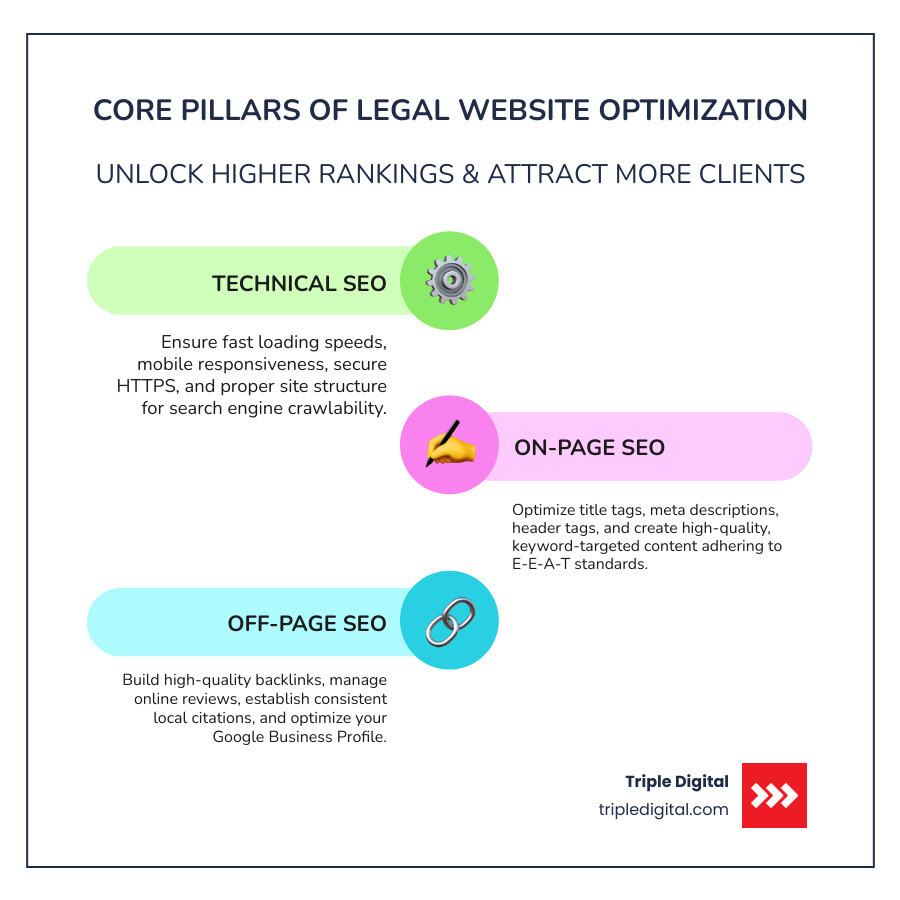
To optimize your legal website, focus on these core elements:
- Technical SEO – Fast page speed, mobile responsiveness, secure HTTPS, and proper site structure
- On-Page Optimization – Strategic title tags, meta descriptions, header tags, and keyword-targeted content
- Content Quality – Practice area pages, attorney bios, and educational content that meets E-E-A-T standards
- Local SEO – Optimized Google Business Profile, consistent NAP information, and local citations
- Off-Page Signals – High-quality backlinks, online reviews, and brand mentions
If your firm doesn’t appear quickly when you search for it on Google, you’re missing out on traffic and new business referrals. Data from the 8am™ LawPay 2023 Benchmark Report shows Google was the top lead source for law firms in 2023. Yet many attorneys treat their website as a digital brochure, not a 24/7 intake engine.
The reality is stark: 74% of consumers visit a law firm’s website to take action, and 96% of people seeking legal services use a search engine. If your site isn’t on the first page, or if it’s slow and confusing, you’re handing clients to your competitors.
Legal website optimization goes beyond visibility—it directly impacts case acquisition and profitability. To understand more about why SEO is crucial for your practice, read our guide Why SEO is Important for Attorneys.
The Foundation: Technical SEO and User Experience
Think of your website as a digital office. If it’s hard to find or inaccessible, potential clients will leave. Technical SEO ensures your website’s foundation is sound, allowing search engines to crawl and index it efficiently while providing a smooth user experience (UX). Google uses automated “crawlers” to read your content and add it to its index, making it eligible for search results. If technical issues block these crawlers, your content remains invisible.
As we discuss in How Web Design Can Make Your Business More Profitable, a robust website isn’t just about aesthetics; it’s about functionality, speed, and security, which directly impact your firm’s profitability.
Mobile Responsiveness and Accessibility
Most people browse on their phones, so if your site isn’t mobile-friendly, you’re losing clients. Google uses mobile-first indexing, meaning it primarily ranks your site based on its mobile version. A poor mobile experience will hurt your SEO traffic. Functionality is key: Can visitors easily tap your phone number to call? Is text legible without zooming? If someone can’t contact your firm with one tap on a smartphone, it’s time to review your mobile design.
Beyond mobile-friendliness, accessibility is crucial for making your website usable by people with disabilities. Following Web Content Accessibility Guidelines (WCAG) not only broadens your audience but also aligns with SEO best practices, as standards like alt text for images and clear heading structures (H1, H2, H3) make your site easier for both users and search engines to understand.
Site Speed and Performance
A slow website is a conversion killer. Fast websites outperform slow ones in rankings and conversions. Even a one-second delay can cost you a lead, as bounce rates jump from 9% for a 2-second load time to 38% for a 5-second load time.
Google’s Core Web Vitals are significant ranking factors that measure user experience:
- Largest Contentful Paint (LCP): Measures loading performance (ideally under 2.5 seconds).
- First Input Delay (FID) / Interaction to Next Paint (INP): Measures interactivity (ideally under 200ms).
- Cumulative Layout Shift (CLS): Measures visual stability (ideally under 0.1).
To improve your site speed, consider these adjustments:
- Image Compression: Use formats like WebP and compress all images before uploading.
- Minimize Redirects and Plugins: Reduce redirects and use only essential plugins.
- Browser Caching: Store website files for faster reloading for repeat visitors.
- Content Delivery Network (CDN): A CDN delivers content from servers closer to your users, speeding up load times.
- Managed Hosting: Improve overall performance and reliability with a managed hosting solution.
For a deeper dive, check out our article on Law Firm SEO: What Are the Most Important SEO Ranking Factors?.
Site Structure and Crawlability
A logical site structure makes information easy for users and search engines to find. It simplifies crawling, ensuring important pages are indexed, and provides an intuitive navigation experience.
Key elements of an optimized site structure include:
- Sitemaps: An XML sitemap tells search engines which pages are important. Submit it to Google Search Console.
- Internal Linking: Linking from one page on your site to another guides users and distributes “link equity,” boosting the authority of key pages and lowering bounce rates.
- URL Structure: Keep URLs short, descriptive, and keyword-rich (e.g.,
yourfirm.com/practice-areas/personal-injury/). - Logical Navigation: Use clear menus to ensure users can reach any page in 4 clicks or less.
- Fixing Errors: Regularly fix 404 errors (page not found) and 301 redirects using tools like Google Search Console.
Content Strategy: Engaging Users and Search Engines
High-quality content is the cornerstone of a successful legal website optimization campaign, as it’s the primary way to communicate expertise and build authority. You can learn more in our guide, Why Do Law Firms Need a Content Marketing Strategy?.
For law firms, content is subject to Google’s “Your Money or Your Life” (YMYL) guidelines, which apply higher standards to topics affecting a person’s health, finances, or safety. This means all legal content must meet stringent E-E-A-T standards:
- Experience: Demonstrate first-hand experience.
- Expertise: Showcase deep knowledge of your legal practice areas.
- Authoritativeness: Be recognized as a go-to source in your field.
- Trustworthiness: Provide accurate, verifiable information.
High-quality content for law firms includes:
- Practice Area Pages: Comprehensive pages targeting specific legal services (e.g., “Houston Personal Injury Lawyer”).
- Attorney Bios: Crucial for E-E-A-T, these should include experience, bar admissions, and notable verdicts.
- Client Testimonials and Case Studies: Powerful trust signals that demonstrate success.
- Blog Posts: Address specific questions and long-tail keywords (e.g., “What to do after a car accident in Houston?”).
- Resource Pages: In-depth content hubs that facilitate internal linking.
Long-form content (1,500+ words) often outperforms shorter articles for complex legal topics, but the primary goal is thoroughness and value, not just word count.
Core On-Page Elements for Legal Website Optimization
On-page SEO involves optimizing individual web pages to rank higher. These are elements entirely within your control.
- Title Tags: The clickable headline in search results and a key ranking factor. Keep it 55-65 characters and include your target keyword.
- Meta Descriptions: This 155-character summary appears under the title tag. While not a direct ranking factor, a compelling description improves click-through rates.
- Header Tags (H1, H2, H3, etc.): These structure your content like an outline. The H1 is your main page title (one per page), while H2s and H3s break down content into sub-sections, helping users and search engines understand the hierarchy.
- Keyword Research: Use tools like Google Keyword Planner to identify what clients are searching for, such as “Houston divorce lawyer” or “personal injury attorney Houston.”
- Plain Language and Readability: Write for an 8th to 9th-grade reading level. Avoid complex jargon and use short sentences, clear paragraphs, and bullet points to make content scannable.
Here’s a quick comparison of good vs. bad title tags and meta descriptions:
| Element | Bad Example | Good Example |
|---|---|---|
| Title Tag | Page 1 | Houston Personal Injury Lawyer – Your Firm Name |
| Meta Description | Click here for legal info. | Experienced Houston personal injury lawyers fighting for your rights. Free consultation for accident victims. |
The Role of Schema Markup
Schema markup (or structured data) is code added to your site to help search engines better understand your content. For law firms, legal service schema is the most important type, as it explicitly tells Google your content is related to a law firm.
Correctly implemented schema can lead to “rich snippets”—improved search results with extra information like star ratings or FAQs. This significantly increases visibility and click-through rates.
Common schema types for law firms include:
- LocalBusiness Schema: Highlights your firm’s name, address, phone number (NAP), and hours.
- LegalService Schema: Details the types of law you practice.
- FAQ Schema: Displays questions and answers directly in search results.
- Review Schema: Shows aggregated star ratings.
- Person Schema: Used for individual attorney profiles.
You can test your schema implementation using Google’s Rich Results Test.
Building Authority: Off-Page Signals and Local SEO
Off-page SEO involves activities outside your website that build its authority and trustworthiness. Think of it as your firm’s digital reputation. These signals tell search engines your site is a reliable and reputable source.

Local SEO for Law Firms
For a Houston-based law firm, local SEO is vital. Most potential clients search for legal help “near me” or within a specific city. Local SEO aims to get your firm listed in the “local pack” (the map results) for these queries.
- Google Business Profile (GBP): Your most powerful local SEO tool. We optimize your GBP with accurate NAP (Name, Address, Phone), hours, services, and photos. Regular posts and review responses boost local visibility. For more tips, see 5 GMB Hacks Not To Miss To Generate More Leads.
- Local Keywords: We target keywords like “Houston car accident lawyer” and create location-specific content addressing local laws and news.
- NAP Consistency: Your Name, Address, and Phone Number (NAP) must be identical across all online listings. Inconsistencies confuse search engines and hurt local rankings.
- Citations: These are mentions of your NAP on other websites. We ensure your firm is listed accurately in reputable legal and local directories.
- Local Link Building: We focus on acquiring links from local businesses, community organizations, and news websites.
Reputation and Trust Signals
In the legal field, trust is paramount. Off-page SEO helps build these crucial trust signals:
- Client Reviews: A huge factor in getting hired. We encourage reviews on your GBP and other platforms. Responding professionally to all reviews is key to managing your reputation.
- Testimonials and Case Studies: Featuring these on your site and GBP showcases your success.
- Brand Mentions: Mentions by reputable news outlets or legal blogs signal authority, even without a link.
- Bar Association Ratings: Positive ratings from bar associations improve your credibility.
- Backlinks: These are “votes of confidence” from other websites. High-quality, relevant backlinks make your site appear more trustworthy to Google. Many pages have few or no backlinks, highlighting a major opportunity for law firms to stand out.
For an in-depth look, explore our guide on Top 3 Digital SEO Strategies for Law Firms.
The Future is Now: AI, SGE, and Advanced Legal Website Optimization
The rise of Artificial Intelligence (AI) and Search Generative Experience (SGE) is changing how users find information. Google’s AI Overviews provide summarized answers in search results, often pulling from top-ranking sites. This requires adapting our approach to legal website optimization.
Adapting to AI-Driven Search
AI search experiences like SGE don’t replace traditional SEO; they make high-quality, trustworthy content more critical. AI models seek clear, authoritative answers, so users still often scroll to traditional organic listings for more detail.
For Houston law firms, this means:
- Answering User Questions Directly: Structure your content to provide clear, concise, and accurate answers to common client questions, making it ideal for inclusion in AI Overviews.
- Trustworthy and Authoritative Content: E-E-A-T standards are more important than ever, as AI prioritizes credible sources.
- Optimizing for SGE: Structure content with clear headings and lists. Your Google Business Profile, distance, and reviews are also critical, as SGE consolidates local information. We can help you understand how AI Overviews impact your visibility.
Leveraging AI for Marketing Efforts
AI also provides powerful tools to improve marketing efforts. We leverage AI to augment our strategies, not replace the essential human touch.
- Automating SEO Tasks: AI tools can streamline keyword research, competitor analysis, and technical audits.
- Streamlining Content Creation: AI can help draft outlines and generate ideas, freeing up our strategists to focus on refining content, adding legal nuance, and ensuring E-E-A-T compliance. Learn more in The Key to AI-Written Content.
- Performance Analysis and Client Targeting: AI-driven analytics can identify trends and measure campaign effectiveness. Our proprietary AI allows for precise client targeting, ensuring our “less fluff, more cases” approach delivers tangible results. We’re proud of how Triple Digital LLC Unveils Groundbreaking AI Tool to Help Law Firms Outrank Competitors Online.
Measuring Success and Making Decisions
In legal website optimization, tracking is essential to avoid guessing. Our data-driven approach connects SEO efforts directly to your firm’s bottom line: new cases. We measure success by qualified leads and signed clients, not just traffic.
Tracking and Measuring SEO ROI
We use a suite of tools to provide comprehensive insights into your website’s performance:
- Google Analytics: This free tool tracks user behavior like traffic sources, time on page, and conversions. We set up goals to track key actions like form submissions and calls.
- Google Search Console: GSC helps monitor search performance, identify indexing issues, and see which keywords drive traffic. Learn more in How Can Google Search Console Help With Law Firm Marketing?.
- Call Tracking: Since phone calls are a primary conversion, we use tools like CallRail to attribute calls to specific marketing channels and keywords.
- Form Submissions and Lead Tracking: We track all form submissions and integrate them into your CRM to follow the client journey from initial contact to signed case.
By monitoring key performance indicators (KPIs) like conversion rate and bounce rate, we continuously refine our strategies. Our approach to Law Firm Lead Tracking ensures we focus on leads that translate into cases.
DIY vs. Professional Legal Website Optimization
Many firms consider DIY SEO to save money, but it has significant challenges. Most legal professionals lack the time or expertise for complex SEO. Our research shows 42% of firms hire consultants for web design and 28% hire an agency for SEO.
DIY Disadvantages:
- Time Investment: SEO is a time-intensive, ongoing process that takes away from practicing law.
- Technical Expertise: Technical SEO, schema, and site speed optimization require specialized knowledge.
- Staying Updated: The SEO landscape constantly changes, requiring dedicated effort to keep up.
Hiring Professional Experts Advantages:
- Expertise and Experience: Agencies specialize in legal marketing and have a proven track record.
- Time Savings: Frees up your team to focus on legal work.
- Comprehensive Strategy: We develop and execute integrated strategies covering all aspects of SEO.
- Measurable Results: We focus on delivering tangible ROI, not just traffic.
While a custom website can be a significant investment, and SEO retainers typically range from $501-$1,000 monthly, this often yields a much higher return than managing it yourself. Choosing the right partner is key. To help guide this decision, read our insights on Should I Hire a Marketing Agency to Run My Law Firm?.
Frequently Asked Questions about Legal Website Optimization
Why is mobile-friendliness so critical for a law firm’s website?
Mobile-friendliness is paramount because Google uses mobile-first indexing, ranking your site based on its mobile version. A poor mobile experience leads to lower rankings and deters potential clients searching on smartphones, making you invisible to a huge part of your audience.
How long does it take to see results from SEO?
SEO is a long-term strategy. While some fixes offer quick improvements, meaningful results for competitive keywords typically take 3 to 6 months, and sometimes longer depending on your practice area and budget. We focus on sustainable growth, not fleeting wins.
What is the single most important factor for ranking a law firm website?
Success depends on a combination of three critical components:
- Content must be comprehensive, trustworthy, and directly answer user intent.
- Backlinks from reputable sources signal authority and trust to search engines.
- Technical SEO ensures your site is fast, mobile-friendly, and easily crawlable.
Neglecting any of these three pillars will significantly hinder your ranking potential.
Conclusion: Turn Your Website into a Case-Winning Machine
Your law firm’s website is more than a brochure; it’s a powerful engine for lead generation. Comprehensive legal website optimization improves rankings and builds a digital asset that works 24/7 to attract, engage, and convert potential clients.
We’ve explored the essential pillars:
- A solid Technical SEO foundation.
- Strategic Content that builds trust.
- Off-Page Signals and Local SEO to establish authority.
- Adapting to AI and SGE to stay ahead.
- Measuring Success to guarantee ROI.
The digital legal landscape is competitive, but a results-driven approach helps your firm stand out. We believe in “less fluff, more cases,” leveraging AI and data mining for precise client targeting to deliver actual growth for our Houston-based law firm partners.
To transform your website into a consistent source of new business, consider a professional partnership. Find your blueprint for online success with Mastering Law Firm SEO: Your Blueprint for Online Success. To implement these strategies and transform your online presence, explore our comprehensive Digital Marketing Strategies for Law Firms.