




Social Media and Event Marketing: Expert Advice Beyond the Basics
Why Social Media and Event Marketing Work Better Together

Social media and event marketing are more powerful when combined than either is alone. If you’re looking for the fastest way to understand how to use social media to promote events, here’s the core of it:
How to use social media for event marketing:
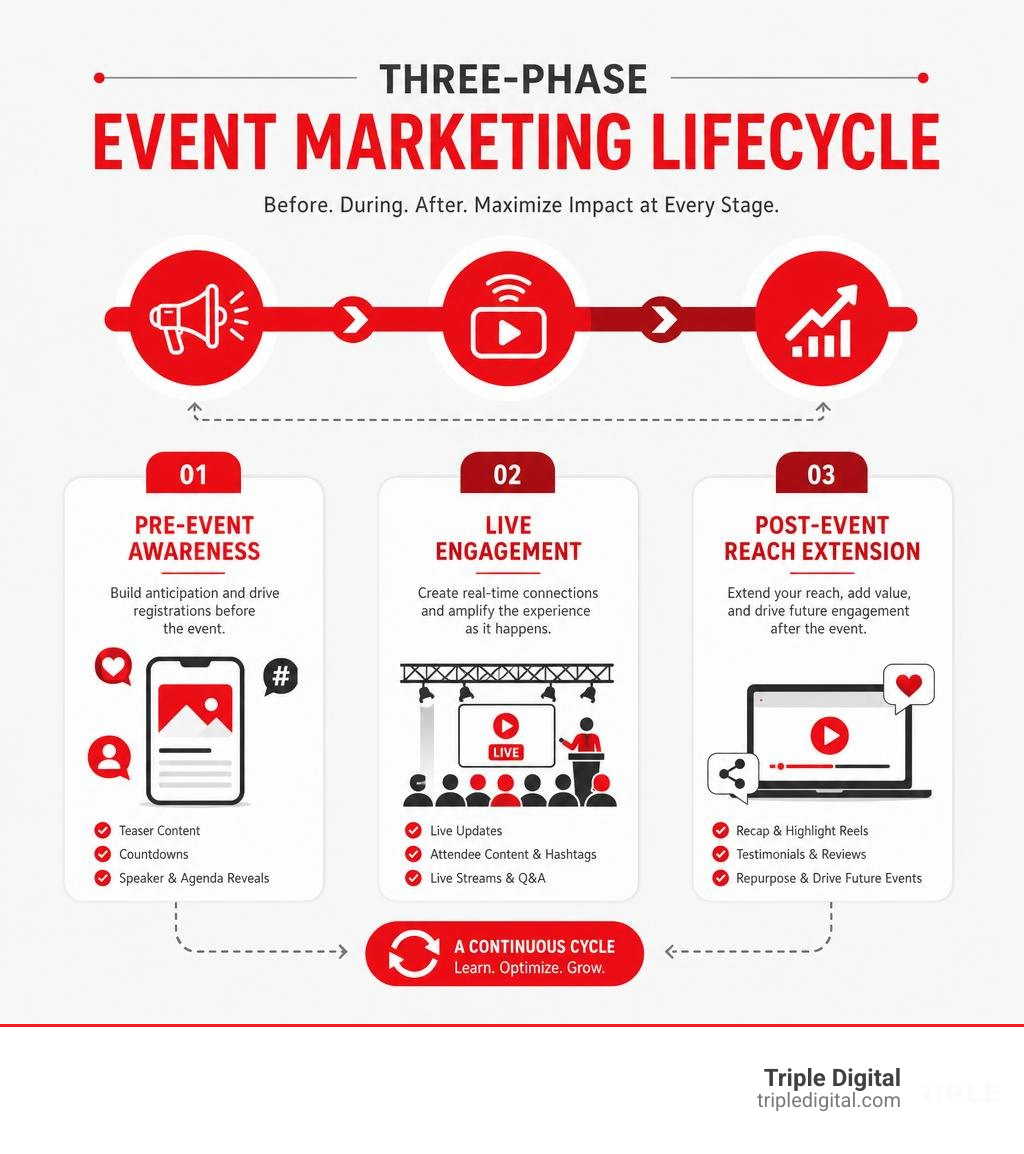
- Before the event – Build anticipation with countdown posts, speaker reveals, and behind-the-scenes content starting 6-8 weeks out
- During the event – Post live updates, encourage attendee content with a branded hashtag, and stream key moments
- After the event – Share recap videos, testimonials, and repurposed content to extend reach and drive future registrations
Events don’t fail because of a bad lineup or venue. They fail because not enough people knew about them — or cared enough to show up.
Social media changes that equation. With more than 5 billion people active on social platforms globally, the audience is already there. The question is whether your event content reaches them at the right time, in the right way.
And the numbers back this up. 86% of marketers report that social media significantly increased their exposure. 58% actively use social media during live events to keep momentum going in real time.
But most event organizers still treat social media as an afterthought — a few posts here, a photo there. That approach leaves enormous value on the table.
The most effective approach is a structured, three-phase system that runs before, during, and after the event. Each phase has its own goals, content types, and metrics. When done well, social media doesn’t just promote your event — it becomes part of the experience itself.
Choosing the Right Platforms for Social Media and Event Marketing
Not all social media platforms are created equal, and trying to be everywhere at once is a quick way to burn out your marketing team. Success in social media and event marketing relies heavily on platform selection. You must meet your audience where they already spend their time.
For professional services, corporate gatherings, and legal seminars in Houston, platform demographics dictate where your marketing dollars should go. If you are hosting a highly technical legal seminar or a B2B networking event, TikTok might not be your primary driver, whereas LinkedIn will be your powerhouse. Conversely, if you are hosting a local community charity run or a visual consumer festival, platforms like Instagram and Facebook Events will dominate.
Let’s break down the primary channels:
- LinkedIn: The absolute gold standard for B2B events, professional development, and legal conferences. In 2026, LinkedIn is no longer just a digital resume holder; it is an active content hub. A single well-crafted post can generate ten times the organic impressions of a traditional email blast. It is essential to understand Best Social Media Sites for Law Firms: Don’t Let Your Feed Be a Brief Case to align your professional event with the right professional crowd.
- Facebook Events: While organic reach on Facebook business pages has declined over the years, Facebook Events remains highly effective for local, community-based, and consumer-facing events. When an attendee RSVPs to a Facebook Event, the platform’s algorithm frequently surfaces that RSVP to their local friends, creating a powerful organic referral loop.
- Instagram Reels & Stories: Instagram is the visual heart of event promotion. Reels drive top-of-funnel discovery through short-form video content, while Stories are perfect for daily countdowns, interactive polls, and direct registration links. Because Instagram Reels generate billions of reshares daily across Meta platforms, visual-first content is a non-negotiable asset.
- TikTok Search: In 2026, TikTok functions as a primary search engine for younger demographics. Nearly 40% of consumers—and over 60% of Gen Z—use TikTok to search for things to do, local events, and educational content. If your event targets Millennials or Gen Z, short-form, trend-aligned video content on TikTok is highly effective.
Many professional firms ask: Are Law Firms Big on Social Media? The answer is a resounding yes, especially when they leverage these platforms to host and promote educational seminars, client appreciation dinners, and community workshops.
To help you choose the ideal mix, here is a quick comparison of the top channels for event marketing:
| Platform | Primary Target Audience | Best Event Types | Key Content Formats |
|---|---|---|---|
| B2B Professionals, Attorneys, Executives | Conferences, CLE Seminars, Corporate Networking | Carousels, Text-based Industry Insights, PDF Agendas | |
| Local Communities, Gen X & Baby Boomers | Charity Galas, Local Workshops, Community Events | Facebook Event Pages, Group Discussions, Live Video | |
| Millennials & Gen Z (Aesthetic-focused) | Consumer Festivals, Creative Workshops, Socials | Reels, Interactive Stories, Countdown Stickers | |
| TikTok | Gen Z & Younger Millennials (Trend-focused) | Large Festivals, Pop-up Events, Dynamic Seminars | Short-form Authentic Video, Behind-the-Scenes Clips |
A Three-Phase Strategy for Event Promotion and Execution
A successful campaign is not a single announcement; it is a system. To maximize registrations and build a community that lasts long after the doors close, we recommend dividing your campaign into a structured three-phase framework. This ensures your editorial calendar, creative team, and PR efforts are perfectly aligned across all channels.
Phase 1: Pre-Event Planning and Building Anticipation
The pre-event phase is all about building momentum and driving early-bird registrations. This phase should begin at least 6 to 8 weeks out for medium-sized events, and up to 90 days out for major conferences.
Your content cadence should start slow and increase in frequency as the event date approaches. During the early “Awareness” stage (90 to 60 days out), focus on the why of the event. Why should someone take time out of their busy schedule to attend? What problems will your speakers solve for them?
As you move into the “Engagement” stage (60 to 30 days out), begin rolling out interactive content:
- Speaker Reveals & Bio Spotlights: Introduce your keynote speakers using engaging graphics or short video introductions.
- Agenda Previews: Share carousels or documents detailing the schedule. B2B audiences want to know exactly what they will learn before they commit.
- Countdown Campaigns: Use Instagram Stories countdown stickers to remind users of registration deadlines and ticket price increases.
If you are wondering how these social touchpoints convert to actual website visits, check out our guide on How Can Social Media Drive Traffic to Law Firm Websites? to understand the mechanics of turning social media followers into registered event attendees.
Phase 2: Real-Time Execution and Live Social Media and Event Marketing
Once the event day arrives, your social media strategy shifts from promotion to documentation. The goal here is twofold: reward the attendees who are in the room and deliberately fuel FOMO (fear of missing out) for those who stayed home.
To do this effectively, we highly recommend setting up a dedicated social war room or command center.
During a busy live event, your primary event coordinator should not be the person running your social media. Designate a dedicated social media lead whose sole responsibility is to capture, edit, and post content in real time.
Key real-time tactics include:
- Live Streaming: Broadcast opening remarks, keynote highlights, or Q&A panels to engage remote followers.
- Interactive Stories: Use live polls, quizzes, and “add yours” stickers to get attendees interacting with your digital channels while sitting in the audience.
- Behind-the-Scenes (BTS): Show the green room prep, speaker warm-ups, and the hustle of the organizing team. This humanizes your brand and builds authentic engagement.
- Aggregating User-Generated Content (UGC): Actively monitor your event’s unique hashtag. Retweet, repost, and share attendee photos and insights to your official channels. This acts as instant, highly credible social proof.
Phase 3: Post-Event Assessment and Extending the Reach
Most event organizers make the mistake of going completely dark the day after the event ends. This is a massive missed opportunity. The post-event phase is when your audience’s enthusiasm is at its peak, making it the absolute best time to capture value and lay the groundwork for your next event.
Within 24 to 48 hours of the event closing, execute the following steps:
- Publish a Highlight Reel: Create a , high-energy 60-second recap video showcasing the best moments, smiling faces, and key takeaways.
- Share Attendee Testimonials: Post raw, authentic video clips or quote cards captured on-site. Raw attendee testimonials consistently outperform highly polished, corporate videos.
- Repurpose Key Sessions: Turn a 45-minute keynote presentation into five 60-second Reels, a LinkedIn carousel of key takeaways, and an educational blog post.
- Promote the Next Event: Offer a limited-time “loyalty discount” or early-bird waitlist for next year’s event while the positive memories are still fresh in attendees’ minds.
Psychological Drivers: Applying the Theory of Planned Behavior to Event Attendance
Why do people actually decide to click “Register” on an event page they saw on social media? To design a high-converting campaign, we can look to established academic models like the Theory of Planned Behavior (TPB).
According to this framework, an individual’s decision to attend an event is driven by three core components:
- Attitude toward the behavior: Does the attendee believe attending this event will be beneficial, educational, or enjoyable?
- Subjective norms: Do the people who matter to the attendee (peers, colleagues, industry leaders) think they should attend? Is it seen as a “must-attend” event within their professional circle?
- Perceived behavioral control: How easy or difficult does the attendee perceive attending the event to be? Factors like ticket price, travel distance, and schedule flexibility play a massive role here.
Research shows that while perceived enjoyment significantly shapes an attendee’s positive attitude toward an event’s social media page, attitude alone does not always guarantee they will buy a ticket. Instead, subjective norms and perceived behavioral control are the strongest drivers of actual registration and attendance.
Leveraging Subjective Norms and Perceived Enjoyment in Social Media and Event Marketing
To turn these psychological insights into actionable marketing tactics, event organizers should design social media content that addresses these drivers directly:
- To influence Subjective Norms: Leverage attendee advocacy and peer influence. When someone registers for your event, provide them with a personalized “I’m attending!” social media tile or share kit. If prominent industry leaders or local Houston influencers are speaking or attending, highlight their involvement. When prospective attendees see their peers sharing these tiles on LinkedIn, the “subjective norm” is activated—they feel they must attend to remain relevant in their field.
- To increase Perceived Enjoyment: Make your social media pages highly interactive and enjoyable to browse. Run creative polls, use humor, share engaging video teasers, and host giveaways.
- To maximize Perceived Behavioral Control: Remove friction. Use social media to clearly address logistical questions. Post simple maps of your Houston venue, share parking instructions, highlight hybrid/virtual attendance options, and provide clear step-by-step registration guides. The easier you make the process look, the higher your conversion rates will be.
Paid Advertising vs. Organic Reach: Maximizing Event ROI
While organic social media content is fantastic for nurturing your existing community, relying solely on organic reach in 2026 is like whispering in a crowded room. To consistently fill seats and scale your reach, you must balance organic efforts with highly targeted paid social campaigns.

A healthy event marketing budget allocates roughly 15% to 25% of the total event budget to social media marketing. For a mid-sized event, this budget is typically split: 30% to content creation, 50% to paid advertising, and 20% to management tools.
When structuring your paid social campaigns, we recommend a two-pronged approach:
- Prospecting Campaigns (60-70% of budget): These ads target cold audiences who fit your ideal attendee profile but may not have heard of your event yet. Use lookalike audiences built from your past attendee email lists, or leverage platform-specific demographic and interest targeting. For professional firms, using Social Media Pinpoint Targeting allows you to serve ads directly to decision-makers in specific industries or geographic locations, such as the Greater Houston area.
- Retargeting Campaigns (30-40% of budget): Retargeting ads convert at 3 to 5 times the rate of cold ads. Install tracking pixels (like the Meta Pixel or LinkedIn Insight Tag) on your event registration page. Then, serve highly specific retargeting ads to users who visited the registration page but didn’t complete their purchase. Use these ads to highlight urgency (“Only 10 tickets left!”) or showcase social proof (“See what last year’s attendees said”).
For professional services and law firms, paid advertising comes with unique responsibilities. It is critical to design campaigns that are highly effective yet ethically compliant. To ensure your paid campaigns align with professional standards, read our guide on How to Run Social Media Ads Without Getting Disbarred and explore our analysis on The Verdict Is In: Are Facebook Ads a Win for Your Law Firm?.
Measuring Success: Key Performance Indicators and Analytics
The final, and perhaps most important, phase of any social media and event marketing campaign is the post-event retrospective. You cannot improve what you do not measure. To prove your social media ROI to stakeholders or sponsors, you must look past simple “vanity metrics” like likes and follows, and focus on indicators that tie directly to business growth.
Key performance indicators (KPIs) to track include:
- Registration Conversions: Use unique UTM parameters on every single promotional link you share. This allows you to track exactly how many ticket sales or registrations came directly from your LinkedIn posts, Instagram Stories, or paid Facebook ads.
- Cost Per Registration (CPR): Calculate your total paid ad spend divided by the number of registrations generated by those ads. Compare this number against traditional marketing channels to prove cost-effectiveness.
- Engagement Rate by Platform: Track how actively your audience interacted with your pre-event and live-event content. High engagement rates indicate that your message is resonating with your target audience.
- Hashtag Volume and Reach: Measure how many times your unique event hashtag was used by attendees and the total potential impressions those posts generated.
- Attendee Advocacy Conversion: Track the registration rate of referral links shared by your registered attendees. Attendee advocacy tools often deliver a conversion rate of 31.9%, compared to the typical 2-3% conversion rate of cold paid social ads.
Frequently Asked Questions About Event Social Media
How far in advance should I start promoting an event on social media?
For major conferences, trade shows, or large-scale corporate events, you should begin your social media promotion at least 90 days in advance. This allows you to build a structured 90-day campaign calendar divided into distinct awareness, engagement, and conversion phases. For smaller workshops, local seminars, or single-speaker events, a 30-to-60-day window is usually sufficient to drive registrations without exhausting your audience’s attention span.
What is the best way to encourage attendee-generated content during a live event?
The best way to get attendees posting is to make sharing easy, fun, and highly visible.
- Create dedicated photo opportunities: Set up aesthetically pleasing backdrops, professional lighting, or fun interactive installations with your event hashtag clearly displayed.
- Use a live social wall: Display real-time attendee social media posts on large LED screens in high-traffic areas of your venue. When attendees see their own photos and tweets displayed on a massive screen, it creates a powerful incentive for others to post and share.
- Provide digital share kits: Send registered attendees, speakers, and sponsors pre-written social captions and branded graphics they can share with their networks with a single click.
How do you measure the direct ROI of social media event campaigns?
Direct ROI is measured by setting up clean conversion tracking before your campaign launch. Use UTM parameters for every link shared across your social channels to track traffic directly to your registration page. By setting up conversion goals in your analytics dashboard, you can attribute ticket sales directly to specific social media posts or paid ad sets. Finally, compare your social media cost-per-registration against other channels (like email marketing or paid search) to determine your most cost-effective acquisition sources.
Elevate Your Firm’s Presence with Expert Event Marketing
In-person events and educational seminars remain one of the most powerful business development tools available for professional services and law firms in Houston. They build trust, establish undeniable thought leadership, and cultivate deep, face-to-face relationships with clients and referral networks that digital communication alone simply cannot match.
But throwing a fantastic event is only half the battle. If the right people aren’t in the room, your hard work and investment won’t deliver the return your firm deserves.
At Triple Digital, we specialize in cutting through the digital noise. Our results-driven, “less fluff, more cases” approach leverages precise, data-driven targeting to ensure your educational seminars, webinars, and firm events reach your exact target audience. We combine advanced paid social strategies, hyper-targeted retargeting, and cohesive branding to turn your firm’s expertise into packed rooms and high-value leads.
If you are ready to take your firm’s growth to the next level, explore our comprehensive guide on Law Firm Marketing with Social Media or reach out to our Houston-based team today to design an event marketing strategy built to perform.