





Why Your Law Firm Website Is Your Most Important Business Asset

Attorney web design is the process of building a professional, conversion-focused website that helps law firms attract potential clients, establish credibility, and generate leads online.
Here is what makes an effective attorney website in 2026:
- Fast loading — pages should load in under 3 seconds or visitors leave
- Mobile-first — over 70% of legal searches happen on phones
- Clear CTAs — visible contact forms, click-to-call buttons, and consultation booking
- Trust signals — attorney bios, client testimonials, case results, and credentials
- SEO structure — practice area pages, local schema, and clean code built for search engines
- ADA compliant — accessible to all users and protected against compliance issues
- Client-owned — built on an open platform like WordPress, not locked to a vendor
Most law firms lose clients before a single conversation happens.
Research shows visitors form an opinion of your website in just 50 milliseconds. You have roughly 3 seconds before they decide to stay or leave. And 75% of people judge a firm’s credibility based on website design alone.
That is not a small thing. That is your first impression, your handshake, your pitch — all happening silently while someone decides whether to call you or scroll past.
The problem is that most law firm websites were not built to convert. They were built to exist. Generic layouts, buried contact details, slow load times on mobile, no clear next step for the visitor. The result? A site that gets traffic but generates almost nothing.
The good news: this is entirely fixable. The difference between a site converting at 2% and one converting at 10% or higher comes down to deliberate design choices — not luck, and not a bigger budget.
This guide walks you through exactly what those choices are.
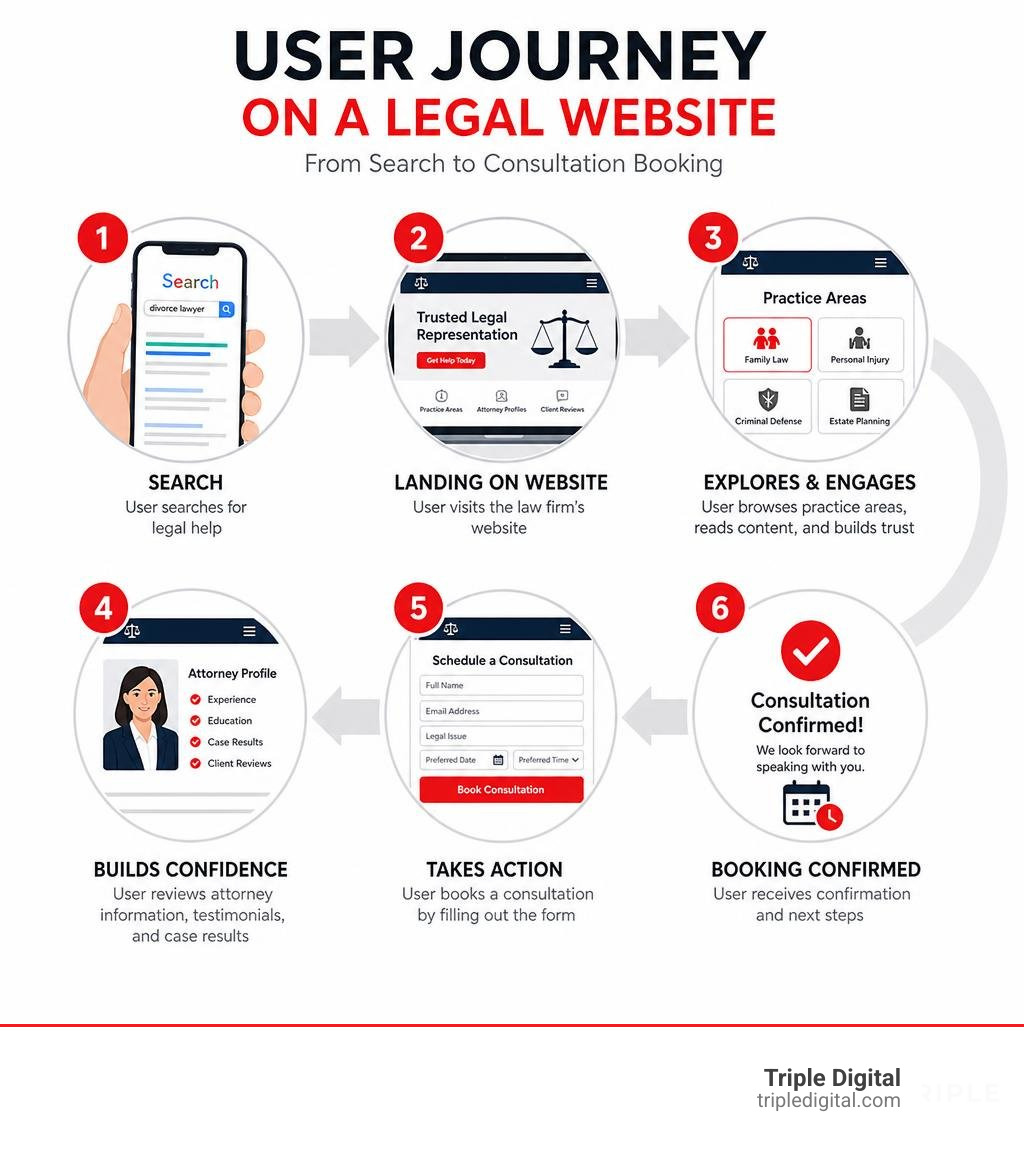
Essential attorney web design terms:
The Core Pillars of High-Converting Law Firm Websites

To build a website that functions as a 24/7 client acquisition machine, you must look beyond basic aesthetics. A beautiful website that does not convert is just an expensive digital brochure. High-performing legal websites rely on a foundation of user experience (UX), strategic conversion rate optimization (CRO), and absolute clarity.
When potential clients land on your site, they are often stressed, anxious, and looking for immediate reassurance. Your design must make finding help as frictionless as possible. By implementing How to Design the Best Websites for Law Firms That Actually Convert, you can transform passive traffic into active consultations. Law firms with optimized, highly professional websites see up to an 80% increase in client inquiries compared to unoptimized digital presences.
Furthermore, the financial impact of structured Web Design for Law Firms is clear. While the industry standard cost per lead for legal marketing hovers around $200, highly optimized, conversion-driven campaigns can slash that metric down to as low as $86 per lead.
Balancing Professional Aesthetics with User-Friendly Navigation
The legal industry demands a high level of dignity, trust, and professionalism. However, many firms mistake “professional” for “stuffy and complicated.” A great design uses clean, modern visual hierarchy to guide the user’s eye naturally toward key information.
To prevent visitors from feeling overwhelmed, your navigation menu should be simple and intuitive. Limit your main menu to five or six key categories: Practice Areas, About the Firm, Case Results, Testimonials, and Contact. Avoid legal jargon in your structural labels. Instead of “Jurisdictional Offerings,” simply use “Where We Practice.”
Your brand identity—including your color scheme and typography—should convey authority and warmth. Cool tones like deep blues, charcoal gray, and forest green are popular because they evoke trust and stability. However, balancing these with warm accents (like gold or soft terracotta) and high-quality, professional photography of your actual team (not generic stock photos of gavels) makes your firm feel approachable. To learn more about structuring your navigation for maximum conversion, explore From Clicks to Clients: The Ultimate Law Firm CRO Strategy.
Best Practices for Incorporating Calls-to-Action (CTAs)
A call-to-action is the bridge between a casual reader and a scheduled consultation. If your CTAs are buried at the bottom of your “About Us” page, you are leaving cases on the table.
Best practices for legal CTAs include:
- Persistent Header CTAs: Place a highly visible, contrasting button in the top right corner of your website (e.g., “Get a Free Case Review” or “Schedule Consultation”). This button should remain visible as the user scrolls.
- Click-to-Call Functionality: Ensure your phone number is prominent at the top of every page and is clickable on mobile devices.
- Low-Friction Contact Forms: Keep initial contact forms short. Asking for a name, email, phone number, and a brief description of their situation is enough. Avoid asking for highly sensitive information upfront.
- Inline CTAs: Place contextual, action-oriented links or buttons throughout your practice area pages. If someone is reading about how to handle a car accident claim, insert a friendly CTA right after explaining their rights.
For a deeper dive into modern conversion strategies, check out our Website Conversion Rate Optimization Services.
Technical Performance: Speed, Mobile Responsiveness, and ADA Compliance

A beautiful design is worthless if it takes ten seconds to load or breaks on a smartphone screen. The technical underpinnings of your website dictate both how search engines rank you and how human users interact with you. Our Lawyer Website Developer Guide outlines how technical execution is just as critical as visual design. For absolute success, your development team must focus heavily on modern Website Development & Design standards.
Why Mobile Responsiveness and Page Speed Rule in 2026
In 2026, mobile-first indexing is the absolute standard. Over 70% of all legal searches originate on mobile devices. When someone is involved in an urgent situation, they do not wait to get home to their desktop computer; they search on their phone from the scene or a waiting room.
If your mobile layout is clunky, has tiny text, or hides the click-to-call button, users will bounce back to search results instantly. Furthermore, Google’s Core Web Vitals heavily weigh page speed as a ranking factor. Research shows that 90% of users will abandon a website if it takes longer than 5 seconds to load. Your technical goal should be a load time of under 3 seconds, with mobile speed optimization scores of 95+ to ensure you capture every lead.
ADA Compliance and Accessibility in Modern Law Firm Web Design
Web accessibility is no longer optional. In 2026, ensuring your website is compliant with the Americans with Disabilities Act (ADA) and Web Content Accessibility Guidelines (WCAG) is essential. A failure to build an accessible website not only alienates potential clients with visual, auditory, or motor impairments, but it also exposes your firm to serious legal liability and lawsuits.
To make your website accessible:
- Use Alt Text: Provide descriptive alternative text for all images so screen readers can interpret them.
- Ensure High Color Contrast: Text must be easily readable against the background color.
- Enable Keyboard Navigation: Users should be able to navigate your entire site using only a keyboard.
- Use Clear Form Labels: Ensure all input fields in your contact forms are clearly labeled for assistive technologies.
Custom vs. Template-Based Attorney Web Design
When investing in your online presence, one of the biggest decisions you will make is choosing between a custom-built website and a template-based solution. While templates can be tempting due to lower upfront costs, they often come with hidden performance penalties and limitations.
| Feature | Custom Legal Website Design | Template-Based Solutions |
|---|---|---|
| Branding & Design | 100% unique, tailored to your firm | Generic, often shared with competitors |
| Page Speed & Code | Clean, optimized, ultra-fast | Bloated code, slower load times |
| SEO Adaptability | Built-in, structured for high rankings | Difficult to optimize technical elements |
| Ownership | Complete ownership of files and hosting | Often locked to proprietary platforms |
| Scalability | Unlimited growth and custom integrations | Restricted features, rigid structures |
Choosing custom over a template is a major step in establishing your firm’s authority. For more details, explore the differences in Custom Lawyer Web Design and learn How to Choose the Best Lawyer Website Design Firm for Your Practice.
Why Custom Attorney Web Design Outperforms Templates
Most template-based websites suffer from “code bloat.” Because templates are designed to fit any business, they include massive amounts of unnecessary code that slows down your site speed.
Custom attorney web design ensures that every line of code is written specifically to support your firm’s goals, resulting in lightning-fast load times. Additionally, custom sites allow you to stand out from competitors who use the same generic legal templates. Perhaps most importantly, custom builds protect you from “vendor lock-in,” giving you full ownership of your digital assets.
Choosing the Right Platform for Your Practice
We strongly recommend building your law firm website on an open-source Content Management System (CMS), with WordPress being the undisputed industry standard.
WordPress offers unmatched flexibility, scalability, and robust security. It allows you to easily integrate essential legal tech tools—such as Clio, MyCase, LawPay, or Calendly—directly into your site. Because it is open-source, you own your website completely. If you ever choose to change marketing agencies, you can take your entire website, database, and SEO equity with you without starting from scratch.
Integrating SEO and AI Search Visibility into Your Build
Search engine optimization (SEO) should never be treated as an afterthought. Many agencies design a beautiful website first and then try to “retrofit” SEO elements later. This approach is a recipe for invisibility. To maximize your reach, SEO must be woven directly into the architectural blueprints of your website. See how to expand your visibility beyond your primary pages in Beyond the Homepage: Maximizing Your Legal Website’s Potential.
Best Practices for Local SEO in Attorney Web Design
Because legal services are inherently local, a massive portion of your case volume will originate from local searches. Your web design should actively support local SEO signals:
- Practice Area & Location Pages: Create dedicated, high-quality pages for each practice area and each physical office location. Do not lump all your services onto a single page.
- Local Schema Markup: Implement advanced structured data (Organization, Attorney, Review, and FAQ schema) into your site’s code. This tells search engines exactly who you are, what you do, and where you are located.
- Google Business Profile Integration: Embed your Google Map and link directly to your verified Google Business Profile to strengthen your local pack rankings.
Designing for AI Search and Answer Engine Optimization (AEO)
The search landscape in 2026 is evolving rapidly. Potential clients are increasingly using AI search tools like ChatGPT, Claude, and Google Gemini to find legal representation.
To ensure AI engines recommend your firm, your website must be built for readability. This means using clean HTML markup, logical heading structures (H2s and H3s), and content formatted to directly answer common client questions. Structured data and clear schema markup are essential, as they act as a direct translation tool for AI crawlers indexing your firm’s credentials.
Showcasing Credibility and Measuring ROI
A high-performing website must bridge the gap between getting traffic and earning trust. When a user lands on your site, they need to see immediate proof that you are capable of solving their legal problems. Highlighting these trust signals effectively is a hallmark of the best websites for law firms.
The Power of Attorney-Writers for Legal Website Content
Your website’s content is the voice of your firm. While generic content writers can draft basic blog posts, legal content requires a much higher standard of precision.
Using attorney-writers to craft your practice area pages and blog posts ensures absolute legal accuracy, professional tone, and strict compliance with state bar advertising rules. High-quality, authoritative legal content immediately builds trust with readers and signals to search engines that your site is a credible source of information.
Measuring the ROI of Your Digital Marketing Efforts
To understand the true value of your website, you must implement proper tracking and analytics. By setting up robust conversion tracking, you can monitor exactly where your leads are coming from—whether it is organic search, local maps, or paid advertising. Tracking your cost per lead and conversion rates allows you to continuously refine your marketing strategy and maximize your firm’s growth.
Tailoring Web Design: Solo Practitioners vs. Large Law Firms
Your approach to web design should align with your firm’s size and target market:
- Solo Practitioners & Small Firms: Focus on building a highly personal, approachable brand. Emphasize your direct availability, community ties, and niche practice areas. Use clear, direct messaging that makes potential clients feel heard.
- Mid-Sized & Large Firms: Emphasize scale, deep resources, and a track record of handling complex litigation. Utilize searchable attorney directories, detailed practice group portals, and robust resource libraries to maintain authority while remaining user-friendly.
Frequently Asked Questions About Law Firm Web Design
How much does a professional law firm website cost?
Custom attorney websites typically start around $5,000 and can scale higher depending on the complexity of the project, the number of practice areas, and specific integration needs. Beware of agencies offering cheap, template-based designs, as they often cut corners on technical SEO, speed optimization, and custom content.
How long does it take to build a new attorney website?
A comprehensive, custom law firm website project typically takes between 4 to 8 weeks from the initial discovery phase to the final launch. This timeline ensures thorough market research, custom design mockups, responsive development, professional content creation, and rigorous testing across all devices.
Will a new website design automatically improve my Google rankings?
While a new website with a clean technical structure, fast loading speeds, and proper schema markup provides an incredibly strong foundation for SEO, ranking high on Google requires ongoing optimization. Combining your new design with a consistent content strategy and local SEO management is the key to long-term search engine dominance.
Transform Your Digital Storefront Into a Case Acquisition Machine
At Triple Digital, we build premium, results-driven websites designed to generate consultations, not just compliments. Based in Houston, Texas, our team leverages a “less fluff, more cases” approach, utilizing AI-driven data mining and precise targeting to connect your firm with high-value cases.
We don’t believe in locking you into proprietary platforms or confusing you with marketing jargon. We focus on clean code, rapid load times, absolute compliance, and designs that turn casual visitors into loyal clients.
Ready to build a website that does your practice justice? Schedule a meeting with Triple Digital today, and let’s turn your online presence into your firm’s most powerful asset.