




The Ultimate Guide to Social Media for Business
Why Social Media Is a Game-Changer for Business Growth
Social media can help business owners reach more customers, build trust, and generate leads — often at a fraction of the cost of traditional marketing.
Here is a quick breakdown of the core ways social media drives business results:
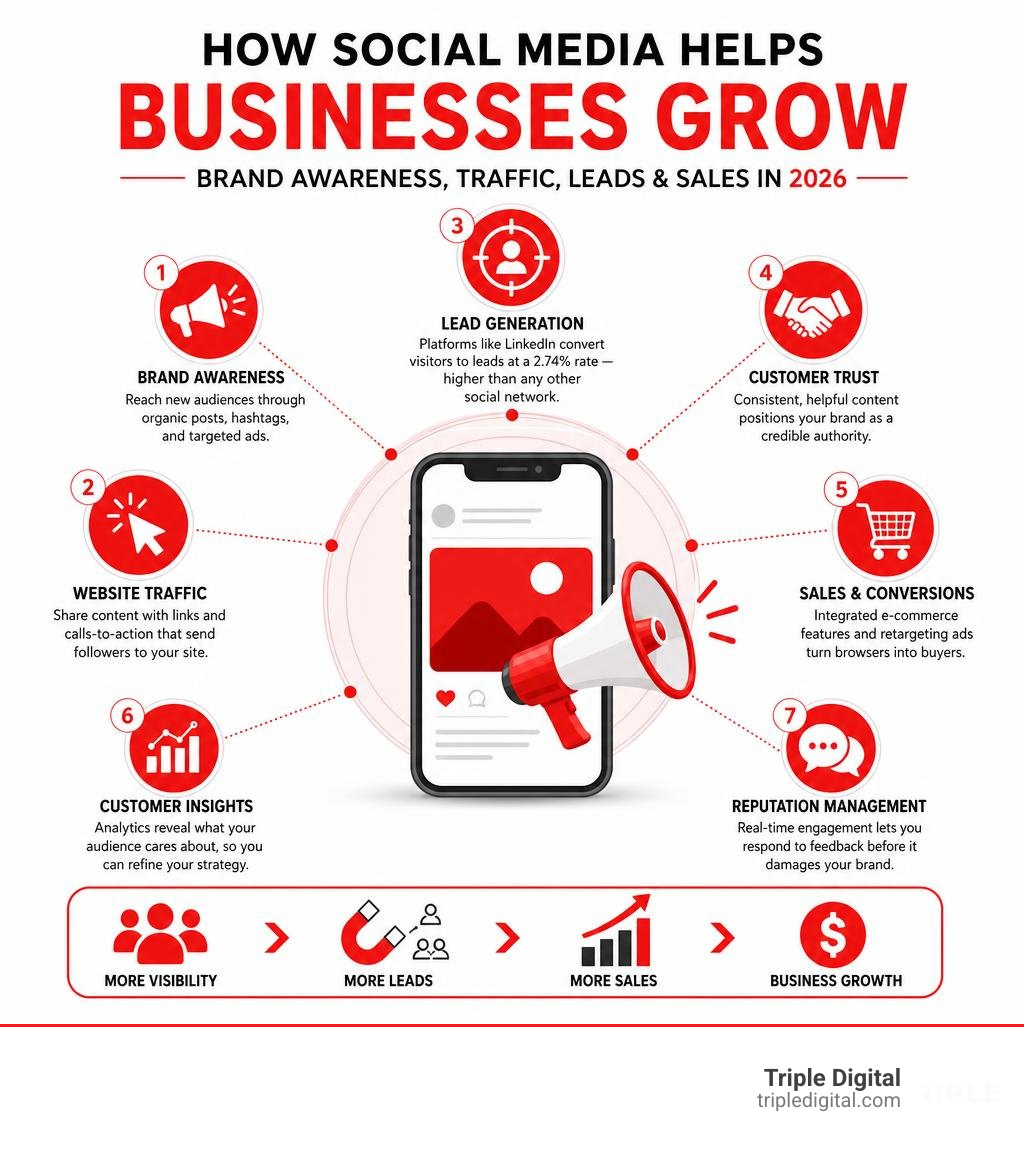
- Brand Awareness — Reach new audiences through organic posts, hashtags, and targeted ads
- Website Traffic — Share content with links and calls-to-action that send followers to your site
- Lead Generation — Platforms like LinkedIn convert visitors to leads at a 2.74% rate — higher than any other social network
- Customer Trust — Consistent, helpful content positions your brand as a credible authority
- Sales and Conversions — Integrated e-commerce features and retargeting ads turn browsers into buyers
- Customer Insights — Analytics reveal what your audience cares about, so you can refine your strategy
- Reputation Management — Real-time engagement lets you respond to feedback before it damages your brand
Social media is no longer optional for businesses that want to grow. Over 70% of social media users log in at least once per day, and 91% of experienced social marketers report improved website traffic from their social campaigns.
Yet many businesses — especially professional services firms like law practices — are still stuck using outdated marketing methods, or treating social media as an afterthought. They post occasionally, get little traction, and assume it simply does not work.
The reality is different. The problem is almost never the platform. It is the strategy.
In 2026, social media algorithms are driven by AI and semantic signals. That means the businesses that show up consistently with relevant, valuable content get rewarded with reach — while those that post sporadically or rely on generic content get buried.
This guide walks you through exactly how to build a social media presence that generates real business results: more visibility, more leads, and more clients.
How Can Social Media Help Business Growth in 2026?
The digital landscape of July 2026 demands a smarter approach to online marketing. Gone are the days when simply posting a stock photo with a generic caption could build a thriving audience. Today, search engines and social algorithms are deeply integrated. Understanding how How Can Social Media Help Your Business? requires looking at how these networks function as modern search engines.
Algorithms now rely heavily on AI-driven semantic search and user behavior signals. Platforms recommend content to users based on their active interests and past engagement. This shift presents a massive opportunity: you can naturally get your brand in front of people who are already looking for your services, even if they have never heard of your business before.
Furthermore, modern AI answer engines like ChatGPT and Perplexity frequently crawl the web to answer user queries. While they rarely cite social media posts directly, they heavily cite the high-quality website pages that your social posts link to. By pairing your social media campaigns with comprehensive, long-form content on your website, you create a powerful digital ecosystem that captures high-intent leads from both social feeds and AI search results.
How Can Social Media Help Business Brand Awareness?
Brand awareness is the foundation of any successful marketing funnel. For a business to win clients, people first need to know it exists. Social media provides an unparalleled, cost-effective way to build this visibility.
Through organic reach, well-crafted posts can travel far beyond your immediate followers. When you use relevant niche hashtags, geographic tags, and engaging formats, you put your brand in front of a highly targeted audience.

Sourcing user-generated content (UGC) and client testimonials is another highly effective way to expand your reach. When a satisfied client shares their positive experience on their own profile, it serves as powerful social proof. This organic word-of-mouth marketing acts as a pre-screened recommendation to their entire network, dramatically improving your brand recall and trust.
Driving Website Traffic and Boosting Conversions
Social platforms are incredible discovery tools, but your website is where the actual business transactions happen. Understanding How Can Social Media Drive Traffic to Law Firm Websites? is key to turning casual scrollers into paying clients.
To successfully funnel social media users to your website, you must provide clear, compelling calls-to-action (CTAs) such as “Learn More,” “Book a Consultation,” or “Download Our Guide.” Simply dropping a link is not enough; you need to give the user a clear reason to click.
To measure the effectiveness of these efforts, always use UTM tracking parameters on your links. This allows you to track exactly which posts, platforms, and campaigns are driving traffic and conversions in your analytics dashboard.
For businesses selling services or products directly online, social commerce has changed the game. Consider this: nearly 70% of online shopping carts are abandoned. By utilizing integrated social shopping tools and running targeted retargeting ads to users who have previously engaged with your brand, you can recapture lost interest and significantly boost your overall conversion rates.
Choosing the Right Platforms for Your Audience and Goals
One of the most common mistakes businesses make is trying to be everywhere at once. Spreading your resources too thin across every available network leads to inconsistent posting, generic content, and poor results. To find the right fit, read our guide on the Best Social Media Sites for Law Firms: Don’t Let Your Feed Be a Brief Case.
Choosing the right platforms requires a clear understanding of your target demographics, a thorough competitor analysis, and alignment with your specific business goals.
| Platform | Primary Target Audience | Primary Content Type | Best Business Goal |
|---|---|---|---|
| Professionals, B2B decision-makers, executives | Text posts, PDFs, industry insights, articles | B2B lead generation, thought leadership | |
| YouTube | Broad demographic (massive reach across all ages) | Long-form video, tutorials, short-form video | In-depth education, search engine visibility |
| Gen Z and Millennials (primarily ages 18–34) | Highly visual photos, Reels, Stories | Brand personality, visual storytelling, product discovery | |
| TikTok | Gen Z and younger Millennials | Short-form, engaging, authentic video | Viral reach, brand humanization, trend participation |
| Older Millennials, Gen X, and Baby Boomers | Community posts, local business updates, Reels | Local business visibility, community building | |
| Highly female demographic, planners, shoppers | Visual pins, infographics, step-by-step guides | Long-term evergreen traffic, visual discovery |
Audience Demographics and Platform Alignment
To make the most of your marketing budget, you must meet your audience where they already spend their time:
- Facebook: Despite being one of the oldest networks, it remains the world’s largest social media platform. It is highly effective for targeting local audiences and running hyper-targeted paid ad campaigns.
- Instagram: A powerhouse for visual storytelling. 83% of Instagram users discover new products or services on the platform, making it essential for brands with strong visual assets or relatable company cultures.
- YouTube: As the second-largest search engine in the world, YouTube is unmatched for educational content. Since 74% of consumers share video content from brands, creating high-quality explainer videos can dramatically extend your organic reach.
- TikTok: Driven by short, authentic, and entertaining mobile videos. It is the fastest-growing platform for reaching younger demographics through creative storytelling.
- Pinterest: Acts more like a visual search engine than a social network. Pins have a much longer shelf-life than standard social posts, making Pinterest excellent for driving long-term, evergreen traffic to your website.
- X (formerly Twitter): Ideal for real-time updates, PR networking, and engaging directly with journalists and industry influencers.
Resource Allocation and Posting Cadence
Consistency is the absolute backbone of social media success. It is far better to post high-quality content three times a week on a single platform than to post low-quality, automated content daily across five different networks.
When launching a new social media profile, we recommend a “warm-up” period. For the first few weeks, log in manually from a consistent device to engage with relevant industry accounts, follow peers, and post native content. This signals to the platform’s AI models that your account is run by a real, authentic creator, preventing your reach from being suppressed.
Once your account is established, build a structured content calendar to plan your posts weeks in advance. Use scheduling tools to automate publishing during peak hours when your target audience is most active, but always make time to jump on the platform live to interact with your followers.
Maximizing B2B Social Media for Professional Services
There is a common misconception that social media is only useful for direct-to-consumer (D2C) brands selling physical products. In reality, professional service providers — including medical practices, financial consultants, and legal professionals — have immense opportunities online. To see how professional services approach these channels, explore: Are Law Firms Big on Social Media? and Law Firm Marketing with Social Media.
B2B social media marketing works differently than D2C. It is not about chasing viral trends or massive follower counts. Instead, it is about consistently showing up with problem-solving content that builds trust across long, complex sales cycles. You are speaking directly to business decision-makers, executives, and referral partners who value competence, authority, and reliability above all else.

How LinkedIn and Social Media Help Business Lead Generation
When it comes to professional networking and B2B lead generation, LinkedIn is the undisputed leader. For a detailed breakdown of this process, see From Likes to Leads: Mastering Social Media for Attorneys.
Consider the data: 80% of B2B marketing leads from social media come through LinkedIn, and 97% of B2B marketers use LinkedIn for their content marketing strategy.
Furthermore, LinkedIn generates the highest visitor-to-lead conversion rate of any social network at 2.74% — which is nearly three times higher than Facebook and X.
To capitalize on this, B2B brands should focus on creating value-first content. Share detailed case studies, break down industry regulations, and post actionable guides that solve your target clients’ immediate business pain points. Lead ads on LinkedIn can also capture high-intent inquiries directly within the platform, minimizing friction for busy professionals.
Thought Leadership and Employee Advocacy
In professional services, people buy from people, not faceless corporations. This is why executive branding and employee advocacy are incredibly powerful tools for B2B growth.
A post shared by a company’s CEO, founder, or senior partner will almost always outperform a polished corporate post. Encourage your leadership team and employees to share their unique industry perspectives, behind-the-scenes insights, and professional milestones on their personal profiles.
By humanizing your brand and empowering your team to act as brand advocates, you build a deep layer of trust and credibility that no traditional corporate advertisement can match.
Content Strategies That Build Trust and Customer Loyalty
To build a loyal online community, your content must serve your audience’s needs rather than just your sales goals. If you want to dive deeper into content creation, browse our Category: Social Media archive.
A winning strategy relies on distinct “content pillars” — 3 to 5 core topics that align with your business expertise and your audience’s interests. For example, a professional services firm might focus on:
- Educational guides and industry updates
- Client success stories and case studies
- Behind-the-scenes culture and team spotlights
By keeping your brand voice consistent, warm, and professional across these pillars, you establish a reliable presence that keeps your business top-of-mind.
Visual Storytelling and Video Content
Text-heavy posts are easily scrolled past in a crowded feed. To capture attention, you must prioritize rich media, custom graphics, and video content.
Short-form video formats — such as Instagram Reels, YouTube Shorts, and TikToks — are incredibly effective for breaking down complex topics into digestible, engaging pieces. Use infographics to simplify data, and leverage high-quality images to show the human side of your business. Visual storytelling makes your brand more relatable and significantly increases the likelihood that viewers will share your content with their own networks.
Managing Customer Interactions and Negative Reviews
Social media is a two-way street. It is not just a megaphone for your marketing; it is a direct customer service channel.
The speed and quality of your responses can make or break your online reputation. Consider these critical statistics:
- 80% of customers expect a response within 24 hours on social media.
- 50% of customers will abandon a business that fails to respond to a negative social media post.
When handling negative comments or complaints, never delete them (unless they violate clear community guidelines with abusive language). Instead, respond quickly and professionally. Acknowledge the user’s frustration, offer a brief, polite explanation, and immediately invite them to resolve the issue privately via direct message, email, or a phone call.
Handling public criticism with grace and professionalism shows prospective clients that you genuinely care about customer satisfaction.
Measuring Success: ROI and Avoiding Common Pitfalls
To ensure your social media efforts are translating into actual business growth, you must look past simple “vanity metrics” like likes, comments, and follower counts. While engagement is a helpful signal, it does not pay the bills. You need a data-driven approach to track your financial return on investment (ROI). For a closer look at targeting the right metrics, read about Social Media Pinpoint Targeting.
By setting up proper tracking from the start, you can identify exactly which campaigns are driving revenue, allowing you to optimize your marketing spend and scale what works.
Key Performance Indicators (KPIs) and Analytics
To measure the true impact of your social media campaigns, focus on key performance indicators (KPIs) that tie directly to your business goals:
- Click-Through Rate (CTR): The percentage of users who clicked on a link in your post to visit your website.
- Lead Generation: The number of contact form submissions, consultation bookings, or phone calls originating from social media traffic.
- Conversion Rate: The percentage of social media visitors who complete a desired action on your website, such as signing up for a newsletter or hiring your firm.
- Attribution Models: Utilizing tools like Google Analytics 4 (GA4) to understand the customer journey, tracking whether social media served as the first touchpoint (discovery) or the final touchpoint (conversion).
Common Mistakes to Avoid on Social Media
Even with the best intentions, it is easy to fall into common social media traps that can stall your growth or alienate your audience:
- Over-Posting: Flooding your followers’ feeds with low-quality content can trigger platform algorithms to flag your account as spam, severely limiting your organic reach.
- The “Hard Sell”: Constantly pushing sales pitches and self-promotional content will cause users to unfollow you. Aim for an 80/20 rule: 80% educational, entertaining, or valuable content, and only 20% direct promotion.
- Inconsistent Branding: Using different logos, colors, and tones across various platforms confuses users and damages brand recognition. Keep your visual identity unified.
- Ignoring Comments: Social media is built for conversation. Failing to respond to questions, direct messages, and comments signals that your business is inactive or unresponsive.
- Relying on Generic AI Content: AI tools are fantastic for brainstorming and structuring posts, but copy-pasting generic, unedited AI text will alienate your audience. Modern users crave authenticity. Always rewrite content in your unique brand voice and include real-world examples.
Frequently Asked Questions About Social Media for Business
How long does it take to see results from social media?
For a brand-new account, you should expect to post consistently for 60 to 90 days before seeing meaningful, steady organic traction. While video formats like TikTok and Instagram Reels can occasionally yield viral moments within 2 to 4 weeks, long-term B2B networks like LinkedIn and YouTube typically take 6 to 12 months to build a highly qualified pipeline of leads. Consistency and patience are key.
Should my business be on every social media platform?
No. It is far more effective to dominate one or two platforms where your target audience is highly active than to maintain a weak, inactive presence across six different networks. Assess your team’s available time and resources, identify where your ideal clients spend their time, and focus your energy on those specific channels.
How do I handle negative comments or reviews?
Always respond promptly, professionally, and politely. Never argue publicly or delete the comment unless it is explicitly abusive. Acknowledge the issue, apologize for their negative experience, and immediately direct the conversation to a private channel (such as email or direct message) to resolve the matter. This demonstrates to other prospective clients that you are highly responsive and committed to customer care.
Elevate Your Brand with Strategic Social Media
Building a social media presence that consistently generates high-quality leads requires time, data, and deep strategic expertise. At Triple Digital, we help professional services firms and law practices cut through the online noise.
Based in Houston, Texas, we specialize in high-performance digital marketing, lead generation, and case acquisition. Our results-driven, “less fluff, more cases” approach leverages advanced AI and data mining to put your brand directly in front of the people who need your services most.
Ready to transform your social channels into a highly profitable client acquisition engine? Schedule a meeting with our team to build your custom social media strategy today, and let us help you grow your business with precision.