





The No-Nonsense Guide to B2B Lead Gen for Skeptical Marketers
Demystifying B2B Lead Gen: What It Is and Why It Matters
B2B lead gen is the process of identifying other businesses as potential buyers of your products or services — and then turning that interest into real sales conversations.
If you landed here wanting a quick answer, here it is:
B2B lead generation at a glance:
- What it is: Finding and attracting businesses that are likely to buy from you
- Why it matters: Without a steady pipeline of qualified leads, revenue stalls
- Main approaches: Inbound (SEO, content, webinars) and outbound (cold email, LinkedIn, calling)
- Key lead types: Marketing Qualified Leads (MQLs) and Sales Qualified Leads (SQLs)
- Biggest challenge: 98% of website visitors never identify themselves — most potential buyers stay anonymous
- Modern tools: AI, intent data, and automation now make it possible to find and reach the right buyers faster and at scale
Here’s the uncomfortable truth most marketing guides skip: most of your potential clients are already researching you — and you have no idea who they are.
That anonymous traffic isn’t just a data gap. It’s missed revenue sitting right in front of you.
For law firms especially, this problem is acute. Traditional referral networks are shrinking. Print ads and billboards don’t scale. And simply having a website is no longer enough when buyers — yes, even legal clients — research their options online long before they ever pick up the phone.
The firms winning new cases today aren’t waiting to be found. They’re using smarter strategies, better data, and the right technology to build a predictable, repeatable pipeline of qualified leads.
This guide cuts through the noise and shows you exactly how to do that — no jargon, no hype.
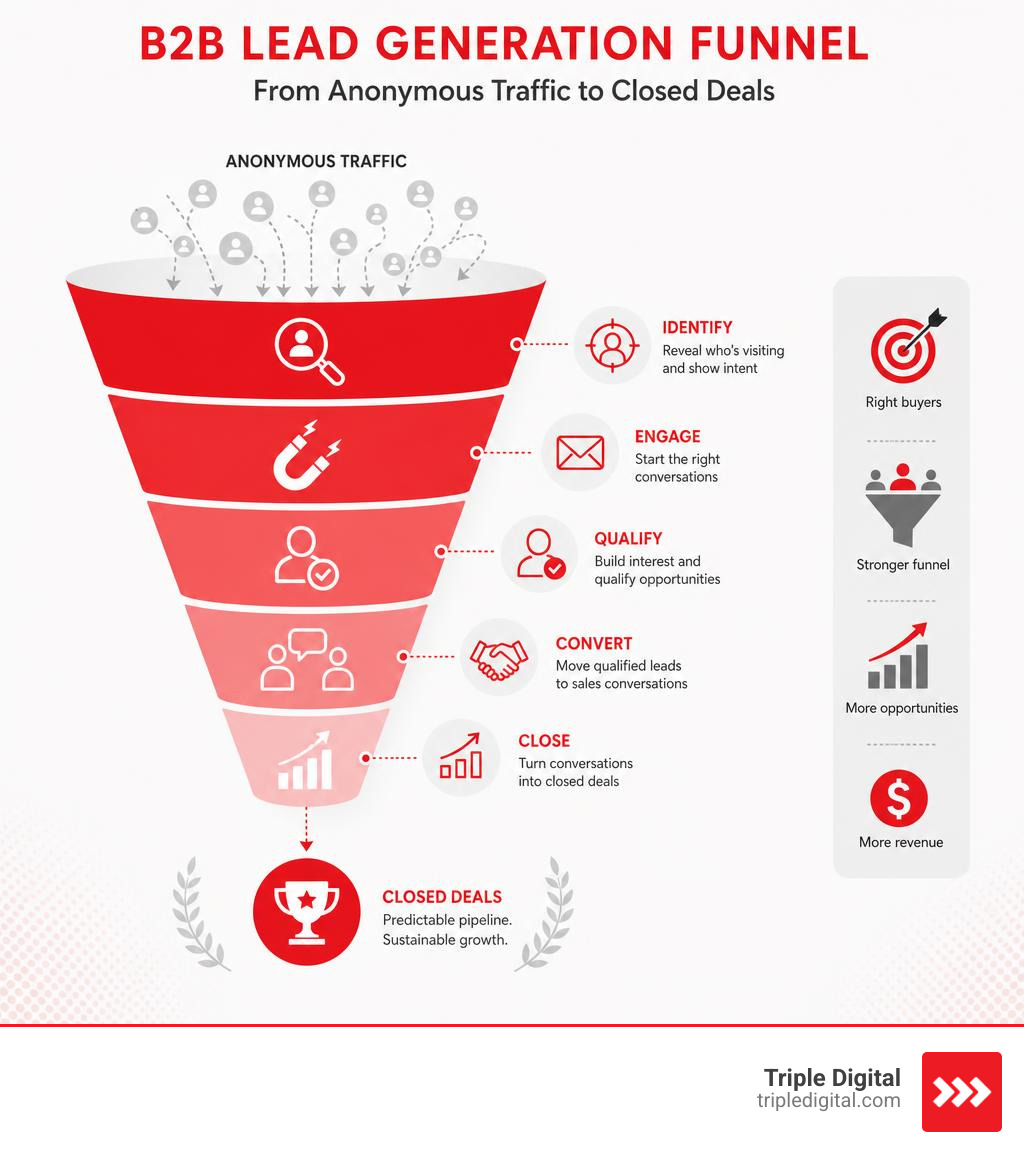
Let’s strip away the corporate buzzwords. At its core, b2b lead gen is simply the act of finding the right businesses, getting their attention, and guiding them toward a conversation with your team.
Why does this matter so much for revenue growth? Because the modern B2B buyer’s journey has completely changed. Buyers in 2026 are highly informed, fiercely protective of their time, and deeply skeptical of generic sales pitches. They do their homework in secret. If you wait around for them to fill out a “Contact Us” form, you are losing deals to competitors who actively identified those prospects when they were still in the research phase.

Building a robust lead generation engine does three critical things for your business:
- Uncovers Your Total Addressable Market (TAM): It shows you exactly who is in-market for your services right now, shifting your strategy from guesswork to precision.
- Builds Real Brand Awareness: By consistently showing up where your prospects are looking, you become the obvious choice when they are ready to buy.
- Creates a Predictable Sales Pipeline: Instead of riding the revenue rollercoaster of feast or famine, you establish a steady flow of opportunities.
For professional services and legal practices, finding the right approach is the difference between stagnation and explosive growth. To learn more about how professional services navigate this landscape, check out our comprehensive guide on Finding Your Next Client: A Guide to Lead Generation Services.
Marketing Qualified Leads vs. Sales Qualified Leads
Not all leads are created equal. One of the most common points of friction in any business is the disconnect between what marketing calls a “lead” and what sales calls “ready to buy.” To solve this, we must clearly distinguish between Marketing Qualified Leads (MQLs) and Sales Qualified Leads (SQLs).
An MQL is a lead that has shown interest by engaging with your marketing materials—such as downloading a guide, attending a webinar, or repeatedly visiting your blog. They are interested, but they aren’t necessarily ready to speak to a sales representative or sign a contract yet.
An SQL, on the other hand, has cleared a much higher bar. They have demonstrated clear buyer intent. This might mean visiting your pricing page, requesting a demo, or matching specific firmographic criteria that make them an ideal fit for your services.
| Feature / Metric | Marketing Qualified Lead (MQL) | Sales Qualified Lead (SQL) |
|---|---|---|
| Stage in Funnel | Awareness / Interest | Consideration / Decision |
| Primary Indicator | High content engagement (downloads, visits) | Direct intent signals (pricing page views, demo requests) |
| Fit Assessment | Broad target profile match | Strict ideal customer profile (ICP) match |
| Next Action | Nurture with relevant content | Direct sales outreach and booking a meeting |
Understanding this distinction is crucial for converting interest into partnerships. For a deeper dive into moving prospects down the funnel, read From Prospects to Partners: The Lawyer’s Playbook for Lead Gen.
Aligning Sales and Marketing Teams
If your marketing team is celebrating “record-high leads” while your sales team is complaining that “all the leads are garbage,” you don’t have a lead problem—you have an alignment problem.
To win in 2026, progressive companies are dissolving these silos and forming unified revenue teams. When marketing and sales share the same revenue goals, the entire dynamic changes.
- Shared Definitions: Both teams must agree on what constitutes an MQL and an SQL.
- Smooth Handoffs: Establish automated, instant lead routing so high-intent prospects are contacted while they are still warm.
- Feedback Loops: Sales must regularly report back on lead quality, allowing marketing to refine their targeting parameters.
When you move past traditional, passive referral networks and align your teams around high-quality, exclusive opportunities, your close rates skyrocket. Explore this paradigm shift further in Beyond the Referral: How Exclusive Leads Can Transform Your Practice.
High-Impact Strategies for Modern Business Growth
The most successful B2B growth engines don’t rely on a single channel. Instead, they deploy a balanced, omnichannel approach that meets buyers wherever they are.

Whether you are attracting inbound interest or proactively reaching out to high-value targets, your strategy must be cohesive, personalized, and driven by real-world data.
Leveraging Inbound Channels for Organic B2B Lead Gen
Inbound lead generation is all about positioning your business as the go-to authority so that when prospects have a problem, they actively seek you out.
The bedrock of organic inbound lead gen is search engine optimization (SEO) and high-value content marketing. By identifying and targeting high-intent keywords—the exact phrases your ideal clients type into search engines when they are looking for solutions—you can capture traffic that is already motivated to buy.
But getting them to your site is only half the battle. Remember: 98% of your website traffic remains anonymous. To convert that anonymous traffic, you must combine exceptional user experience (UX) with compelling, value-first lead magnets (like proprietary research, templates, or assessments) and clear, frictionless calls-to-action.
If you are looking for creative ways to draw high-value prospects to your site, check out our guide on how to Magnetize Your Leads: Creative Strategies for Law Firm Growth.
Executing Outbound Campaigns with Precision
While inbound is fantastic for building long-term equity, outbound campaigns allow you to pick your dream clients and go after them directly.
Modern outbound is a far cry from the spammy, high-volume email blasts of the past. Today, successful outbound relies on signal-based targeting and hyper-personalization. Instead of sending 10,000 generic emails, you send 100 highly tailored messages to accounts that have shown a specific trigger event—such as hiring for a specific role, adopting a new technology, or showing surge intent on a particular topic.
To execute outbound with precision:
- Protect Deliverability: Configure your domain infrastructure (SPF, DKIM, DMARC) and warm up your mailboxes to ensure your emails actually land in the primary inbox, not the spam folder.
- Leverage LinkedIn Outreach: Combine personalized, value-driven cold email with thoughtful social engagement on LinkedIn.
- Use Intent-Based Calling: When a prospect engages with your content or visits your high-intent website pages, follow up with a timely, helpful phone call.
For organizations looking to take a proactive approach to pipeline generation, we’ve mapped out the ultimate playbook in Don’t Just Wait for Cases: Strategies for Proactive Legal Lead Generation.
Choosing the Right Technology and Tools
You cannot scale a modern lead generation strategy with spreadsheets and manual prospecting. You need a robust, integrated technology stack.
Mid-sized B2B firms often spend $150,000 to $300,000 each year on lead generation tools, data, and campaigns. With that much capital on the line, choosing the right platform is critical.
Key Criteria for Evaluating B2B Lead Gen Software
When evaluating lead generation software, look past the flashy user interfaces and focus on the metrics that actually impact your bottom line:
- Identification and Match Rates: How accurately can the tool identify anonymous website traffic? For instance, leading website visitor identification tools achieve a 35–40% identification rate in highly dense business regions.
- Database Depth and Freshness: A tool is only as good as its data. Platforms like Apollo.io offer massive databases containing over 275 million contacts and 73 million companies, but you must ensure the data is verified in real-time to prevent bounces.
- CRM and Workflow Integrations: Your lead gen tool must seamlessly sync with your existing CRM (like Salesforce or HubSpot) to ensure your revenue team has a single source of truth.
- Data Enrichment Capabilities: Can the tool enrich your existing, dusty CRM data with real-time social profiles, direct-dial phone numbers, and technographic data?
Selecting the wrong technology or partner can set your growth back by months. To make an informed decision, read our expert advice on Hire Smart, Grow Fast: Finding Your Perfect Lead Gen Expert.
Navigating GDPR and Data Privacy Compliance
In 2026, data privacy is not optional. With regulations like GDPR and CCPA carrying heavy penalties, how you source and process B2B data matters immensely.
When selecting and using lead generation tools, keep these compliance principles in mind:
- Focus on Company-Level Data: Website visitor identification tools that identify the company visiting your site (rather than tracking individual personal behavior across the web) generally fall under “legitimate interest” clauses, making compliance much simpler.
- Understand Data Hosting Locations: After major legal developments like Schrems II, strict rules govern the transfer of personal data outside the European Union. If you deal with international clients, ensure your tools offer compliant data hosting options.
- Prioritize Cookieless Tracking: As third-party cookies continue to phase out, adopt privacy-first, cookieless tracking methods to identify and analyze buyer intent.
Essential Metrics and ROI Tracking
To prove the value of your b2b lead gen efforts, you must move beyond vanity metrics like “clicks” or “impressions” and track the numbers that impact your balance sheet.
- Cost Per Lead (CPL): Total campaign spend divided by the number of leads generated. (e.g., If a campaign costs $1,000 and generates 200 leads, your CPL is $5).
- Conversion Rate (CVR): The percentage of leads that move from one stage of your funnel to the next (e.g., MQL to SQL, or SQL to Closed-Won).
- Pipeline Contribution: The total dollar value of the sales pipeline generated directly by your marketing campaigns.
- Customer Acquisition Cost (CAC): The total sales and marketing spend required to acquire a single paying client.
By tying every dollar spent directly to pipeline value and revenue, you can confidently scale the channels that perform and cut the ones that don’t. For a step-by-step guide on setting up your tracking systems, explore Crunching Numbers, Winning Cases: Your Guide to Data-Powered Lead Gen.
Frequently Asked Questions About B2B Lead Generation
What is the difference between lead scoring and lead grading?
While they sound similar, they measure two completely different things:
- Lead Scoring measures a prospect’s behavior and interest. You assign points when they take actions like visiting your pricing page (+15 points) or downloading a guide (+5 points). A lead with a score above 80 is highly engaged.
- Lead Grading measures market fit. It evaluates how closely the prospect matches your Ideal Customer Profile (ICP) using criteria like industry, company size, and job title (often using frameworks like BANT: Budget, Authority, Need, and Timing).
Ideally, you want leads that have both a high grade (perfect fit) and a high score (highly interested).
How does AI improve the quality of business leads?
AI has transformed lead generation from a numbers game into a precision science. Modern AI-driven platforms use predictive analytics and real-time intent data to identify which accounts are actively researching solutions like yours before they ever reach out. Furthermore, AI tools can automate real-time email verification to protect your domain reputation, personalize outreach copy at scale, and power autonomous agents that engage web visitors 24/7.
Why does CRM data decay so quickly?
Your CRM data decays by roughly 30% every single year. People change jobs, companies get acquired, phone numbers change, and email addresses are deactivated. If you aren’t continuously cleaning and enriching your database, your outbound campaigns will suffer from high bounce rates, damaging your domain deliverability and wasting your sales team’s time. Continuous database hygiene and automated data enrichment are essential to keep your pipeline healthy.
Conclusion
At the end of the day, b2b lead gen isn’t about chasing shortcuts or buying low-quality email lists. It’s about building a predictable, data-driven system that consistently connects your business with the people who need your expertise.
At Triple Digital, we help law firms and professional services cut through the fluff and build high-converting lead generation engines. Based in Houston, Texas, we leverage cutting-edge AI, precise data mining, and high-performance SEO to turn anonymous web traffic into signed cases and loyal partners.
If you are ready to stop guessing where your next client is coming from and start building a predictable pipeline, we are here to help. Explore our specialized services and Invest in Growth: The Best Lead Generation Services for Lawyers today.