





How Professional Law Firm Web Designers Can Help You to Attract More Clients
Why Law Office Website Design Is Now a Client Acquisition Tool
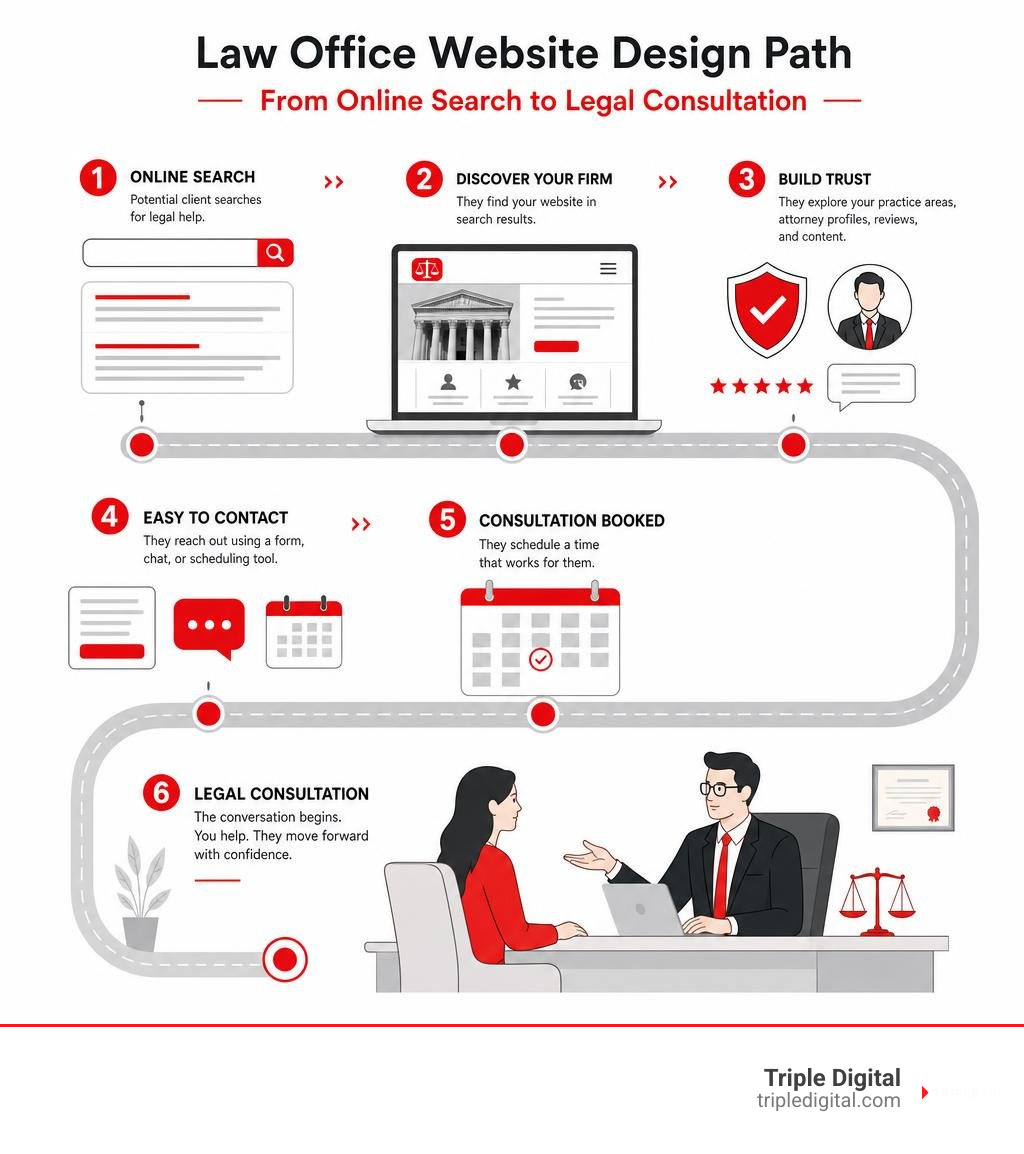
Law office website design helps a firm earn trust, appear in search and AI-driven results, and turn a visitor’s first question into a consultation request. A professional legal website is no longer just an online brochure. It is the central place where prospective clients evaluate your practice, your attorneys, your reviews, and the next step to contact you.
For firms relying on outdated sites or word-of-mouth alone, a well-designed website can create a more dependable path to qualified leads:
- Get found: Clear practice-area and local content gives search engines and AI tools useful information about who you help.
- Build trust quickly: Professional design, attorney profiles, reviews, and transparent contact details help visitors feel confident.
- Make contact easy: Mobile-friendly calls, forms, chat, and scheduling options reduce friction when someone needs legal help.
- Support long-term growth: A fast, accessible, well-maintained site can serve marketing, intake, reputation, and client-service goals at once.
People now find attorneys through traditional search, online directories, referrals, and generative AI tools such as ChatGPT and Gemini. In many cases, they may receive an answer or recommendation before they ever visit a firm’s website. That makes the quality, clarity, and credibility of your web presence more important than ever.
This guide explains what professional law firm web designers can do to help your site attract the right prospects and give them a strong reason to reach out.
Law office website design terms to learn:
Strategic Law Office Website Design for Generative AI and Search Engines
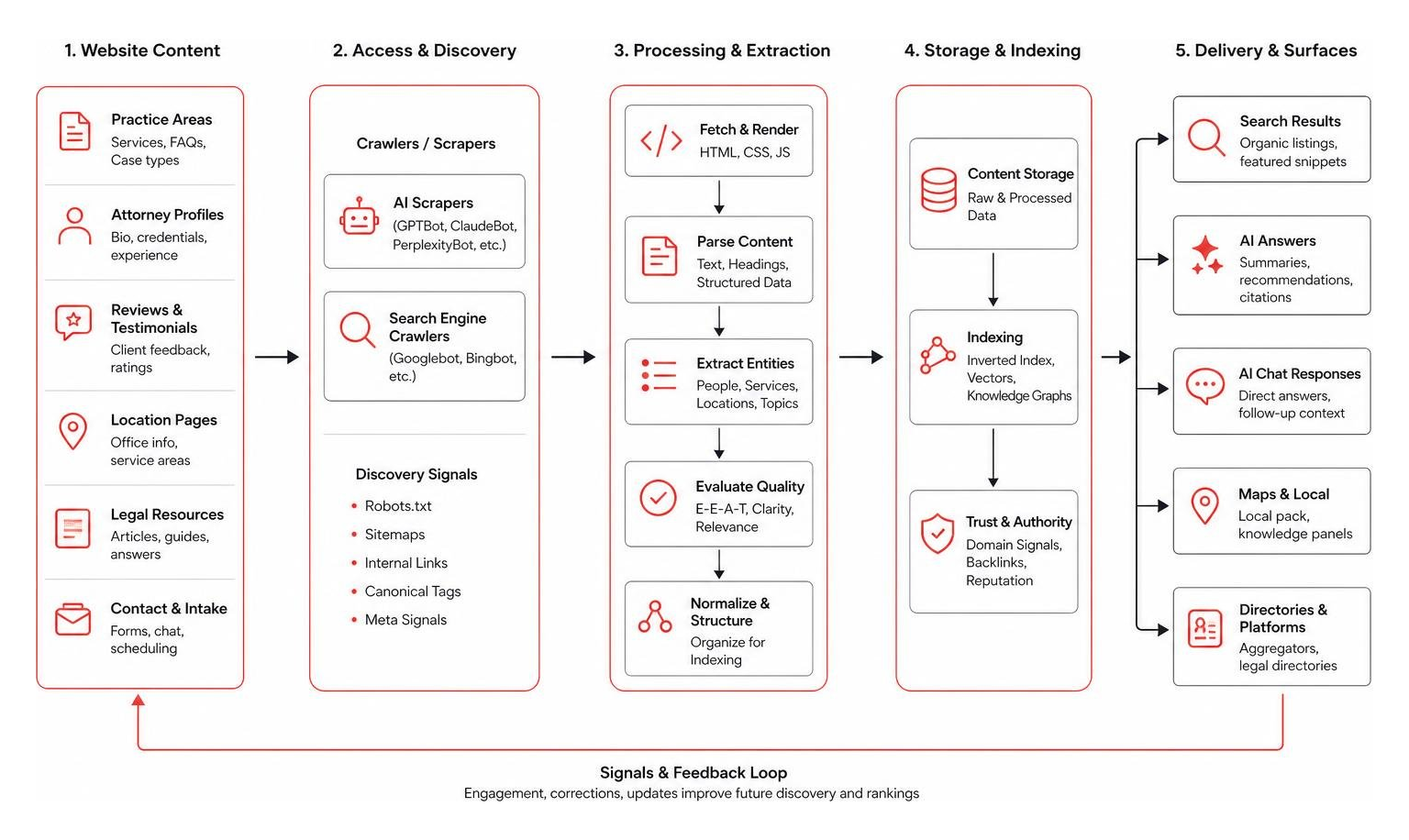
Search engines and generative AI tools have altered how prospective legal clients look for counsel. Traditional search engine optimization (SEO) focused heavily on driving clicks to a specific homepage or landing page. Today, generative AI platforms like ChatGPT, Gemini, and Google AI Overviews deliver direct answers and attorney recommendations right on the search results page. This shift toward zero-click searches means your website must function as a trusted data source for AI scrapers and human visitors alike.
When someone asks an AI tool for the top family lawyer or business attorney in Houston, the model pulls information from across the web to synthesize an answer. If your firm’s digital footprint is vague, slow, or inconsistent, AI engines will skip past your site. Strategic law office website design ensures your site’s structure, authority signals, and content hierarchy make it easy for both traditional search algorithms and generative AI tools to cite and recommend your firm.
By applying modern web design for law firms, we help legal practices build websites that establish domain authority and stay visible across every modern search interface.
Optimizing Content for AI Engine Visibility
Generative AI models prioritize clear, authoritative, and direct information. To make your website content easy for AI crawlers to parse and extract, pages should be formatted with first-principles reasoning. This means breaking down complex legal issues into fundamental concepts, explaining how a legal process unfolds, and answering direct user queries clearly upfront before diving into statutory nuances.
Key ways to structure content for AI visibility include:
- Upfront key takeaways: Place a concise TL;DR summary or direct answer at the top of practice area pages.
- Logical heading hierarchy: Use clear H2 and H3 tags that frame common legal questions (e.g., “What happens during probate?”).
- Structured schema markup: Implement legal-specific schema (such as Attorney, LegalService, and FAQPage code) to help machines index your location, services, and credentials precisely.
- Direct language: State key legal facts clearly without unnecessary filler or aggressive sales copy.
AI engines look for verifiable authority. When your site clearly outlines your services, locations, and qualifications using structured formatting, AI models are much more likely to surface your practice as a recommended solution.
Speed and Performance Optimization for AI Scrapers
Site performance is a direct ranking factor for Google and a technical requirement for AI web scrapers. AI tools use automated bots to index millions of pages daily. If a web server responds too slowly or takes too long to render content, these bots may timeout and skip your pages entirely.
To ensure both human users and automated crawlers process your site effectively, target the following performance metrics:
- Server Response Time: Target an initial server response time under 0.5 seconds.
- Total Page Load Speed: Ensure complete visual rendering occurs within 2.5 to 3.0 seconds on mobile devices.
- Core Web Vitals: Maintain high scores for Largest Contentful Paint (LCP), First Input Delay (FID), and Cumulative Layout Shift (CLS) to satisfy search engine thresholds.
Fast-loading sites keep bounce rates low when visitors arrive. Prospective clients seeking legal help are often stressed and impatient; an extra two-second delay on mobile devices can prompt them to click back and call a competitor instead.
Core Pages and Content Architecture for High-Converting Legal Sites
A logical content architecture acts as a natural roadmap for site visitors. If a user lands on a blog post or practice area page, they should instantly understand how to learn more about your attorneys, review past case outcomes, and schedule a consultation.
Effective site hierarchy groups related practice areas under clear categories, keeps main navigation menus uncluttered, and places primary call-to-action buttons where users naturally look.
Essential Components of Law Office Website Design
Every high-performing legal website relies on a core set of foundational pages. Leaving out any of these elements can hurt user trust or suppress search rankings:
- Homepage: Delivers a clear value proposition, identifies who you serve and where you practice, and highlights immediate contact channels.
- Attorney Profile Pages: Introduces your legal team with professional portraits, qualifications, bar admissions, and background stories that humanize your firm.
- Dedicated Practice Area Pages: Provides individual, highly detailed pages for every legal service you provide rather than a simple bulleted list.
- About Us & Firm History: Explains your practice philosophy, community involvement, and local presence.
- Client Testimonials & Case Results: Displays social proof, third-party badges, and verified reviews.
- Contact Page: Offers multiple ways to get in touch, including phone numbers, direct intake forms, office location maps, and chat tools.
- Legal Disclaimers & Privacy Policy: Fulfills regulatory standards, state bar compliance guidelines, and data collection transparency rules (including 10DLC compliance for text messaging).
If you want to dive deeper into structuring these elements smoothly without getting overwhelmed by technical details, explore our guide on how to design a high-performing law firm website without losing your mind.
Enhancing Practice Area Pages and Attorney Profiles

Attorney profile pages and individual practice area pages are frequently the most visited sections of any legal website. Potential clients want to know exactly who will handle their case and whether that lawyer has relevant experience.
To maximize engagement on practice area pages:
- Focus copy on solving the client’s problem rather than boasting about courtroom reputation.
- Clearly describe what to expect during the legal journey.
- Highlight specific case types (e.g., separating commercial real estate disputes from residential lease disagreements).
For attorney profiles:
- Use warm, professional headshots instead of generic stock photos.
- Include a personal narrative explaining why the lawyer practices law alongside their academic credentials.
- Add client feedback or quotes directly on the bio page.
- Keep legal disclaimers visible near outcome metrics so visitors understand past performance does not guarantee future results.
By organizing these key components, you turn standard information pages into active conversion engines. You can learn more advanced structuring strategies in our resource on beyond the homepage maximizing your legal websites potential.
Driving Conversions: Accessibility, Trust, and Lead Capture
Attracting website visitors is only half the battle. Once a prospective client arrives, your website must earn their confidence and guide them toward taking action. Converting clicks into phone calls or submitted intake forms requires accessible design, strong social proof, and low-friction communication channels.
At Triple Digital, we focus heavily on conversion rate optimization for legal practices, turning raw website traffic into active consultation requests.
ADA Compliance and Web Accessibility Best Practices
Digital accessibility is an essential legal standard, an ethical responsibility, and a major usability factor. Under Title III of the Americans with Disabilities Act (ADA), law firm websites must be accessible to individuals with visual, auditory, motor, or cognitive impairments. Non-compliant sites risk legal demand letters and exclude prospective clients who rely on assistive tools.
To ensure your law office website design meets Web Content Accessibility Guidelines (WCAG 2.1 AA) standards:
- Screen Reader Compatibility: Use descriptive alt text for all visual images and logical semantic HTML tags (such as
, and). - Color Contrast: Maintain sufficient contrast ratios between text and background colors so visitors with low vision can read every word easily.
- Keyboard Navigation: Ensure visitors can navigate through all menus, forms, and interactive widgets using only the keyboard tab key.
- Transcripts and Closed Captions: Provide text transcripts and closed captions for all embedded video introductions or informational audio podcasts.
In addition to expanding your reachable audience, accessible coding practices give search engine crawlers cleaner code to index, boosting overall SEO performance.
Building Reputation and Maximizing Lead Capture

When prospective clients face a pressing legal problem, they reach out through whatever channel is most convenient for them at that exact moment. Providing multiple communication pathways increases conversion rates significantly.
Consider implementing these lead capture options:
- Instant Click-to-Call Buttons: Essential for mobile users looking for immediate phone assistance.
- Simple Intake Forms: Keep fields short (3 to 5 fields) on initial consultation requests to minimize drop-offs.
- Live Chat or Conversational AI: Offers 24/7 engagement for late-night visitors asking preliminary intake questions.
- Direct Online Scheduling Integration: Allows prospective clients to directly book initial calls through scheduling platforms like Calendly or practice software systems like Clio and MyCase.
Off-page reputation management reinforces these on-site capture tools. Generative AI tools and prospective clients examine review profiles on Google Business Profile, Avvo, Yelp, and Martindale-Hubbell. Encouraging happy clients to leave honest reviews and actively responding to feedback builds the multi-platform authority needed to convert casual visitors into signed cases.
For deeper insights on turning web traffic into signed cases, see our complete walkthrough on landing page optimization 101 tips to turn clicks into customers.
DIY vs. Agency Partnership: Choosing the Best Growth Path
When planning a website redesign, law firms generally consider two paths: using a DIY platform or partnering with an agency specializing in legal design. While DIY platforms appeal to start-up budgets, custom agency development delivers the technical foundations and conversion strategy needed for long-term growth.
DIY vs. Hiring an Agency for Law Office Website Design
| Feature / Factor | DIY Website Builders (Wix, Squarespace) | Professional Legal Agency |
|---|---|---|
| Upfront Cost | Low initial subscription fees | Higher upfront investment |
| Attorney Time Required | High; attorneys must write copy & design layouts | Low; agency manages content, strategy & build |
| Custom Functionality | Limited to standard pre-made templates | Fully custom layouts, practice software integration |
| Technical SEO & AI Readiness | Basic on-page fields; limited schema control | Advanced local schema, AI optimization & speed tuning |
| ADA Compliance | Requires manual add-ons and manual code edits | Built-in WCAG 2.1 AA compliance standards |
| Conversion Optimization | Generic lead forms | Strategic intake flows, lead capture, and CRO design |
While a solo attorney launching a brand-new practice might begin with a basic builder, growing practices quickly run into limitations. Attorneys earn their livelihood advising clients—not troubleshooting plugin updates, setting up schema markup, or writing marketing copy.
Partnering with an experienced team lets you focus on practicing law while specialists build a client acquisition system tailored to your practice. To evaluate potential design partners effectively, read our guide on how to choose the best lawyer website design firm for your practice.
Common Web Design Pitfalls to Avoid
Whether building in-house or working with external contractors, watch out for these frequent mistakes:
- Slow Load Times: Hosting large, uncompressed imagery or heavy video files that slow mobile performance past 3 seconds.
- Outdated Content: Leaving retired partners listed on bio pages or featuring old blog posts that showcase outdated statutes.
- Unoptimized Mobile UX: Forcing mobile users to pinch and zoom because menus or call buttons scale down to desktop dimensions.
- Broken Links and 404 Errors: Neglecting 301 redirects when updating old page URLs, destroying accumulated SEO equity.
- Sensationalized Copy: Writing overly aggressive sales claims that violate state bar rules rather than providing helpful, client-focused legal information.
Avoiding these simple mistakes protects your brand reputation and maintains your search visibility.
Frequently Asked Questions About Law Office Website Design
How quickly should a law firm website load to keep visitors and AI crawlers engaged?
A modern law office website should respond within 0.5 seconds at the server level and load completely within 2.5 to 3 seconds on mobile devices. AI search crawlers and human visitors favor fast sites. Pages that take longer than 3 seconds to load suffer from higher bounce rates and risk being skipped by automated indexing bots.
What are the most critical pages to include on a modern law firm website?
Every law firm website requires a clear Homepage, individual Practice Area pages for every service offered, detailed Attorney Profile bios, an About Us page, verified Client Testimonials/Reviews, a dedicated Contact page with intake forms, and mandatory legal Disclaimers and Privacy Policies.
How does generative AI impact how potential clients find law firms online?
Generative AI search tools summarize online information to answer queries directly and recommend legal service providers within the chat interface. AI models favor websites featuring clear content structures, structured schema markup, positive off-page review signals, and fast loading performance.
Transforming Your Web Presence into a Results-Driven Client Engine
A successful legal web presence requires more than an attractive visual design. Modern law office website design serves as a strategic client acquisition system. It builds authority across AI engines, satisfies technical search requirements, delivers accessible user experiences, and turns prospective client queries into direct consultation requests.
At Triple Digital, our Houston-based team takes a transparent, results-driven approach focused on lead acquisition and measurable case growth. We combine technical search optimization, strategic content architecture, and modern UX design to help your firm stand out in an increasingly digital marketplace.
If you are ready to modernize your firm’s web presence and capture higher-quality leads, Schedule a consultation with Triple Digital today.