
Why Traditional Marketing No Longer Wins Cases
Online marketing for lawyers has become non-negotiable. Consider these facts:
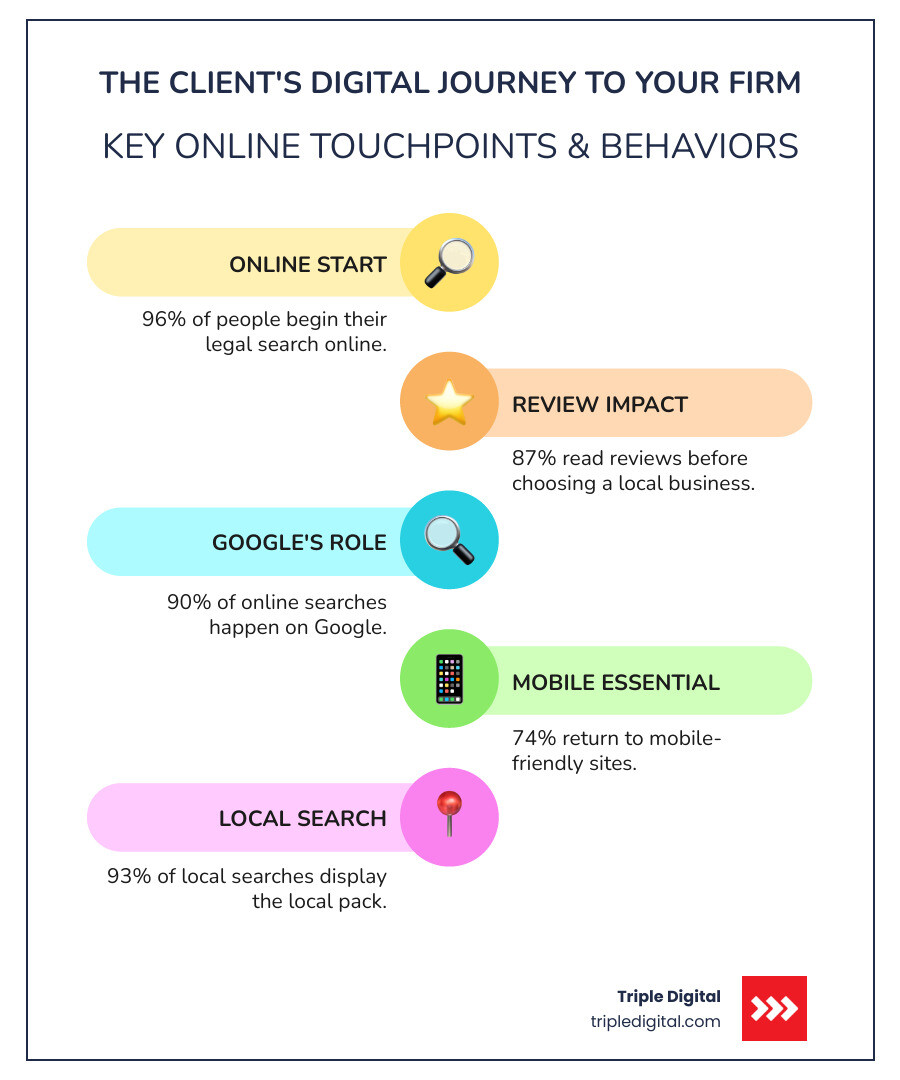
- 96% of people search for legal help online before making contact.
- Traditional marketing (billboards, print ads) lacks the reach and measurability of digital.
- Law firms can see up to 400% improvement by combining local visibility with digital marketing.
- Digital channels let you target specific clients when they need your services.
- You can track every dollar spent and every lead generated.
The legal landscape has shifted. Potential clients aren’t in the Yellow Pages; they’re Googling “personal injury lawyer near me” at 2 AM, reading reviews, and making decisions before ever picking up the phone.
If your firm isn’t visible online, you’re invisible to the vast majority of potential clients. This isn’t just a marketing problem—it’s a survival problem.
The stakes are high. Around 90% of online searches happen on Google, and very few people click past the first page. Pages ranking first get significantly more clicks than those at the bottom of the page. If you’re not on page one, you might as well not exist.
This guide breaks down how to build an online marketing strategy that generates leads and cases. We’ll show you which tactics work—from SEO and PPC to content and social media—and how to put your firm in front of clients actively searching for legal help.
The Digital Shift: Why Your Firm Can’t Afford to Be Offline
What is online marketing for lawyers? It encompasses all online strategies used to increase brand awareness, build your reputation, and grow your business—from search engine results to social media and email.
The shift to digital is a fundamental change in how clients find legal services. Beyond personal recommendations, most clients use search engines, online reviews, and legal directories. Without an online presence, your firm is invisible to a vast majority of potential clients.
The benefits of digital marketing are clear:
- Increased Reach: Target prospective clients far beyond your immediate network, reaching individuals in Houston and beyond who are actively searching for your legal services.
- Cost-Effectiveness: Digital marketing often provides a higher return than traditional advertising by precisely targeting audiences, ensuring your budget is spent on people likely to need your services.
- Measurable Results: Every click, visit, and lead can be monitored, allowing us to refine strategies and maximize your return on investment (ROI).
- Credibility and Trust: A strong online presence with helpful content and positive reviews establishes your firm as an authority before a potential client even contacts you.
However, lawyers must steer the digital landscape while adhering to stringent ethical guidelines. Key risks include:
- Bar Association Rules: All marketing must comply with jurisdictional advertising rules, such as the ABA Model Rules of Professional Conduct, ensuring all claims are accurate and not misleading.
- Unintentional Client-Lawyer Relationships: Answering specific legal questions on public forums can inadvertently create a client-lawyer relationship. Disclaimers on all platforms are crucial.
- Disclosure of Confidential Information: All online content must be carefully curated to avoid disclosing any private client details.
- Blurred Personal and Professional Lines: Social media can blur personal opinions and professional representation. Maintaining a professional demeanor is essential to protect your firm’s reputation.
- Legal and Privacy Implications: Marketing must comply with privacy laws. For example, the CAN-SPAM Act requires commercial emails to have sender information and an unsubscribe option. Data privacy regulations like GDPR and CCPA mean all client data must be handled securely and transparently, with clear privacy policies on your website.
We understand these complexities. Our approach ensures your online marketing for lawyers is not only effective but also fully compliant with all ethical and legal standards.
Building Your Case: Crafting a Winning Digital Marketing Strategy

Before diving into tactics, we need a solid digital marketing strategy aligned with your firm’s goals. Think of it as building a legal case—a clear strategy is essential.
First, we define success. Are you looking to increase website traffic, generate more leads, or expand into a new practice area in Houston? Specific, measurable, achievable, relevant, and time-bound (SMART) goals provide a clear roadmap.
Next, we pinpoint your ideal client. Understanding their demographics, legal needs, and online behavior is paramount. For instance, an employment lawyer’s clients might be on LinkedIn, while a personal injury lawyer’s clients are on Facebook or local search. We focus on their pain points, crafting messaging that shows empathy and offers solutions.
Promoting an individual lawyer versus a firm requires a nuanced approach. Individual promotion highlights unique expertise and builds a personal brand, which strengthens the firm’s overall reputation. A firm-wide strategy showcases collective expertise and services, leveraging the individual reputations of its lawyers. Both are intertwined for a powerful online presence.
Central to this is defining your firm’s unique value proposition in five clear steps. What makes your Houston law firm stand out? Clarifying this helps us craft compelling messaging across all digital channels.
Finally, let’s talk budget. While the U.S. Small Business Administration suggests 7%-8% of gross revenue for marketing, law firm consultants often recommend 2% to 5%. We help you determine a strategic budget that makes sense for your firm, ensuring every dollar is invested wisely. To learn more, see How Much Do Small Law Firms Spend on Marketing?.
Essential Components of a High-Converting Law Firm Website
Your website is the cornerstone of your online marketing for lawyers strategy. It’s your digital storefront and a potential client’s first impression.
- Professional, User-Friendly Design: A modern, fast, and easy-to-steer site instills confidence. A cluttered or slow website deters potential clients.
- Clear Navigation: Visitors should effortlessly find information about your practice areas, attorneys, and contact details through intuitive menus.
- Comprehensive Practice Area Pages: Each service needs a dedicated page detailing your approach and how you help clients. These are vital for SEO.
- Engaging Attorney Bios: People hire lawyers, not firms. Personalize bios with professional photos, experience, and a glimpse of personality to build trust.
- Client Testimonials and Case Studies: Social proof is powerful. Showcase positive feedback and successful case outcomes (with permission) to build credibility.
- Strong Calls-to-Action (CTAs): Guide visitors with clear next steps like “Schedule a Consultation” or “Call Now” prominently displayed on every page.
- Mobile-Friendly Design: With over 58% of internet traffic from mobile, your site must be responsive. Nearly 74% of users are more likely to return to mobile-friendly websites.
- Conversion Optimization: A high-converting website turns visitors into leads with strategically placed CTAs and clear contact forms.
A well-designed website is an investment that can significantly boost your bottom line. Explore How Web Design Can Make Your Business More Profitable to understand its full potential.
The Playbook: Core Channels for Online Marketing for Lawyers

With a strategy and website in place, let’s explore the core channels for effective online marketing for lawyers. These are the tools we use to connect your firm with clients.
Dominate Search Results with Law Firm SEO
Search Engine Optimization (SEO) is crucial because 96% of people use a search engine for legal advice, mostly on Google. If you’re not visible in search, you’re not in the race. SEO improves your website’s visibility in organic (unpaid) search results. We know that only two to three percent of people visit Google’s second page, so our goal is to get your Houston law firm on page one.
Google’s algorithm classifies legal information as “Your Money or Your Life” (YMYL) content, holding it to a higher standard of Expertise, Authority, and Trustworthiness (E-A-T). Your content must demonstrate deep legal knowledge and be highly reliable.
SEO includes:
- On-page SEO: Optimizing elements on your website, like high-quality content, keywords, optimized titles, and a user-friendly site structure.
- Off-page SEO: Activities outside your website that influence rankings, primarily building links from other reputable sites to signal your authority to Google.
For a deeper dive, check out Reasons to Use Law Firm SEO and Law Firm SEO: What Are The Most Important SEO Ranking Factors?.
Leverage Local SEO to Attract Nearby Clients
For a competitive market like Houston, local SEO is non-negotiable. It optimizes your online presence to attract clients in your geographic area. A key component is your Google Business Profile, a free listing that appears in local search and Google Maps.
The “local pack” is a game-changer, appearing above organic results for 93% of local searches. Firms in the local pack see a massive increase in views and clicks. To rank here, we focus on local keywords, NAP (Name, Address, Phone) consistency, and generating positive reviews.
Studies report up to a 400% improvement in online performance when local visibility and digital marketing are combined, making local SEO one of the most effective ways to generate leads for Houston law firms. For quick wins, explore 5 GMB Hacks Not To Miss To Generate More Leads.
The Role of Paid Advertising (PPC)
While SEO builds long-term visibility, Pay-Per-Click (PPC) advertising with Google Ads offers immediate visibility at the top of search results. It’s powerful for capturing high-intent searches from people needing immediate legal help.
However, PPC for lawyers is expensive. We manage costs effectively through:
- Targeted Keywords: Focusing on specific, long-tail keywords to reduce wasted spend.
- Quality Score: Improving ad relevance and landing page experience to achieve a higher Quality Score, which lowers costs and improves ad position.
- Smart Budgeting: Implementing intelligent bidding strategies and budgets to control spend and maximize ROI.
- Conversion Tracking: Monitoring calls and form fills to reallocate budget to what’s working.
Since many consumers don’t trust ads as much as organic results, PPC works best as part of a comprehensive plan.
| Feature | SEO (Organic Search) | PPC (Paid Search) |
|---|---|---|
| Visibility | Earned over time, below ads | Immediate, at top of results |
| Cost | Ongoing investment | Pay-per-click, can be high |
| Speed | Slower results (months) | Instant traffic and leads |
| Trust | Higher user trust | Lower user trust |
| Sustainability | Long-term asset | Stops when budget runs out |
| Best For | Brand building, consistent flow | Immediate leads, testing |
Build Credibility with Content and Social Media
Content marketing packages your expertise to attract and retain clients. Why Do Law Firms Need a Content Marketing Strategy? Because it builds credibility, improves SEO, and engages potential clients by answering their questions.
Key formats include:
- Blogging: Regularly publishing articles that explain legal concepts or offer advice. Firms with blogs are more likely to acquire clients from their content.
- Video Marketing: A powerful tool used by only 24% of firms. Websites with video are 53 times more likely to reach Google’s first page, and video can boost landing page conversions by 80%.
- Answering Client Questions: Proactively creating content that addresses common concerns positions your firm as helpful and client-focused.
Social media complements these efforts by building brand awareness and driving traffic. Platforms like LinkedIn (professional networking), Facebook (broad reach), and even TikTok (short, engaging insights) help humanize your brand and build trust. For more, see our guide to Law Firm Marketing With Social Media.
Nurture Leads with Email Marketing and Online Reviews
Once you’ve attracted leads, you need to nurture them. Email marketing is highly effective, with a potential 4,200% ROI. It’s great for nurturing leads not yet ready to hire and for engaging past clients to generate referrals.
Best practices include client newsletters, automated lead nurturing sequences, and list segmentation, all while complying with anti-spam laws.
The importance of online reviews cannot be overstated. A study found 87% of consumers read online reviews before choosing a local business. Reviews on Google, Avvo, and Yelp are often the most influential factor in hiring decisions. We help manage your online reputation by encouraging and responding to reviews.
Optimized profiles on legal directories like Justia also provide valuable backlinks and another avenue for clients to find you. For a detailed guide, consult The Ultimate Legal Directory Profile Optimization Checklist.
The Verdict: Measuring Success and Knowing When to Partner Up
In online marketing for lawyers, if you can’t measure it, you can’t improve it. We use a data-driven approach, tracking Key Performance Indicators (KPIs) to ensure your investment yields tangible results.
Key metrics we monitor include:
- Website Traffic: Using tools like Google Analytics to track visitor sources and on-site behavior.
- Conversion Rates: Measuring how many visitors complete a desired action (call, form fill). Legal sector conversion rates on Google Ads can range from 3.75% to 6.98%.
- Cost Per Acquisition (CPA): Calculating the cost to acquire a new client. A good CPA is about 1/5th of the average case value.
- Return on Investment (ROI): Aiming for a strong ROI, with a 5:1 revenue-to-cost ratio being a common benchmark.
- Keyword Rankings: Monitoring performance for target keywords with tools like Google Search Console.
- Local SEO Presence: Tracking local rankings and call conversions to ensure visibility for your Houston law firm.
For comprehensive insights, explore Law Firm Lead Tracking.
When should a law firm partner with a digital marketing agency? Your time is best spent practicing law, not wrestling with SEO algorithms. The complexity of digital marketing often requires specialized expertise.
Working with an agency like Triple Digital offers:
- Expertise: We bring years of experience in legal marketing and its ethical nuances.
- Time Savings: Outsourcing frees you to focus on clients and cases.
- Data-Driven Strategies: We leverage AI and data mining for precise client targeting, ensuring a “less fluff, more cases” approach.
- Comprehensive Solutions: We provide a full suite of services for a cohesive and effective strategy.
The decision to partner with an agency depends on your firm’s goals and resources. If you’re looking for a dedicated team to drive results, it makes sense to bring in experts. For more insights, read Should I Hire a Marketing Agency to Run My Law Firm?.
Frequently Asked Questions about Online Legal Marketing
How much should a law firm spend on online marketing?
The answer depends on your goals, but there are benchmarks. The U.S. Small Business Administration suggests allocating 7%-8% of gross revenue to marketing. A 5:1 revenue-to-cost ratio is a good target for marketing spend. More importantly, we focus on your Cost Per Acquisition (CPA) relative to your average case value. For a good ROI, your CPA should be about 1/5th of the case value. This is why high-value case keywords can justify a high cost per click. For a detailed breakdown, see How Much Should Lawyers Pay for SEO?.
How long does it take for law firm SEO to show results?
SEO is a long-term strategy. While some improvements may appear in a few weeks, significant results—like consistent first-page rankings and a steady flow of organic leads—typically take 6-12 months. The timeline varies based on your practice area’s competitiveness and the consistency of your SEO efforts. Patience is key, as the long-term benefits are substantial.
Can a solo practitioner compete with large firms online?
Absolutely. Solo and small firms in Houston can thrive online with smart, targeted strategies:
- Niche Targeting: Focus on a specific practice area (e.g., “Houston small business contracts”) to become the go-to expert for a highly relevant audience.
- Local SEO Focus: Dominate local search results for your specific services in your immediate area to bypass larger, less-focused firms.
- Personalized Content: Use your unique story and expertise in blogs, videos, and social media. Your personal brand is a powerful differentiator.
- Leveraging Unique Strengths: Highlight what makes you different, whether it’s accessibility, a unique fee structure, or specialized background.
Conclusion: Your Firm’s Digital Future Starts Now
The legal landscape has shifted online. For Houston law firms, embracing online marketing for lawyers is a necessity for growth. We’ve explored why digital is essential, how to build a strategy, and the core channels—SEO, local SEO, PPC, content, social media, and email—that drive success.
The verdict is clear: a robust digital presence, backed by a data-driven and ethical strategy, is the most effective way to attract new clients in today’s competitive environment. Don’t let your firm be invisible to the 96% of potential clients searching online.
Your firm’s digital future starts now. Let us help you build a winning digital marketing strategy that delivers “less fluff, more cases.” Contact us to build your winning digital marketing strategy.