
Why LinkedIn Matters for Modern Law Firms
LinkedIn for lawyers has evolved from a simple online resume into a powerful business development engine. With 1 billion users worldwide and 87% of law firms actively using the platform, LinkedIn represents the single most important professional network for legal professionals today.
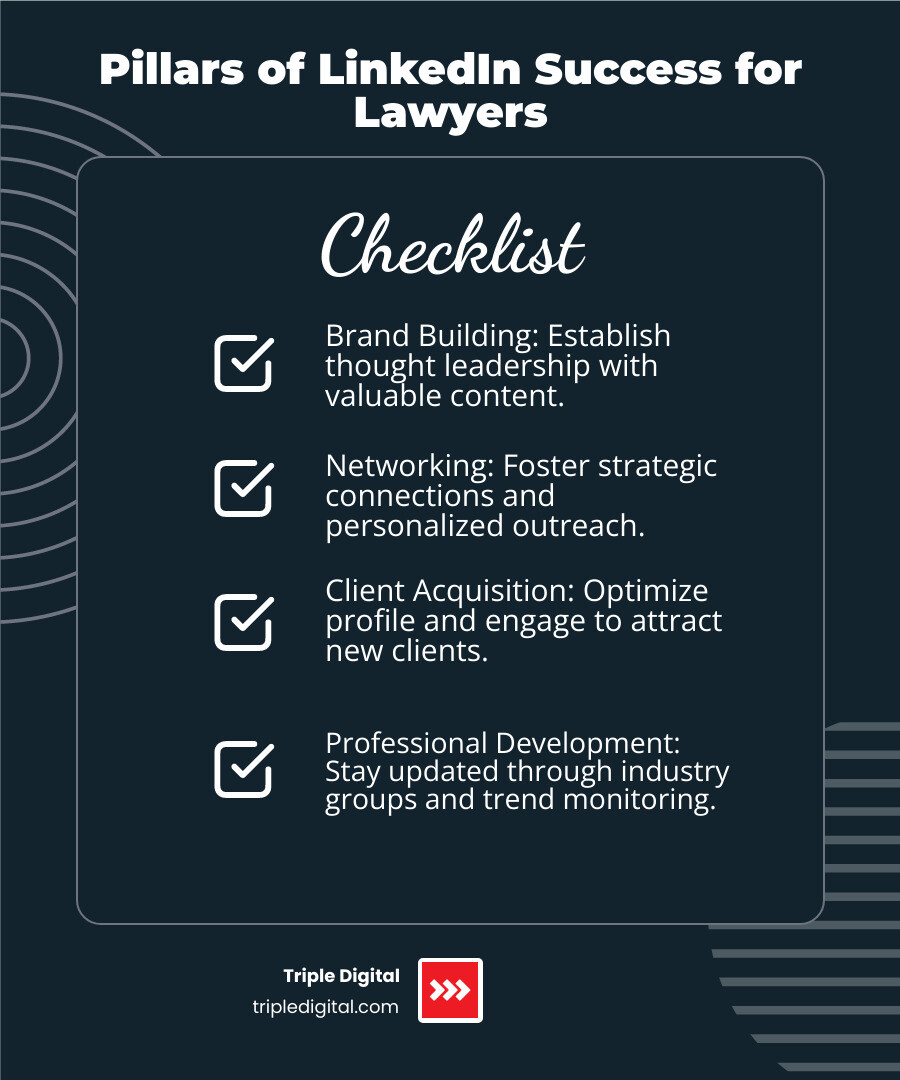
Quick Answer: What LinkedIn Can Do for Your Law Firm
- Build Your Brand – Establish yourself as a thought leader in your practice area
- Acquire Clients – Nearly 70% of corporate counsel use LinkedIn to find and vet attorneys
- Generate Referrals – Network strategically with other professionals who can send business your way
- Stay Informed – Monitor industry trends and legal developments in real-time
- Recruit Talent – Attract top legal professionals to your firm
The numbers tell a compelling story. People spend nearly 2.5 hours on social media daily, and 94% of legal associates maintain active LinkedIn profiles. Yet most lawyers treat LinkedIn like a static resume—a missed opportunity that leaves money on the table.
The legal industry is undergoing a digital change. Clients increasingly find and vet lawyers online before ever picking up the phone. They consume thought leadership content—articles, videos, podcasts—to evaluate expertise. LinkedIn reported a 55% increase in engagement, content posting, and messaging during recent years as this shift accelerated.
For law firms struggling with traditional marketing methods, LinkedIn offers a modern solution. It’s not about becoming a social media influencer or posting constantly. It’s about strategic presence, meaningful connections, and demonstrating expertise where potential clients are already looking.
This guide will show you exactly how to leverage LinkedIn for real business results—from optimizing your profile to creating content that builds trust, and from networking strategically to measuring your return on investment.
Why LinkedIn is an Essential Tool in a Lawyer’s Arsenal
In today’s professional landscape, digital presence isn’t just an option; it’s a necessity. For lawyers and law firms, LinkedIn for lawyers has become an indispensable tool, acting as a virtual extension of your professional self and your firm’s reputation. We’ve seen how it transforms how legal professionals connect, attract clients, and stay ahead of the curve.
Consider this: people are spending an average of 2 hours and 23 minutes on social media every single day. Statistics show that people spend nearly 2.5 hours on social media daily. A significant portion of that time is dedicated to professional platforms like LinkedIn, where individuals and businesses actively seek information, connections, and opportunities. If your firm isn’t visible there, you’re missing out on vital interactions.
Why is LinkedIn for lawyers so essential? It’s the number one place law firms market themselves, both digitally and on paper. Around 87% of law firms leverage this platform. This widespread adoption isn’t accidental; it’s driven by LinkedIn’s unique ability to foster professional connections and showcase expertise in a credible environment. From solo practitioners to large corporate law firms in Houston, we find that a strong LinkedIn strategy is paramount for success. You can learn more about how social media can transform your firm’s outreach by exploring our insights on Law Firm Marketing with Social Media.
The Power of Personal Branding for Attorneys
Your personal brand as an attorney is more than just your legal expertise; it’s about what makes you unique, how you solve problems, and the values you uphold. LinkedIn for lawyers offers an unparalleled stage to cultivate this personal brand. By consistently sharing insights and engaging thoughtfully, you build trust and establish yourself as an authority in your niche. This differentiation is crucial in a competitive legal market like Houston.
Think of it this way: when potential clients or referral partners search for legal counsel, they’re looking for more than just a name. They’re looking for someone they can trust, someone who understands their challenges, and someone who can articulate solutions. A well-curated LinkedIn profile and active presence allow you to tell your story, showcase your accomplishments, and demonstrate your thought leadership, setting you apart from the crowd.
LinkedIn for Client Acquisition and Business Development
One of the most compelling reasons to master LinkedIn for lawyers is its direct impact on client acquisition and business development. This isn’t just about networking; it’s about lead generation. Nearly 70% of corporate counsel use LinkedIn, with 38% relying on it specifically for selecting and hiring attorneys. That’s a significant pool of potential clients actively seeking legal services!
LinkedIn allows us to identify and connect with key decision-makers, nurture referral relationships, and position ourselves as the go-to experts in our practice areas. Clients are increasingly vetting lawyers online, and your LinkedIn profile often serves as their first impression. A strong, optimized presence instills confidence and can be the deciding factor in securing new business. According to the American Bar Association, LinkedIn is the top marketing channel for law firms, solidifying its role as a primary driver for growth.
Crafting an Irresistible Profile: Your Digital Handshake
Your LinkedIn profile is your digital handshake, often the first impression you make on potential clients, referral partners, or even future colleagues. It’s not just a resume; it’s a dynamic marketing tool that, when optimized, can attract opportunities directly to you. Most legal associates have active LinkedIn profiles, but many fail to optimize them, missing out on crucial visibility. Our goal is to ensure your profile stands out in Houston’s busy legal community.
Optimizing your profile is key to building your brand and becoming searchable. We want to make sure that when someone searches for a lawyer with your specific expertise, your profile is among the first they see.
Mastering the Essentials: Photo, Headline, and URL
Let’s start with the basics, because sometimes, the basics make all the difference.
- Professional Headshot: This is non-negotiable. Your profile picture should be a recent, high-quality, professional headshot. Smile, make eye contact, and ensure it reflects the professional image you want to project. This isn’t the place for vacation photos or blurry selfies!
- Cover Photo: Often overlooked, your cover photo is prime real estate to reinforce your brand. It can display your firm’s logo, a relevant legal image, or a skyline of Houston, TX. Ensure it’s correctly formatted (JPG or PNG, under 8MB, 1584 width x 396 height in pixels) to make a strong visual statement.
- Compelling Headline: This is your 120-character elevator pitch. Move beyond “Attorney at [Firm Name].” Instead, use client-focused language that highlights your specialization, who you help, and the unique value you provide. For example, instead of “Family Law Attorney,” consider “Houston Family Law Attorney | Guiding Clients Through Divorce & Custody Disputes with Compassion.” This immediately tells visitors what you do and for whom. Incorporate keywords that potential clients might use in their searches.
- Custom URL: A personalized LinkedIn URL looks more professional and is easier to remember. It’s a small detail that improves your credibility. We recommend making it your name (e.g., linkedin.com/in/yourname). Create a custom URL directly from your profile settings.
The “About” and “Experience” Sections: Telling Your Story
These sections are where you transform a dry resume into a compelling narrative.
- The “About” Section: This is your opportunity to tell your story in up to 2,000 words. Don’t just list your qualifications; explain why you do what you do. Focus on your clients’ needs, the problems you solve, and the impact you’ve had. Use conversational language and avoid excessive legal jargon. This is where your passion for justice or helping people can truly shine through. Highlight achievements with quantifiable results whenever possible (e.g., “Successfully negotiated X settlements totaling Y dollars”).
- The “Experience” Section: Beyond listing job titles and dates, describe your professional experiences in a way that showcases your accomplishments and expertise. Instead of copying and pasting job descriptions, focus on what you achieved in each role. How did you help clients? What challenges did you overcome? How did you contribute to your firm’s success?
- Featured Section: This powerful section allows you to highlight articles you’ve written, media mentions, important presentations, or even client testimonials. It’s your digital portfolio, providing social proof and deeper insight into your work and thought leadership.
Building Credibility with Skills, Endorsements, and Recommendations
Credibility is currency in the legal profession, and LinkedIn provides several mechanisms to build it.
- Skills & Endorsements: You can add up to 50 skills to your profile. These should be relevant to your practice areas and expertise. Once added, LinkedIn automatically asks your connections to endorse you for these skills. This peer validation boosts your profile’s authority.
- Recommendations: These are personal testimonials written by colleagues, clients, or supervisors. They are incredibly powerful. Actively seek recommendations from those you’ve worked with, and offer to write them in return. A recommendation from a satisfied client or a respected peer speaks volumes about your capabilities and professionalism.
Content and Networking: The Core of LinkedIn for Lawyers
An optimized profile is just the beginning. To truly master LinkedIn for lawyers, we need to engage, share, and connect. Think of your profile as your storefront; your content and networking are the activities that bring people in. Consistent activity is key: profiles that post weekly see twice the engagement than those that don’t.
What to Post: Content That Builds Authority and Trust
The content you share on LinkedIn should position you as a knowledgeable and trustworthy expert. Our goal is to provide value, not just self-promote.
- Thought Leadership: Share your insights on current legal trends, recent court decisions, or legislative changes. What’s your unique perspective on a complex issue? This demonstrates your expertise and helps your audience stay informed.
- Educational Content: Break down complex legal concepts into easily digestible information for non-lawyers. Offer practical tips or answer common questions related to your practice area. For example, a Houston real estate lawyer might share “5 Things to Know Before Buying Commercial Property in Texas.”
- Case Studies (Anonymized): With client permission and careful anonymization, share stories of how you’ve helped clients achieve positive outcomes. Focus on the problem, your approach, and the successful resolution. This showcases your impact without revealing confidential information.
- Industry Analysis: Comment on how legal developments might affect specific industries. This is particularly valuable for business law attorneys.
- Video Content: Short, engaging videos (1-2 minutes) perform exceptionally well on LinkedIn. Use them to explain a legal concept, share a quick tip, or offer a “behind-the-scenes” look at your legal work. Studies show that 69% of people favor video over text. This visual format can significantly boost engagement and help humanize your brand.
- Curated Content: Don’t feel pressured to create everything from scratch. Share relevant articles, reports, or news from reputable sources, adding your commentary or perspective. This shows you’re well-read and engaged with your field.
Quality over quantity is paramount. Every piece of content should aim to educate, inform, or inspire your audience. For more ideas on how content can drive your business, check out our guide on How can social media help your business?
Strategic Networking: Building Your Professional Circle
Networking on LinkedIn isn’t about collecting as many connections as possible; it’s about building meaningful relationships with the right people.
- Quality Over Quantity: Focus on connecting with individuals who are genuinely relevant to your professional goals: potential clients, referral partners (e.g., CPAs, financial advisors, realtors), fellow attorneys, and community leaders in Houston.
- Personalized Requests: Always, always personalize your connection requests. A generic “I’d like to add you to my professional network” is a missed opportunity. Reference a shared connection, a piece of their content you admired, or a common interest. For example, “I enjoyed your recent post on AI in contract law; your insights were spot-on. I’d love to connect.”
- Engaging in Comments: Be active! Comment thoughtfully on posts from your connections and industry leaders. Share your experiences, ask questions, and offer valuable perspectives. This keeps you visible and positions you as an engaged professional.
- Taking Conversations Offline: LinkedIn is a fantastic place to start conversations, but business often gets done face-to-face (or screen-to-screen). If an online conversation progresses and there’s mutual interest, don’t hesitate to suggest a phone call or a virtual meeting.
- Joining Relevant Groups: LinkedIn groups are excellent for targeted networking and staying informed. Seek out groups related to your practice area, industry, or local legal community. Participate actively by sharing knowledge and engaging in discussions. Join relevant LinkedIn groups and contribute to the conversation. This is also a great way to stay informed about industry trends and developments, answering Q11 (stay informed) and Q15 (groups for growth).
Common Mistakes to Avoid on LinkedIn for Lawyers
Even with the best intentions, it’s easy to stumble on LinkedIn. We’ve identified some common pitfalls that lawyers often encounter:
- Cookie-Cutter Profiles: Profiles that read like a generic resume and lack personality or a clear value proposition. Your profile should tell your unique story and highlight your impact.
- “Zombie Networking” (Spray-and-Pray): Sending out mass connection requests without personalization or follow-up. This approach is rarely effective and can even be detrimental to your reputation.
- Overly Promotional Content: Constantly posting about your services or achievements without providing value to your audience. Remember the 4:1 rule: for every self-promotional post, aim for four value-driven, educational, or informative posts.
- Ignoring Engagement: Posting content and then disappearing. You need to respond to comments, engage with your network’s posts, and be part of the ongoing conversation.
- Ethical Breaches: Overlooking the strict ethical guidelines that govern lawyers’ conduct, even online. This is a critical area we’ll dig into next.
Beyond the Individual: LinkedIn for Law Firm Success
While individual lawyer profiles are vital, a strong law firm presence on LinkedIn multiplies your impact. It’s not just about showcasing individual talent; it’s about building a collective brand, attracting new clients, and recruiting the best legal minds to your team.

Establishing a Strong Law Firm Company Page
Your law firm’s LinkedIn Company Page serves as its digital headquarters, providing a central hub for your brand, services, and culture.
- Company Page Creation: If your firm doesn’t have one, it’s time to create a business page for your firm. Fill out every section comprehensively, including your firm’s mission, values, practice areas, and a compelling “About Us” section.
- Firm Branding & Consistency: Ensure your company page reflects your firm’s brand identity—logo, colors, tone of voice. Consistency across all platforms builds trust and recognition.
- Showcasing Expertise: Use the company page to share firm-wide achievements, awards, pro bono work, and thought leadership content from your attorneys. You can publish articles, share news, and highlight your team’s collective knowledge.
- Highlighting Culture: A company page is an excellent way to showcase your firm’s culture. Share photos of team events, community involvement, or employee spotlights. This humanizes your firm and can attract both clients and potential hires.
Leveraging LinkedIn for Recruiting Top Legal Talent
In a competitive market like Houston, attracting and retaining top legal talent is crucial for growth. LinkedIn is an invaluable tool for recruiting, allowing us to showcase our firm as an employer of choice.
- Talent Acquisition: Law firms can use their LinkedIn page to highlight what makes them a great place to work. Share testimonials from current employees, details about professional development opportunities, and information about your firm’s values.
- Showcasing Firm Culture: Potential associates aren’t just looking for a job; they’re looking for a culture where they can thrive. Use your page to visually represent your firm’s environment, diversity, and community involvement.
- Job Postings: LinkedIn’s job posting features are highly effective for reaching qualified candidates. You can target specific legal professionals and leverage the platform’s vast network to fill open positions. You can find legal jobs on LinkedIn directly through their job board. This is a powerful way to find the right fit for your team.
Navigating Ethics and Measuring Your LinkedIn ROI
While LinkedIn for lawyers offers immense opportunities, it also comes with significant responsibilities, particularly regarding ethical conduct. Furthermore, to ensure our efforts are paying off, we need a clear strategy for measuring success.
Upholding Ethical Obligations on a Public Platform
As lawyers, we operate under strict ethical guidelines that extend to our online activities. Navigating these rules on a public platform like LinkedIn requires vigilance.
- ABA Model Rules & State Bar Guidelines: Always adhere to the American Bar Association’s Model Rules of Professional Conduct and your specific state bar association’s guidelines. These rules govern everything from advertising to client confidentiality.
- Client Confidentiality: The duty to protect client information is as strong online as it is offline. Even discussing public record information requires caution. ABA Formal Opinion 18-480 emphasizes that confidentiality isn’t something you can set aside just because you’re online. We must ensure that anything we post, share, or discuss does not inadvertently reveal confidential client information.
- Conflicts of Interest: Be extremely mindful of potential conflicts. Something as seemingly harmless as messaging a judge on LinkedIn could be misconstrued and create an issue. Model Rule 1.7 is a big one here—avoid anything online that could create a conflict of interest.
- Advertising Rules & Specialist Claims: Lawyers cannot make misleading claims about their services or exaggerate accomplishments. Be particularly careful with words like “expert” or “specialist.” Many bar associations have strict guidelines on who can use such titles. Always ensure your profile and content comply with these advertising regulations. This includes monitoring endorsements and recommendations from others, as you are responsible for content on your profile.
How to Measure the Success of Your LinkedIn Strategy
To truly understand the value of your LinkedIn for lawyers efforts, we need to track our progress and measure our return on investment (ROI).
- Key Metrics:
- Profile Views: How many people are looking at your profile or your firm’s page? An increase indicates growing visibility.
- Post Engagement: Track likes, comments, shares, and clicks on your content. High engagement suggests your content resonates with your audience.
- Follower Growth: An increasing number of followers indicates a growing audience for your insights and brand.
- Lead Tracking: The ultimate metric. How many inquiries, consultations, or new clients can be directly attributed to your LinkedIn activity? This might involve asking new clients how they found you or tracking website traffic originating from LinkedIn.
- Using LinkedIn’s Analytics: LinkedIn provides built-in analytics tools for both personal profiles and company pages. Review your LinkedIn activity regularly. Notice which posts get traction and which don’t. Adjust your strategy based on what resonates with your audience. These insights are invaluable for refining your content strategy and engagement tactics.
Frequently Asked Questions about LinkedIn for Lawyers
We often get asked similar questions from legal professionals looking to optimize their LinkedIn presence. Here are some of the most common ones:
How often should a lawyer post on LinkedIn?
Consistency is more important than sheer volume. While some sources suggest posting 3-5 times a week, a good starting point is at least 2-3 times per week. The key is quality over quantity. Instead of forcing daily posts, focus on sharing valuable, insightful content regularly. Profiles that post weekly see twice the engagement. So, find a schedule that works for you and your firm, and stick to it. We recommend creating a content calendar to help plan your posts in advance.
What’s the difference between a personal profile and a law firm page?
Think of your personal LinkedIn profile as your individual professional brand. It highlights your unique experience, skills, and thought leadership. It’s your voice, your story, and your direct connections.
A law firm page, on the other hand, represents your firm’s collective brand. It showcases the firm’s services, team, culture, and overall mission. It’s a corporate voice that builds firm-wide credibility and can be used for recruitment and broader marketing efforts. While your personal profile can share firm content, the firm page is where the firm’s official announcements and broader narrative reside. Both are crucial and work synergistically.
Can I actually get clients from LinkedIn?
Absolutely! While it might not be as direct as a Google search ad, LinkedIn for lawyers is a powerful client acquisition tool, especially for B2B or corporate clients. Nearly 70% of corporate counsel use LinkedIn, and 38% of them specifically rely on it for selecting and hiring attorneys.
Client acquisition on LinkedIn is often a long-term strategy built on relationship building, consistent value provision, and establishing trust. By optimizing your profile, sharing thought leadership, engaging strategically, and networking with key individuals, you can position yourself and your firm as the preferred choice when a potential client needs legal services. It’s about being visible, credible, and approachable in the digital space where your future clients are already looking.
Conclusion: From Digital Presence to Professional Powerhouse
LinkedIn for lawyers is no longer a luxury; it’s a fundamental component of a successful legal career and a thriving law firm. From building a robust personal brand and attracting new clients to recruiting top talent and staying ethically compliant, the platform offers unparalleled opportunities for growth and visibility.
By following the strategies we’ve outlined—optimizing your profile, creating valuable content, networking strategically, and measuring your impact—you can transform your LinkedIn presence from a dormant online resume into a dynamic professional powerhouse. It requires a long-term commitment and consistent effort, but the rewards in terms of reputation, relationships, and revenue are immense.
In the competitive legal landscape of Houston, standing out means embracing digital innovation. We at Triple Digital specialize in leveraging platforms like LinkedIn to drive lead generation and case acquisition for law firms. Our “less fluff, more cases” approach, powered by AI and data mining, ensures your efforts are precisely targeted for maximum impact.
Ready to open up the full potential of your firm’s digital strategy? Learn more about our digital marketing services for law firms and let us help you turn your online presence into tangible results.