
The Dawn of Data-Driven Legal Strategy
Predictive analytics legal is changing how attorneys approach litigation, risk management, and strategic planning by using artificial intelligence and machine learning to analyze vast amounts of historical legal data and forecast probable outcomes. Instead of relying solely on intuition and experience, lawyers now have access to data-driven insights that can predict case success rates, estimate costs, analyze judicial behavior, and inform settlement strategies.
Key Applications of Predictive Analytics in Law:
- Case Outcome Prediction – Forecast the likelihood of winning motions, trials, or appeals based on historical data
- Litigation Strategy – Analyze judge tendencies, opposing counsel patterns, and jurisdiction trends
- Risk Management – Identify regulatory risks, compliance gaps, and contract vulnerabilities before they escalate
- Resource Optimization – Allocate staff and budget more efficiently based on predicted case trajectories
- Client Communication – Provide accurate estimates of legal fees, case duration, and probable outcomes
Back in 1870, Oliver Wendell Holmes characterized a lawyer’s role as a professional predictor of legal outcomes. Today, that prediction has evolved from experience-based intuition to sophisticated algorithmic analysis. According to the American Bar Association’s 2024 Legal Technology Survey Report, 47% of firms used legal analytics in the previous year, with 68% of lawyers at firms of all sizes now using these tools on case matters.
The shift from traditional methods to predictive analytics is a fundamental change in legal service delivery. Instead of relying on instinct, lawyers now process massive datasets to find patterns and correlations human analysis could miss. This isn’t about replacing human judgment—it’s about augmenting it with data-driven insights for more informed strategic decisions.
For law firms struggling to compete, predictive analytics offers a competitive advantage: the ability to assess cases more quickly, pitch clients more persuasively, and allocate resources more efficiently. As one survey respondent noted, 67% of lawyers find these tools useful for demonstrating expertise to potential clients, while 71% use them for gaining competitive insights on opposing counsel, parties, and judges.
What is Predictive Analytics and How Does It Differ from Traditional Methods?
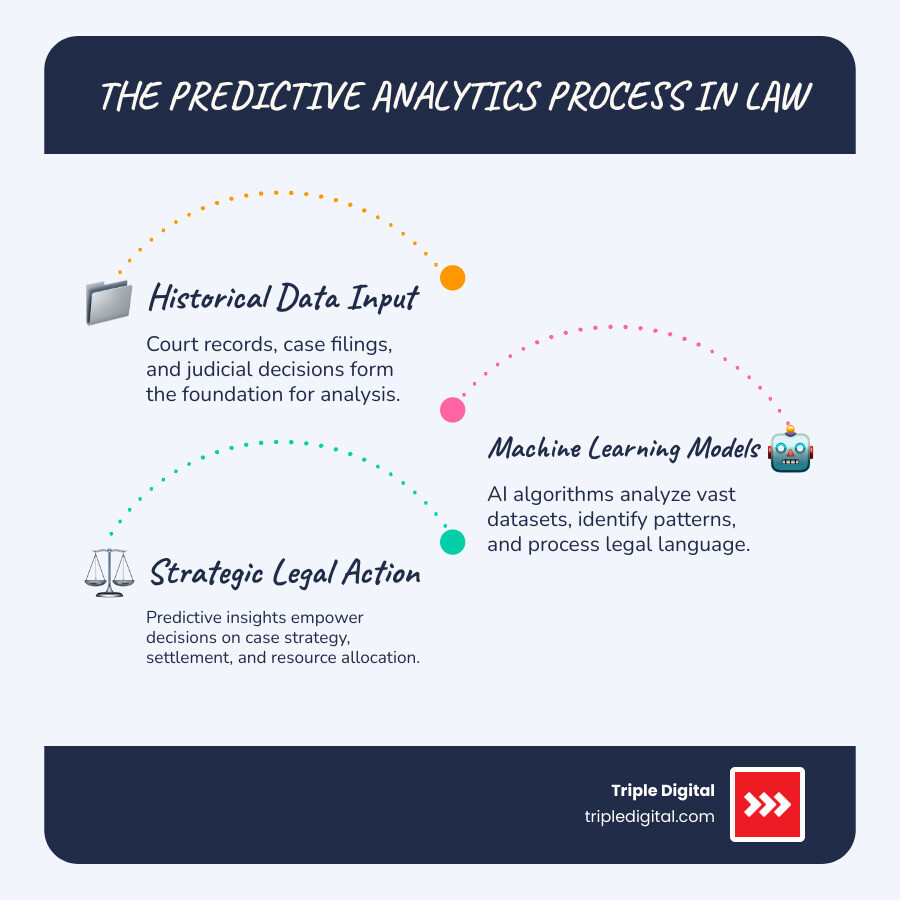
At its core, predictive analytics legal uses data, statistics, and modeling to forecast future outcomes. In law, this means leveraging Artificial Intelligence (AI) and Machine Learning (ML) to analyze historical legal data. Instead of looking backward, these tools discern patterns to predict what might happen next, turning raw information into actionable insights for litigators.
The algorithms are trained on comprehensive datasets, including past case rulings, legal filings, and judicial decisions, to identify subtle patterns and trends. This enables us to forecast probabilities, such as the likelihood of success in a motion, the estimated duration of a trial, or the potential range of damages in a case. While traditionally, legal professionals relied heavily on intuition and experience, predictive analytics provides a systematic, data-backed approach to understanding and anticipating legal outcomes. As highlighted in “Using AI for Predictive Analytics in Litigation,” this technology empowers legal professionals to forecast outcomes and shape strategies with greater precision and confidence.
How Predictive Analytics Legal Models Work
The journey from raw data to predictive insight involves several key steps:
- Data Collection: It all begins with gathering massive amounts of legal data. This includes court records, case filings, judicial opinions, legislative texts, and even communication logs. The more comprehensive and diverse the dataset, the more robust the predictions will be.
- Data Preprocessing and Cleaning: Before analysis, the data must be cleaned, normalized, and transformed. This crucial step ensures the data is consistent and accurate for the algorithms. Best practices in data preprocessing are vital for reliability. You can learn more about these techniques and best practices for data normalization.
- Natural Language Processing (NLP): Much of legal data is unstructured text. Natural Language Processing (NLP) technologies are used to extract relevant information, identify key entities, and understand the context within these documents. This allows algorithms to “read” and interpret complex legal language, turning it into structured data points for analysis.
- Training and Validating Models: Machine learning models are then trained on this processed historical data. During training, the algorithms learn to identify correlations and patterns. Once trained, these models are rigorously validated against new, unseen data to ensure their accuracy and reliability.
- Generating Probability Scores: Finally, the validated models generate probability scores and predictions. These aren’t certainties but rather statistically derived likelihoods that inform our strategic decisions. For example, a model might predict an 80% chance of a favorable ruling in a contract dispute, or estimate a trial could last between six and nine months.
Comparing Traditional Legal Analysis vs. Predictive Analytics
The contrast between traditional legal analysis and predictive analytics legal couldn’t be starker. While both aim for effective legal strategy, their methodologies and capabilities diverge significantly.
| Feature | Traditional Legal Analysis | Predictive Analytics Legal |
|---|---|---|
| Foundation | Intuition, experience, anecdotal evidence, human judgment | Data-driven insights, statistical modeling, AI, Machine Learning algorithms |
| Data Scope | Limited to what a human can manually review and recall | Massive datasets, including court records, filings, judicial opinions, and more |
| Analysis Speed | Time-intensive, manual research | High-speed, automated processing of vast information |
| Pattern Recognition | Relies on human ability to spot trends | Identifies complex, subtle patterns and correlations across data that humans might miss |
| Outcome Prediction | Subjective estimates based on experience | Objective probabilities and forecasts based on historical data |
| Resource Intensity | High manual labor, significant billable hours | Automated tasks, freeing up legal professionals for strategic work |
| Bias Susceptibility | Prone to human biases and emotional states | Can have algorithmic biases if not carefully managed, but offers systematic review |
| Strategic Advantage | Relies on individual lawyer’s prowess | Provides collective intelligence, competitive insights, and improved decision-making |
While traditional legal analysis remains invaluable for its nuance and ethical reasoning, predictive analytics acts as a powerful co-pilot. It processes information at a scale and speed impossible for human attorneys alone, providing a robust foundation for strategic decision-making and enhancing the quality of legal services. This integration of technology with human expertise is revolutionizing legal practice.
The Strategic Advantages: Key Use Cases for Predictive Analytics Legal Strategy
The adoption of predictive analytics legal isn’t just about new technology; it’s about gaining a strategic edge. For law firms in Houston and across the nation, these tools offer tangible benefits: increased efficiency, reduced costs, better decision-making, higher client satisfaction, and a strong competitive advantage. We believe leveraging such technology is paramount for modern legal practice.

By integrating predictive analytics, we optimize our workflows, allowing legal professionals to focus on strategic work rather than time-consuming tasks. This leads to substantial cost savings and a more streamlined operation. Moreover, data-backed insights empower us to make more informed choices, leading to better client outcomes. This directly impacts client satisfaction, as we can provide more accurate expectations regarding costs, timelines, and potential results. In a competitive market, this level of data-driven insight can be a powerful differentiator.
Litigation Strategy and Case Outcome Prediction
One of the most impactful applications of predictive analytics legal is in refining litigation strategy and forecasting case outcomes. Imagine assessing the likelihood of success for a critical motion or predicting probable damages in a personal injury case. Predictive tools make this a reality by analyzing historical data.
- Assessing Motion Success Probability: By analyzing past rulings, judge tendencies, and opposing counsel’s record, we can estimate a motion’s probability of success. This insight helps determine whether to pursue, modify, or drop the motion.
- Judge and Opposing Counsel Analysis: These tools allow us to “know the judge” and “know the opponent” better than ever. We can analyze a judge’s historical rulings, their favorability towards certain motions, or their tendencies in damage awards. Similarly, we can gain competitive insights on opposing counsel, understanding their litigation history and settlement patterns. This is a significant advantage, with 71% of lawyers finding litigation analytics useful for gaining competitive insights on opposing counsel, parties, and judges, according to a 2024 survey by legal analytics provider Lex Machina.
- Settlement vs. Trial Analysis: Predictive analytics simulates legal scenarios, estimating costs, damages, and success rates for settlement versus trial. For instance, analytics might show a 60% chance of winning $100k-$300k at trial versus a 70% chance of settling for $80k-$150k. This data empowers clients to make informed decisions based on a clear understanding of risks and rewards.
- Estimating Damages: By analyzing jury-delivered damage awards in similar cases across jurisdictions, we can provide more accurate estimates of potential awards or liabilities. This is particularly valuable for corporate clients with significant legal exposure.
Risk Management and Compliance
Beyond litigation, predictive analytics legal offers robust capabilities in risk management and compliance, helping legal teams proactively identify and mitigate potential issues.
- Identifying Regulatory Risks: Predictive models can analyze regulatory texts, news, and enforcement actions to identify emerging risks specific to an industry, allowing us to advise clients on proactive compliance.
- Proactive Compliance Monitoring: These tools can monitor internal data—such as communications and contract drafts—to detect patterns that might indicate non-compliance. For example, AI can flag unusual communication patterns that suggest conflicts of interest, acting as an early warning system. We can learn more about this through predictive risk modeling.
- Contract Analysis for Risk: AI-powered analytics can quickly review large volumes of contracts to identify potential risks, non-compliance, or unfavorable clauses, reducing the time and cost of manual review.
- Internal Investigations: When issues arise, predictive analytics can accelerate internal investigations by sifting through digital communications to pinpoint relevant information and identify key players more efficiently.
Improving Law Firm Operations
The benefits of predictive analytics legal extend to law firm operations, driving efficiency and enhancing business development.
- Optimizing Resource Allocation: By forecasting case workloads and durations, we can better allocate legal talent and resources, ensuring the right attorneys are on the right cases.
- Matter Budgeting and Cost Forecasting: Predictive analytics can analyze historical data from comparable proceedings to provide precise budgets for current and future matters. This transparency helps manage client expectations.
- Enhancing Client Pitches: Data-driven insights are incredibly persuasive when pitching to potential clients. We can use analytics to demonstrate expertise, provide data-backed success rates, and offer realistic cost estimates. In fact, 67% of survey respondents said that legal analytics tools are useful for pitching and demonstrating expertise to potential clients.
- Managing Client Expectations: By providing clients with data-backed predictions on case outcomes, costs, and timelines, we foster greater transparency and trust, leading to higher client satisfaction and retention. For more insights on optimizing law firm operations, consider our expertise in law firm consulting.
Navigating the Problems: Data, Bias, and Ethical Considerations
While predictive analytics legal offers immense promise, its implementation has challenges. We must steer issues of data quality, bias, and ethics to ensure responsible use. The complexity of legal data makes ensuring completeness and consistency difficult. Furthermore, the “black box” problem—where AI reasoning is opaque—creates accountability issues, especially when these tools influence critical legal decisions.
The Role of Data and Data Privacy
Data is the fuel that powers predictive analytics legal. The effectiveness of any predictive model hinges on the quality, quantity, and relevance of the data it’s trained on, which we source from public court records, legal documents, and proprietary databases.
However, collecting and using such vast information raises critical concerns about data privacy and confidentiality. Protecting sensitive client information and complying with data protection regulations is a continuous effort. In the US, this involves adhering to federal and state privacy laws, such as HIPAA for health information. Techniques like anonymization are crucial for stripping identifying details from data, allowing for analysis without compromising privacy. The “Age of Predictive Analytics: From Patterns to Predictions” report highlights how analytics can be “creepy” if it reveals private information, underscoring the need for careful handling and transparency. We must ensure our use of data aligns with the highest standards of privacy and ethics.
Algorithmic Bias and Fairness
One of the most significant ethical challenges in predictive analytics legal is the potential for algorithmic bias. AI models learn from historical data; if that data reflects societal biases, the algorithm can perpetuate or even amplify them.
For example, if past judicial decisions contain historical biases against certain demographics, a model trained on this data might produce discriminatory outcomes. This not only damages a firm’s reputation but can also undermine the principles of due process and fairness. The “black box” nature of some algorithms exacerbates this, making it hard to identify why a prediction was made. To combat this, we must implement rigorous “fairness audits” and strive for “interpretable machine learning.” This means continuously testing algorithms to ensure they are not discriminating and developing methods to explain their decisions. As explored in “The Legal And Ethical Concerns That Arise From Using Complex Predictive Analytics In Health Care,” the need for transparency and mitigating bias is critical.
Professional Responsibility and Accountability
The integration of predictive analytics legal tools demands a renewed focus on professional responsibility. These tools are meant to support, not replace, the nuanced judgment and ethical reasoning of legal professionals.
We have an obligation to ensure the accuracy of any AI-generated outputs. This means implementing “human-in-the-loop protocols,” where attorneys review and validate all insights. The consequences of over-reliance on technology can be severe. There have been instances of lawyers getting in trouble for citing cases that AI programs fabricated, underscoring the critical need for human verification. Our professional guidelines emphasize that predictive insights should support, not replace, lawyer judgment.
Law firms must establish clear governance frameworks addressing data protection, confidentiality, and the ethical use of AI. This includes being transparent with clients about how these technologies are used and ensuring that client trust is maintained. While AI can assist in predicting outcomes, the final strategic decisions and accountability for legal advice rest with the legal professional.
Implementation and the Future of Legal Analytics
Integrating predictive analytics legal into a law firm’s workflow is a strategic journey requiring careful planning and adaptation. For Houston-based firms, a structured approach is key. This begins with defining problems and goals, then selecting the right tools, starting with pilot projects, and training your team.
How to Integrate Predictive Analytics into Your Firm
Successfully integrating predictive analytics requires a thoughtful, step-by-step approach:
- Define Objectives: Begin by identifying specific pain points or strategic goals. Are you aiming to improve litigation success rates, streamline document review, or improve client intake? Clear objectives will guide tool selection.
- Evaluate Tool Types: Research and evaluate the various types of predictive analytics tools available, from litigation analytics platforms to risk management solutions. Focus on tools that align with your objectives and integrate with existing tech.
- Start with Pilot Projects: Don’t implement everything at once. Begin with small, manageable pilot projects to test the technology, understand its nuances, and gather feedback before scaling up.
- Train Your Staff: Technology is only as good as the people using it. Provide thorough and ongoing training for all staff who will interact with the predictive analytics tools to ensure adoption and maximize utility.
- Establish Governance Frameworks: Develop clear policies for the ethical and responsible use of predictive analytics. These should address data privacy, bias mitigation, confidentiality, and accountability.
- Measure Impact with KPIs: Continuously monitor the impact of your initiatives using key performance indicators (KPIs). Track metrics like cost savings, efficiency gains, improved case outcomes, and client satisfaction to demonstrate ROI.
By following these steps, law firms can effectively integrate predictive analytics into their workflows, leading to improved client satisfaction and profitability.
The Future of Predictive Analytics Legal Technology
The predictive analytics legal landscape is evolving rapidly, promising more sophisticated solutions for law firms in Houston and beyond. We anticipate several key trends shaping its future:
- Increased Integration with Other LegalTech: Predictive analytics tools will become seamlessly integrated with other legal technologies like case management systems and e-findy platforms, creating a unified ecosystem and enhancing workflow efficiency.
- Advancements in AI and NLP: Continuous breakthroughs in AI and Natural Language Processing will lead to greater accuracy and versatility of predictive models. These advancements will enable more nuanced analysis of unstructured legal data and deeper insights.
- Greater Accuracy and Interpretability: As models become more sophisticated, prediction accuracy will improve. Simultaneously, there will be a stronger focus on making “black box” algorithms more transparent, allowing lawyers to understand the reasoning behind a prediction.
- Growing Adoption in Small and Mid-Sized Firms: While initially adopted by larger firms, cloud-based solutions and accessible pricing are making predictive analytics increasingly viable for small and mid-sized law firms. This democratization of technology will level the playing field, allowing more firms to leverage data-driven insights. The legal tech industry is experiencing significant innovation, and we expect this trend to continue, impacting how firms get more cases in the years to come.
The future of legal practice is undeniably data-driven. As these technologies mature, predictive analytics legal will become an indispensable component of strategic decision-making, enabling law firms to deliver superior legal services with unprecedented efficiency and insight.
Frequently Asked Questions about Predictive Analytics in Law
We often hear common questions from legal professionals curious about predictive analytics legal. Here are some of the most frequent ones we encounter:
Can predictive analytics replace a lawyer’s judgment?
No, absolutely not. Predictive analytics legal is a powerful tool designed to augment, not replace, a lawyer’s judgment and expertise. It provides data-driven insights and probabilities, offering a robust foundation for strategic decisions. However, the nuanced understanding of human factors, ethical considerations, client relationships, and the art of advocacy remain firmly in the hands of the legal professional. AI can tell us the likelihood of a certain outcome, but it’s the lawyer who decides how to use that information to craft a compelling argument or negotiate a favorable settlement.
Is predictive analytics only for large law firms?
While initially adopted by large law firms due to the significant investment required, predictive analytics legal is becoming increasingly accessible to firms of all sizes. The rise of cloud-based solutions, subscription models, and more user-friendly platforms has democratized this technology. Small and mid-sized firms can now leverage powerful analytical tools without the need for extensive in-house IT infrastructure. This means that even a solo practitioner in Houston can gain a competitive edge by incorporating predictive insights into their practice.
How accurate are the predictions from these tools?
The accuracy of predictions from predictive analytics legal tools can vary significantly depending on several factors, including the quality and comprehensiveness of the underlying data, the sophistication of the machine learning models used, and the specific legal question being addressed. Reputable tools are transparent about their data sources, methodologies, and stated accuracy rates, often providing confidence intervals rather than absolute certainties. It’s crucial to remember that these tools provide probabilities and insights into likelihoods, not guarantees. A prediction of an 80% chance of success is highly valuable but doesn’t eliminate the remaining 20% risk. Human oversight and critical evaluation of these outputs are always necessary to ensure reliability.
Conclusion: The Data-Driven Future of Law
Predictive analytics legal is not merely a technological trend; it’s a transformative force reshaping the very foundation of legal practice. It empowers lawyers to move beyond intuition, making smarter, faster, and more strategic decisions grounded in vast datasets and advanced algorithms. For any modern law firm, embracing this technology is no longer optional—it’s a market-driven imperative for staying competitive and delivering exceptional client value.
From forecasting litigation outcomes and optimizing operational efficiency to proactively managing risk and enhancing client communications, the benefits are clear. As the legal landscape continues to evolve, the ability to harness data for strategic advantage will define success.
To truly harness the power of AI and data-driven strategies for case acquisition and growth, firms need an expert partner. At Triple Digital, we leverage cutting-edge technology and data mining techniques for precise client targeting, delivering more cases, not just more clicks. We understand the unique challenges and opportunities facing law firms in Houston and are dedicated to providing results-driven digital marketing solutions. Learn more about our Digital Marketing Strategies for Law Firms and how we can help you thrive in this data-driven era.