
Why Legal Social Media Matters for Client Acquisition
Legal social media is the strategic use of social platforms by law firms to connect with potential clients, build credibility, and grow their practice while upholding ethical standards. Here’s what you need to know:
Key Benefits:
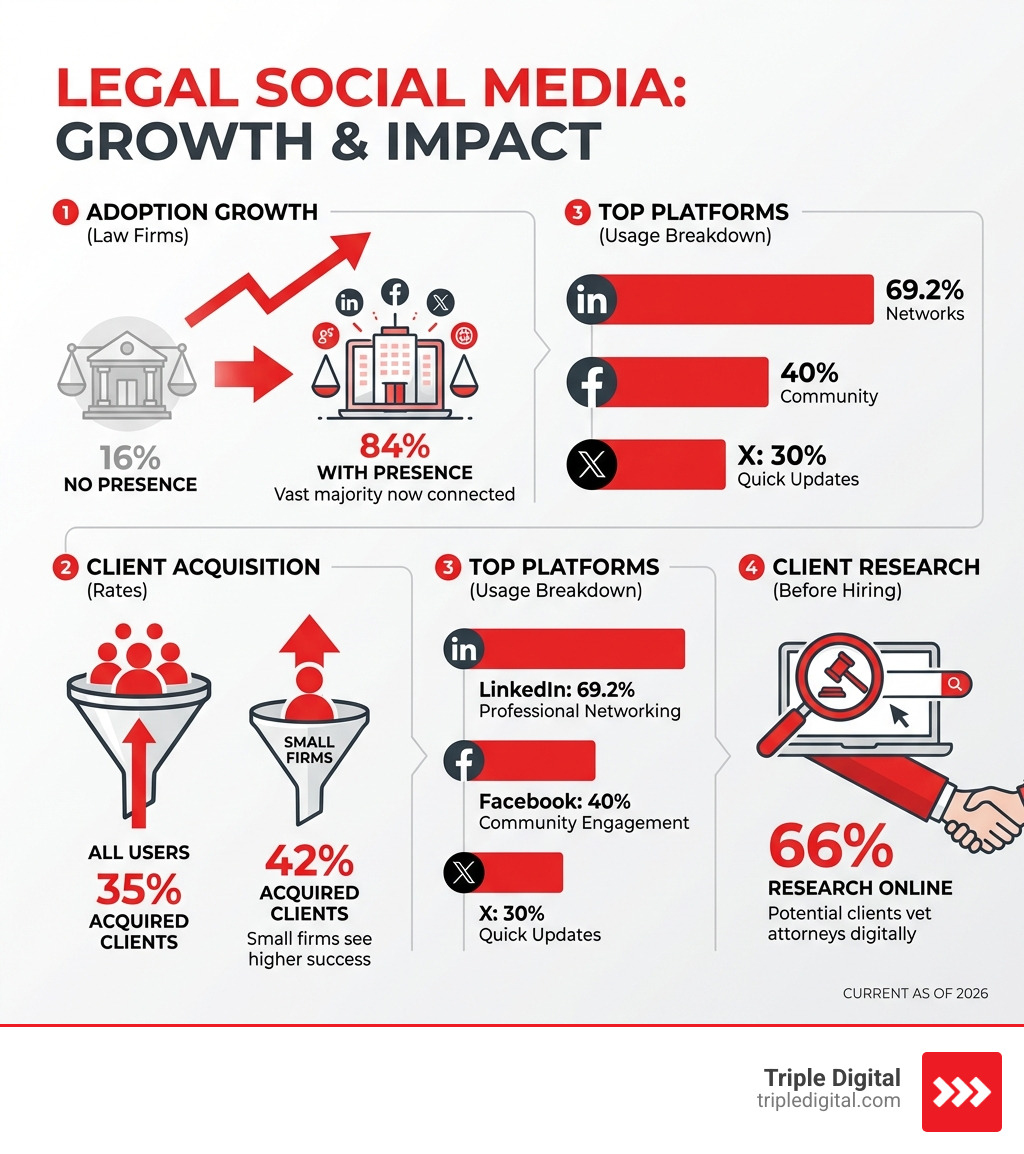
- 35% of attorneys using social media for professional purposes have gained clients
- 42% of small firms acquired new clients through social media marketing
- 84% of law firms now maintain a social media presence
- 66% of legal clients research online before hiring a lawyer
Top Platforms for Law Firms:
- LinkedIn – 69.2% of firms (professional networking)
- Facebook – 40% of firms (community engagement)
- YouTube – Nearly 3 billion users (educational content)
- X/Twitter – 30% of firms (quick updates)
Your clients are on social media. The question isn’t if your firm should be there, but how to do it effectively. When people face a legal issue, they no longer use the phone book; they search online, read reviews, and check social profiles. Ignoring this shift makes your firm invisible.
The challenge for attorneys is unique: you must balance marketing goals with strict professional conduct rules. Every post carries ethical weight, from potential confidentiality breaches to advertising violations. A casual remark or an exaggerated claim can have serious consequences.
However, when done right, social media is a powerful engine for client acquisition. It allows you to demonstrate expertise, build trust, and stay top-of-mind. The firms succeeding on social media follow strategic, ethical approaches—they don’t just post randomly.
The Verdict: Why Your Firm Needs a Social Media Presence
In today’s digital-first world, an online presence is as critical as a physical office. Embracing legal social media isn’t optional—it’s essential for growth. With 84% of law firms on social networks, the platform offers unprecedented exposure. The ABA’s 2018 Survey found that 35% of legal professionals who use social media have gained clients, a figure that rises to 42% for small firms.
Beyond client acquisition, social media is a powerful tool for brand building, establishing thought leadership, and community engagement. You can shape your firm’s public perception and connect with local communities. For more on these benefits, see How can social media help your business?. However, this opportunity comes with responsibility. Ethical compliance is paramount, as breaches of confidentiality or misleading advertising carry severe repercussions.
How Social Media Improves SEO and Builds Credibility

A strong legal social media presence indirectly boosts your firm’s search engine optimization (SEO) and credibility. Sharing valuable content drives traffic to your website, signaling to search engines that your site is a relevant resource. This can improve key SEO metrics like time-on-page. For more, see How can social media drive traffic to law firm websites?.
Popular content also increases the chance of earning high-quality backlinks from other sites, a cornerstone of effective SEO. Furthermore, consistently sharing insightful content establishes your attorneys as experts, building a reservoir of trust that makes prospective clients more likely to choose your firm. Authenticity on social media humanizes your practice and fosters a crucial sense of connection.
Gaining New Clients Through Social Media
With 66% of legal clients researching online before hiring, a strategic legal social media presence is a necessity. Social media acts as a vital entry point to your lead generation funnel. By sharing educational content, you can guide potential clients from a social media post to your website’s intake form, turning an interaction into a qualified lead.
The 2023 ABA TechReport confirms this, stating that 31% of lawyers acquire clients through social media. Success stems from:
- Visibility: Being where your target audience is.
- Education: Providing valuable legal information.
- Engagement: Interacting with your audience to build rapport.
- Trust-building: Highlighting your firm’s expertise and success.
By leveraging social media, you can create a consistent flow of potential clients who are already familiar with your firm’s value.
Building Your Case: A 7-Step Social Media Strategy

A successful legal social media strategy requires a methodical, ethical, and results-driven approach. We’ve distilled it into seven essential steps. For more on effective strategies, explore our resources on Social Media.
Developing Your Legal Social Media Strategy
A well-defined strategy is the foundation of an effective social media presence. Without a roadmap, your efforts will be scattered.
- Know the Rules: First and foremost, understand the ethical obligations for lawyers on social media in your jurisdiction.
- Identify Your Goals: Set SMART (Specific, Measurable, Achievable, Relevant, Time-bound) goals, such as increasing client intake or website traffic.
- Do Your Research: Analyze competitors to see what works and identify your ideal client’s online behavior and legal pain points.
- Start Small: Choose one or two platforms that align with your goals and master them before expanding.
- Plan Your Content: Decide on a mix of educational articles, Q&As, firm news, and other content types.
- Set a Schedule: Use a content calendar to maintain consistency and allow time for ethical review before posting.
- Measure Your Results: Track performance against your goals to refine your strategy over time.
Stay updated on the digital landscape by refreshing yourself on what’s new to keep your strategies effective.
The Role of AI in Law Firm Social Media
Artificial intelligence (AI) is changing legal social media by improving efficiency in content creation and targeting.
AI can assist with:
- Content Generation: Brainstorming ideas and drafting initial posts.
- Caption Writing: Optimizing captions for engagement and tone.
- Post Scheduling: Recommending optimal posting times.
- Data Mining for Targeting: At Triple Digital, we leverage AI for precise client targeting, embodying our “less fluff, more cases” approach.
However, AI in legal marketing requires strict oversight. While AI can draft content, it cannot ensure legal accuracy or ethical compliance. Every AI-generated piece must be reviewed by a legal professional for accuracy, compliance with advertising rules, and ethical alignment. AI is a powerful assistant, but human judgment remains irreplaceable.
Measuring Success and ROI
Understanding your return on investment (ROI) is crucial. For legal social media, focus on metrics that drive growth, not just vanity numbers.
Key Performance Indicators (KPIs) to track include:
- Reach: How many unique users saw your content.
- Engagement Rate: How actively your audience interacts (likes, comments, shares).
- Click-Through Rate (CTR): The percentage of users who clicked a link.
- Lead Tracking: The most critical KPI—how many inquiries or signed cases originated from social media.
Tracking these metrics allows for data-driven optimization to ensure your social media efforts contribute directly to lead generation.
Common Mistakes in Legal Social Media and How to Avoid Them
Avoiding common pitfalls is as important as implementing best practices for a successful legal social media presence.
- Ignoring the Audience: Don’t just broadcast; engage with comments and messages promptly.
- Excessive Sales Pitches: Follow the 80/20 rule: 80% of content should be valuable and educational, with only 20% being promotional.
- Inauthentic Content: Avoid generic posts. Let your firm’s unique voice shine through to build a genuine connection.
- Inconsistent Posting: Use a content calendar and scheduling tools to maintain a regular presence.
- Violating Ethical Rules: This is the most critical mistake. Implement a social media policy and ensure all content is reviewed by a legal professional before publication.
Navigating the Ethical Minefield of Legal Social Media
The ethical landscape of legal social media is complex. Attorneys are held to high standards of professional conduct that extend to all online activities. The American Bar Association (ABA) Model Rules and state bar ethics opinions provide the framework, but navigating the tension between digital engagement and ethical duties is challenging. For more on this, see insights from the ABA here. While rules like the UK’s SRA Standards and Regulations are jurisdiction-specific, their core principles of integrity and client protection are universal. The key takeaway: existing ethical duties apply with full force online.
Attorney-Client Confidentiality and Social Media
Protecting confidentiality (ABA Model Rule 1.6) is paramount on social media. Even vague case descriptions can inadvertently reveal client information. A celebratory post about a “big win” could lead to client identification. As the D.C. Bar’s Ethics Opinion 370 advises, always obtain informed client consent before posting about a case. Furthermore, social media messaging is not secure for confidential communication; guide clients to safer channels.
To safeguard confidentiality:
- Obtain explicit, written client consent before posting anything related to their case.
- When in doubt, do not post.
- Train all firm employees on digital confidentiality standards.
Advertising, Solicitation, and Jurisdictional Rules
The rules on advertising and solicitation (ABA Model Rules 7.1, 7.2, and 7.3) apply directly to legal social media activities.
- False or Misleading Statements: Rule 7.1 prohibits exaggerated claims. Avoid superlatives like “best”; use verifiable terms like “award-winning.”
- Impermissible Solicitation: Rule 7.3 governs direct contact. Unsolicited messages to potential clients can be viewed as improper solicitation.
- Jurisdictional Issues: Publicly posting legal advice can create issues with practicing in jurisdictions where you are not licensed (Rule 5.5).
- Disclaimers: Include disclaimers stating your content is informational and does not create an attorney-client relationship, as noted in Ethics Opinion 371.
- Communication with Represented Parties: Rule 4.2 prohibits contacting a represented person about their case without their counsel’s consent. Viewing public profiles is generally fine, but sending a friend request to gain access is not.
Creating a Law Firm Social Media Policy
A comprehensive social media policy is a necessity for any firm. It provides clear guidelines to protect the firm and ensure ethical compliance. The New York State Bar Association offers a model for such guidelines, which can be found in resources like its Social Media Guidelines.
Key components of a policy should include:
- Professionalism: Mandate respectful and courteous online conduct.
- Accuracy: Require fact-checking and truthfulness in all posts.
- Transparency: Disclose your professional identity and affiliation.
- Confidentiality: Strictly forbid disclosing client information without written consent.
- Avoiding Legal Advice: Prohibit offering specific legal advice online and clarify that interactions do not create an attorney-client relationship.
- Advertising Compliance: Ensure adherence to all rules on advertising and solicitation.
- Employee Guidelines: Outline responsibilities for all staff, including a review process for content.
- Supervision and Monitoring: Define supervisory duties and protocols for responding to comments.
Establishing and reviewing this policy allows your firm to steer legal social media confidently, mitigating risks while maximizing potential.
Choosing Your Platform: Where to Engage and What to Post
Choosing the right platforms is crucial for an effective legal social media strategy. Be strategic about where your target audience is most active. Each platform has unique strengths.
Here’s a comparison of key platforms for law firms:
| Platform | Best For | Content Type | Key Statistic |
|---|---|---|---|
| Professional networking, B2B, thought leadership | In-depth articles, professional insights, firm news, career opportunities | 69.2% of law firms maintain a presence | |
| Community engagement, broad audience reach, local marketing | Blog posts, educational videos, firm updates, local news, client stories | 2.96 billion monthly active users; 40% of law firms present | |
| X (Twitter) | Real-time updates, news commentary, quick insights, legal discussions | Short text posts (280 chars), links to articles, trending legal topics | 30% of law firms maintain a presence |
| YouTube | Educational content, showcasing personality, complex explanations | Long-form videos, Q&A sessions, webinars, client testimonials, “day in the life” | Nearly 3 billion users; 85% of American adults use YouTube |
Consider your firm’s practice areas and ideal client. A personal injury firm might use Facebook, while a corporate law firm will find more value on LinkedIn. We help clients tailor content to each network for maximum engagement.
LinkedIn: The Professional’s Network
For legal professionals, LinkedIn is the top platform for legal social media. The ABA’s 2023 TechReport shows 69.2% of firms use it. It’s designed for professional networking, making it ideal for building a professional persona, connecting with peers, establishing thought leadership, and B2B marketing. Focus on sharing in-depth articles, legal analyses, and firm news.
Facebook: Connecting with Your Community
With 2.96-billion users, Facebook offers massive reach. The 2023 ABA TechReport notes 40% of firms are present on the platform. It’s best for broad audience engagement, building local trust, and targeted local marketing. Share blog posts, educational videos, and community updates to humanize your practice. For more, see The Verdict Is In: Are Facebook Ads a Win for Your Law Firm?.
X, Instagram, and TikTok: The Power of Short-Form Content
Platforms like X (formerly Twitter), Instagram, and TikTok excel at concise, visual, and short-form content.
- X (formerly Twitter): Used by 30% of firms, X is ideal for quick updates and real-time commentary on legal news.
- Instagram: A powerful visual platform for showcasing firm culture, sharing professional photos, and creating legal infographics to humanize your brand.
- TikTok: With 1 billion monthly active users, this platform is key for reaching younger demographics with short, engaging videos that explain legal concepts. Authenticity and relevant hashtags like #LawTok are crucial.
These platforms help diversify your content strategy and adapt to the growing demand for short-form video.
Frequently Asked Questions about Social Media for Lawyers
Can a lawyer’s casual comment be misconstrued as legal advice?
Yes. A casual comment on social media can easily be misconstrued as legal advice, creating significant risks like inadvertently forming an attorney-client relationship or implying you can practice in any jurisdiction. Lawyers must exercise extreme caution, use disclaimers, and keep online interactions educational, not advisory.
What are the rules for a lawyer being “friends” with a judge on social media?
Rules vary by jurisdiction, but this practice raises concerns about judicial impartiality and the appearance of impropriety. The key factor is whether the connection could suggest bias. If a connection is a “close social relationship,” disclosure to opposing counsel or judicial recusal may be necessary. It is best to avoid any action that creates even the appearance of impropriety.
How much of my content should be promotional?
We recommend the 80/20 rule for your legal social media content. 80% of your content should provide value through education, information, or entertainment (e.g., legal tips, industry news, firm culture). Only 20% should be directly promotional with calls to action. Focusing on value builds trust and relationships, which in turn generates leads. A feed full of sales pitches will alienate your audience.
Conclusion
Mastering legal social media is no longer a luxury; it’s a strategic imperative for law firms seeking to thrive in the modern legal landscape. We’ve explored the profound benefits—from client acquisition and improved SEO to brand building and community engagement—and steerd the crucial ethical considerations that underpin every online interaction. From protecting client confidentiality to adhering to strict advertising and solicitation rules, diligence is paramount.
By developing a robust social media strategy, embracing the judicious use of AI, tailoring content to the right platforms, and carefully measuring your results, your firm can transform “likes” into legitimate leads and lasting client relationships. The future of legal marketing is dynamic, and continuous adaptation, coupled with unwavering ethical conduct, is the key to success.
At Triple Digital, we understand the unique challenges and immense opportunities that legal social media presents for law firms. Our results-driven, “less fluff, more cases” approach leverages AI and data mining for precise client targeting, ensuring your marketing efforts are not just visible, but effective.
Ready to lift your firm’s online presence and turn social media into a powerful engine for growth? Develop your law firm’s digital marketing strategy with us.