
Why Local SEO for Lawyers Is the Most Important Marketing Decision Your Firm Can Make
Local SEO for lawyers is the practice of optimizing your law firm’s online presence so it appears prominently when nearby clients search for legal help on Google.
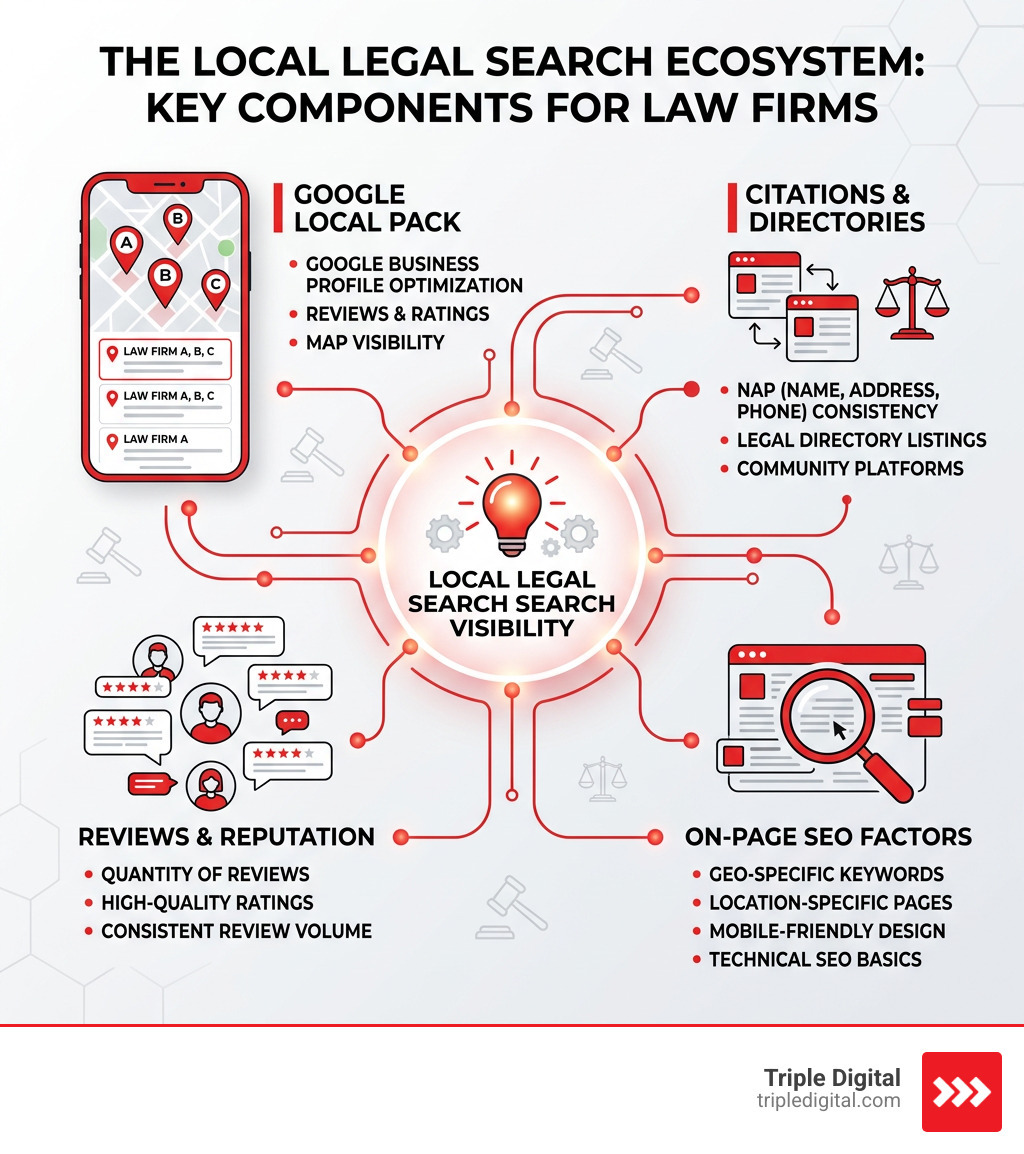
Here’s a quick breakdown of how to do it:
- Claim and optimize your Google Business Profile – complete every field, add photos, and collect reviews
- Build consistent citations – list your firm’s name, address, and phone number accurately across legal directories like Avvo, Justia, and FindLaw
- Create location-specific pages – build dedicated pages targeting your city and practice areas
- Do geo-specific keyword research – target phrases like “divorce attorney in [city]” rather than broad terms
- Implement technical SEO basics – fast load times, mobile-friendly design, and schema markup
- Earn local backlinks – from community events, legal associations, and local press
Think about how your next client will find you.
They’re not asking a friend first. They’re opening Google and typing “personal injury lawyer near me” or “divorce attorney in [city].” If your firm doesn’t show up in those results, you’re invisible to them — no matter how good you are in the courtroom.
The numbers back this up. 97% of consumers search online for local legal services, and 46% of all Google searches have local intent. That means nearly half of the people searching on Google right now are looking for something nearby — and legal help is one of the most common things they need urgently.
What makes local SEO different from general SEO is where your firm shows up. The goal is the Google Local Pack — the map-based block of three law firm listings that appears at the top of search results. Businesses in this pack see dramatically more visibility than those buried in organic results below.
The firms winning there aren’t necessarily the biggest or the most experienced. They’re the ones who’ve done the work to optimize their local presence.
This guide walks you through every step of that process.
Related content about local seo lawyers:
- search engine optimization for family law attorneys
- search engine optimization for patent law firms
- seo services for law firms
The Fundamentals of Local SEO for Lawyers
To dominate your local market, we first need to understand the playing field. When a potential client in Houston searches for legal help, Google doesn’t just look for the “best” lawyer in the country; it looks for the most relevant firm nearby. This is where local seo lawyers strategies come into play.
There is a distinct difference between the “Local Pack” and traditional organic search results. The Local Pack (or Map Pack) appears at the very top of the page in 93% of searches with local intent. It displays three firms, their ratings, contact info, and a map. Organic results are the standard blue links that appear below the map.
| Feature | Local Pack (Map Pack) | Organic SEO Results |
|---|---|---|
| Primary Goal | Rank in the top 3 map listings | Rank in the top 10 blue links |
| Main Factor | Proximity, Relevance, Prominence | Backlinks, Content, Technical SEO |
| Click Share | Approx. 44% of clicks | Approx. 29% of clicks |
| Key Asset | Google Business Profile (GBP) | Website Landing Pages |
Understanding why SEO is important for attorneys starts with recognizing transactional intent. People searching for a “DUI lawyer near me” usually need help right now. They aren’t browsing; they are buying. By securing a spot in the Local Pack, you are positioning your firm at the exact moment a decision is being made.
Core Ranking Signals for Legal Services
Google’s local algorithm is a bit of a “black box,” but we know it relies on three primary pillars:
- Relevance: How well does your firm match what the user is searching for? If they search for “probate,” but your profile only mentions “personal injury,” you won’t show up.
- Distance (Proximity): How far is your office from the searcher? This is a massive factor. If a searcher is in Downtown Houston, Google is less likely to show them a firm in Katy, even if that firm has better reviews.
- Prominence: This is your firm’s reputation. Google looks at your review count, your presence in legal directories, and your overall law firm ranking factors like backlinks to determine if you are a “big deal” in your community.
There are many reasons to use law firm SEO, but the most compelling is that it levels the playing field. A solo practitioner with a perfectly optimized local presence can outrank a massive “billboard” firm that has ignored its digital footprint.
Practice Area Differences in Local Search
Local SEO isn’t “one size fits all.” Different practice areas require different approaches. For example, personal injury law is hyper-competitive. To rank there, you need a mountain of high-quality reviews and aggressive link-building.
Conversely, family law often requires a softer, more content-focused approach. Clients looking for divorce or custody help often do more research before calling. We recommend tailored SEO for family law that focuses on answering common questions through blog posts and local guides.
For niche practices, such as SEO for patent attorneys, the geographic area might be broader because the services are more specialized. However, the core principles of relevance and prominence remain the same.
Optimizing Your Google Business Profile for Maximum Visibility
Your Google Business Profile (GBP) is the single most important piece of digital real estate your firm owns. It’s free, it’s hosted by Google, and it’s the gateway to the Local Pack.
The first step is verification. Google usually sends a postcard to your physical office to ensure you actually exist at that location. Once verified, you need to fill out every single section. Don’t leave anything blank!
- Primary Category: Choose the most specific category possible (e.g., “Criminal Justice Attorney” rather than just “Lawyer”).
- Secondary Categories: Add other relevant areas like “Personal Injury Attorney” or “Trial Attorney.”
- Business Description: You have 750 characters. Use them to explain what makes your firm unique, but keep it client-focused. Instead of “We have 30 years of experience,” try “We help Houston families navigate complex divorce cases with compassion.”
To really stand out, we suggest using GMB hacks for lead generation, such as using the “Services” section to list every specific sub-practice area you handle. Be careful, though—there are common GMB mistakes to avoid, like keyword stuffing your business name. If your firm is “Smith & Associates,” don’t change it to “Smith & Associates Best Houston Personal Injury Lawyers” unless you’ve legally changed your name (DBA). Google will suspend you for that.
Managing Reviews and Engagement
Reviews are the “social proof” of the legal world. 82% of potential clients check online reviews before choosing a lawyer. But it’s not just about the star rating; Google looks at:
- Review Quantity: Firms with 50+ reviews see a 71% increase in clicks.
- Review Velocity: How often are you getting new reviews? A steady stream is better than a burst of 20 and then silence for a year.
- Review Diversity: Google likes to see keywords in reviews. When a client mentions “best car accident lawyer in Houston,” it boosts your relevance for that specific term.
Always respond to reviews—both good and bad. It shows Google (and prospective clients) that you are engaged. Beyond reviews, use Google Posts to share firm updates, blog links, or community news. Profiles with active photos and posts get 42% more engagement than those that remain static.
Maintaining NAP Consistency and Citations
NAP stands for Name, Address, and Phone Number. For local seo lawyers, consistency is king. If your address is “123 Main St, Suite 200” on your website but “123 Main Street #200” on a directory, Google might get confused. This confusion leads to lower trust and lower rankings.
Citations are mentions of your firm on other websites. While general directories like Yelp matter, legal-specific directories are much more powerful.
Top Legal Directories for Citations:
- Avvo: Essential for attorney ratings and Q&A.
- Justia: High authority and great for backlinks.
- FindLaw: One of the oldest and most trusted legal directories.
- Martindale-Hubbell: Critical for professional standing.
Consistent citations across 60+ sources can increase your local rankings by 35%. If you feel like you’re spinning your wheels, it might be time to stop wasting money on bad local SEO and perform a citation audit to clean up old, incorrect data.
Content and On-Page Strategies for Local SEO Lawyers
Your website needs to serve as a “local hub” for your practice. This starts with geo-specific keyword research. Instead of just targeting “personal injury lawyer,” we target “Houston personal injury lawyer” or “car accident attorney in Harris County.”
When building your mastering law firm SEO blueprint, focus on long-tail queries. These are longer, more specific phrases like “What to do after a truck accident in Houston?” These keywords have lower search volume but much higher conversion rates because they indicate specific needs.
Creating location-specific landing pages is a game-changer. If you have an office in Houston but serve clients in Sugar Land and The Woodlands, create dedicated pages for those areas. Firms that implement location-specific content often see a 240% increase in local traffic.
On-Page Optimization Best Practices
Every page on your site should be optimized for both Google and the human user. This is part of our top digital SEO strategies:
- Title Tags: Keep these under 60 characters. Example: Top Houston Divorce Lawyer | [Firm Name].
- Meta Descriptions: These are your “ad copy” in search results. Keep them under 160 characters and include a call to action.
- Header Tags (H1, H2, H3): Use these to structure your content. Your H1 should always include your primary local keyword.
- Google Maps Embed: Always embed a Google Map on your “Contact” or “Location” pages. It helps Google verify your physical location.
For more deep dives into these tactics, check out our SEO category insights.
Local Link Building and Authority
Backlinks (links from other websites to yours) are like votes of confidence. For local SEO, you want “local” votes.
How do you get them?
- Sponsorships: Sponsoring a local Little League team or a charity 5k usually gets you a link from their “Sponsors” page.
- Local Events: Host a free legal seminar at a community center and get listed on local event calendars.
- Legal Associations: Ensure you are linked from the State Bar or local trial lawyer associations.
- Guest Posting: Write an article for a local Houston news site or business blog.
When building links, pay attention to anchor text (the clickable text of the link). Using your city name in the anchor text (e.g., “Houston criminal defense firm”) can provide a powerful signal to Google about your geographic relevance.
Technical SEO and Ethical Compliance for Law Firms
Technical SEO is the foundation your content sits on. If your site is slow or broken, no amount of great content will save your rankings.
One of the most critical technical elements for local seo lawyers is Schema Markup. This is a snippet of code that tells Google exactly what your firm is. By using LegalService and LocalBusiness schema, you can tell Google your hours, your price range, and even your specific practice areas in a language it understands perfectly.
Site speed is also non-negotiable. Sites that take more than 3 seconds to load lose a massive chunk of their visitors. Google’s “Core Web Vitals” are now a ranking factor, meaning your site must be fast, stable, and mobile-friendly. Since over 60% of legal searches happen on mobile, if your site doesn’t look great on a smartphone, you are losing cases.
Ethical Pitfalls and ABA Compliance
Lawyers have a higher burden of responsibility when it comes to marketing. The ABA Model Rule 7.2 (and various state rules) governs how you can advertise.
- Avoid Unverifiable Claims: Never call yourself the “best” or “top” lawyer unless you are quoting a specific, verifiable award.
- Jurisdictional Limits: Your website must clearly state where you are licensed to practice.
- Virtual Offices: Be careful with using virtual offices to “game” the proximity factor. If you don’t have a staffed physical office at a location, listing it on Google can lead to a suspension and potential ethical complaints.
- Review Transparency: Never pay for reviews or “incentivize” them in a way that violates your state bar’s rules on testimonials.
Measuring and Tracking Local SEO Success
You can’t manage what you don’t measure. We use a combination of tools to track ROI:
- Google Analytics 4 (GA4): To see where your traffic is coming from and what pages they visit.
- Google Search Console: To see which keywords are actually driving clicks.
- Local Rank Trackers: Tools like Whitespark or BrightLocal to see exactly where you rank in the Map Pack across different parts of the city.
When deciding how much lawyers should pay for SEO, consider the “Cost Per Lead” (CPL). Local SEO leads typically cost 50-75% less than PPC (Pay-Per-Click) leads, making it a much more sustainable long-term investment.
Frequently Asked Questions About Local SEO Lawyers
How long does it take to see results from local SEO?
Local SEO is a marathon, not a sprint. While you might see some small wins in the first 30-60 days, most law firms see significant results (like a 180% increase in inquiries) after six months of consistent effort. Highly competitive markets like personal injury in Houston may take longer than niche practices.
What is the difference between Local SEO and Organic SEO?
Local SEO focuses on “near me” searches and the Google Map Pack. Organic SEO focuses on ranking your website for broader terms in the traditional search results. A good strategy uses both: Local SEO to capture immediate, nearby leads, and Organic SEO to build long-term authority and capture researchers.
How do I handle negative reviews ethically?
First, take a breath. A single negative review won’t ruin you. Respond professionally and calmly. Do not reveal confidential client information. If the review is fake or violates Google’s terms, you can flag it for removal. Often, a professional response to a bad review can actually increase trust with prospective clients because it shows you are reasonable and responsive.
Conclusion
Mastering local seo lawyers strategies is no longer optional—it is the baseline for growth in the modern legal market. By focusing on your Google Business Profile, maintaining NAP consistency, and building high-quality local content, you can ensure that when your next client needs help, your firm is the first one they see.
At Triple Digital, we specialize in this exact process. As a Houston-based digital marketing agency, we don’t believe in “fluff.” We use AI-driven data mining and precise targeting to help law firms acquire more cases and generate high-quality leads. Our approach is results-driven, ensuring your marketing budget is an investment, not an expense.
Ready to dominate the Houston legal market? Let’s build your digital marketing strategy for your law firm today.