





The Definitive Guide to GEO Strategy for Attorneys
AI Is Changing How Clients Find Lawyers — Here’s What to Do About It
A solid GEO strategy for attorneys is now one of the most important investments a law firm can make in 2026. Here’s why — and what it actually involves:
What is a GEO strategy for attorneys?
GEO (Generative Engine Optimization) is the practice of structuring your firm’s online presence so that AI-powered tools like ChatGPT, Google AI Overviews, and Perplexity cite your firm in their generated answers when potential clients search for legal help.
Core elements of an attorney GEO strategy:
- Entity clarity — consistent firm name, address, and credentials across all platforms
- Answer-ready content — pages structured to directly answer client questions
- Schema markup — technical signals that help AI understand your services
- Off-site authority — mentions in legal directories, publications, and review platforms
- Content freshness — regularly updated pages reflecting current laws and cases
- Technical accessibility — ensuring AI bots can actually crawl your site
The way potential clients find lawyers has shifted dramatically. Not long ago, ranking on page one of Google was the goal. Today, a growing number of people skip traditional search results entirely.
77.67% of legal search queries now trigger Google AI Overviews — more than any other industry. ChatGPT has become the second most-used source for researching attorneys, with 28.1% of people turning to it before making a decision. And when an AI Overview is present, click-through rates for the top organic result drop by 58%.
Put simply: if your firm isn’t showing up in AI-generated answers, you’re invisible to a growing share of your market.
This guide covers everything you need to know — from the technical setup to the content structure to how to measure whether it’s actually working.
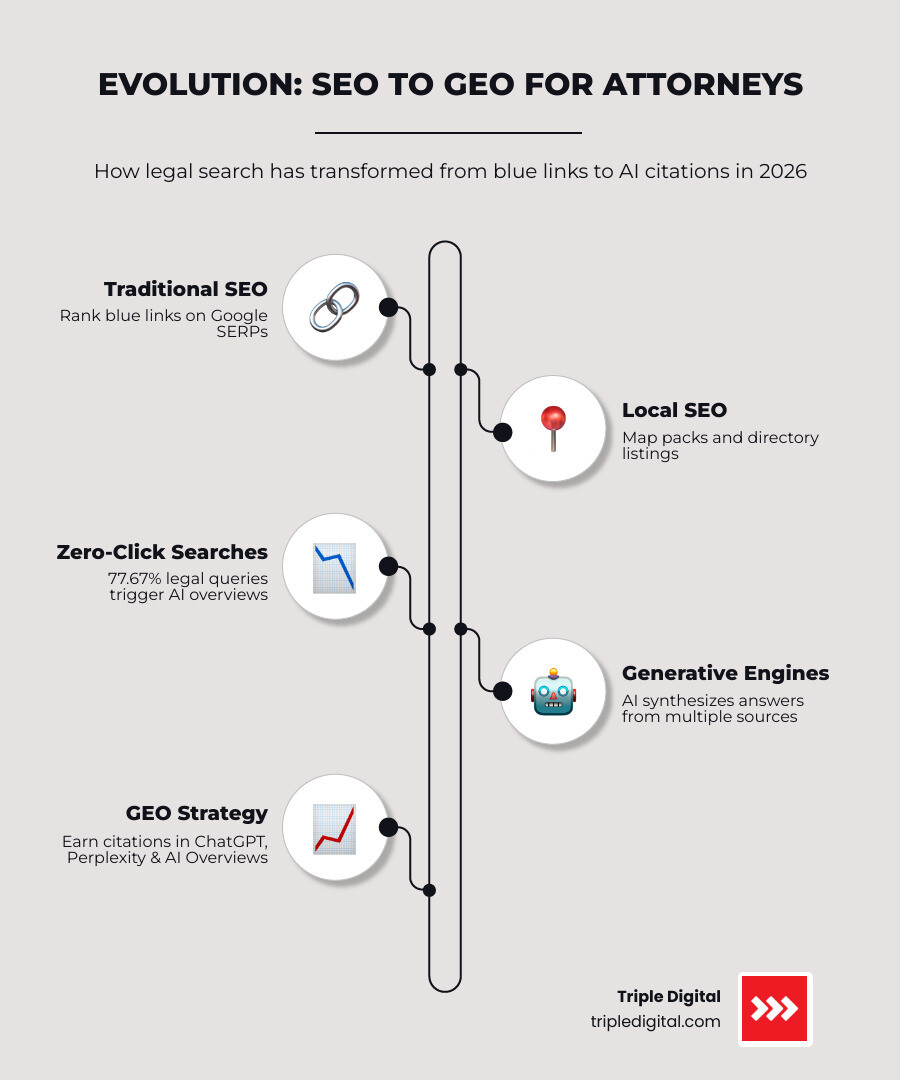
Understanding GEO Strategy for Attorneys in 2026
As we navigate through 2026, the digital landscape for law firms has fundamentally transformed. While traditional SEO was about climbing a list of blue links, a GEO strategy for attorneys focuses on becoming the “source of truth” for artificial intelligence.
Traditional SEO relies on keywords and backlinks to rank a page sequentially. GEO, however, is about synthesis. AI engines like ChatGPT or Google’s AI Overviews don’t just point to a website; they read dozens of sources, summarize the information, and provide a direct answer. If your firm’s insights are part of that summary, you gain a level of authority that a simple #1 ranking can no longer provide.
The rise of “zero-click searches” means more than half of all Google searches now end without a click to any website. Users get their answers directly from the AI. To stay relevant, our goal is no longer just traffic—it’s citation-based visibility.
Comparison: Traditional SEO vs. Local SEO vs. GEO
| Feature | Traditional SEO | Local SEO | GEO (Generative Engine Optimization) |
|---|---|---|---|
| Primary Goal | Rank #1 for keywords | Appear in the “Map Pack” | Be cited/recommended by AI |
| Main Metric | Organic traffic/Clicks | Directions/Calls | Share of Voice/Citations |
| Content Focus | Long-form articles | NAP Consistency/Reviews | Answer-ready “Semantic Triples” |
| Search Intent | Broad Research | Near Me/Transactional | Conversational/Complex Logic |
The Rise of Generative Search in Legal Research
The way clients “shop” for lawyers has become more conversational. Instead of typing “Houston personal injury lawyer,” they ask ChatGPT, “I was hit by a truck in Houston, what are my first legal steps?”
AI tools are uniquely suited for legal research because they can digest complex statutes and case law. Perplexity and Gemini are now major players in this space, often providing citations that users click to verify findings. In fact, 94% of people who use ChatGPT to research attorneys also use Google to verify what the AI told them. This makes a multi-layered approach essential.
Core Components of a Successful GEO Strategy
A successful GEO strategy for attorneys isn’t built on a single trick; it’s an ecosystem of authority. At Triple Digital, we focus on making your firm an “Entity”—a recognized, trustworthy brand that AI can identify across the web.
Building Authority through a GEO Strategy for Attorneys
AI systems decide which firms to recommend based on authority signals. One of the strongest correlations for appearing in AI results is “off-site mentions.” This means your firm needs to be present on high-trust legal directories, news sites, and bar association listings.
Consistency is key. If your firm’s name or address varies between your website and your Google Business Profile, the AI gets “confused” and is less likely to cite you as a reliable source. As a Houston Legal GEO Agency, we emphasize that your brand mentions must be “clean” and authoritative.
Content Architecture for AI Citation
To be cited, your content must be readable by a machine. This involves several specific tactics:
- Direct Answers: Lead with a 2-3 sentence direct answer before diving into the nuance.
- Semantic Triples: Use clear Subject-Predicate-Object statements (e.g., “Our law firm provides legal representation for personal injury cases”).
- Passage-Level Extraction: AI doesn’t always cite a whole page; it pulls specific paragraphs. Every section of your site should be able to stand alone.
- Heading Hierarchy: Use H2 and H3 tags as questions that mirror what clients actually ask.
Understanding The Key to AI Written Content is about balancing human readability with machine-friendly structure.
Technical Optimization and AI Accessibility
If the AI bots can’t crawl your site, you don’t exist. This is the “plumbing” of your GEO strategy for attorneys.
Ensuring Crawlability for LLM Bots
Many firms accidentally block AI crawlers in their robots.txt file. To be visible, you must explicitly allow bots like GPTBot, ChatGPT-User, ClaudeBot, and Google-Extended.
Technical UX also matters. AI engines prefer fast-loading, mobile-friendly sites with clean HTML. If your content is buried behind heavy JavaScript or complex pop-ups, the bots may skip over your most valuable insights.
We also track how these technical changes impact your standing in the Attorney Generative AI Rankings 2026. Using structured data like LegalService, Attorney, and FAQPage schema is no longer optional—it’s the primary way we tell AI exactly what you do and where you do it.
High-Performance Content Types for AI Search
Not all content is created equal in the eyes of an LLM (Large Language Model). To dominate the “Share of Voice” in AI answers, you need to produce specific types of high-value assets.
Optimizing Practice Area Pillars for a GEO Strategy for Attorneys
Pillar pages are exhaustive guides on a specific topic—like “Overview of Houston Personal Injury Law.” These should be supported by “topic clusters”—smaller articles answering niche questions.
When you use AI Tools for Law Firm Marketing, focus on identifying “long-tail” questions. Instead of just “Divorce Lawyer,” target “Understanding Texas Community Property Laws.” This level of jurisdictional nuance makes you a prime candidate for AI citations. Our Guide to Law Firm AI Strategies goes deeper into how to map these clusters.
Leveraging Video and Rich Media for Citations
Interestingly, video content is cited by AI tools at twice the rate of traditional text. This is because AI can now “read” video transcripts and extract direct answers. By integrating video with text transcripts, you provide two ways for the AI to verify your expertise. This is a core part of AI Digital Marketing for Law Firms in 2026.
Measuring Visibility and Share of Voice in Generative Engines
You can’t manage what you can’t measure. In GEO, we look beyond just “keyword rankings.”
Monitoring AI Citation Share
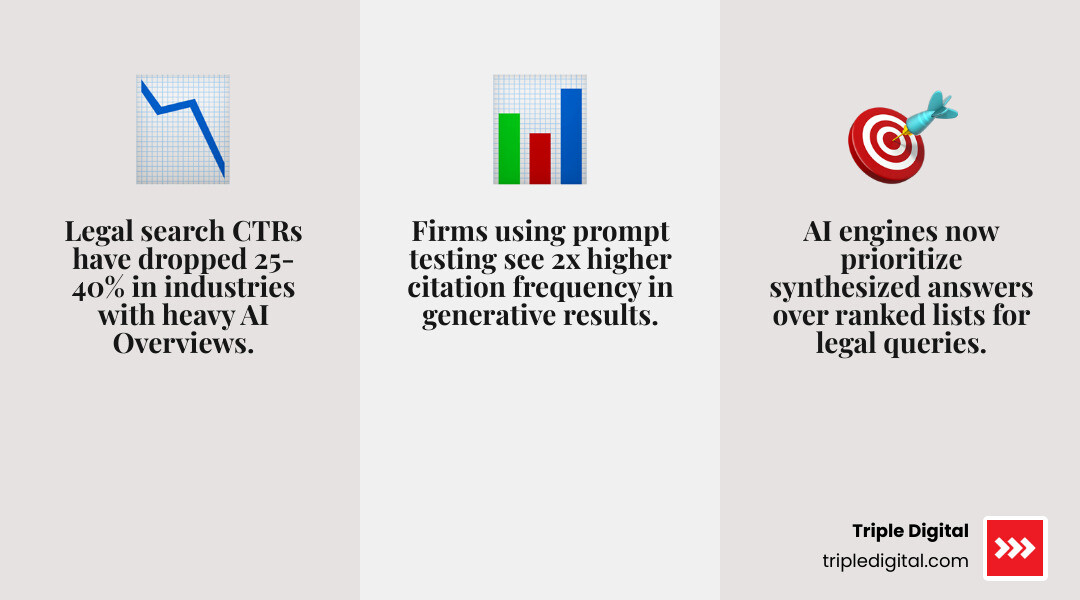
We use “prompt testing” to see how AI responds to various queries. For example, we might ask ChatGPT, “Who are the top-rated criminal defense lawyers in Houston?” and track if your firm is mentioned.
Triple Digital has stayed at the forefront of this; in fact, Triple Digital LLC Unveils Groundbreaking AI Tool to Help Law Firms Outrank Competitors Online which allows us to perform deep gap analysis. We look at:
- Share of Voice: How often you appear compared to competitors.
- LLM-Referred Traffic: How many users are clicking through from ChatGPT or Perplexity.
- Intake Attribution: Connecting those AI mentions to actual signed cases.
Frequently Asked Questions about GEO for Law Firms
How does GEO differ from traditional SEO for attorneys?
Traditional SEO focuses on ranking your website in a list of results. GEO focuses on getting your firm’s information synthesized and cited within the AI’s actual answer. SEO is about being found; GEO is about being recommended.
Which AI bots should I allow in my robots.txt file?
You should ensure that GPTBot, ChatGPT-User, PerplexityBot, ClaudeBot, and Google-Extended are not disallowed. These bots are the “eyes” of the major AI engines.
How long does it take to see results from a GEO strategy?
Foundational technical fixes can show results in weeks. However, building the necessary authority and “Entity” signals typically takes 4 to 6 months to see a consistent increase in AI citations and referred traffic.
Conclusion
The shift toward AI search isn’t a temporary trend—it’s a permanent change in how legal consumers behave. By 2026, firms that haven’t adapted their GEO strategy for attorneys will find themselves fighting for the scraps of a shrinking organic search pie.
At Triple Digital, we are committed to Future-Proof Your Firm: The AI Advantage in Legal Marketing. We don’t just chase clicks; we chase cases. Our Houston-based team uses data mining and AI-driven strategies to ensure your firm is the one the machines recommend.
Ready to stop being invisible and start dominating the AI era? Get started with our legal marketing services today and let’s build a strategy that turns AI answers into signed contracts.