





Top Attorney Generative AI Rankings 2026
Why Attorney Generative AI Rankings Matter in 2026
Attorney generative AI rankings have quickly become one of the most important benchmarks for law firms navigating a rapidly changing legal landscape.
Here’s a quick overview of what you need to know:
Top Law Firms for Gen AI Litigation (BTI 2026 Rankings)
| Tier | Law Firms |
|---|---|
| Gen AI Powerhouses | Cooley, DLA Piper, Faegre Drinker, Latham & Watkins, Orrick, Wilson Sonsini |
| Gen AI Leaders | Arnold & Porter, Axinn, Goodwin Procter, Hogan Lovells, Jenner & Block, WilmerHale |
| Gen AI Distinguished | 20 additional firms including Akin, ArentFox Schiff, and others |
Top-Ranked AI Tools for Law Firms in 2026
| Tool | Best For |
|---|---|
| Harvey AI | Enterprise legal workflows, AmLaw 100 firms |
| CoCounsel | Legal research with citation verification |
| Spellbook | Contract drafting and redlining |
| Clio Work | Practice management + legal research |
| Claude 4 | General-purpose drafting, accessible pricing |
The legal AI market has moved fast. In 2024, only a handful of credible tools existed. By May 2026, there are over 50 tools claiming to transform legal practice — and the gap between firms using AI well and those frozen by uncertainty is growing.
The numbers tell the story clearly:
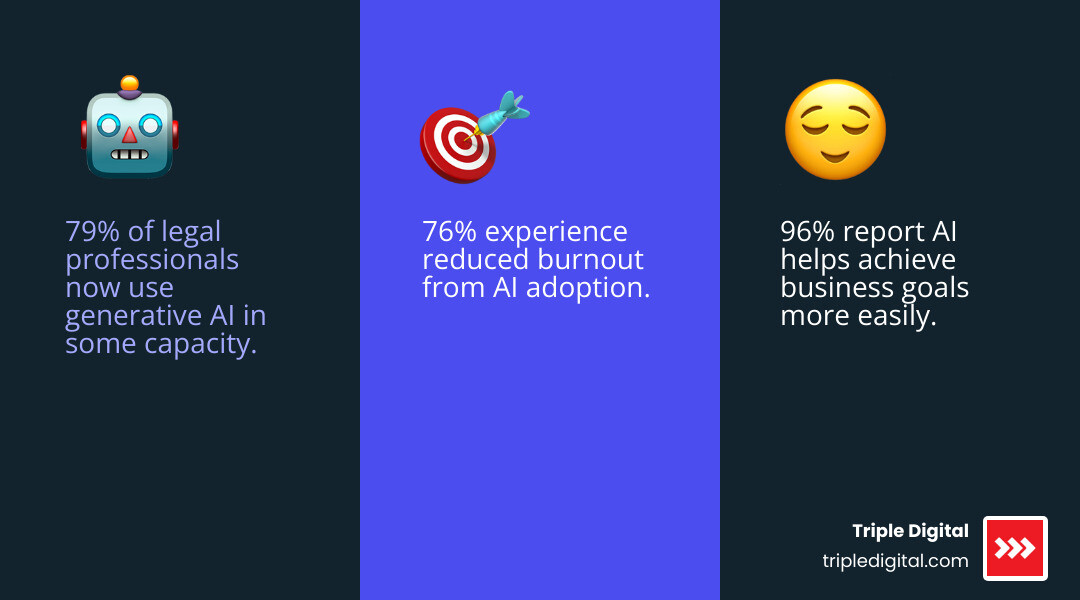
- 79% of legal professionals now use AI in some capacity
- 96% say AI helps them hit business goals more easily
- 76% report that AI has reduced feelings of burnout
As one widely cited analogy puts it, generative AI litigation risk isn’t a massive tidal wave — it’s a dike riddled with mission-critical leaks. Issues are quietly seeping into contracts, supply chains, IP disputes, and data governance — often before firms have a plan to deal with them.
For law firms focused on winning more clients and staying competitive, understanding who’s leading in AI — and which tools actually deliver — is no longer optional.
The 2026 Attorney Generative AI Rankings for Litigation Defense
As we reach the middle of 2026, the BTI Litigation Outlook has solidified its place as the gold standard for identifying which law firms corporate counsel trust most. This year, the focus has shifted heavily toward a firm’s ability to handle the “seepage” of AI-related risks. Unlike traditional litigation, AI-driven legal issues don’t always announce themselves with a massive lawsuit. Instead, they appear as subtle vulnerabilities in intellectual property (IP) filings, supply chain contracts, and data governance protocols.
Leading firms are now categorized by their proactive approach to these risks. The firms topping the Attorney generative AI rankings are those that didn’t wait for a crisis to build an AI defense playbook. They are helping clients spot and plug these “leaks” before they turn into multi-million dollar liabilities.

In 2026, we see a clear divide: firms that are “AI-first” and firms that are hesitant. The leaders are leveraging Beyond The Gavel Using Ai For Predictive Analytics In Legal Proceedings to anticipate how judges might rule on emerging AI copyright issues or contract disputes involving automated decision-making.
Which law firms lead the Attorney generative AI rankings for litigation?
According to the primary research conducted with hundreds of corporate counsel, the following firms have been named the best at defending against Generative AI litigation:
- Gen AI Powerhouses: These six firms are the elite of the elite, recognized for their deep technical understanding and aggressive defense strategies. They include Cooley, DLA Piper, Faegre Drinker, Latham & Watkins, Orrick, and Wilson Sonsini.
- Gen AI Leaders: These firms are highly sought after for their sophisticated handling of AI-related legal challenges. This group includes Arnold & Porter, Axinn, Goodwin Procter, Hogan Lovells, Jenner & Block, and WilmerHale.
- Gen AI Distinguished: This tier includes 20 firms that have demonstrated significant expertise and success in the field, such as Akin and ArentFox Schiff.
These firms have set themselves apart by moving beyond the “experimental” phase of AI. They aren’t just using AI to summarize documents; they are using it to redefine how they defend their clients’ most valuable business assets.
Top-Ranked Generative AI Software for Law Firms
Choosing the right software is just as critical as choosing the right firm. In 2026, the market has moved toward “Agentic AI”—systems that don’t just answer questions but actually execute multi-step workflows.
| Feature | Harvey AI | CoCounsel | Spellbook |
|---|---|---|---|
| Primary Use | Enterprise Workflows | Verified Research | Transactional/Contracts |
| Security | SOC 2, Vault-level | Integrated with Westlaw | AES-256 Encryption |
| Best For | AmLaw 100 / Large Teams | Litigators | Solo to Mid-Market |
| Workflow | Custom AI Agents | Legal Research Memos | Microsoft Word Native |
The shift toward specialized tools has been dramatic. While general-purpose tools like ChatGPT were popular in 2024, by 2026, attorneys have realized that The Key To Ai Written Content lies in domain-specific guardrails. This is why tools like Clio Work and Ironclad have seen massive adoption—they integrate directly into the lawyer’s existing environment, whether that is a practice management system or a contract lifecycle management (CLM) platform.
How do attorney generative AI rankings impact firm productivity?
The impact of these high-ranked tools on a firm’s bottom line is no longer theoretical. Data from 2026 shows that firms adopting top-tier AI solutions are seeing:
- Reclaimed Time: MyCase and Clio users report gaining 3+ billable hours per day by automating routine administrative tasks.
- Annual Savings: On average, AI tools can save a single lawyer up to 200 hours per year on document review and drafting.
- Cost Reductions: E-discovery costs have plummeted by roughly 70% as AI agents handle the bulk of initial document sorting and relevance tagging.
- Faster Closings: Transactional teams using tools like Spellbook report reducing contract review times from 10 hours down to just 2, allowing for significantly faster deal cycles.
By utilizing Ai Tools For Law Firm Marketing, firms are also able to provide a better client experience through real-time updates and more transparent, automated billing.
Emerging Trends in Attorney generative AI rankings and Adoption
One of the most significant shifts we’ve seen since 2025 is the rise of AI Overviews in search engines. For law firms in Houston and across the U.S., this has fundamentally changed how potential clients find them. Instead of a list of links, users now see a synthesized answer at the top of the search results.
To stay visible, firms are having to optimize for Ai Overviews by creating structured, authoritative content that directly answers complex legal questions. This “Zero-Click” search environment means your content must be cited as a source by the AI to maintain your firm’s authority.
We’ve also seen a massive jump in specific AI use cases:
- Case Law Summarization: Usage is up 34% since last year.
- Contract Analysis: In-house teams have increased their usage by 17%.
- Tech Investment: 64% of legal and compliance leaders are accelerating their technology spend in 2026 to keep up with competitors.
To help our clients stay ahead of these shifts, Triple Digital Llc Unveils Groundbreaking Ai Tool To Help Law Firms Outrank Competitors Online, focusing on data-driven case acquisition that traditional SEO methods can no longer guarantee.
Critical Factors for Evaluating Legal AI Software
With so many options available, how do you choose the right tool for your firm? In 2026, “hype-avoidance” is a necessary skill. Not every tool that claims to be “AI-powered” is built with the security and precision required for legal work.
When we evaluate software, we focus on several non-negotiable factors:
- SOC 2 Compliance & Data Privacy: You must ensure that the vendor does not use your confidential client data to train their public models.
- Integration Capabilities: Does it work with your existing stack (Clio, Outlook, Word)? If it doesn’t, it will likely become part of your “AI tool graveyard.”
- Hallucination Safeguards: Top-ranked tools now include “Reasoning Logs” and direct citations to primary sources like statutes or case law.
- Ethical Compliance: Every tool used must align with ABA Formal Opinion 512, which emphasizes the need for human oversight and the duty of competence.
Preparing your firm for this future is about Future Proof Your Firm The Ai Advantage In Legal Marketing. It’s not just about efficiency; it’s about maintaining the trust of your clients and the courts. For those in specialized fields, checking out Top Seo Tips For Criminal Defense Lawyers In The Ai Search Era can provide a roadmap for maintaining visibility while navigating these new ethical boundaries.
Frequently Asked Questions about Attorney Generative AI Rankings
What are the top-ranked AI tools for legal research in 2026?
The leaders in 2026 are CoCounsel (by Casetext/Thomson Reuters), Lexis+ AI, and Vincent AI (by vLex). These tools are preferred because they offer citation verification and are grounded in massive, verified legal databases rather than general internet data. Usage of AI for legal research has seen a 9% increase year-over-year as these tools have become more reliable.
How has AI adoption evolved in the legal industry since 2024?
Adoption has moved from “curiosity” to “necessity.” In 2024, only about 40% of firms were testing AI. By May 2026, 79% of legal professionals report using it. There has been a 17% increase in contract review automation and a significant acceleration in tech investment. We have moved toward Ai Digital Marketing For Law Firms as a standard practice for firms looking to acquire high-value cases.
What are the main risks of using generative AI in legal practice?
The primary risks remain hallucinations (AI making up facts or citations) and data privacy. High-profile cases like Mata v. Avianca serve as warnings of what happens when lawyers don’t verify AI output. To maintain professional standards, firms should implement rigorous internal verification processes and always ensure there is a “human in the loop” to review every AI-generated document.
Conclusion
The Attorney generative AI rankings of 2026 show a legal industry that is finally embracing the power of automation, not to replace lawyers, but to empower them. Whether you are a solo practitioner in Houston or a partner at an AmLaw 100 firm, the goal is the same: spend less time on tedious tasks and more time on high-level strategy and client relationships.
At Triple Digital, we live by a “less fluff, more cases” philosophy. We understand that for Houston-based law firms, the only ranking that truly matters is how many qualified leads and signed cases you are generating. By combining AI data mining with precision digital marketing, we help firms dominate their local markets.
If you’re ready to implement these tools and strategies, here is your AI action plan:
- Audit your workflows: Identify the 3 most time-consuming tasks in your firm.
- Trial a specialized tool: Start with a 14-day trial of a tool like Spellbook or CoCounsel.
- Establish an AI policy: Ensure your team follows ABA 512 guidelines for verification and privacy.
- Optimize your online presence: Ensure your firm is being cited in AI Overviews.
For more information on how we can help your firm grow, check out our Triple Digital services and let’s start building your firm’s future today.