Why Ethical Legal Marketing Matters for Your Law Firm
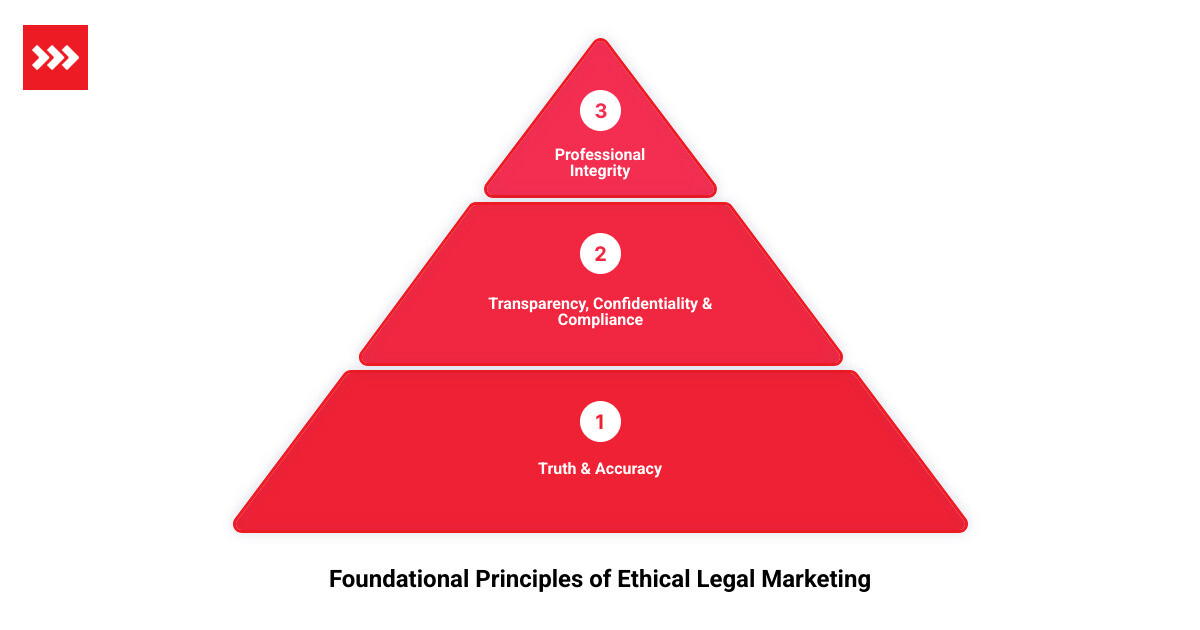
Ethical legal marketing is the practice of promoting legal services in ways that are truthful, transparent, and compliant with regulatory standards set by state bar associations, the ABA Model Rules of Professional Conduct, and the Federal Trade Commission. For law firms, it means balancing effective client acquisition with professional integrity and avoiding disciplinary action.
Key principles of ethical legal marketing:
- Truth and accuracy – All claims must be verifiable and fact-based
- Transparency – Clear communication about fees, services, and limitations
- Client confidentiality – Protecting sensitive information in all marketing materials
- No misleading claims – Avoiding guarantees of outcomes or unsubstantiated expertise
- Respectful solicitation – Following state-specific boundaries on direct outreach
- Proper documentation – Maintaining records of all marketing activities for compliance
We’re facing a crisis of trust. According to the 2025 Edelman Trust Barometer, 68% of people believe leaders deliberately mislead the public. For lawyers, whose profession depends entirely on trust, this presents both a challenge and an opportunity.
The stakes are high. A 2023 Global Business Ethics Survey found that 87% of employees say their workplace does not have a strong ethical culture. For law firms, one misleading ad or inappropriate solicitation can lead to bar complaints, lost reputation, and financial penalties.
But here’s the good news: ethical marketing isn’t just about avoiding problems. It’s about building a sustainable practice. When you market with integrity, you attract better clients, build stronger referrals, and create a competitive advantage that generic advertising can never match.
The rules have evolved too. Recent amendments to ABA Model Rules have broadened “advertising” to “communications,” deleted outdated labeling requirements, and recognized modern practices like real-time electronic solicitations. States are adopting these changes, creating both new opportunities and new compliance requirements.
Whether you’re running SEO campaigns, managing social media, or responding to online reviews, every digital touchpoint must align with ethical standards. This guide will show you exactly how to steer these requirements while still growing your practice.
Ethical legal marketing helpful reading:
The Regulatory Framework of Ethical Legal Marketing
Navigating ethical legal marketing feels a bit like walking through a minefield while carrying a heavy law book. In the United States, we are governed by a multi-layered regulatory framework. At the top, the American Bar Association (ABA) provides a national roadmap, but the real “teeth” come from your local State Bar Association.
In states like Wisconsin, for example, lawyers must strictly adhere to the Rules of Professional Conduct which mandate that all communications about services be truthful and non-deceptive. Failure to comply doesn’t just result in a slap on the wrist; it can lead to formal reprimands or license suspension. This is why we always tell our clients: don’t get sued by bad SEO. Hiring an agency that doesn’t understand the ABA Model Rules of Professional Conduct is a recipe for disaster.
ABA Model Rules and State Bar Influence
The core of our ethical obligations lies in the ABA Model Rules 7.1 through 7.3.
- Rule 7.1 focuses on communications concerning a lawyer’s services, prohibiting false or misleading statements.
- Rule 7.2 covers advertising, recently updated to broaden the term “advertising” to “communications” and allowing for nominal gifts as tokens of appreciation.
- Rule 7.3 deals with solicitation, notably removing the “Advertising Material” label requirement for most written solicitations and easing restrictions on real-time electronic contact.
While these rules provide a framework, jurisdictional variations are common. While we focus on U.S. standards, it’s worth noting that international neighbors have similar structures, such as the LSO in Ontario or the BC Code in British Columbia. For a Houston-based firm, your primary concern remains the Texas Disciplinary Rules of Professional Conduct, which dictate what the most important SEO ranking factors are from a compliance perspective.
FTC Guidelines and Truth in Advertising
Beyond the bar, the Federal Trade Commission (FTC) plays a massive role. The FTC’s mission is consumer protection, and they are increasingly cracking down on “deceptive patterns”—tricks used in websites and apps that make users do things they didn’t intend to, like signing up for a recurring fee.
The ANA Ethics Code of Marketing Best Practices provides 15 general principles that align with FTC standards. The golden rule here is substantiation. If you claim you are the “Top Rated Digital Marketing Agency,” you better have the data to prove it. Tools like Google Search Console can help you track your performance, but they won’t save you if your marketing copy makes promises your legal skill can’t keep.
Essential Do’s and Don’ts for Law Firm Compliance
To make things easier, we’ve broken down the essential components of ethical legal marketing into a simple list of “Do’s” and “Don’ts.” Following these ensures you stay on the right side of the law while still mastering law firm SEO.
Prioritizing Truth, Transparency, and Confidentiality
- DO use fact-based claims: Instead of saying “We are the best,” say “We have recovered over $10 million for clients in 2024.”
- DO use anonymized data: When sharing case studies on social media, ensure no details are shared that could identify the client without their explicit, written consent.
- DO document everything: Keep copies of all ad versions, social media posts, and client permissions. This is your “get out of jail free” card during an audit.
- DO have a strategy: Knowing why law firms need a content marketing strategy helps you create educational content that builds trust without crossing ethical lines.
Avoiding Misleading Claims and Solicitation Pitfalls
- DON’T guarantee outcomes: No matter how “open and shut” a case looks, promising a specific result is a major ethical violation.
- DON’T engage in “ambulance chasing”: The Barristers’ Society and most U.S. state bars strictly prohibit direct, in-person, or real-time electronic solicitation of people who are in a vulnerable state due to a recent accident or trauma.
- DON’T use superlatives: Words like “best,” “greatest,” or “fastest” are subjective and often impossible to verify.
- DON’T provide legal advice online: Use your platform to provide general legal information, not specific advice that could inadvertently create an attorney-client relationship.
| Permissible Solicitation | Prohibited Solicitation |
|---|---|
| Targeted mail/email with clear disclaimers | In-person solicitation of accident victims |
| Educational webinars and seminars | Real-time chat “pushing” legal services |
| Responding to direct inquiries | Coercive or harassing follow-ups |
| Marketing to other lawyers/existing clients | Soliciting someone in physical/mental distress |
Navigating Digital Presence and Social Media Ethics
Your digital presence is often the first point of contact for a potential client. Whether it’s your website or your LinkedIn profile, professionalism is key. We recommend maintaining a professional online presence that clearly states your jurisdictional limits. If you are only licensed in Texas, your website should say so.
Ethical Legal Marketing on Websites and Social Platforms
Ethics in the digital age also includes accessibility. Under the Americans with Disabilities Act (ADA), your website should be accessible to everyone. Following the Web Content Accessibility Guidelines (WCAG) is not just a “nice to do”—it’s an ethical and legal requirement.
Furthermore, social media can drive traffic effectively, but it requires a disciplined approach. Avoid “casual” responses that could be interpreted as legal advice. Every post should reflect the high standard of professionalism expected of the bar. For more tips, check out our guide on law firm marketing with social media.
Managing Online Reviews and Reputation
Online reviews are a double-edged sword. While positive reviews build trust, a single negative review can feel like a personal attack. However, your response must be ethically sound.
In cases like 2019 ONLSTH 35 1, it’s clear that even when a client attacks you online, you cannot breach confidentiality in your response. Never discuss the specifics of a case in a public forum. Instead, use a professional protocol: “Thank you for your feedback. We take client satisfaction seriously. Please contact our office directly so we can address your concerns.” Avoiding these GMB mistakes is crucial for maintaining your firm’s standing.
Advanced Compliance: Specializations, Testimonials, and Data Privacy
As you grow, you might want to highlight your expertise or use client success stories. This is where ethical legal marketing gets highly technical.
Ethical Legal Marketing for Client Endorsements
Testimonials are powerful, but they are heavily regulated. In many jurisdictions, you must obtain written consent before using a client’s words. Furthermore, you must include a disclaimer stating that “results are case-specific and do not guarantee a similar outcome.”
Legal precedents like 2018 ONLSTH 86 4 remind us that misleading testimonials—those that imply a lawyer is a “specialist” without proper certification—can lead to disciplinary action. For more on this, see our Digital Marketing FAQ for Lawyers.
Data Privacy, Global Standards, and Fee Advertising
If your firm handles clients with ties to Europe or California, you must comply with GDPR and CCPA. These regulations mandate how you collect and store data. Additionally, the CAN-SPAM Act requires that all marketing emails include a clear “unsubscribe” link.
When it comes to fees, transparency is non-negotiable. While some jurisdictions like Barreau du Québec allow advertising lump-sum fees under strict conditions, you must always be precise about what is included. If you’re wondering how much lawyers should pay for SEO, the same rule applies: look for transparency in pricing and deliverables.
Global Impact and Societal Marketing
In an interconnected world, your marketing might reach people across state or even national lines. This brings up the challenge of cross-border marketing. A lawyer qualified in one area must be careful not to imply they are qualified everywhere. Cases like 2013 ABLS 5 3 highlight the risks of claiming specialization or expertise across jurisdictions without proper credentials.
Intellectual Property and Mission-Based Marketing
Finally, ensure your marketing materials respect intellectual property. Don’t use images or music you don’t own the rights to. Beyond simple compliance, many firms are now turning to “mission-based” marketing. This aligns with the United Nations’ 2030 Agenda for Sustainable Development, focusing on how the firm contributes to the public good and the rule of law. This type of online marketing playbook builds deep, lasting trust with a modern audience.
Frequently Asked Questions about Ethical Legal Marketing
Can I use the word “expert” in my marketing?
Generally, no—unless you are formally certified as a specialist by your state bar. The BC Code and most U.S. rules prohibit the use of “expert” or “specialist” if it implies a status you haven’t officially earned. Stick to “Experience in Personal Injury” or “Focusing on Criminal Defense.”
How should I respond to a negative Google review?
Keep it brief, professional, and private. “We’re sorry you had a negative experience. Please call our office directly so we can discuss this.” Never reveal that the person was a client or discuss their case. Check our guide on GMB mistakes for more info.
Are paid rankings and awards ethical?
They can be, but only if they are bona fide. Awards from Canadian Lawyer Magazine or similar reputable publications are generally fine, but “pay-to-play” awards that anyone can buy are misleading and could land you in hot water with the bar.
Conclusion
At Triple Digital, we believe that ethical legal marketing is the only way to build a lasting, profitable law firm. Our “less fluff, more cases” approach isn’t just about aggressive growth; it’s about using AI and data mining to find the right cases for you in a way that respects the dignity of the legal profession.
If you’re ready to grow your firm with a partner that values integrity as much as you do, let’s talk. We specialize in digital marketing strategies for law firms that deliver results without compromising your ethics.
Schedule a no-pressure, 15-minute call with our growth strategist and let’s talk about your firm’s future.