





The Definitive Guide to Law Firm Digital Marketing for AI Visibility
Your Law Firm’s Clients Are Now Finding Legal Help Through AI — Not Google
Law firm digital marketing for AI visibility has become the defining challenge for legal practices in 2026.
Here’s the fast answer if you need it now:
How to improve your law firm’s AI visibility — quick summary:
- Optimize for AI citation — structure content so AI systems like ChatGPT, Perplexity, and Google AI Overviews can quote it directly
- Strengthen E-E-A-T signals — attorney bios, bar credentials, case experience, and third-party validation
- Use schema markup — LegalService, FAQPage, Attorney, and LocalBusiness structured data
- Build authority off-site — legal directories, peer recognition, earned media, and consistent NAP data
- Publish scenario-based content — answer real client questions, not generic legal topics
- Track AI-specific metrics — AI Share of Voice, citation rate, and qualified leads — not just traffic
Law firms everywhere are watching their website analytics with the same growing concern. Organic traffic is sliding month after month. And it’s not a fluke.
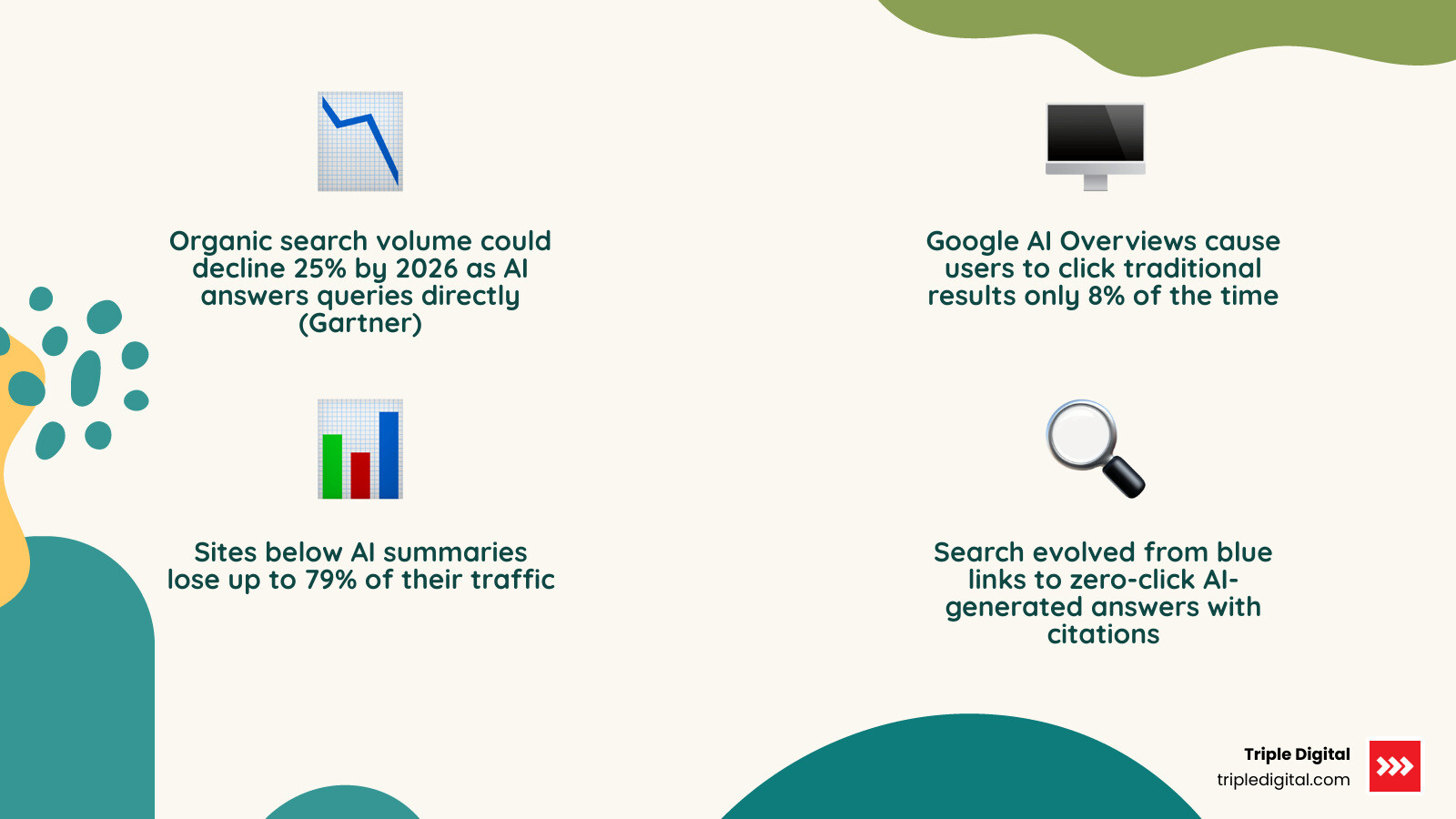
Gartner predicts search engine volume could decline 25% by 2026 as AI chatbots and virtual agents answer questions directly. When a Google AI Overview appears, users click traditional results only 8% of the time — compared to 15% when no summary is shown. Sites sitting below AI summaries can lose up to 79% of their traffic.
The way people find lawyers has fundamentally shifted. A potential client used to type “personal injury lawyer near me” and scan a list of blue links. Now they ask ChatGPT, “What should I do after a truck accident in Dallas?” — and they expect a complete answer, including which firms to consider.
That’s a different game entirely.
The firms showing up in those AI-generated answers aren’t necessarily the biggest or the oldest. They’re the ones whose content is structured, credible, and machine-readable — built for how AI systems select and cite sources.
This guide walks you through exactly how to become one of those firms.
What AI Visibility Means for Law Firms in 2026
AI visibility means your firm can be found, cited, summarized, or recommended inside AI-powered search experiences. That includes Google AI Overviews, ChatGPT, Perplexity, voice assistants, and other answer engines.
For law firms, that changes the goal. It is no longer just “rank on page one.” It is also “be the source the AI trusts enough to mention.”
This matters because legal search is now heavily zero-click. Research shows roughly 60% of Google searches end without a click, and law firms are already seeing organic traffic declines in the 15% to 25% range as AI handles more top-of-funnel questions.
Why law firm digital marketing for ai visibility is now essential
If your firm is not visible in AI results, you may lose visibility before a user ever reaches the old list of links. That is why law firm digital marketing for AI visibility is now a core marketing function, not a side project.
The business reason is simple:
- Fewer clicks are available
- AI summaries shape trust before a user visits your site
- Clients increasingly compare firms through AI-generated answers
- Visibility now depends on credibility and clarity, not just keywords
Traditional SEO still matters, but firms also need to win the “pre-click” moment where AI forms the shortlist.
How AI changed legal client search behavior
Legal search has become more conversational and more specific. Instead of short phrases, people now ask:
- “What should I do after a car accident in Houston?”
- “Do I need a probate lawyer if there is no will in Texas?”
- “How long does a divorce usually take if children are involved?”
These are not keyword strings. They are real-world questions with urgency, context, and emotional weight.
Voice search also reinforces this trend. Research cited in the market shows voice now influences a large share of online queries, which pushes content toward natural language, direct answers, and question-based structure.
Why traditional rankings still matter, but no longer tell the whole story
Good rankings still help. AI systems often pull from strong organic sources, trusted local results, and authoritative pages. Google Business Profile, local pack visibility, and branded search demand still matter too.
But rankings alone are no longer enough. We also need to measure:
- Whether AI tools cite the firm
- Whether branded searches are increasing
- Whether AI-referred visitors convert
- Whether practice pages are being summarized correctly
For a refresher on the foundation, see Mastering Law Firm SEO: Your Blueprint for Online Success.
SEO vs GEO vs AEO: The New Framework for Legal Visibility
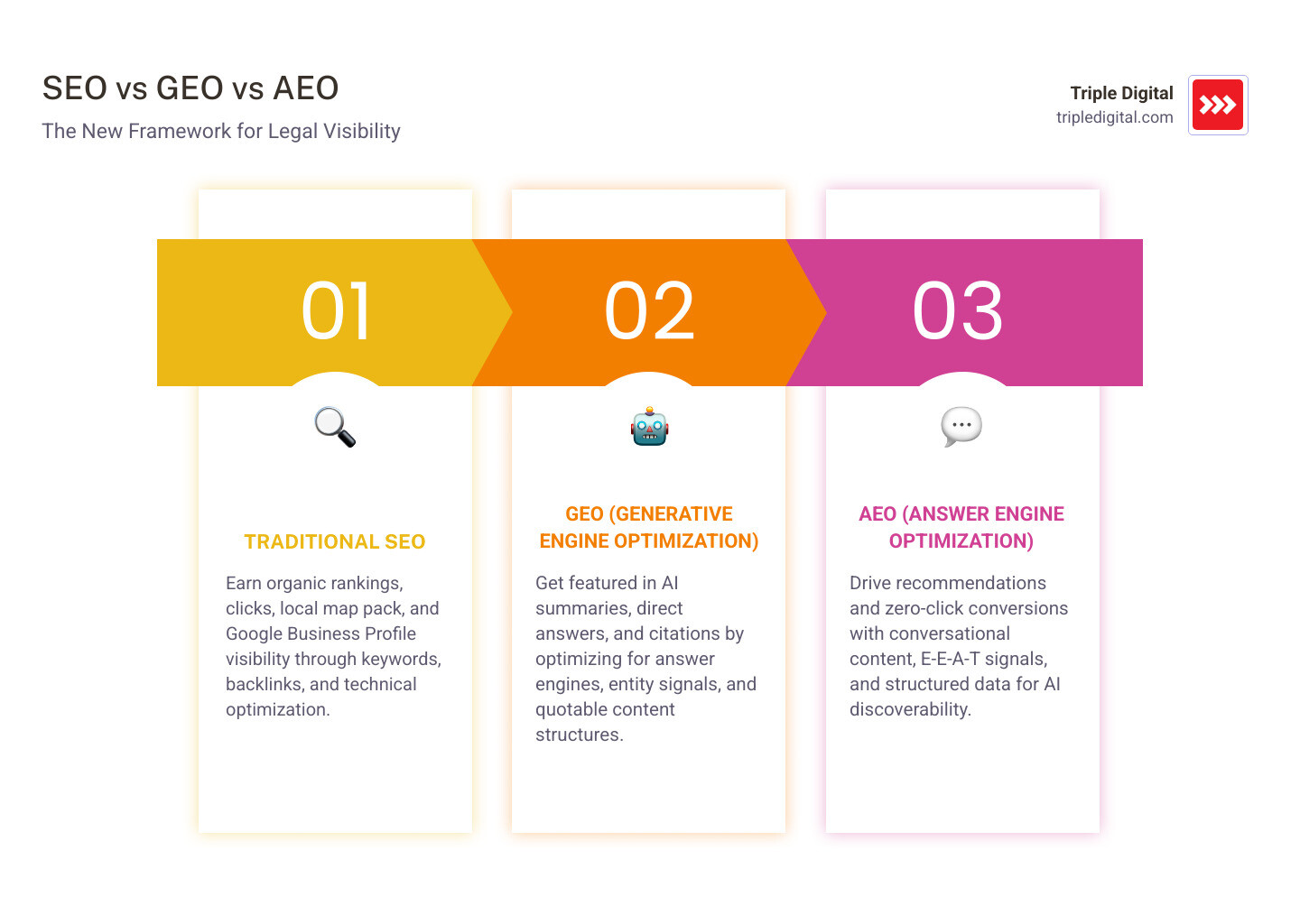
Think of modern legal visibility as a three-part system, not a winner-takes-all cage match.
Traditional SEO: earning rankings, clicks, and local visibility
Traditional SEO helps your firm rank in search engines and local results. It includes:
- Keyword targeting
- Practice area pages
- Link earning
- Google Business Profile optimization
- Technical SEO
- Local citations and reviews
This is still the bedrock. If your technical setup and local signals are weak, AI visibility usually will be weak too. For more, read Why SEO Is Important for Attorneys.
GEO and AEO: earning citations, summaries, and recommendations
GEO, or Generative Engine Optimization, focuses on helping AI systems use your content in summaries and citations.
AEO, or Answer Engine Optimization, focuses on helping your content directly answer questions in a format that answer engines prefer.
A simple way to think about it:
- SEO = help search engines rank you
- GEO = help generative systems cite you
- AEO = help answer engines quote you clearly
In practice, GEO and AEO reward:
- Clear entity signals
- Direct answers near the top of the page
- Structured FAQs
- Strong off-site authority
- Consistent facts across the web
You can learn more about this shift in AI Overviews.
How law firm digital marketing for ai visibility blends all three
The smartest approach is hybrid. We do not abandon SEO just because AI is flashy and wearing a futuristic jacket.
Instead, law firm digital marketing for AI visibility combines:
- SEO for rankings and local discovery
- GEO for citations and summary inclusion
- AEO for direct answer extraction
- Conversion optimization so human visitors actually contact the firm
That is how firms future-proof without chasing every new acronym like it is the last helicopter out of the internet. For the broader picture, see Future-Proof Your Firm: The AI Advantage in Legal Marketing.
How to Create AI-Friendly Legal Content That Gets Cited and Converts

Build content around real client questions, not generic topics
Generic content like “Understanding Personal Injury Law” is easy for AI to replace. Specific content is harder.
Better topics answer the questions clients ask at 2 a.m., such as:
- What should I bring to my first consultation?
- What happens if the other driver has no insurance?
- What if my spouse moved money before filing?
That kind of content maps to intent, emotion, and next-step behavior. It also gives AI tools something usable and relevant to cite.
Use question-led headings, short summaries, and practical next steps. A good model is to pair every major practice page with FAQ and scenario content. For supporting strategy ideas, see Top 3 Digital SEO Strategies for Law Firms.
Use experience-driven storytelling to outperform generic AI content
This is where law firms have an advantage.
AI is good at generic explanations. It is much worse at lived judgment, pattern recognition, and nuance. That means your attorneys’ experience is not a nice extra. It is the moat.
Instead of writing broad textbook pages, create content that reflects real-world insight:
- What clients often misunderstand
- Mistakes people make before hiring counsel
- What changes the timeline in a case
- How similar matters tend to unfold
You do not need to reveal confidential details. You do need to sound like people who have actually helped clients through these situations.
That is why experience-driven storytelling often performs better than generic informational copy. It builds trust with humans and provides distinct language AI can cite. See Advanced SEO: Authoritative Content.
Structure pages so AI can quote them quickly
AI systems like clarity. They do not want to dig through a 1,500-word wall of legal oatmeal.
Make pages easy to extract from:
- Start with a direct answer in 40 to 60 words
- Use descriptive H2s and H3s
- Break key points into bullets
- Add FAQ sections
- Keep URLs stable and readable
- Include short quotable definitions and summaries
A strong page often follows this pattern:
- Direct answer
- What it means
- What to expect from the firm
- Common mistakes to avoid before hiring
- Next steps for seeking counsel
- Contact CTA
Strengthen E-E-A-T for YMYL legal topics
Legal content falls into YMYL, or Your Money or Your Life, which means search systems apply a higher trust threshold. E-E-A-T matters here: Experience, Expertise, Authoritativeness, and Trustworthiness.
Ways to strengthen it:
- Publish detailed attorney bios
- List bar admissions and jurisdictions clearly
- Show practice focus and years of relevant experience
- Cite statutes, court rules, or official guidance where appropriate
- Date legal updates and refresh stale pages
- Make contact information easy to verify
In AI search, E-E-A-T is not just about ranking. It helps systems decide whether your content is safe to surface. For related reading, visit Rank Higher, Get More Clients: Essential Website SEO for Attorneys.
Make AI-friendly content convert for human visitors
Being cited is great. Being contacted is better.
Every AI-friendly page should still help a human take action. That means:
- Clear consultation buttons
- Tap-to-call on mobile
- Short forms
- Trust-building copy near CTAs
- Internal links to related services
- Plain-English readability
And yes, AI-assisted writing can help with drafts, structure, and research. But it still needs human review, brand voice, and legal accuracy. More on that in The Key to AI-Written Content.
Technical and Authority Signals That Improve AI Discoverability
The technical SEO foundations AI systems still rely on
AI visibility is not magic dust sprinkled on a broken site.
The basics still matter:
- Fast mobile load speed
- HTTPS
- Clean heading structure
- Accurate metadata
- XML sitemaps
- Crawlable internal links
- Correct canonical tags
- Robots.txt that does not block important crawlers
Many AI systems also rely heavily on visible page text and simple structure. If your best content is hidden behind tabs, scripts, or clutter, it may not be understood well.
Structured data that helps legal content become machine-readable
Schema markup helps machines understand who you are, what you do, and how pages relate to each other.
For law firms, the most useful schema types often include:
- Organization
- LocalBusiness
- Attorney
- LegalService
- FAQPage
- Review, where appropriate and compliant
This supports entity clarity, which is critical in AI results. It helps connect your attorneys, office, practice areas, and contact details into one coherent identity.
Emerging AI-specific signals law firms should prepare for
A newer area to watch is AI crawler guidance, including LLMs.txt. It is not yet a universal standard, but it is increasingly discussed as a way to guide large language model access and preferred content paths.
You should also prepare for a multibot world:
- Review robots.txt regularly
- Keep sitemaps current
- Make visible text strong and complete
- Refresh important pages as laws and procedures change
- Avoid overcomplicated layouts that hurt machine legibility
Why directories, peer recognition, reviews, and media mentions matter more in AI search
AI systems often validate your claims against third-party sources. That is why off-site authority signals carry more weight now.
Important signals include:
- Consistent name, address, and phone data
- Complete legal directory profiles
- Client reviews on major platforms
- Peer recognition and professional listings
- Earned media mentions
- Bylined articles on reputable publications
Think of PR as proof, not vanity. AI systems are more confident citing firms that other trusted sources also mention. Explore more resources in Category Legal Marketing.
How small and solo firms can compete without enterprise budgets
Small firms are not locked out of AI visibility. In some cases, they have an edge because they can be more focused and more specific.
A lean strategy works well when you:
- Own one niche before expanding
- Build strong local pages for Houston and nearby service areas
- Write differentiated attorney bios
- Publish consistently on high-intent topics
- Earn a few high-quality mentions instead of chasing volume
- Keep directory data clean
In other words, depth beats sprawl. See Top SEO Tips for Criminal Defense Lawyers in the AI Search Era for a practical example of niche-focused optimization.
Measuring Success Beyond Traffic: KPIs, Audits, and Common Mistakes
The KPIs that matter for law firm digital marketing for ai visibility
If you only track sessions, you will miss the real story.
For law firm digital marketing for AI visibility, we recommend tracking:
- AI Share of Voice
- AI inclusion rate for priority prompts
- Citation frequency by platform
- Branded search growth
- Qualified leads by practice area
- Consultation requests
- Signed cases tied to digital channels
Traffic still matters, but conversion quality matters more.
How to audit your firm’s presence across AI-driven search
A simple monthly audit can reveal a lot.
Test 5 to 10 priority prompts across major AI platforms. Include:
- Practice-area prompts
- Local intent prompts
- Comparison prompts
- Question-based urgent prompts
Then log:
- Whether your firm appears
- Whether your site is cited
- Which competitors or publishers appear instead
- What language the AI uses to describe your firm
- Which sources get cited repeatedly
Over time, patterns emerge. One platform may favor FAQs, another may lean on directory profiles, another may cite local pages more often.
Common mistakes law firms make with AI marketing
We see the same issues repeatedly:
- Thin pages that say little of value
- Duplicate attorney bios
- Generic AI-written content with no human insight
- Weak or missing schema
- Inconsistent NAP across the web
- Obsessing over traffic while ignoring signed cases
- Blocking useful crawlers accidentally
- Publishing without review or fact-checking
The biggest mistake? Treating AI visibility like a shortcut. It is really a quality and authority game wearing new clothes.
How to stay compliant while protecting confidentiality
Law firms can improve AI visibility without risking ethics or confidentiality if they stay disciplined.
Best practices:
- Use only public-facing information in AI optimization
- Never include client secrets or identifying facts without proper permission
- Maintain attorney review on legal content
- Use clear disclaimer language where needed
- Keep internal policies for AI-assisted drafting and approvals
- Separate marketing data from confidential matter data
Compliance is not the enemy of strong content. Sloppy process is. For broader guidance, read Digital Marketing FAQ for Lawyers: 2026 Edition.
A Practical 90-Day AI Visibility Roadmap for Law Firms
Days 1–30: fix entity clarity, technical issues, and priority pages
Start with the foundation:
- Audit homepage, attorney bios, and top practice pages
- Standardize firm name, address, phone, and attorney details
- Implement core schema markup
- Clean up title tags, headings, and metadata
- Update XML sitemaps and review robots.txt
- Fix weak internal links and outdated pages
This first month is about making your firm legible to both search engines and AI systems. For more SEO resources, browse Category SEO.
Days 31–60: publish citation-ready content and build authority signals
Next, create pages that deserve citations.
Priorities:
- Scenario-based pages for high-intent client questions
- FAQ clusters around practice areas
- Stronger attorney bios with differentiated experience
- Review generation systems
- Directory cleanup and completion
- Thought leadership and local media outreach
This is where content and authority start working together.
Days 61–90: measure, refine, and scale what drives consultations
By month three, start improving based on evidence.
Focus on:
- Re-testing prompts across AI tools
- Reviewing which pages get cited most
- Updating weak content with clearer answers
- Improving intake pathways on top-performing pages
- Monitoring form fills, calls, and qualified consultations
- Expanding winning formats into more practice areas
Monthly AI visibility checks should include:
- Priority prompt testing
- AI citation log updates
- Branded search trend review
- Lead quality review by source
- Directory consistency check
- Technical crawl review
- Content freshness review
Conclusion
AI did not end legal marketing. It just ended lazy legal marketing.
The future belongs to firms that are clear, credible, technically sound, and genuinely useful. That is the heart of law firm digital marketing for AI visibility: not more fluff, not more noise, just better signals that help the right clients find and trust your firm.
At Triple Digital, we believe in a simple standard: less fluff, more cases. If your firm wants to future-proof its visibility and turn AI-driven discovery into real consultations, start by strengthening the basics, then build for citation, trust, and conversion.
For more on where legal marketing is heading, read Top Law Firm Marketing Agency: How Firms Will Get More Cases in 2026 and Beyond.
And if you are ready to build a smarter visibility strategy, explore our services here.