




How to Get More Clients as a Lawyer When Clients Ask AI
The path people take to find legal representation has fundamentally shifted. For decades, prospective clients followed a predictable search sequence: identify a possible legal problem, navigate to a search bar, browse through ten blue links or local map listings, read a few websites, and call two or three firms.
As of November 2026, conversational discovery engines like ChatGPT, Claude, Perplexity, and Google AI Overviews have rewritten that journey. Today, consumers treat AI platforms as an anonymous, on-demand sounding board where they can ask unvarnished questions before they ever pick up the phone.
Research reveals the scale of this behavior: 57% of consumers now state they have used or would use AI to answer legal questions. When consumers present their problems to an AI assistant, the platform doesn’t simply return a directory of links. It synthesizes case facts, explains statutory concepts in plain English, and provides direct advice on what steps the person should take next.
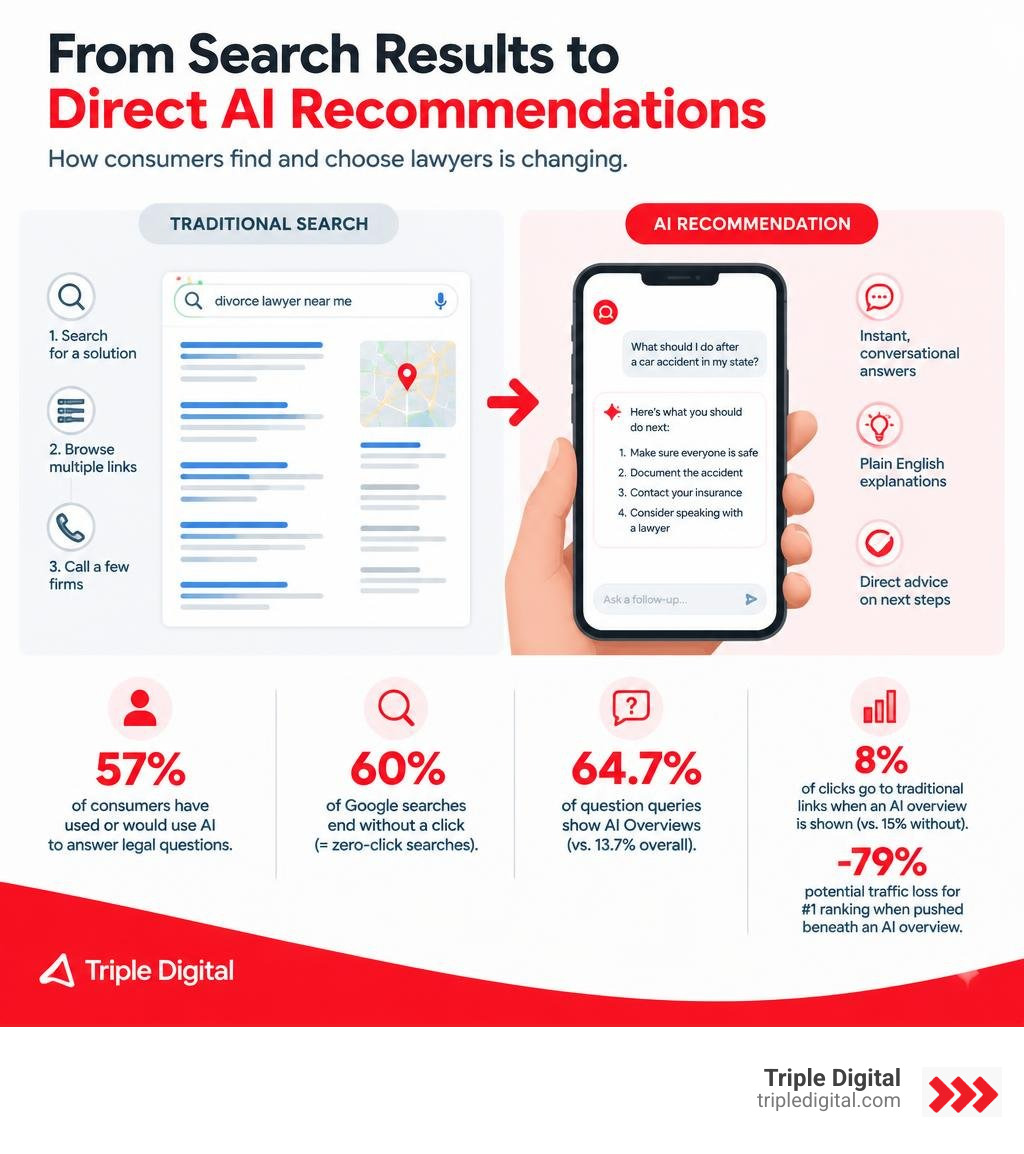
This evolution is fundamentally altering organic search traffic:
- The rise of zero-click searches: Roughly 60% of Google searches now conclude without a single click through to an external website, because users receive complete answers directly within the AI response.
- Question queries trigger AI synthesis: Google’s AI Overviews now appear for approximately 13.7% of all searches overall, but surge to 64.7% for queries phrased as direct questions—the exact type of queries prospective clients submit when facing distress.
- Loss of traditional link visibility: When an AI overview displays, traditional organic listings capture clicks only 8% of the time, compared to 15% when no summary is shown. A web page ranking in the coveted number-one organic spot can lose up to 79% of its expected traffic when pushed beneath an AI overview.
- AI as an intake gatekeeper: Among consumers who consult AI for legal questions, 53% believe the AI sufficiently resolved their inquiry, while 28% receive a recommendation from the AI prompting them to consult an attorney.
- The risk of abandoned claims: Alarmingly, 12% of consumers report being convinced by an AI response that their issue was not worth pursuing, often based on incomplete context or generic responses that fail to account for local jurisdiction.
For law firms, this means client acquisition no longer begins on your website’s contact form. It begins inside the prompt window of a large language model. If your firm is not cited, referenced, and recommended during that initial conversational query, you are invisible to a rapidly growing segment of prospective clients.
What Must Law Firms Do to Appear in AI-Generated Recommendations?
Large language models (LLMs) do not rank websites the way traditional search engine algorithms do. Traditional search engines crawl web pages for specific keywords, header tags, and backlink volume. Generative AI engines, by contrast, act as reasoning and synthesis machines. They evaluate authoritative entities across the entire web, seeking verified facts, cross-source consistency, and established professional credibility.
If an AI engine is asked, “Who is an experienced employment lawyer in Houston for executive contract severance disputes?”, it will not simply scan for keyword stuffing. It looks for independent verification across multiple trusted digital databases to confirm that an attorney actually handles those disputes, possesses reputable peer recognition, and maintains consistent credentials across public records.
To secure a position within these AI-generated answers, law firms must move beyond outdated SEO tactics and implement Generative Engine Optimization (GEO).
| Strategy Dimension | Traditional Legal SEO | Generative Engine Optimization (GEO) |
|---|---|---|
| Primary Objective | Rank on page one for targeted search phrases | Be cited and recommended within AI responses |
| Discovery Mechanism | Keyword density, metadata, backlink quantity | Entity recognition, knowledge graphs, verified sources |
| Content Structure | Practice-area pages with legal terminology | Plain-language problem solving and FAQ frameworks |
| Authority Signals | Domain authority and directory link volume | Peer-reviewed recognitions, citations, cross-platform consistency |
| Client Experience | Users browse multiple sites to compare lawyers | AI delivers direct recommendations and synthesized summaries |
Building an effective, modern AI lawyer growth strategy does not require an enterprise-level marketing budget. It requires clarity, entity optimization, and structured authority.
Building Multi-Platform Entity Authority
AI engines crawl third-party directories, legal publications, bar registries, and digital databases to corroborate your firm’s identity. If your firm has conflicting business names, mismatched addresses, or outdated practice areas listed across legal profiles, an AI model experiences low confidence in your entity data and will avoid recommending you.
To build reliable entity authority on a budget:
- Conduct an entity audit: Review your firm’s presence across state bar listings, major legal directories, Google Business Profiles, and professional associations. Ensure practice areas, office addresses, attorney credentials, and firm descriptions match across every listing.
- Eliminate duplicated, generic attorney bios: Many firms copy and paste identical, templated bios across several directory platforms. Large language models easily spot generic text and discount its authority. Replace templated biographies with distinctive narratives highlighting specific matter types, jurisdictions, and professional recognitions.
- Maintain strict privacy boundaries: Never publish confidential client details or sensitive case summaries in marketing materials. AI training models ingest public data, so maintain clear boundaries between public-facing marketing assets and privileged matter files.
Tailoring Content Specifically for Generative Search Engines
Generative engines favor clear, logically structured information that can be readily extracted and summarized. When you structure practice content, you should specifically optimize content for Perplexity, Google AI Overviews, and ChatGPT by using modular, scannable formats.
Structure your core informational pages with:
- Direct answer blocks: Provide concise, 40-to-60-word answers directly beneath question headers before expanding into deeper nuances.
- Factual data points and structured lists: Use bulleted steps, summary tables, and clear headings that AI algorithms can easily parse and display as citations.
- Schema markup integration: Implement structured data (such as
LegalService,Attorney, andFAQPageschema) within your site code to explicitly declare your practice focus, geographic jurisdiction, and professional credentials to search bots.
How Can Lawyers Turn Real Client Questions Into AI-Discoverable Content?
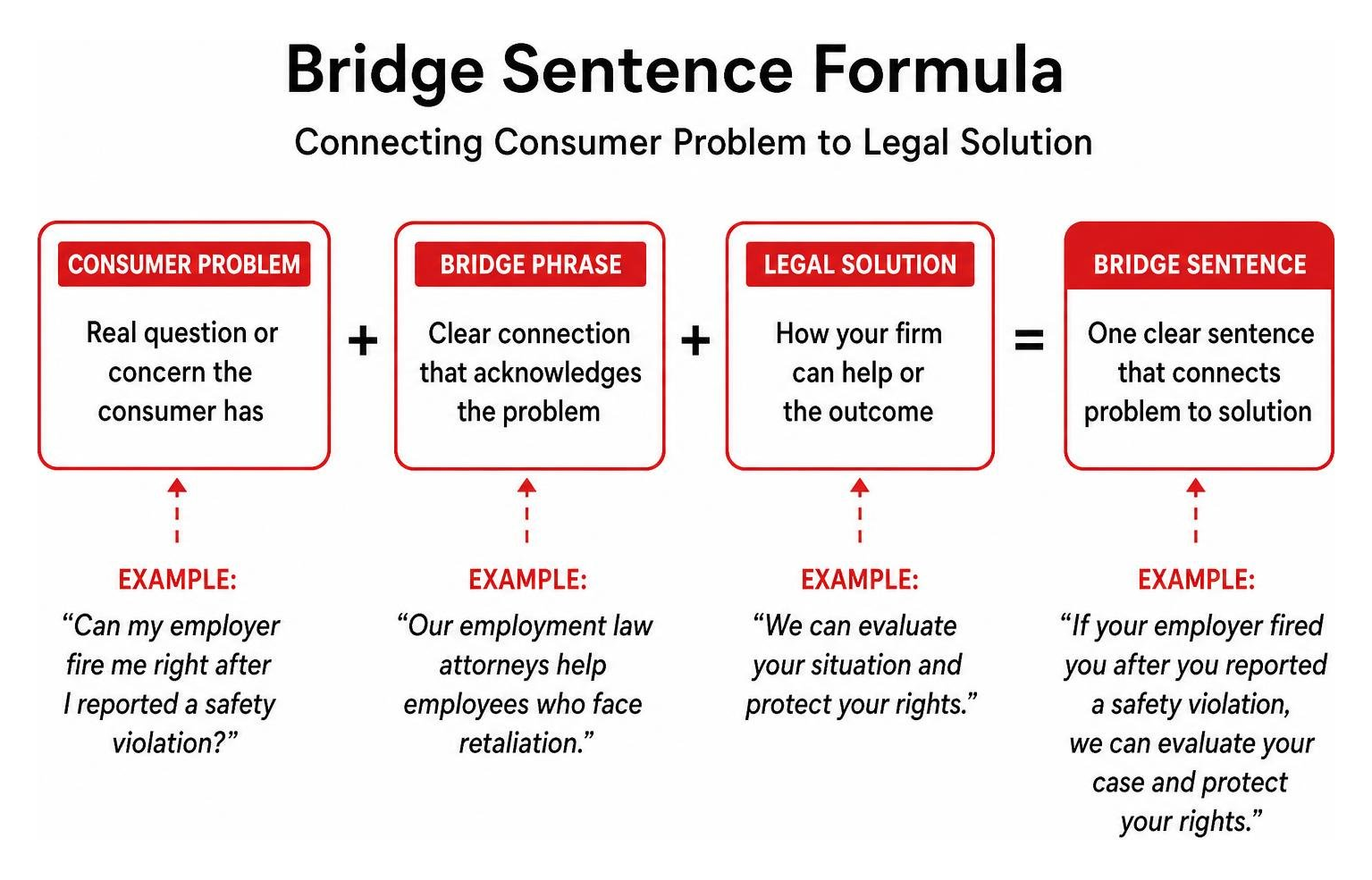
Most law firm websites fail to capture conversational AI traffic because they organize their content around formal legal categories rather than how consumers actually experience problems. A person facing a workplace conflict rarely searches for “Title VII civil rights litigation counsel.” Instead, they ask an AI assistant: “Can my employer fire me right after I reported a safety violation?”
If your site only features high-level practice pages written in dense legal terminology, conversational engines will overlook your content when answering everyday consumer questions. To capture high-intent inquiries, you must build content around the real questions prospects ask during initial points of contact.
You can optimize legal services for AI search cost-effectively by mining your existing firm communications for content topics:
- Review intake records and phone logs: Note the exact phrasing prospective clients use during their first call to your receptionist or intake team.
- Audit initial consultation notes: Identify common misunderstandings, immediate fears, and procedural questions prospects raise before retaining your firm.
- Analyze website chat and contact form submissions: Document the specific fact patterns potential clients write when asking for guidance.
High-Converting Question Formats for Legal AI Discovery
When compiling client questions, prioritize formats that AI search engines frequently index for direct answers:
- “What happens if…” queries: e.g., “What happens if my business partner withdraws funds from our operating account without approval?”
- “Do I need a lawyer if…” scenarios: e.g., “Do I need an attorney if the insurance adjuster already made an initial settlement offer?”
- “What kind of lawyer handles…” inquiries: e.g., “What kind of lawyer do I hire to resolve a dispute over a family property transfer?”
- “How long do I have to…” timelines: e.g., “How long do I have to file a formal complaint after experiencing wage non-payment in Texas?”
- “Can my employer/landlord/bank…” rights questions: e.g., “Can a commercial landlord change the locks without written notice?”
The Bridge-Sentence Content Formula
To ensure your informational content is helpful to users, easily understood by AI, and compliant with state bar advertising regulations, apply the Bridge-Sentence Formula:
- The Client’s Question: State the inquiry in plain, natural language as the section heading.
- The Direct Answer: Provide a clear, objective 2–3 sentence explanation of the legal reality without confusing legal jargon.
- The Bridge Sentence: Connect the practical scenario to its formal legal practice area. For instance: “When an employee is dismissed shortly after reporting workplace safety violations, this situation falls under whistleblower protection and wrongful termination laws.”
- The Practical Context: Explain the relevant factors, documentation requirements, and timelines an individual must consider.
- The Compliance Guardrail: Maintain professional standards by avoiding outcome guarantees, unsupported claims of certification, or direct legal advice. Clearly state that real-world outcomes depend on specific matter facts and local jurisdictional rules.
- Internal Entity Link: Connect the explainer article directly to the relevant attorney biography and core practice page on your website.
Capturing Zero-Click AI Overview Real Estate
Securing placement within Google AI Overviews requires targeted formatting. As explained in our guide to AI Overview for attorneys, AI overviews extract content that provides immediate clarity on long-tail, nuanced queries.
When drafting FAQ hubs or informational articles, keep answers objective, define procedural steps in numbered sequences, and cite relevant statutory authorities or published judicial rules where appropriate. This structured layout provides the factual grounding that generative algorithms rely upon when synthesizing overviews.
How Should Law Firms Address the Risks of Clients Using Consumer AI?

As consumer use of general AI grows, attorneys are encountering a new type of prospective client: individuals who arrive at initial consultations with pre-formed legal conclusions, drafted contracts, or litigation strategies generated by consumer chatbots.
While consumer AI tools provide accessible starting points for general information, they present distinct risks when used as a substitute for professional counsel:
- Hallucinations and fictitious authorities: General-purpose LLMs predict word sequences rather than verifying legal statutes, occasionally fabricating citations, nonexistent judicial opinions, or invalid precedents.
- Outdated statutory frameworks: Public consumer AI models may train on historical data that does not reflect recently enacted state statutes, revised procedural rules, or local municipal ordinances.
- Total absence of confidentiality and privilege: Public AI platforms frequently ingest user inputs for model training. A prospective client inputting proprietary business data or sensitive matter details into an open chatbot may inadvertently waive confidentiality or compromise trade secrets.
- Lack of local procedural context: A consumer chatbot cannot evaluate the strategic preferences of a specific local judge, the negotiation posture of opposing counsel, or the practical risks of local court procedures.
Educating Clients on General AI Limitations
Law firms should proactively address consumer AI use through educational content on their websites, client welcome guides, and consultation prep materials. Rather than dismissing a client’s AI research, position your firm as the indispensable strategic partner who validates facts, assesses human context, and provides accountability.
Frame the distinction clearly:
“AI can summarize general legal definitions, but it cannot evaluate witness credibility, navigate local courtroom procedures, or protect your confidential communications under attorney-client privilege.”
Firms must also ensure their own technology usage complies with professional ethics opinions. For example, Florida Bar Ethics Opinion 24-1 clarifies that while lawyers may utilize generative AI tools to assist in research and document preparation, they remain strictly obligated to protect client confidentiality under Rule 4-1.6, verify all factual and legal assertions, and maintain human oversight over all generated work product.
Offering Unbundled Review and Intake Options
Instead of turning away prospective clients who have used AI to draft preliminary agreements or outline their disputes, progressive law firms are developing targeted, unbundled service packages:
- Document verification consultations: Offer fixed-fee reviews to examine client-prepared drafts for legal validity, omitted clauses, and jurisdictional compliance.
- Risk assessment audits: Provide structured evaluations of dispute summaries that clients have drafted using AI tools, identifying procedural risks that algorithms overlook.
- Discovery roadmap sessions: Help clients organize raw case documents and factual timelines into actionable records suitable for formal representation.
By offering accessible, budget-conscious intake reviews, you establish an early working relationship with self-guided clients. Once they recognize the strategic complexity of their matter, these introductory engagements frequently convert into full retained representation.
How Can Law Firms Use AI Internally to Increase Responsiveness and Client Retention?
Winning clients in an AI-driven market requires more than external visibility; it demands operational agility. Potential clients who use AI in their daily lives expect rapid communication, clear pricing, and immediate answers.
Industry data confirms this shift: 83% of surveyed attorneys report that clients now expect substantially quicker response times. Delays in responding to initial inquiries often lead prospects to contact the next firm on their list. Furthermore, 33% of law firms report losing clients due to uncompetitive or opaque pricing structures, as clients increasingly question hourly fees for routine administrative tasks.
By integrating legal-specific AI tools into internal workflows, solo practitioners and boutique law firms can operate with the speed and precision of large firms while maintaining a lean operational budget.
Translating Operational Efficiency Into Client-Facing Value
Law firms that leverage AI effectively do not merely automate back-office drafting; they convert operational time savings into visible advantages for their clients:
- Same-day structured intake summaries: Use secure, legal-specific AI platforms to transcribe, summarize, and extract key facts from raw intake forms and consultation calls within minutes.
- Rapid matter planning: Deliver a structured initial matter roadmap to the prospect within hours of their consultation, outlining key procedural milestones, required documents, and strategic considerations.
- Transparent alternative fee structures: By automating document review and initial draft generation, firms can accurately scope matters and offer predictable flat-fee or hybrid billing options that attract cost-conscious clients.
Adopting lean law firm digital marketing for AI visibility alongside streamlined intake technology levels the playing field for boutique practices. At Triple Digital, our team helps law firms integrate high-performance lead generation with data-driven client acquisition systems designed to secure more retained matters without bloated overhead.
Fostering Transparent Client Communication
While consumers embrace AI for general inquiries, they remain cautious about how legal practitioners apply technology to their personal matters. Surveys indicate that 47% of consumers feel uncomfortable with lawyers relying on AI for core decision-making, and 78% of clients expect full disclosure regarding how their law firm utilizes AI tools. In the corporate sector, 77% of in-house counsel demand complete transparency regarding legal tech usage.
Firms can build immediate trust by establishing a clear, client-facing AI Use and Data Protection Policy:
- Human Judgment Guarantee: State unequivocally that licensed human attorneys supervise, review, and remain accountable for all research, drafting, and case strategy.
- Confidentiality Safeguards: Confirm that all client data is processed solely through enterprise-grade, secure legal platforms that never share or train on private client information.
- Value-Driven Efficiency: Explain that AI tools are used to accelerate document processing and research, allowing the firm to dedicate more attorney time to high-value strategic counsel and direct client communication.
Frequently Asked Questions About Winning Legal Clients Through AI?
How does AI search differ from traditional Google SEO for law firms?
Traditional Google SEO focuses on optimizing individual web pages with targeted keywords, metadata, and backlinks to rank in a list of web links. AI search engines (like ChatGPT, Perplexity, and Google AI Overviews) synthesize information from multiple authoritative sources to provide direct, natural-language answers and recommendations. To succeed in AI search, firms must focus on multi-platform entity verification, schema markup, structured problem-and-solution content, and consistent professional citations across trusted directories.
Can a solo or small law firm win AI visibility on a limited budget?
Yes. AI discovery rewards verified expertise, clear answers, and cross-platform consistency rather than large ad spend. Small firms can gain significant visibility on a realistic budget by:
- Standardizing their business profiles and attorney bios across all legal directories.
- Publishing plain-language FAQ articles that answer specific client intake questions.
- Adding structured schema markup to their website pages.
- Collecting authentic client reviews and peer recognitions that establish entity trust across third-party platforms.
How should attorneys disclose AI usage during client intake and service delivery?
Attorneys should provide a concise, transparent disclosure in their client engagement agreements and intake materials. The disclosure should explain that the firm uses secure, enterprise-grade legal technology to assist with administrative organization, research, and initial drafting to improve efficiency. It must clearly affirm that licensed attorneys review and verify all work product, make all strategic decisions, and enforce strict data security protocols to protect client confidentiality and privilege.
How Can Your Law Firm Build an AI-Driven Client Acquisition System Today?
The rise of conversational AI has transformed how prospective clients discover, evaluate, and retain legal counsel. As more individuals bring their legal concerns to AI assistants first, the firms that thrive will be those that align their digital footprint with how these models find and verify authority.
Winning cases in this new environment comes down to four fundamental actions:
- Capture real conversational intent: Mine your intake calls and consultation notes to build structured, plain-language content that answers the exact questions prospects ask AI platforms.
- Establish verifiable entity authority: Eliminate mismatched business listings and duplicated bios, ensuring your practice credentials and peer recognitions are consistent across all trusted public records.
- Bridge client problems to legal solutions: Use structured formatting and the bridge-sentence framework to make your content scannable, helpful, and easily cited by generative search engines.
- Pair modern marketing with rapid intake: Utilize ethical internal workflows to respond faster, communicate transparently about your technology, and deliver clear, value-driven service from the very first interaction.
If you are ready to modernize your firm’s growth strategy and turn AI search visibility into a consistent stream of qualified inquiries, our team is here to help.
You can schedule a consultation with Triple Digital to review your current digital presence and discover how a customized GEO strategy for attorneys can expand your firm’s caseload on a realistic, measurable budget.