





The Definitive Guide to Paid Advertising for Lawyers
Why Paid Advertising for Lawyers Is the Fastest Way to Get New Clients
Paid advertising for lawyers is one of the most powerful ways to generate new cases — fast. Unlike SEO, which can take months to show results, paid ads put your firm at the top of search results the same day you launch.
Quick answer: What is paid advertising for lawyers?
| Type | How It Works | Best For |
|---|---|---|
| Google Search Ads (PPC) | Pay per click when someone searches for legal help | High-intent leads ready to hire |
| Local Services Ads (LSAs) | Pay per lead (call or message); Google-verified | Local visibility and trust |
| Facebook/Instagram Ads | Pay to reach targeted audiences by demographics | Awareness and retargeting |
| LinkedIn Ads | Pay to reach professionals and businesses | B2B and corporate law |
Here’s the reality most law firms face: referrals slow down, organic search is competitive, and the phone isn’t ringing enough. Paid advertising fills that gap — immediately.
The numbers back this up. Over 80% of consumers use search to find local businesses, including law firms. And more than 60% of people searching for legal help will click on a paid ad if it matches what they need.
But legal PPC isn’t cheap or simple. The legal industry carries the highest average cost-per-click of any industry on Google — $8.58 on average, with personal injury keywords reaching $150 to $300 per click in major cities. Without the right strategy, budgets disappear fast with little to show for it.
This guide breaks down everything your firm needs to know — from how the auction works, to what to spend, to which channels actually drive signed cases.
What is PPC and How Does It Work for Law Firms?
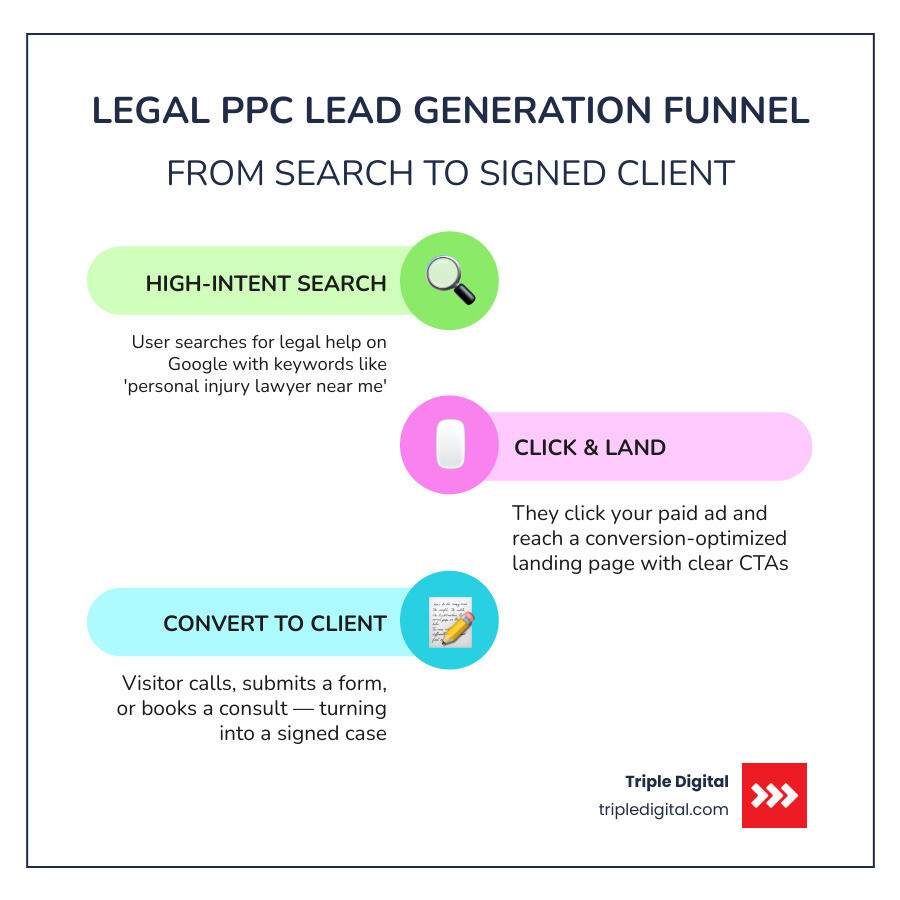
Pay-per-click (PPC) advertising is an online marketing model where you only pay when a user actively clicks on one of your ads. Instead of paying for billboard space or a television spot hoping the right person sees it, PPC allows you to bid on specific search terms (keywords) so your ads appear at the exact moment a prospect is searching for legal services.
These ads appear in the sponsored results section at the very top or bottom of search engine results pages (SERPs). Because these users are actively looking for legal representation, their user intent is incredibly high.
However, getting your ad to the top isn’t just a matter of who throws the most money at Google. Search engines use a metric called Ad Rank to determine where your ad appears, calculated using your maximum bid and your Quality Score.
Quality Score is Google’s rating of the quality and relevance of both your keywords and your PPC ads, as well as the user experience of your landing page. If you write highly relevant ads and send users to a fast, helpful page, Google rewards you with a higher Quality Score. Improving your Quality Score from a mediocre 5 to an excellent 7 can reduce your cost-per-click (CPC) by roughly 28%, meaning you get more leads for the exact same budget.
Why Paid Advertising for Lawyers is Essential in 2026
As we navigate 2026, the legal landscape is more competitive than ever. Organic search algorithms are continuously shifting, and AI-driven search results are taking up valuable real estate on the first page of Google. Relying solely on organic SEO means waiting months for traffic that might disappear with the next algorithm update.
Paid advertising gives your firm immediate visibility. In fact, research shows that firms using online search ads are hired 25% faster than firms that don’t. When a client is in a high-stress situation, they don’t want to scroll through pages of organic results—they click the first credible option that answers their immediate need.
To understand how paid ads fit into a larger business model, check out our guide on Law Firm Advertising Strategies: From Small Practice to Legal Empire to see how to scale your marketing efforts predictably.
Choosing the Right Channels for Paid Advertising for Lawyers
Not all paid advertising platforms are created equal, and the best channel for your firm depends heavily on your practice areas:
- Google Search Ads: The gold standard for high-intent leads. If someone searches “car accident lawyer near me,” they need help immediately. This is where you want to be.
- Facebook and Instagram Ads: Excellent for building brand awareness, running educational campaigns, and retargeting people who have already visited your website. For a deep dive into whether social media ads make sense for your specific practice, read The Verdict Is In: Are Facebook Ads a Win for Your Law Firm? and learn How Facebook Advertising Can Bring Traffic to Your Website.
- LinkedIn Ads: Ideal for corporate law, intellectual property, contract disputes, and B2B legal services where you need to target business owners, executives, or in-house counsel.
The Economics of Paid Advertising for Lawyers: Budgets and CPCs

To win at legal PPC, you must treat your ad spend as a business investment measured by cost-per-case rather than a marketing expense measured by clicks.
Law firms in the US spend an average of $3,000 to $5,000 per month on PPC advertising across all platforms. However, because the legal market is incredibly competitive, we recommend a minimum starting budget of $4,000 per month to gather enough data to optimize your campaigns effectively.
When setting your budget, you must consider the relationship between your monthly spend, Client Lifetime Value (LTV), and your Cost per Acquisition (CPA). Because a single personal injury or commercial litigation case can yield tens of thousands of dollars in revenue, firms bid aggressively. This high lifetime value drives up auction prices, making legal keywords the most expensive in digital marketing.
While a click might seem pricey, the key metric is your cost per retained client (which can sometimes exceed $930 depending on the practice area). If your intake team converts those leads efficiently, a high CPC still yields a massive return on investment.
Average Cost-Per-Click (CPC) by Practice Area
Because legal cases vary wildly in financial value, average CPCs and lead costs differ dramatically by practice area. For instance, a personal injury case has a much higher potential payout than a bankruptcy or disability case, which directly influences how much attorneys are willing to bid.
| Practice Area | Average Cost-Per-Click (CPC) | Average Cost Per Lead (CPL) |
|---|---|---|
| Personal Injury | $150 – $300+ | $159 |
| Workers’ Compensation | $100 – $200 | $110 |
| DUI / Criminal Defense | $80 – $160 | $95 |
| Disability Law | Under $100 | $85 |
| Bankruptcy Law | Under $50 | $82 |
Note: The single most expensive keyword identified in recent search trends was “motorcycle injury lawyer” at approximately $210 per click, with highly populated metropolitan areas seeing even higher rates.
Setting Budgets and Bidding Strategies
Choosing the right bidding strategy determines how efficiently your budget is spent. Google offers several automated and manual bidding options:
- Maximize Clicks: Best for new campaigns where you need to gather initial traffic data quickly.
- Maximize Conversions: Google uses machine learning to get you the most leads possible within your specified daily budget. This is highly effective once your conversion tracking is fully set up.
- Maximize Conversion Value: Excellent if you integrate your CRM data with Google Ads, allowing the algorithm to optimize for high-value cases rather than just any lead.
For a strategic breakdown of how to structure your bidding and budget allocations, explore our resource on Ad-Vantage: Mastering Paid Advertising for Law Firms.
Local Services Ads (LSAs) vs. Traditional Google PPC
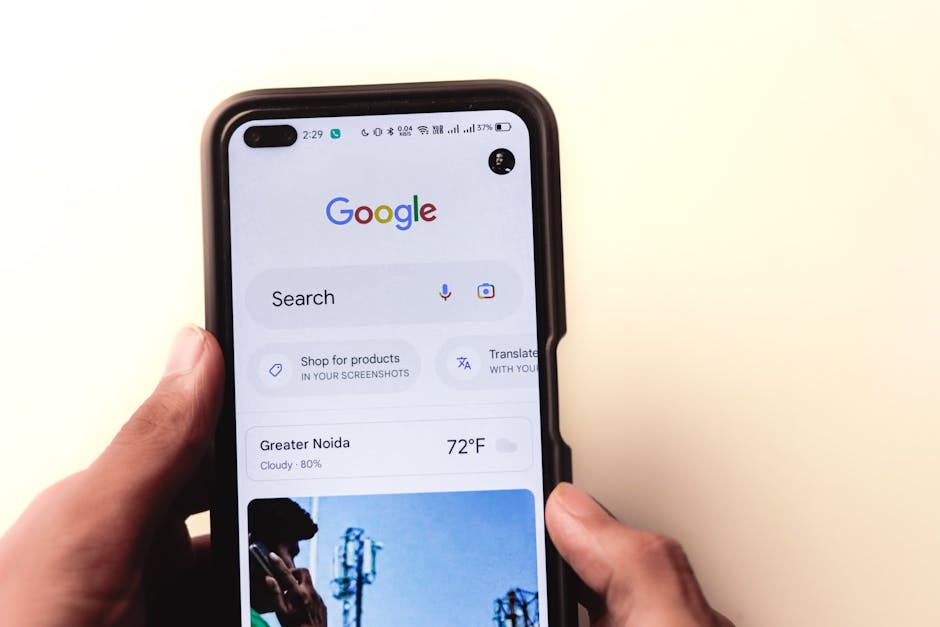
Google Local Services Ads (LSAs) are a game-changer for local law firms. They appear at the absolute top of the search engine results page—even above traditional PPC ads and organic map packs.
Unlike traditional PPC, where you pay every time someone clicks your ad (regardless of whether they contact you), LSAs operate on a pay-per-lead model. You only pay when a prospect calls, leaves a voicemail, or sends a text message through the ad.
LSAs rely heavily on trust signals. To run them, your firm must pass Google’s rigorous screening process, which includes license verifications, insurance checks, and background checks for your attorneys. Once passed, your ads display a prominent “Google Screened” badge.
Because they showcase your firm’s Google review rating, have built-in click-to-call functionality for mobile users, and carry Google’s stamp of approval, LSAs are incredibly effective at driving highly qualified local phone calls.
Best Practices for High-Converting Legal Ad Campaigns
To prevent your budget from being wasted on empty clicks, your campaigns must be structured with precision. This involves writing compelling, benefit-driven ad copy that speaks directly to a prospect’s pain points, utilizing clear calls-to-action (like “Call for a Free Consultation”), and conducting continuous A/B testing on your headlines and descriptions.
Keyword Selection and Negative Keywords
Most law firms lose money on PPC because they target broad keywords like “lawyer” or “attorney.” These keywords are incredibly expensive and attract low-intent searches. Instead, focus on long-tail, high-intent keywords like “car accident lawyer near me” or “workers comp attorney in Houston.”
Equally important is maintaining a strict list of negative keywords. Negative keywords prevent your ads from showing up on irrelevant searches. For example, if you do not handle pro bono cases, you should add “free,” “pro bono,” “jobs,” and “salary” as negative keywords. This simple step protects your budget from burning through cash on searchers who have no intention of hiring a private firm.
Landing Page Optimization and Geofencing
Your ad is only half the battle; the landing page is where the conversion actually happens. Never send paid traffic to your firm’s homepage. If someone clicks an ad for a DUI lawyer, they should land on a dedicated page focused exclusively on DUI defense, featuring a prominent phone number, a simple contact form, and proof of your past success.
With mobile devices driving the vast majority of legal searches, your landing pages must load in under two seconds and feature one-touch “Click-to-Call” buttons.
Additionally, you can use geofencing and precise location targeting to reach prospects when they are in specific physical areas. For example, personal injury firms can set tight geographic parameters around local hospitals, emergency rooms, and chiropractic clinics, while criminal defense firms can target areas near county jails or courthouses.
Ethical Compliance in Legal Advertising
The legal industry is heavily regulated, and your ads must comply with the strict rules set by your state’s bar association. Making misleading claims, promising specific financial outcomes, or using prohibited terms like “specialist” or “expert” (unless officially certified by your state bar) can land your firm in hot water.
To ensure your campaigns generate cases without risking your license, review these essential guides:
- Stay Clean, Stay Green: Your Guide to Ethical Legal Ads
- Integrity in Advertising: Your Guide to Ethical Legal Marketing
Frequently Asked Questions about Legal PPC
How much do law firms typically spend on PPC advertising per month?
While some small practices spend around $3,000 per month, the recommended minimum budget for a competitive market is $4,000 to $5,000 per month. Highly competitive practice areas like personal injury in major metropolitan areas often require budgets of $10,000+ per month to remain competitive.
What is the difference between PPC and LSAs for attorneys?
With traditional PPC, you bid on keywords and pay per click, regardless of whether the user contacts your firm. With LSAs, your ads appear at the very top of Google, carry a “Google Screened” badge, and you only pay when a prospect actually calls or messages your firm directly through the ad.
How can law firms protect their ad campaigns from click fraud?
Click fraud occurs when competitors or bots repeatedly click your ads to drain your budget. You can protect your campaigns by utilizing Google’s built-in click fraud filters, implementing IP blocking for suspicious activity, and using specialized click-monitoring software to detect and block fraudulent behavior in real time.
Conclusion
Paid advertising is one of the fastest, most reliable ways to scale your law firm’s case acquisition. However, because legal keywords are among the most expensive in the world, running successful campaigns requires deep technical expertise, constant optimization, and a focus on actual signed cases rather than vanity metrics like clicks or impressions.
At Triple Digital, a Houston-based digital marketing agency specializing in lead generation and case acquisition for law firms, we take a results-driven, “less fluff, more cases” approach. We leverage advanced data mining and precise AI targeting to ensure your ad budget is spent only on the prospects most likely to become high-value clients.
Ready to stop paying for empty clicks and start signing more cases? Let’s Talk today.