
Why Lawyer Website SEO Determines Whether Clients Find You or Your Competitor
Lawyer website SEO is the process of optimizing your law firm’s website so it ranks higher on Google and attracts more potential clients organically. Here’s what it involves at a glance:
- Keyword research – Target the terms your potential clients actually search for
- Quality content – Publish authoritative, attorney-reviewed pages that answer real questions
- Technical performance – Ensure your site loads fast, works on mobile, and is easy to crawl
- Local SEO – Appear in the Google Map Pack when nearby clients search for legal help
- Backlink building – Earn links from trusted sources to grow your site’s authority
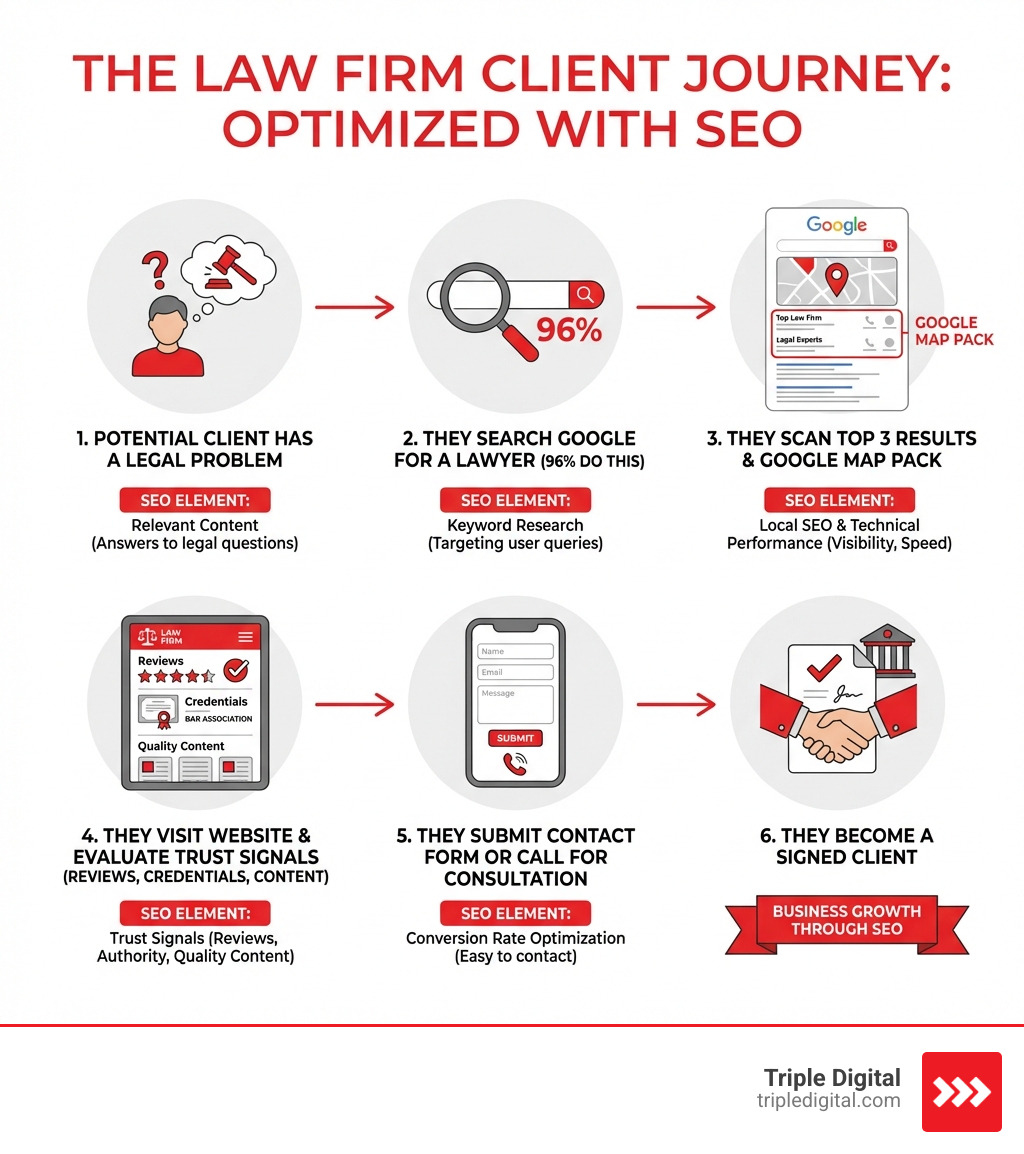
96% of people seeking legal advice start with an online search. That’s nearly every potential client you could ever have.
Yet most law firms are invisible on Google. They rely on referrals, word of mouth, or expensive pay-per-click ads that stop working the moment the budget runs out.
The firms showing up at the top of search results aren’t necessarily the best lawyers. They’re the ones with the best-optimized websites.
And here’s the thing: organic SEO compounds over time. Unlike PPC ads that cost law firms $9,000–$10,000 per month on average, a well-executed SEO strategy keeps delivering leads long after the initial work is done.
This guide walks you through exactly how to optimize your law firm’s website to rank higher, attract qualified leads, and convert more visitors into consultations.
Lawyer website seo terms you need:
- Local SEO for Law Firm
- Search Engine Optimization for Family Law Attorneys
- SEO Services for Law Firms
Mastering the Fundamentals of Lawyer Website SEO
When we talk about lawyer website seo, we are essentially discussing how to make your firm the most attractive option to search engine algorithms. Google doesn’t just “guess” which firm is the best; it uses a complex set of rules to evaluate your site’s relevance and authority.
Think of SEO as a three-legged stool. If one leg is weak, the whole thing topples over. Those three pillars are:
- Content: Does your site answer the questions potential clients are asking?
- Backlinks: Do other reputable websites vouch for you by linking to your pages?
- Technical SEO: Can search engine bots easily “read” and navigate your site?

Understanding Mastering Law Firm SEO: Your Blueprint for Online Success means recognizing that search engines exist to help people find what they’re looking for. If someone in Houston searches for a “divorce lawyer,” Google wants to provide the most helpful, local, and trustworthy result possible.
Many attorneys ask us if they should just stick to Pay-Per-Click (PPC) advertising. While PPC can get you leads today, it is a “rented” strategy. Once you stop paying, the leads stop. SEO is an “owned” asset. It is a marathon, not a sprint, but the long-term ROI is significantly higher.
| Feature | Organic SEO | Pay-Per-Click (PPC) |
|---|---|---|
| Cost | Upfront investment, but “free” traffic over time | High monthly spend ($9k-$10k avg for lawyers) |
| Sustainability | Leads continue even if you pause work | Leads stop the moment the budget hits zero |
| Trust | Users trust organic results more than “Ad” tags | Some users skip ads entirely |
| Speed | Takes 3–6 months to see real impact | Results can be seen within 24 hours |
There are many Reasons to Use Law Firm SEO, but the most compelling is market share. Only about 0.63% of users ever click to the second page of Google. If you aren’t in the top ten results, you are missing out on over 99% of potential traffic.
Step 1: Conduct Keyword Research for High-Intent Leads
Keyword research is the foundation of any successful lawyer website seo strategy. You need to know exactly what your potential clients are typing into the search bar when they are in crisis.
If you are a personal injury attorney in Houston, you might think “lawyer” is your best keyword. But that is too broad. You want high-intent keywords—terms used by people who are ready to hire someone now.
We look at three main factors:
- Search Volume: How many people are searching for this term each month?
- Competition: How many other firms are trying to rank for it?
- Intent: Is the searcher just curious, or do they need an attorney immediately?
For example, there are about 3,000 searches each month for “law firm near me” and 2,800 searches for “personal injury law firms near me.” These are high-intent, local phrases that drive business. Understanding Why SEO is Important for Attorneys starts with capturing these ready-to-hire clients.
Identifying High-Intent Keywords for Lawyer Website SEO
We categorize keywords into two main types: Transactional and Informational.
- Transactional Intent: “Houston car accident lawyer,” “best criminal defense attorney,” or “law firm near me free consultation.” These searchers are looking for a service provider.
- Informational Intent: “What to do after a car accident” or “how long does a divorce take in Texas.” These searchers are looking for answers.
While transactional keywords lead to immediate calls, informational keywords help you build authority. By using Top 3 Digital SEO Strategies for Law Firms, you can create a “topic cluster” where your blog posts about legal questions link back to your main service pages, signaling to Google that you are an expert in your field.
Analyzing Competitor Keyword Gaps
Don’t just look at what you’re doing; look at what your competitors are doing. Use tools like Ahrefs or Semrush to see which keywords are driving traffic to the firms down the street.
Are they ranking for “workplace injury lawyer” while you’re only focusing on “car accidents”? That’s a keyword gap. By identifying these niches, you can target underserved areas of the market and capture leads your competitors are ignoring.
Step 2: Create Authoritative Content and E-E-A-T Signals
Google treats legal websites differently than a blog about cat photos. Because legal advice affects a person’s well-being and finances, Google classifies law firm sites as YMYL (Your Money or Your Life).
This means you are held to a higher standard of E-E-A-T:
- Experience: Does the content reflect real-world legal practice?
- Expertise: Is the author a qualified legal professional?
- Authoritativeness: Is your firm recognized as a leader in your field?
- Trustworthiness: Is the information accurate and the site secure?
To satisfy these requirements, every page on your site should be high-quality and, ideally, attorney-reviewed. Advanced SEO: Authoritative Content is about more than just word count; it’s about providing genuine value.
Content Formats that Drive Lawyer Website SEO Results
To maximize your lawyer website seo, you need a variety of content formats:
- Practice Area Pages: These are your “money pages.” They should be over 1,000 words, explain the legal process in plain language, and include clear calls to action (CTAs).
- Legal Blogs: Use these to answer common client questions. For example, “How is child support calculated in Texas?”
- Case Studies/Results: Showing that you’ve won $1M+ settlements for clients builds massive trust.
- FAQ Sections: Answering frequently asked questions directly on your page can help you appear in Google’s “People Also Ask” boxes.
Whether you are handling personal injury or Family Matters: Boosting Your Firm’s Online Presence with Tailored SEO, your content must guide the user from the “awareness” stage (I have a problem) to the “decision” stage (I should hire this firm).
Optimizing On-Page Elements for Conversion
Once you have great content, you need to make sure search engines can find it. This is where on-page optimization comes in:
- Title Tags: Keep them between 55-60 characters. Include your primary keyword and location (e.g., “Houston Personal Injury Lawyer | Your Firm Name”).
- Meta Descriptions: These are the “sales pitches” in search results. Keep them under 155 characters and include a CTA.
- Header Tags (H1, H2, H3): Use a logical hierarchy. Your H1 should contain your main keyword.
- Internal Linking: Link from your blog posts to your practice area pages to distribute “link juice” and keep users on your site longer.
- Alt Text: Add descriptive text to your images so search engines know what they are.
Step 3: Optimize Technical Performance and Local Visibility
You could have the best legal content in the world, but if your site takes 10 seconds to load, no one will ever read it. Technical SEO is the “behind-the-scenes” work that ensures your site is fast, secure, and mobile-friendly.
Recent data shows the average web page load time is 2.5 seconds on desktop. If your site is slower, users will “pogo-stick” back to the search results, which tells Google your site isn’t a good result. To see how you’re doing, we recommend using Google PageSpeed Insights.
Key technical factors include:
- Core Web Vitals: Metrics like Largest Contentful Paint (LCP) and Cumulative Layout Shift (CLS) that measure speed and visual stability.
- Mobile-First Indexing: Google now primarily uses the mobile version of your site for ranking. If your site is clunky on a phone, you won’t rank.
- HTTPS Security: No one wants to share their legal details with an “Unsecured” website.
- XML Sitemaps: This is a map you give to Google to help it find all your pages.
Understanding Law Firm SEO: What Are the Most Important SEO Ranking Factors is essential for any firm looking to scale.
Dominating the Local 3-Pack
For most law firms, local search is everything. When someone searches “lawyer near me,” Google shows the “Local 3-Pack”—the three businesses featured next to the map.
To get there, you must:
- Claim your Google Business Profile: Fill out every section, add photos of your office, and list your hours.
- Maintain NAP Consistency: Your Name, Address, and Phone number must be exactly the same across the web (your site, Yelp, Avvo, etc.).
- Get Reviews: 70% of clicks in local searches go to the firms in the 3-pack, and reviews are a major ranking factor. Respond to every review, even the bad ones!
We recommend you Stop Wasting Money: The Ultimate Guide to Local SEO for Your Law Firm by focusing on these high-impact local signals.
Building a High-Authority Backlink Profile
Backlinks are like votes of confidence. When a reputable site links to yours, it tells Google you are an authority. However, not all links are created equal. One link from a major legal directory or a news site is worth more than 1,000 links from random, low-quality blogs.
Effective strategies for law firms include:
- Legal Directories: Get listed on Avvo, Justia, and Lawyers.com.
- Guest Posting: Write articles for legal publications or local Houston community blogs.
- Digital PR: Use tools like HARO (Help a Reporter Out) to provide quotes for news stories in exchange for a link.
Be careful not to “buy” links or use “black-hat” tactics. Don’t Get Sued by Bad SEO: Finding Top Agencies for Your Law Firm is a real concern if you hire an agency that uses shady methods that could lead to a Google penalty.
Frequently Asked Questions about Legal SEO
Is SEO still relevant for law firms in the age of AI?
Absolutely. While AI tools like ChatGPT are changing how people find information, those AI models are trained on the very content that SEO experts produce. Furthermore, Google is now using “AI Overviews” in search results, which often cite the most authoritative, well-optimized websites. By focusing on lawyer website seo now, you are future-proofing your firm to be the source that AI tools recommend.
How long does it take to see results from lawyer SEO?
SEO is a long-term investment. While you might see some minor improvements in 30 days, it typically takes 3 to 6 months to see a significant impact on your rankings and lead volume. This is because it takes time for Google to crawl your new content and for your backlink profile to grow. However, once you achieve those top spots, the traffic is much more stable and cost-effective than ads.
How much should a law firm budget for SEO services?
Budget varies based on the size of your market and your goals. For monthly retainer rates, $501–$1,000 per month is a standard starting point for many firms, though highly competitive markets (like personal injury in Houston) may require a larger investment. When considering How Much Should Lawyers Pay for SEO, look at it as an investment in a compounding asset rather than a monthly expense.
Conclusion
The legal landscape is more competitive than ever, and a “brochure” website is no longer enough. To grow your firm in Houston and beyond, you need a strategic approach to lawyer website seo that combines high-intent keyword research, authoritative content, and rock-solid technical performance.
At Triple Digital, we help law firms stop wasting money on “fluff” and start acquiring more cases. As a Houston-based digital marketing agency, we specialize in lead generation and case acquisition through AI-driven data mining and precise client targeting. We don’t just care about clicks; we care about signed cases and your bottom line.
Ready to dominate the search results and grow your practice? Rank Higher and Get More Clients Today by scheduling a consultation with our team. Let’s put your firm where it belongs: at the top.