
Why Ethical Legal Advertising Matters for Your Firm
Ethical legal advertising means promoting your law firm in a way that is truthful, not misleading, and compliant with your state bar’s rules — and it’s the foundation of any sustainable legal marketing strategy.
Here’s a quick overview of what that means in practice:
- Be truthful — All claims must be accurate and verifiable
- Avoid misleading content — This includes omissions, exaggerations, and unsubstantiated comparisons
- No false expertise claims — Don’t call yourself an “expert” or “specialist” unless properly certified
- Handle testimonials carefully — Client reviews require consent and proper disclaimers
- No direct solicitation — You can’t contact prospective clients in person or in real time for financial gain
- Include required disclosures — Firm name, office address, and fee disclaimers are often mandatory
- Keep copies of your ads — Most states require retention for 1–3 years
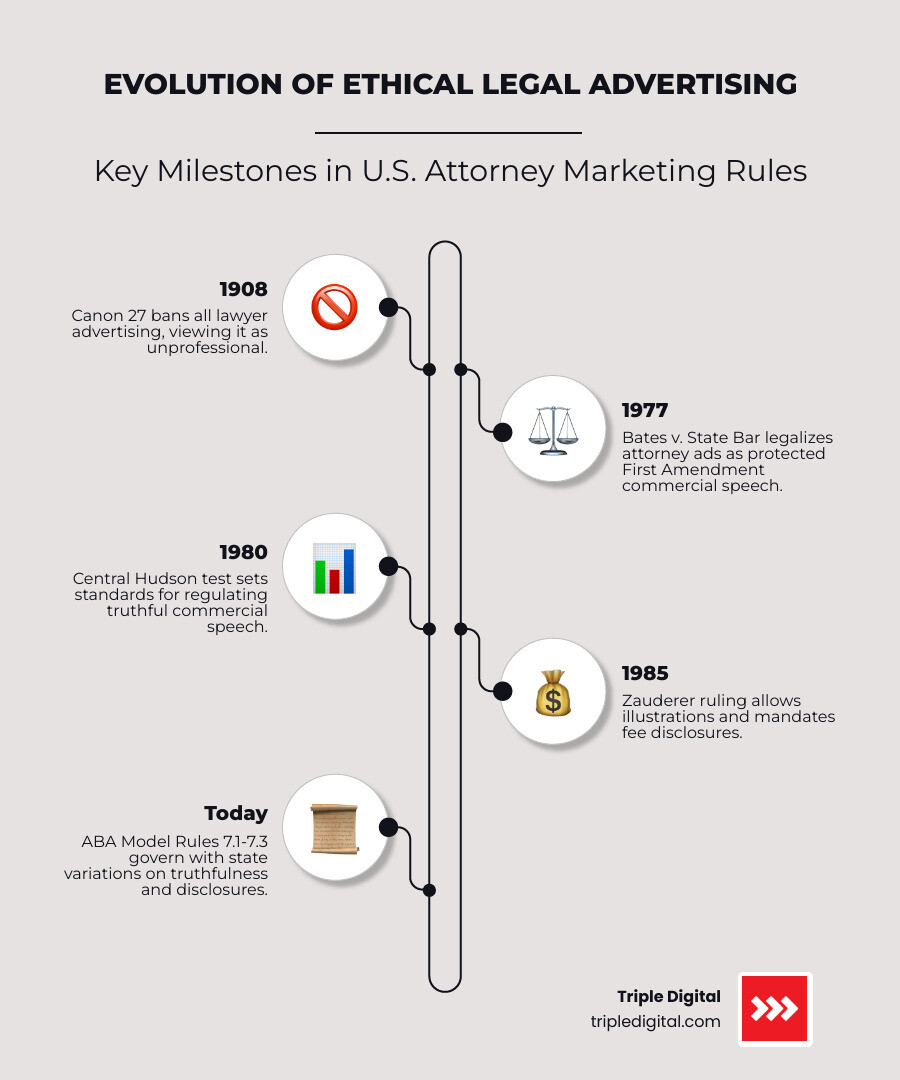
Before 1977, lawyers in the U.S. were completely banned from advertising. Then the Supreme Court changed everything with Bates v. State Bar of Arizona, ruling that attorney advertising is protected commercial speech under the First Amendment.
That opened the floodgates — but it didn’t remove all limits.
Today, every state has rules governing what lawyers can and can’t say in their marketing. The ABA Model Rules (especially Rules 7.1–7.3) set the baseline. But state bars layer on their own requirements, and the gaps between them can catch even experienced attorneys off guard.
The stakes are real. Violating advertising rules can mean disciplinary action, fines, or suspension. And beyond the legal risk, misleading ads erode public trust in your firm — which is the opposite of what good marketing should do.
This guide walks you through exactly what the rules require, where the common traps are, and how to market your firm confidently and compliantly.
Simple ethical legal advertising glossary:
The Core Pillars of Ethical Legal Advertising
At its heart, ethical legal advertising is built on one simple commandment: Thou shalt not lie. But in the legal world, “lying” is a lot broader than just making things up. It includes anything that might give a potential client the wrong idea.
The primary rule you need to know is ABA Model Rule 7.1. This rule prohibits any communication about a lawyer or their services that is “false or misleading.” A communication is considered misleading if it contains a material misrepresentation of fact or law, or if it omits a fact necessary to make the statement as a whole not materially misleading.

When we evaluate whether an ad is misleading, we use the objective reasonable person standard. This means we ask: is there a substantial likelihood that a reasonable person would form an unfounded conclusion about the lawyer or their services based on the ad?
Common pitfalls under Rule 7.1 include:
- Material Misrepresentations: Claiming you won a $10 million settlement when you actually only assisted a larger firm on the case.
- Unsubstantiated Comparisons: Saying your firm is “the best in Houston” or “cheaper than Firm X” without objective data to back it up.
- Unjustified Expectations: Promising a “guaranteed win” or using slogans that imply you can achieve results through influence rather than the merits of the case.
Even if a statement is technically true, it can still be misleading if it leaves out crucial context. For example, advertising a “free consultation” but failing to mention it only lasts five minutes while your average intake takes thirty could be seen as deceptive. For those looking to grow their presence while staying within these lines, understanding Law Firm SEO: What Are the Most Important SEO Ranking Factors? is essential for ethical visibility.
Different jurisdictions have specific interpretations. For instance, the Ohio Rules of Professional Conduct provide a solid foundation for how these rules are applied in practice, emphasizing that all information must be accurate and not misleading.
Navigating Expertise and Specialization in Ethical Legal Advertising
We all want to be seen as the best in our field, but in legal marketing, words like “expert” and “specialist” are loaded with regulatory meaning. Under ABA Rule 7.2(c), you generally cannot state or imply that you are a certified specialist in a particular field of law unless you have been actually certified by an organization approved by your state bar or accredited by the ABA.
If you aren’t certified, you can still talk about your experience. You can say you “focus on,” “practice in,” or even “specialize in” (in some jurisdictions) a specific area, provided it’s truthful. However, claiming to be a “Certified Specialist” without the paperwork is a fast track to a bar complaint.
The rules vary significantly by state:
- In California, there are very specific requirements to be considered a legal specialist, involving peer evaluations and exams.
- In Ohio, recent Amendments eff. April 15, 2024.pdf) have expanded the ability of attorneys to communicate their specialization, but the core requirement for formal certification remains.
The takeaway? Stick to facts. Instead of saying “I am the expert on truck accidents,” try “I have handled over 500 truck accident cases in the last decade.” It’s just as impressive and much safer.
Ethical Legal Advertising and Client Testimonials
Client reviews are the lifeblood of modern marketing. They build social proof and trust. However, they are also one of the most regulated areas of ethical legal advertising.
The biggest rule here is consent. You should never use a client’s name or story in an ad without their written informed consent. This applies even to Google and Yelp reviews if you decide to pull them onto your own website for marketing purposes.
According to Ohio Advisory Opinion 2016-8 Client Testimonials in Lawyer Advertising and Online Services, testimonials must be uncompensated. You cannot pay a client for a good review, nor can you offer “quid pro quo” arrangements.
Furthermore, testimonials must not create “unjustified expectations.” If a client says, “This lawyer got me $1 million in two weeks!” you must include a clear disclaimer stating that past results do not guarantee future outcomes. This helps prevent a “reasonable person” from assuming they will get the exact same result.
For more on how to use these reviews effectively on social platforms, check out our guide on From Likes to Leads: Mastering Social Media for Attorneys. As noted in the State Bar of California’s Comment [4] to the new Rule 7.1, the goal is to inform the public without misleading them into expecting identical success.
Constitutional Protections and Regulatory Boundaries
To understand why we can advertise at all, we have to look at the Supreme Court. The Central Hudson test is the standard used to determine if a government regulation on commercial speech (like legal ads) is constitutional. To be valid, the regulation must:
- Concern lawful activity and not be misleading.
- Serve a substantial government interest.
- Directly advance that interest.
- Be no more extensive than necessary.
A landmark case in this area is Zauderer v. Office of Disciplinary Counsel. In 1985, Philip Zauderer ran a newspaper ad featuring a line drawing of a Dalkon Shield IUD to attract women who had been injured by the device. The ad was incredibly successful: it led to inquiries from over 200 women and resulted in lawsuits for 106 of them.
At the time, Ohio had a blanket ban on illustrations in attorney ads. The Supreme Court struck that down, ruling that truthful illustrations are protected. However, the Court upheld the requirement that lawyers must disclose if a client will be liable for costs (as opposed to fees) in a contingent fee arrangement.
The Zauderer Supreme Court Opinion remains a cornerstone of ethical legal advertising. It reminds us that while we have the right to use illustrations and dramatizations, we also have an obligation to be transparent about the financial side of the relationship. This transparency is part of Why SEO is Important for Attorneys; it ensures that the traffic you generate is built on a foundation of trust.
The Dalkon Shield Context:
- By 1979, an estimated 2,500 claims had been made for injuries.
- By mid-1980, lawsuits rose to 4,000.
- By the end of 1984, the manufacturer settled 6,289 cases, with 3,600 still pending.
These statistics show the massive impact a single, truthful advertisement can have on public health and legal access.
Transparency in Fees and Firm Disclosures
One of the most common areas for ethical violations is the disclosure of fees. If you advertise a “contingent fee” or “no win, no fee” arrangement, you must be incredibly clear about what that actually means.
In many jurisdictions, “fees” and “costs” are different things. If a client still has to pay for filing fees, expert witnesses, or court reporters even if they lose, your ad must say so. Failing to distinguish between the two is considered deceptive because it implies the legal process is entirely free for the client. The Ohio Advisory Opinion 2017-1 Advertisement of Contingent Fee Arrangements provides clear guidance: provide accurate info about liability for costs to avoid misleading the public.
Office Address and Identifying Information You can’t be a “ghost” law firm. Most states require you to include the name of at least one lawyer or the firm name, and often a physical office address.
- In Florida, Rule 4-7.12(a)(2) requires all lawyer advertisements to have a real office location in the same city, town, or county where the lawyer performs the services.
- New York’s Ethics Opinion 1017 clarifies that while you can use partner initials in a firm name, you generally cannot use a trade name that is misleading or implies a connection to a government agency.
| Requirement | Florida | New York | Ohio | Texas |
|---|---|---|---|---|
| Physical Office Address | Required in same city/county | Required on website/ads | Required (Rule 7.2c) | Required |
| Attorney Name | At least one required | Required | Required | Required |
| Trade Names | Allowed if not misleading | Generally prohibited | Allowed | Allowed |
| Fee Disclosures | Must clarify costs | Must clarify costs | Must clarify costs | Must clarify costs |
Modern Challenges: Solicitation, Fearmongering, and Digital Compliance
The line between “advertising” and “solicitation” is one you do not want to cross. Advertising is a communication directed to the general public (like a billboard or a Google search ad). Solicitation is a communication directed to a specific person known to need legal services.
Under ABA Rule 7.3, you generally cannot solicit professional employment through live, person-to-person contact (in person, on the phone, or via real-time video) when your motive is financial gain. The reason? It’s too easy to overwhelm or pressure someone who is in a vulnerable state.
The Rise of “Health Alerts” and Fearmongering Recently, several states have cracked down on legal ads that look like government health warnings. These ads often use terms like “Health Alert” or “Medical Warning” to scare people into calling a law firm.
- Texas’ S.B. 1189 prohibits presenting a TV ad as a medical alert or public service announcement. It also requires a warning: “Do not stop taking a prescribed medication without first consulting your doctor.”
- Florida’s H.B. 1205 prohibits the use of government logos and requires written consent before sharing private health information gathered from these ads.
- Louisiana’s S.B. 383 mandates that ads disclose attorney fees from past settlements and prohibits misleading portrayals.
These laws are designed to prevent “fearmongering” that could lead patients to stop taking necessary medications. Even the FTC weighs in here; their Advertising and Marketing Basics emphasize that all claims must be evidence-based and non-deceptive. This is why a solid Digital Marketing Strategies Law Firm plan always prioritizes compliance alongside conversion.
Frequently Asked Questions about Ethical Legal Advertising
How long must I keep copies of my legal advertisements?
The “why” is simple: if the Bar ever questions your ad, you need to prove what you actually said. Retention periods vary by state. For example, Rule 7.1 New York requires lawyers to keep copies of ads for at least three years. In other states, it might only be one year. This includes digital content; for websites, New York requires the content to be preserved at least every 90 days. Always archive your social media posts, landing pages, and email campaigns.
Can I use a trade name like “The Injury Pros” in my marketing?
This depends entirely on where you practice. In some states, practicing under a trade name is not allowed. New York is famously strict about this, often requiring firms to use the names of current or deceased partners. However, many other states allow trade names as long as they aren’t misleading. You can’t call yourself “The Supreme Court Law Firm” because it implies a government connection. Always check your local rules before branding your firm around a catchy pseudonym.
What is the difference between advertising and prohibited solicitation?
The difference lies in the targeting and the medium. Advertising is “one-to-many” (a blog post, a billboard, a YouTube ad). Solicitation is “one-to-one” and usually involves “live” contact. Sending a direct mail piece to someone who was recently in a car accident is often allowed (provided you label it as “Advertising Material”), but calling them on the phone or showing up at their hospital room is prohibited. To stay safe, ensure you Don’t Get Sued by Bad SEO: Finding Top Agencies for Your Law Firm who might use “black hat” tactics that mimic solicitation.
Conclusion
Navigating ethical legal advertising doesn’t have to be a minefield. By focusing on truthfulness, transparency, and a deep respect for the rules set by your state bar, you can build a marketing engine that not only brings in cases but also enhances your firm’s reputation.
At Triple Digital, we live by a “less fluff, more cases” philosophy. Based in Houston, TX, we specialize in lead generation and case acquisition for law firms using a results-driven approach. We leverage AI and data mining for precise client targeting, ensuring that your ads reach the right people at the right time — all while staying strictly within ethical boundaries.
If you’re ready to grow your firm with a partner who understands both the art of marketing and the science of compliance, we’re here to help.