
Why Legal Client Acquisition Matters More Than Ever
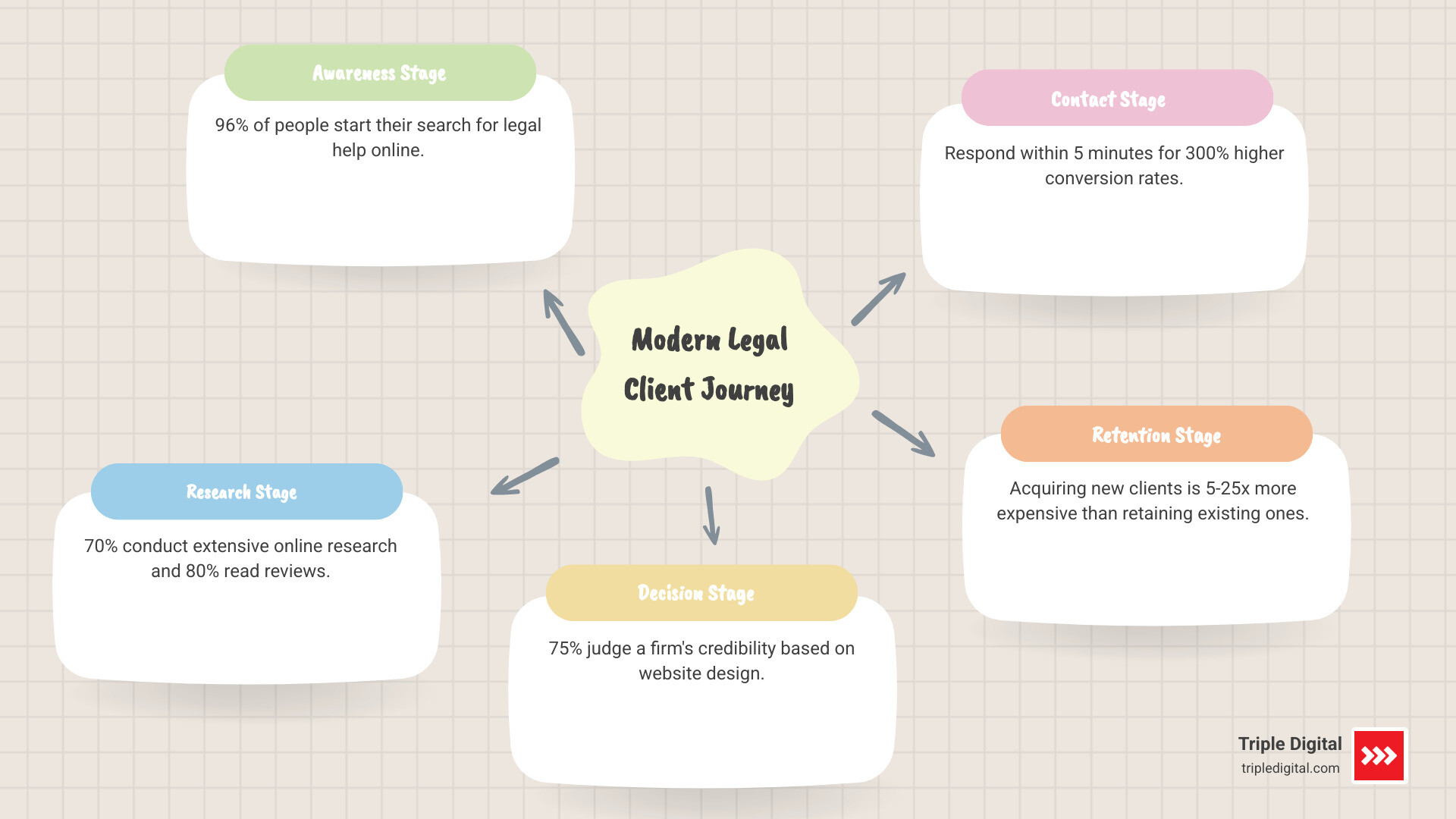
Legal client acquisition has become one of the most pressing challenges facing law firms today. With 96% of people now beginning their search for legal help online, the traditional methods of finding clients—word-of-mouth referrals, phone book ads, and local networking alone—are no longer sufficient to sustain a thriving practice.
Quick Answer: How to Acquire Legal Clients
- Build a strong digital foundation – Professional website, mobile optimization, clear calls-to-action
- Dominate local search – SEO, Google Business Profile, and online reviews
- Create valuable content – Answer client questions through blogs, videos, and practice area pages
- Leverage paid advertising – PPC campaigns for immediate visibility
- Nurture referral relationships – Professional networks and exceptional client service
- Optimize your intake process – Respond within 5 minutes to increase conversion by 300%
- Track and measure results – Monitor KPIs to understand what’s working
The legal market has transformed dramatically. Clients are more informed, more selective, and expect transparent pricing, fast response times, and seamless communication. They’re conducting extensive online research before ever picking up the phone—70% conduct online searches before making contact—and making high-stakes decisions based on what they find.
For many law firms, especially smaller practices, this creates a perfect storm. Fee earners are juggling client service with business development, stretched thin between delivering legal expertise and finding the next case. Meanwhile, acquiring a new client costs 5-25 times more than retaining an existing one, yet most firms still prioritize acquisition over retention.
The good news? Law firms that adapt their strategies to this new reality are thriving. They’re combining cutting-edge digital marketing with time-tested relationship building. They’re using data to make smarter decisions. And they’re implementing systems that convert more leads into paying clients.
This guide will show you exactly how to do the same—no fluff, just proven strategies that drive real cases.
Laying the Foundation: Define Your Ideal Client and Value Proposition
The legal market in Houston, like many major cities, is increasingly crowded. With a plethora of choices available, clients are more discerning than ever. This means that to succeed in legal client acquisition, we must first understand the landscape: increasing market competition, evolving client expectations, and the undeniable need for transparency and accessibility.
Clients today aren’t just looking for a lawyer; they’re looking for a trusted advisor who understands their unique situation, communicates clearly, and provides a seamless, stress-free experience. This shift demands that law firms move beyond generic marketing and focus on precision. If you’re feeling overwhelmed by the thought of strategizing, expert guidance is available to help steer these complexities. More info about law firm consulting can provide the strategic direction your firm needs.
Building a Foundation for Sustainable Legal Client Acquisition
Before we even think about marketing tactics, we need to answer a fundamental question: Who are we trying to reach? Identifying your target market and focusing on niche practice areas is paramount. This isn’t about excluding potential clients; it’s about concentrating our resources where they’ll have the greatest impact. For instance, a firm specializing in maritime law in Houston will have a very different target audience than one focused on family law.
Determining your target market involves analyzing your existing client base, understanding their demographics and firmographics, and then comparing that to the broader market. Our goal is to pinpoint the specific types of clients who are high-reward and low-effort, allowing us to strategically steer clear of those that drain resources.
Once we know who we’re talking to, we can craft a Unique Value Proposition (UVP). This is what makes your firm stand out. Is it specialized expertise in a complex area of law? Exceptional client service that goes above and beyond? A unique fee structure? Your UVP should clearly articulate the benefits of choosing your firm over the competition. Conducting competitive analysis helps us understand what others are offering and where we can differentiate ourselves in the crowded Houston legal marketplace.
Your Website: The Digital Hub for Attraction and Conversion
Your law firm’s website is often the first impression a potential client has of your practice. And as we know, first impressions count! Studies show that 75% of website visitors judge credibility based on design and testimonials. A clunky, outdated website can unconsciously signal a firm that’s out of touch.
More than just looking good, your website needs to be a high-performance machine. With over 60% of legal service searches occurring on mobile devices, mobile-first design is no longer optional—it’s essential. Imagine a potential client in Houston searching for a lawyer on their phone after an accident. If your site loads slowly or is difficult to steer on a small screen, they’ll bounce to a competitor. In fact, 47% of law firm websites fail Google’s recommended 3-second load time, a critical benchmark for user experience.
Our websites must be fast, responsive, and provide a seamless experience across all devices. Clear calls-to-action (CTAs) are vital, guiding visitors on what to do next, whether it’s “Book Your Free Consultation” or “Download Our Free Legal Guide.” Showcasing client testimonials and success stories also builds trust and credibility, turning casual browsers into qualified leads. For more insights on this, read about How Web Design Can Make Your Business More Profitable.
Mastering Digital Dominance for Legal Client Acquisition
Now that we’ve laid the groundwork, it’s time to dive into the digital strategies that will drive your legal client acquisition efforts. The digital landscape has fundamentally transformed how law firms attract clients, making it crucial to have a robust online presence. As a leading Online Presence: Digital Marketing Agency, we understand that success hinges on mastering these tactics.
The importance of organic search cannot be overstated: 53% of all website traffic comes from organic search. This means appearing prominently in search results is like having a prime storefront on the busiest street in Houston, attracting potential clients who are actively looking for legal services.

Dominating Search with SEO and Google Business Profile
Search Engine Optimization (SEO) is the backbone of modern legal client acquisition. It’s how we ensure your firm appears at the top of search results when potential clients are searching for legal help. Why SEO is Important for Attorneys is simple: Visibility equals opportunity.
For law firms in Houston, local SEO is particularly critical, as 46% of all Google searches are location-specific. This means optimizing your online presence to attract clients in your immediate geographic area. A cornerstone of local SEO is your Google Business Profile (GBP). Claiming your free Google Business Profile allows us to manage your firm’s information, respond to reviews, and showcase your services directly in local search results and Google Maps. These local listings are often the first point of contact for clients seeking immediate help.
The power of online reviews in building trust and driving inquiries is immense. 80% of potential clients consider reviews and testimonials before hiring a lawyer. Positive reviews act as powerful social proof, while prompt and professional responses to all feedback, positive or negative, demonstrate your commitment to client satisfaction. Don’t miss these 5 GMB Hacks Not to Miss to Generate More Leads for boosting your local presence.
Creating Compelling, SEO-Optimized Content
Content marketing is where your firm establishes authority and connects with potential clients on a deeper level. Why Do Law Firms Need a Content Marketing Strategy? Because it allows us to answer the questions potential clients are asking, often before they even realize they need a lawyer. 89% of law firms consider content marketing “very important” to their overall strategy, and for good reason.
Producing SEO-optimized content means creating valuable, informative pieces that not only resonate with your audience but also signal to search engines that your firm is a trusted source of information. This includes:
- “How-to” guides: “How to File for Divorce in Texas”
- Case studies: anonymized examples of successful outcomes for clients.
- FAQ pages: “Frequently Asked Questions About Personal Injury Claims in Houston”
- Local legal news updates: Commentary on new Texas laws impacting your practice area.
- Videos: Explaining complex legal concepts in an easy-to-understand format.
We focus on creating content that directly answers common client questions, utilizing long-tail keywords that capture specific legal queries. This approach is crucial not just for traditional SEO, but also for Answer Engine Optimization (AEO) and Generative Engine Optimization (GEO), ensuring your firm appears in AI-powered search results and featured snippets.
Engaging Leads with Email and Social Media Marketing
Once we’ve attracted potential clients to your digital ecosystem, the next step is to engage and nurture them. This is where email marketing and social media come into play. Law Firm Marketing with Social Media offers powerful avenues for building relationships and staying top-of-mind.
Email marketing boasts an incredible ROI: it delivers $42 for every $1 spent. It’s our silent, consistent closer, perfect for nurturing leads who aren’t ready to commit yet, staying in touch with past clients, and gently reminding prospects of your firm’s expertise. We can use automated sequences to send valuable content, firm updates, and special offers, changing cold leads into warm prospects.
Social media platforms like LinkedIn and Facebook are essential for building trust and authority. While LinkedIn is a goldmine for B2B and corporate law practices, Facebook offers massive reach for consumer-facing practices, with 71% of law firms using social media for marketing. We can leverage these platforms to share valuable content, engage in direct communication, and even run targeted ad campaigns. For instance, How Facebook Advertising Can Bring Traffic to Your Website details how to target specific demographics in Houston who might be in need of your services.
Implementing Paid Advertising (PPC) for Immediate Impact
While SEO builds long-term organic visibility, sometimes you need immediate impact. That’s where Paid Advertising, or Pay-Per-Click (PPC), comes in. The benefits of PPC advertising are clear: it provides immediate visibility for your firm, placing your ads at the top of search results for relevant keywords.
For law firms in Houston, geographic targeting is a powerful feature, allowing us to show ads only to potential clients within specific zip codes or neighborhoods who are actively searching for legal help. We can also segment campaigns by practice area, ensuring that someone searching for “Houston personal injury lawyer” sees your personal injury ad, not an estate planning ad.
Pay-per-click advertisements (PPC) also allows for advanced strategies like remarketing, which keeps your firm at the top of a lead’s mind even after they’ve left your website. We develop optimized landing pages specifically designed to convert ad clicks into inquiries, and carefully manage budgets to ensure maximum return on investment. Ethical considerations are always paramount, ensuring our ad copy aligns with industry standards while still being compelling.
The Enduring Power of Relationships and Referrals
While digital marketing has revolutionized legal client acquisition, we must never forget the enduring power of human connection. The statistics are clear: acquiring a new customer costs 5-25 times more than retaining an existing one. Yet, surprisingly, 44% of businesses prioritize customer acquisition while only 18% focus on retention. This imbalance represents a huge missed opportunity.
Investing in strong relationships and exceptional client service not only fosters loyalty but also turns satisfied clients into powerful advocates for your firm.
Building a High-Value Referral Engine
Referrals remain a cornerstone of legal client acquisition, even in the digital age. They are, in essence, pre-qualified leads with built-in trust. 62% of people get lawyer recommendations from a friend, colleague, or family member. Referred clients also demonstrate 25x higher lifetime value and 37% higher retention rates. These numbers speak volumes about the quality of leads generated through referrals.
Creating a robust referral program means being intentional. This involves:
- Professional Relationships: Actively building and nurturing connections with other attorneys, accountants, financial advisors, and other professionals who might encounter individuals needing legal services. Lawyers still dedicate 5-7 hours weekly to in-person networking.
- Client Referral Programs: Systematically encouraging satisfied clients to refer new business. A simple thank-you card or a small token of appreciation can go a long way.
- Community Engagement: Participating in local Houston community events, pro-bono work, and local business organizations to build goodwill and visibility.
Optimizing traditional referral methods by combining them with your digital presence amplifies their impact. When someone gets a referral, their next step is often to search for that firm online, making a strong digital footprint essential.
How Exceptional Client Service Drives Acquisition and Retention
Exceptional client service is not just good practice; it’s a powerful legal client acquisition and retention strategy. It’s the difference between a one-time client and a lifelong advocate. Clients today expect more than just legal expertise; they demand a positive experience throughout their engagement.
This includes:
- Ensuring client satisfaction: From the initial consultation to the final resolution, every interaction matters.
- Effective communication: Prompt, clear, and empathetic communication builds trust. Unfortunately, 67% of law firms fail to respond to email inquiries and 48% don’t answer or return phone calls. This is a massive opportunity for your firm to stand out!
- Transparency and accessibility: Clients want to understand processes, timelines, and costs. Utilizing client portals and transparent billing practices improves their experience.
- Optimizing the intake process: This is a crucial step. A streamlined, empathetic intake process sets the tone for the entire client relationship. Enhancing Client Satisfaction and Firm Profitability: Optimizing the Intake Process highlights how critical this is.
By balancing our efforts between acquiring new clients and retaining existing ones through superior service, we build a sustainable and thriving practice.
Future-Proofing Your Firm: Technology, Measurement, and Conversion
In the changing legal landscape, adapting to industry changes is not just an option, it’s a necessity for successful legal client acquisition. This means embracing new technologies, rigorously measuring our efforts, and continuously optimizing our conversion processes.
Advanced Technologies for Modern Legal Client Acquisition
Artificial Intelligence (AI) is no longer a futuristic concept; it’s a present-day tool that can significantly improve legal client acquisition. From improving efficiency to personalizing client interactions, AI offers exciting possibilities. Our AI Overviews show just how impactful these tools can be.
- Leveraging AI for Content and SEO: AI can assist in keyword research, content generation (for first drafts), and optimizing content for Answer Engine Optimization (AEO), ensuring your firm appears in AI-powered search results and featured snippets.
- Using Chatbots for 24/7 Client Engagement: Chatbots can answer common legal questions, qualify leads, and even schedule consultations, ensuring no potential client inquiry goes unanswered, even outside business hours. This enables 24/7 client engagement.
- Implementing CRM Systems: Customer Relationship Management (CRM) systems powered by AI can automate follow-up sequences, track lead sources, and score lead quality, ensuring no potential client falls through the cracks.
- Marketing Automation: AI-driven tools can personalize email marketing campaigns, segment audiences, and optimize ad bidding for maximum impact.
However, with great power comes great responsibility. Ethical considerations for technology use, especially AI, are paramount. We must always adhere to ABA guidance on AI use for lawyers, particularly concerning client confidentiality and the accuracy of AI-generated information.
From Lead to Client: Optimizing Your Intake and Conversion Process
Getting a lead is only half the battle; converting that lead into a paying client is the ultimate goal. Speed and efficiency are critical here. The “speed-to-lead” best practice is non-negotiable: 78% of leads go to the first lawyer who responds, and law firms responding within 5 minutes increase conversion rates by 300%. Conversely, firms responding within 5 minutes are 21 times more likely to convert leads than those waiting 30 minutes or more. This is a huge competitive advantage for your Houston firm.
Implementing structured intake systems that combine immediate response with professional qualification is vital. This ensures that valuable leads are quickly identified, nurtured, and converted. Our Law Firm Lead Tracking solutions help you manage this process seamlessly.
Understanding conversion rate benchmarks for different practice areas helps us set realistic goals and identify areas for improvement. For example:
- Personal Injury practices typically achieve 8% – 12% average conversion rates.
- Criminal Defense practices demonstrate 10% – 20% conversion rates.
- Family Law practices achieve 7% – 15% conversion rates.
- Bankruptcy Law practices show 5% – 12% conversion rates.
- Employment Law practices demonstrate 6% – 12% conversion rates.
The nationwide average new call to case conversion rate is 7%. By optimizing your intake process, your firm can significantly surpass these averages.
Measuring Success with Key Performance Indicators (KPIs)
How do we know if our legal client acquisition strategies are working? By measuring everything! Tracking marketing ROI and identifying and monitoring Key Performance Indicators (KPIs) are essential for making data-driven decisions.
Key KPIs we focus on include:
- Website traffic analysis: How many visitors are coming to your site, and where are they coming from? Tools like Google Analytics are invaluable here.
- Conversion rate tracking: What percentage of visitors are becoming leads, and what percentage of leads are becoming clients?
- Cost per lead (CPL) and Cost per Acquisition (CPA): How much are we spending to get each lead and each new client?
- Client lifetime value (CLTV): The total revenue we expect from a client over their relationship with your firm.
- Return on SEO investments: Law firms are seeing an average three-year ROI of 526% on SEO investments. For a deeper dive, consider How Much Should Lawyers Pay for SEO?.
By consistently monitoring these metrics, we can identify what’s working, what’s not, and where to allocate our resources for the best possible results. This data-driven approach is at the heart of our “less fluff, more cases” philosophy.
Frequently Asked Questions about Legal Client Acquisition
What are the most effective client acquisition strategies for a new law firm?
For new law firms, especially in a competitive market like Houston, a blended approach is most effective. Start by clearly defining your niche and ideal client. Then, prioritize building a strong online presence through a professional, mobile-friendly website and robust local SEO, including an optimized Google Business Profile. Actively seek referrals from your professional network and past connections, as these are often high-value leads. Finally, be responsive! Fast follow-up on inquiries can significantly boost your conversion rates.
How much should a law firm spend on marketing?
Marketing budgets for law firms can vary significantly. A common guideline suggests that firms spend 2% to 10% of their annual revenue on marketing. For new firms, or those looking to accelerate growth or expand into a new practice area, allocating towards the higher end of this range, or even more, is often necessary to establish a foothold and gain visibility. The key is to view marketing as an investment, not an expense, and to track its ROI diligently.
How can I measure the ROI of my marketing efforts?
Measuring the ROI of your marketing efforts involves tracking key metrics across your entire client acquisition funnel. Use tools like Google Analytics to monitor website traffic, user behavior, and conversion points. Implement robust lead tracking systems (like our Law Firm Lead Tracking) to attribute leads to specific marketing channels. Key KPIs include conversion rates (website visitor to lead, lead to client), cost per lead, cost per acquisition, and client lifetime value. By analyzing these numbers, we can determine which strategies are most profitable and optimize your spending for maximum impact.
Conclusion
The journey of legal client acquisition in today’s digital age is complex but incredibly rewarding. We’ve explored how to define your ideal client, build a high-performing digital hub, master search dominance, engage leads through content and social media, leverage paid advertising, and harness the enduring power of relationships and referrals. We’ve also highlighted the critical role of technology, meticulous measurement, and efficient conversion processes.
The most successful law firms today are those that accept a data-driven approach, blending cutting-edge digital strategies with the foundational principles of exceptional client service and strong professional networks. For firms in Houston seeking to implement these advanced strategies with a “less fluff, more cases” mindset, partnering with a specialist like Triple Digital can provide a significant competitive edge. We’re here to help you steer this landscape, ensuring your firm not only attracts the right clients but also converts them efficiently into lasting relationships. Develop your digital marketing strategy with us and let’s open up your firm’s full potential.