
When One Voice Isn’t Enough: What a Class Action Lawsuit Attorney Can Do for You
A class action lawsuit attorney is a lawyer who represents a large group of people harmed by the same company or entity — filing a single, unified legal claim on their behalf instead of dozens or hundreds of separate suits.
Here’s what you need to know at a glance:
- What they do: Class action attorneys file and manage lawsuits on behalf of an entire group (called a “class”) of injured people
- Who pays: Almost always on contingency — no upfront fees, attorneys only get paid if they win
- Who qualifies: Anyone harmed by the same defendant in the same way (defective products, data breaches, wage theft, fraud, and more)
- What you get: A share of any settlement or verdict, proportional to your individual losses
- What you give up: Some control over the case — and the right to sue individually (unless you opt out)
When a large corporation harms thousands of people at once, each individual loss might seem too small to fight over in court. A data breach exposes your personal information. A company quietly underpays thousands of workers. A defective product hurts people across the country.
Each person, on their own, has little power.
Together, it’s a different story.
Class action lawsuits exist precisely for this reason — to give ordinary people the same legal firepower that well-resourced corporations can bring to bear. And the results can be substantial. Cases have resulted in recoveries ranging from tens of millions to hundreds of millions of dollars for affected groups.
In April 2026, class action litigation covers more ground than ever — from social media addiction claims to data privacy violations, from wage theft to defective medical devices. Understanding how this legal tool works, and what a class action lawsuit attorney actually does, is the first step toward knowing whether it applies to your situation.
Understanding the Role of a Class Action Lawsuit Attorney

At its heart, the role of a class action lawsuit attorney is one of high-stakes advocacy. These lawyers don’t just represent one person; they represent the collective interests of hundreds, thousands, or even millions of individuals. Because the scale is so massive, these attorneys act as a shield and a sword for the “little guy” against corporate giants that might otherwise ignore individual complaints.
When we look at the legal landscape in April 2026, we see that these attorneys are responsible for the heavy lifting of litigation. They handle the investigation, the filing of the complaint, the complex discovery process (where they dig through corporate emails and records), and the ultimate negotiation of a settlement. For a law firm, managing these cases requires sophisticated systems to identify and communicate with potential class members. This is where Finding Your Next Client: A Guide to Lead Generation Services becomes essential, as it helps firms connect with the people who have been truly harmed.
Furthermore, because these cases are so visible and complex, firms must maintain a strong digital presence to ensure victims can find them. Strategies outlined in Mastering Law Firm SEO: Your Blueprint for Online Success are often what allow a lead plaintiff to discover the right legal team to champion their cause.
How a Class Action Lawsuit Attorney Evaluates Your Claim
Not every group grievance qualifies for class status. A class action lawsuit attorney must put a potential case through a rigorous “stress test” before filing. In the legal world, this usually involves four key pillars:
- Numerosity: There must be so many people affected (typically at least 40, though often thousands) that it would be impractical for everyone to file their own separate lawsuits.
- Commonality: The legal and factual issues must be the same across the board. For example, did the same software glitch cause everyone’s data to be leaked?
- Typicality: The claims of the “lead plaintiff” (the person whose name is on the lawsuit) must be typical of the rest of the group.
- Adequacy of Representation: The attorney must prove they have the experience and resources to actually win the case for the group.
Our team at Triple Digital understands that for a firm to take on such a massive responsibility, they need a steady stream of qualified inquiries. We help firms move From Prospects to Partners: The Lawyer’s Playbook for Lead Gen to ensure that when a major corporate wrong occurs, the right victims are connected with the right advocates.
Why You Need a Specialized Class Action Lawsuit Attorney
You wouldn’t ask a general practitioner to perform heart surgery; similarly, you shouldn’t ask a general practice lawyer to handle a nationwide class action. These cases often involve Multidistrict Litigation (MDL), where cases from across the country are consolidated into one court for efficiency.
A specialized class action lawsuit attorney brings:
- Deep Pockets for Discovery: They often spend millions upfront on expert witnesses and data analysis.
- Negotiation Leverage: Corporations are more likely to settle when they face a unified front led by a feared litigation team.
- Resource Management: Handling thousands of clients requires specialized software and staff.
Finding the right expert to help grow a practice of this scale is a challenge in itself. If you are a firm looking to expand into this area, you might consider how to Hire Smart, Grow Fast: Finding Your Perfect Lead Gen Expert to keep your case pipeline full.
What Defines a Class Action vs. Individual Lawsuit?
The main difference between these two paths is efficiency and “strength in numbers.” In an individual lawsuit, you are the star of the show. You make the decisions, you testify, and you receive the full award. In a class action, you are part of a team.
| Feature | Individual Lawsuit | Class Action Lawsuit |
|---|---|---|
| Number of Plaintiffs | One person or entity | A large group (the “Class”) |
| Control | High; you decide to settle or go to trial | Low; the Class Representative and Attorney decide |
| Cost to You | Often high (hourly or contingency) | Usually zero upfront; costs shared by the group |
| Recovery | You keep the full amount (minus fees) | Proportional share of a large fund |
| Participation | Active (depositions, court dates) | Mostly passive for most members |
| Efficiency | Low; courts handle one case at a time | High; one ruling applies to everyone |
Class actions are designed for “judicial economy.” Imagine if 10,000 people all sued a bank for a $50 hidden fee. The court system would collapse. By bundling those 10,000 claims into one, a class action lawsuit attorney makes it possible for those $50 claims to actually be heard. For law firms, this scale is why Beyond the Referral: How Exclusive Leads Can Transform Your Practice is such a game-changer; it allows them to build the “numerosity” required for certification quickly.
Common Types of Class Action Cases in 2026
As of April 2026, the types of harm that lead to class actions have evolved with technology. While old-school cases like environmental toxins still exist, we are seeing a massive surge in digital and tech-related claims.
- Consumer Fraud: Hidden fees in online donations, “bait and switch” advertising, or unauthorized subscription renewals.
- Wage Theft: Large employers failing to pay overtime, misclassifying employees as independent contractors, or “off-the-clock” work requirements.
- Data Privacy & Breaches: When a major retailer or social media platform loses your Social Security number or private messages to hackers.
- Defective Medical Devices: Malfunctioning pacemakers, hip implants that leach metal into the blood, or dangerous drugs like Truvada.
- Environmental Toxins: Water contamination (like the historic Camp Lejeune cases) or toxic air emissions from manufacturing plants.
- Social Media & Video Game Addiction: New frontiers in 2026 involving claims that platforms were designed to be intentionally addictive to minors.
For firms specializing in these high-value areas, The Mass Tort Magnet: Strategies for Attracting Your Next Big Case provides the blueprint for finding the right plaintiffs for these specific niches.
The Legal Process: From Filing to Settlement Distribution
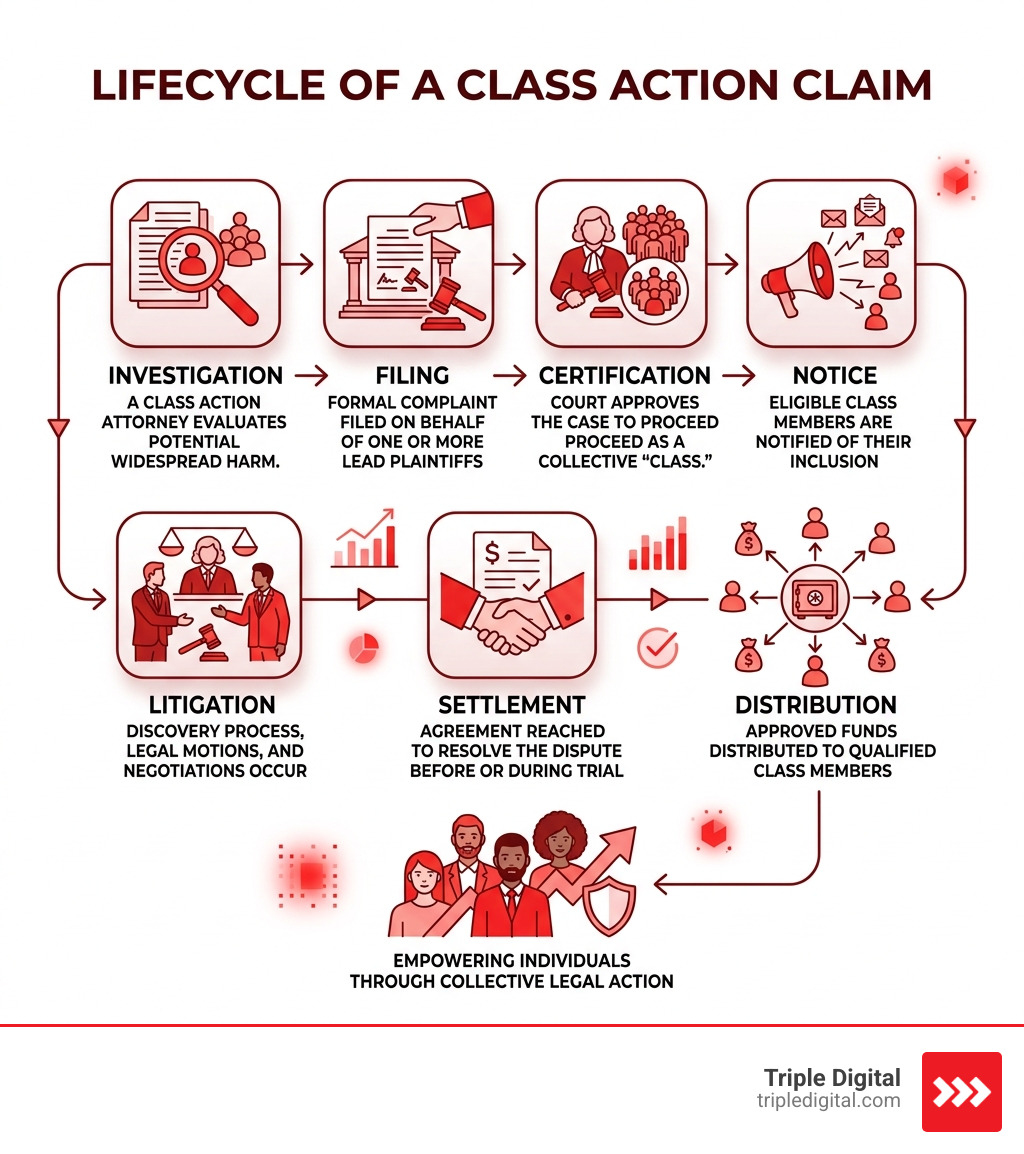
The journey of a class action is a marathon, not a sprint. It follows a very specific legal path:
- Initial Filing: The class action lawsuit attorney files the complaint on behalf of the lead plaintiff.
- Class Certification: This is the “make or break” moment. A judge must rule that the case meets the criteria (numerosity, commonality, etc.) to proceed as a class action.
- Discovery: Both sides exchange documents. This can involve millions of pages of evidence.
- Notification: Once certified, the court orders that potential class members be notified. You’ve likely seen these as emails or postcards saying, “You may be a member of a class action settlement.”
- The Opt-Out Period: Members are given a deadline to leave the class if they want to sue on their own.
- Fairness Hearing: If a settlement is reached, a judge must hold a hearing to ensure the deal is “fair, reasonable, and adequate” for the members — not just a good deal for the lawyers.
- Distribution: Finally, the money is sent out. This is often done proportionally; if you were harmed more, you might get a larger slice of the pie.
Navigating this process requires a marketing partner who understands the legal nuances. Don’t Just Advertise, Dominate: Picking Your Perfect Legal Marketing Partner is about finding a team that can support a firm through the years-long lifecycle of these cases.
Costs, Compensation, and Real-World Outcomes
One of the biggest draws of joining a class action is that it is virtually “risk-free” for the participants. Most class action lawsuit attorneys work on a contingency fee basis. This means they advance all the costs—filing fees, expert witness pay, travel, and research—and only get reimbursed if they win.
The scale of these wins can be staggering. Over the last few decades, top firms have recovered over $50 billion for their clients. Some recent and notable statistics include:
- $873,344,636 settlement in a major Florida-based class action.
- $240 Million nationwide settlement for defective medical devices.
- $17.3 Million jury verdict for civil detainees in a minimum wage violation case.
- $52 Million settlement fund for consumer rights violations.
While the “lead plaintiff” or “class representative” might receive a Service Award (sometimes ranging from $5,000 to $20,000) for their extra work, the rest of the class receives a portion of the remaining fund. For attorneys, the rewards are high, but so is the competition. To stay ahead, firms must Rank Higher, Get More Clients: Your SEO Playbook for Law Firms to ensure they are the ones leading these multi-million dollar recoveries.
Frequently Asked Questions about Class Actions
How long does a class action lawsuit typically take to resolve?
There is no “speedy” class action. Because of the sheer volume of evidence and the number of people involved, most cases take between one and three years to resolve. If the case goes to a full trial and is then appealed to a higher court, it can take even longer. However, many cases settle after the “Class Certification” phase because corporations realize that fighting a certified class is a losing battle.
Can I opt out of a class action to pursue an individual claim?
Yes. When you receive a class notice, it will include instructions on how to opt out. You might choose to do this if your injuries are significantly worse than the average class member. For example, if a defective car part caused everyone a $500 repair bill but caused you a life-altering accident, you would likely want to opt out and hire your own attorney to seek much higher damages.
What are the responsibilities of a class representative?
The class representative (or lead plaintiff) is the “face” of the lawsuit. Unlike passive class members, the representative must:
- Consult with the class action lawsuit attorney on case strategy.
- Provide personal records and evidence.
- Sit for a deposition (answering questions from the defendant’s lawyers).
- Attend court hearings or trials if necessary. In exchange for this extra work, they are often eligible for an “incentive award” or “service award” at the end of the case.
Conclusion
Class action lawsuits are more than just legal filings; they are a vital check on corporate power. They ensure that when a company chooses “profits over people,” there is a mechanism for those people to stand up and demand accountability. Whether it’s a $15 hidden fee or a multi-billion dollar environmental disaster, the power of the people is magnified through the work of a dedicated class action lawsuit attorney.
At Triple Digital, we are proud to support the firms that take on these massive battles. Based in Houston, we specialize in the data-driven lead generation and case acquisition that allows law firms to find the “strength in numbers” needed to win. We don’t do fluff; we use AI and precision targeting to help firms find the cases that change lives and hold the powerful accountable.
If your firm is ready to lead the next big class action, Contact Triple Digital for specialized legal marketing services and let’s start building your class today.