
Why Legal Content Marketing Is the Growth Engine Modern Law Firms Need
Legal content marketing is the practice of creating and sharing helpful, informative content — blogs, videos, guides, and more — to attract potential clients, build trust, and grow your law firm online.
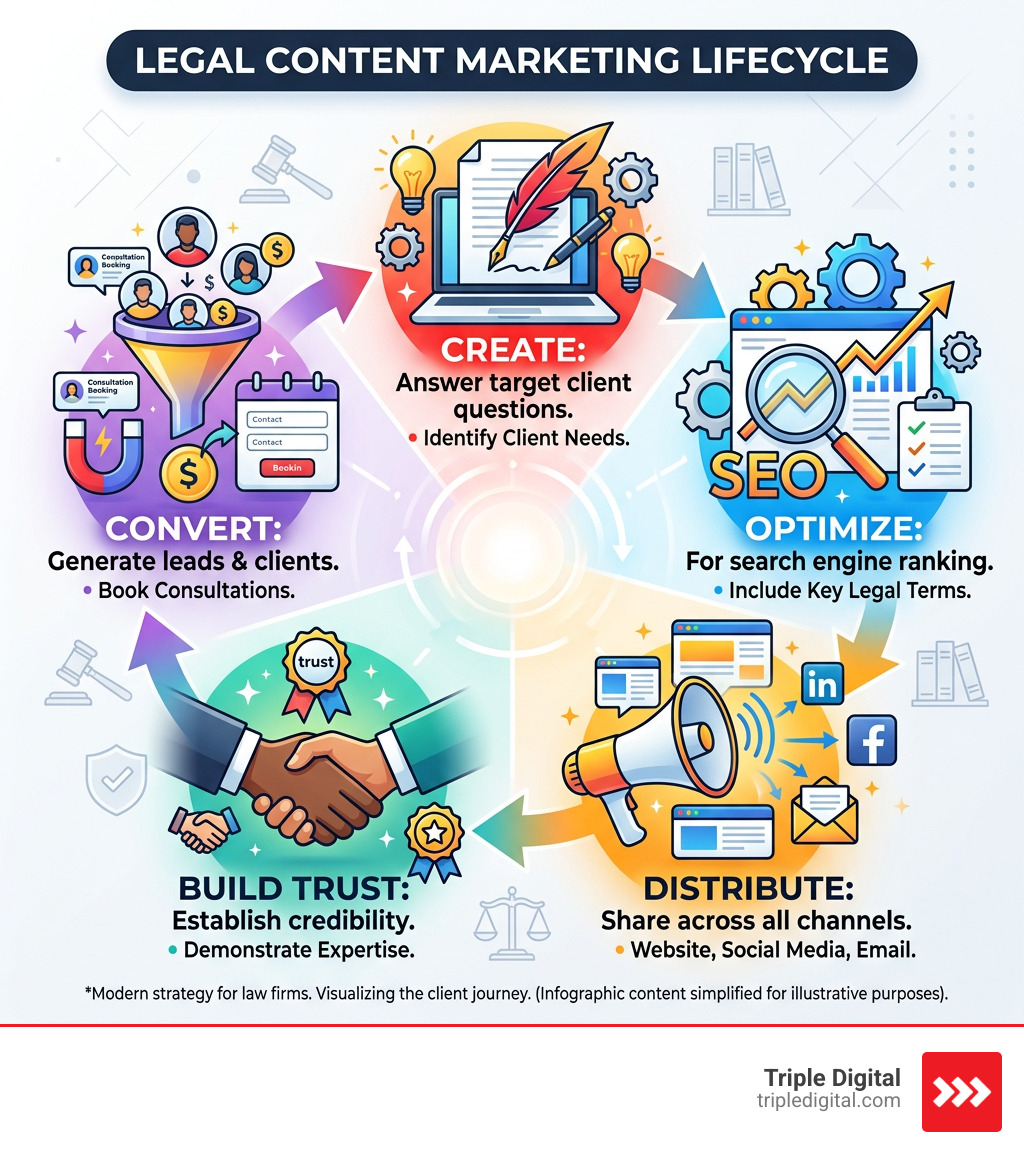
Here’s a quick breakdown of how it works:
- Create content that answers real legal questions your target clients are searching for
- Optimize that content so search engines can find and rank it
- Distribute it across your website, social media, and email
- Build trust with potential clients before they ever contact you
- Convert informed readers into qualified leads and booked consultations
If your firm still relies mostly on referrals and word-of-mouth, you’re leaving a lot of clients on the table. 97% of potential clients now search for legal services online. And 70% of people prefer learning about a business through articles rather than ads.
That’s a massive audience actively looking for answers — answers your firm could be providing.
The legal market is competitive. But here’s the thing: only 27% of law firms publish blog content regularly. That gap is your opportunity.
Content marketing doesn’t just drive traffic. It builds the kind of credibility and trust that turns a stranger into a paying client — often before they’ve even spoken to you.
This guide walks you through exactly how to make that happen.
Essential legal content marketing terms:
Mastering Legal Content Marketing for Law Firm Growth
In the modern legal landscape, expertise alone isn’t enough to fill a caseload. You need a way to transform that expertise into a client acquisition engine. This is where Why do law firms need a content marketing strategy? becomes the central question for every partner.
At its core, legal content marketing is about building authority. Google uses a framework called E-E-A-T (Experience, Expertise, Authoritativeness, and Trustworthiness) to rank legal websites. Because legal advice falls under “Your Money or Your Life” (YMYL) content, the stakes for accuracy and credibility are incredibly high. By consistently publishing well-researched articles, you signal to both Google and potential clients that you are a trusted leader in your field.
To succeed, we must move away from “attorney-centric” writing (dense legalese) and move toward “client-centric” storytelling. This starts with identifying your client personas. You aren’t just writing for “anyone with a legal problem.” You are writing for:
- The stressed-out parent navigating a child custody dispute.
- The small business owner in Houston worried about a breach of contract.
- The individual injured in a car accident who doesn’t know what to do next.
Effective Client Persona Components:
- Demographics: Age, location (e.g., Houston, TX), and occupation.
- Pain Points: What keeps them up at night? (e.g., “Will I lose my house in the divorce?”)
- Search Behavior: Do they search for “Texas family law statutes” or “how to file for divorce in Houston”?
- Decision Timeline: Are they looking for immediate help or researching for the next three weeks?
Why Legal Content Marketing is Essential in 2025
As we move through 2025, the digital transformation of the legal industry is complete. Traditional advertising like billboards and Yellow Pages has been replaced by a sophisticated online marketing playbook for legal success.
The modern client journey begins with a search engine 96% of the time. If you aren’t providing the answers they find, your competitors will. Content marketing provides a massive competitive advantage because it generates 3x more leads than traditional marketing while costing 62% less. It’s not just about getting “clicks”; it’s about building a relationship before the first phone call. When a client reads an article you wrote that solves a small part of their problem, you’ve already won half the battle of earning their trust.
Creating High-Value Legal Content Marketing Assets
To truly stand out, we recommend focusing on “pillar” content—comprehensive resources that establish you as the ultimate authority. This is often referred to as being a client whisperer, where you anticipate and answer questions before they are even asked.
High-value assets include:
- Educational Blogs: Instead of news about your firm, write about “5 Mistakes to Avoid After a Slip-and-Fall.”
- Webinars and Podcasts: Great for humanizing your brand and explaining complex topics like estate planning or intellectual property.
- Guest Posting: Writing for reputable legal or industry-specific sites to build backlinks and reach new audiences.
- Infographics: Visualizing a court process or a timeline for a personal injury claim makes “scary” legal concepts digestible.
Diversifying Content Formats to Capture Every Lead
Not every client wants to read a 2,000-word blog post. Some want a quick video while they’re on their lunch break; others want a checklist they can download and print. Diversifying your legal content marketing formats ensures you capture leads at every stage of the funnel.

High-Converting Content Types for Law Firms:
- FAQ Pages: These are goldmines for SEO because they naturally match the “how-to” and “what is” questions people type into Google.
- Case Studies: (While maintaining confidentiality) Showing the process of how you achieved a result builds immense credibility.
- Downloadable Guides: Offer a “Texas Probate Checklist” in exchange for an email address. This allows you to nurture leads through email marketing.
- Legal Podcasts: While only a small percentage of firms do this, it is a fantastic way to build a loyal, captive audience.
Leveraging Video and Visual Storytelling
Video is no longer optional. In 2025, it is the most powerful tool for humanizing attorneys. A 60-second video answering “Do I need a lawyer for a minor car accident?” can build more trust than a dozen text-only pages.
YouTube is the world’s second-largest search engine. By creating a YouTube strategy that focuses on answering common questions, you can reach clients who are in the “research” phase. Short-form video on platforms like LinkedIn or even TikTok (for certain practice areas) allows you to show empathy and personality, which are often the deciding factors when a client chooses a firm.
Integrating SEO and Geotargeting for Local Dominance
Content is the fuel, but SEO is the engine that gets it in front of people. To dominate your local market, you must combine advanced SEO and authoritative content with precise geotargeting.
Generic legal content is hard to rank for. Instead of trying to rank for “personal injury lawyer,” focus on long-tail keywords like “best truck accident attorney in Houston TX.” These keywords have lower competition and much higher intent—the person searching is ready to hire.
| Feature | Organic SEO | Local Geotargeting |
|---|---|---|
| Primary Goal | Rank for broad legal topics | Rank for “near me” and city-specific searches |
| Content Focus | Educational guides and blog posts | Location-specific landing pages and local news |
| Key Tool | Keyword Research (SEMrush/Ahrefs) | Google Business Profile & Local Citations |
| Target Audience | National or State-wide | Local residents in your specific city/county |
For firms in Houston, this means mentioning local landmarks, specific Texas statutes, and local court procedures. This signals to Google that you are a local authority, helping you appear in the “Map Pack” (the top three local results on Google).
Building a Winning Strategy with AI and Analytics
The biggest challenge for busy attorneys is time. You didn’t go to law school to become a full-time blogger. This is where the key to AI-written content becomes a game-changer.
At Triple Digital, we use a “less fluff, more cases” approach. We leverage AI and data mining to identify exactly what your potential clients are searching for and then use AI to help draft, personalize, and optimize content at scale. This isn’t about “bot-written” junk; it’s about using technology to increase efficiency so you can focus on practicing law while your content works in the background to find your next case.
How to Measure Your Content Success:
- Traffic: Are more people visiting your site?
- Engagement: How long are they staying on the page? (Session duration)
- Conversions: Are they filling out the contact form or calling the office?
- Keyword Rankings: Are you moving up for high-value terms like “Houston divorce lawyer”?
Frequently Asked Questions about Legal Content
How often should law firms update their website content?
Ideally, you should be publishing new content at least 2-4 times a month. However, it is just as important to update old content. Laws change, and Google rewards “freshness.” We recommend a quarterly audit to ensure your top-performing posts are still accurate and link to your latest services.
What are the most important KPIs for legal content?
While traffic is nice, qualified leads and Cost Per Acquisition (CPA) are the KPIs that actually matter for your bottom line. We track how many people who read a specific blog post ended up booking a consultation. If a post about “car accident settlements” generates 10 cases, that is a high-value asset.
How can attorneys ensure content remains ethically compliant?
Legal marketing is subject to strict State Bar rules. Always include a clear disclaimer that “content is for informational purposes only and does not constitute legal advice or an attorney-client relationship.” Avoid making “guarantees” of results and ensure all headers and claims are truthful and not misleading.
Conclusion
The firms that will thrive in the coming years are those that stop “selling” and start “helping.” Legal content marketing is the most effective way to do this at scale. By providing value, answering questions, and showing up where your clients are searching, you build a moat around your practice that traditional advertising can’t touch.
Consistency is the secret sauce. Whether it’s a weekly blog, a monthly webinar, or daily social media tips, staying top-of-mind ensures that when a legal crisis hits, your firm is the first one they call.
Ready to stop chasing leads and start attracting cases? Start growing your firm today with a data-driven content strategy that delivers “less fluff and more cases.”