
Why Your Inbox is Your Law Firm’s Most Powerful Business Development Tool
Email marketing for attorneys is a direct, cost-effective way to nurture client relationships, generate qualified leads, and establish your firm as a trusted legal authority—all while maintaining full control over your audience.
Quick Answer: How to implement email marketing for attorneys:
- Build your list ethically – Use website opt-ins, lead magnets, and client intake forms (never buy lists)
- Segment your audience – Group contacts by practice area interest, client status, and engagement level
- Provide consistent value – Send educational content, legal updates, and case studies that solve real problems
- Automate strategically – Use welcome sequences, nurture campaigns, and milestone messages
- Stay compliant – Follow CAN-SPAM, GDPR, and state bar advertising rules
- Measure and optimize – Track open rates, click-through rates, and conversions to refine your strategy
If you’ve been relying solely on referrals, word-of-mouth, or expensive advertising to grow your practice, you’re leaving money on the table. The research is clear: 64% of small businesses use email marketing to reach customers, and for good reason. Email marketing ROI can range anywhere from $7 to $40 for every dollar spent.
Unlike social media posts that disappear into algorithm black holes, email gives you direct access to your audience’s inbox. It’s a channel you own, not rent. You’re building a genuine asset for your firm.
The challenge? Most attorneys either don’t know where to start, or they send sporadic “updates” that get ignored. This guide will show you exactly how to build an email marketing strategy that generates cases, not spam complaints.
Why Email Marketing is a Non-Negotiable for Modern Law Firms
In today’s competitive legal landscape, relying on traditional methods alone is inefficient. Email marketing for attorneys offers a potent blend of direct communication, cost-effectiveness, and measurable results, making it indispensable for any forward-thinking law firm.
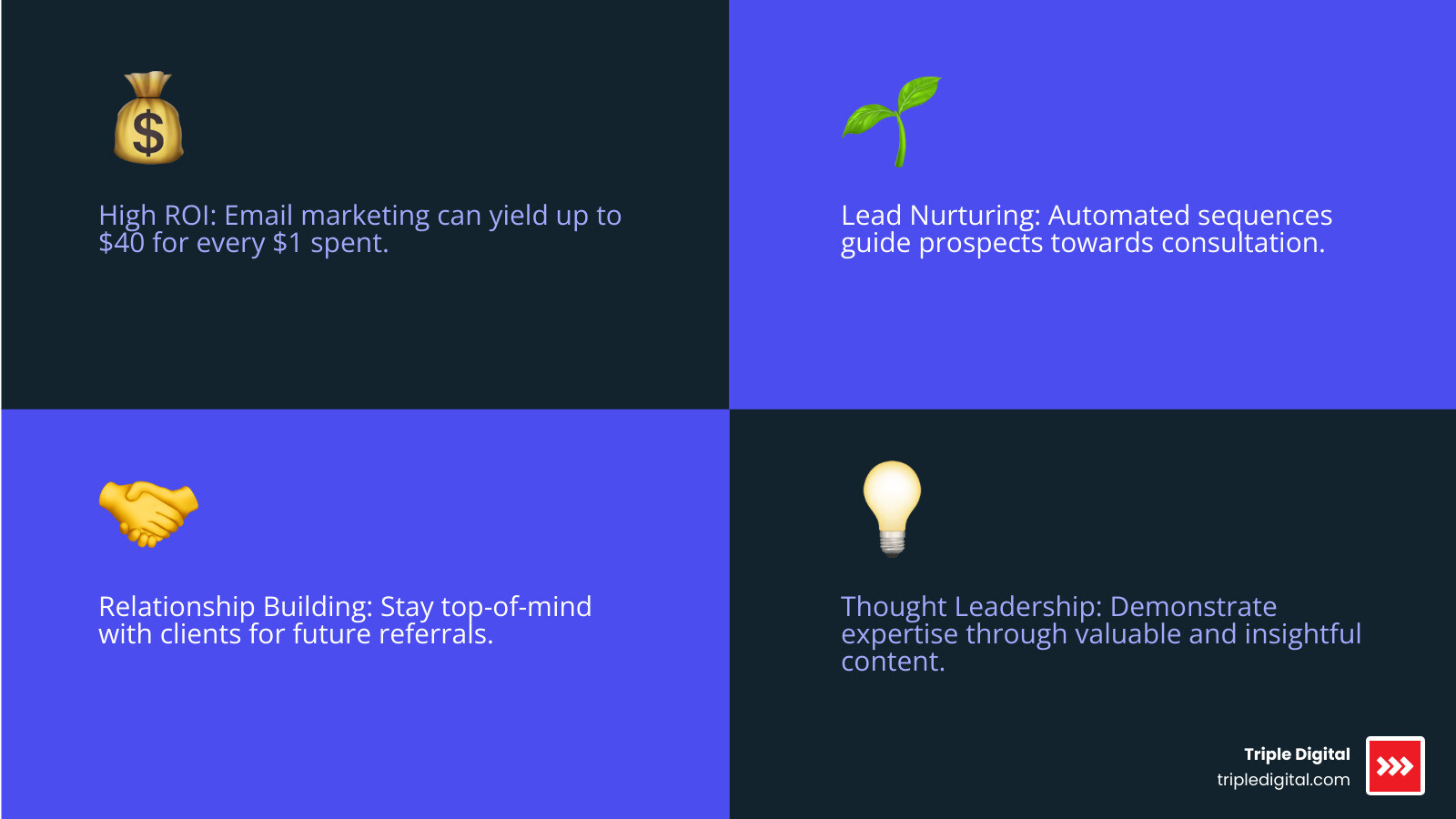
Email marketing is a strategic powerhouse that consistently delivers a high ROI, with studies showing returns of $7 to $40 for every dollar spent. This makes it far more cost-effective than many traditional advertising methods.
Beyond ROI, email marketing is critical for lead generation, client retention, and establishing thought leadership. It nurtures prospects through their decision-making process and deepens relationships with past clients, leading to more referrals and repeat business.
By consistently delivering valuable content, we establish our authority and expertise, positioning ourselves as thought leaders. This attracts new clients and opens doors for media coverage and speaking engagements. If you’re curious about how this fits into a larger strategy, explore our insights on Why SEO is Important for Attorneys.
The Primary Benefits for Attorneys
So, what exactly are these benefits that make email marketing such a game-changer for legal professionals? Let’s break them down:
- Attract New Clients and Generate Leads: Directly reach potential clients by offering valuable content, like a guide on “What to do After a Car Accident.” This captures their interest and guides them toward a consultation, making it essential for lead generation.
- Nurture Leads Over Time: Not every prospect is ready to hire an attorney. Email marketing lets you stay connected, building trust over time by providing helpful information. This educational journey nurtures prospects until they’re ready to act.
- Stay Top-of-Mind with Past Clients: Maintain relationships with former clients by sending legal updates or firm news. This consistent engagement keeps you top-of-mind for future legal needs or referrals.
- Demonstrate Expertise and Authority: Through educational emails, legal insights, and case studies, we can showcase our firm’s knowledge and experience. This establishes us as trusted advisors, not just service providers. For more on this, consider Why Do Law Firms Need a Content Marketing Strategy?.
- Drive Traffic to Your Website: Every email can serve as a conduit to our firm’s website, where prospects and clients can find more in-depth articles, attorney bios, service pages, and contact forms. This integrated approach ensures our digital assets work together to convert interest into action.
Email vs. Social Media: Owning Your Audience
Social media is powerful, but you don’t own your audience. Algorithms change and organic reach plummets. For instance, Facebook post reach has drastically decreased, while over 90% of emails reach their destination inbox.
Email marketing offers a direct communication channel free from platform algorithms. When someone opts in, you gain a direct line to their inbox—a privilege that builds immense value when respected.
As a result, email is much more effective at reaching your intended audience than social media. Your email list is a tangible firm asset—a direct connection to warm leads who have expressed interest. You control the message, timing, and delivery, ensuring your content reaches the right people.
Building Your Foundation: The Strategic Email Marketing Plan
Before we even think about sending our first email, we need a solid blueprint. A strategic email marketing for attorneys plan is our roadmap to success, ensuring every effort is purposeful and contributes to our firm’s growth.

Our plan starts with setting clear goals. Without a target, we’re just shooting in the dark. We use the SMART format for this: Specific, Measurable, Attainable, Relevant, and Timely. Instead of “get more clients,” a SMART goal might be “generate 10 new qualified leads for personal injury cases per month through email marketing within the next six months.” This clarity guides our content, segmentation, and measurement. For a broader perspective, consider our guide on Digital Marketing Strategies for Law Firms.
Next, we define our audience. Who are we trying to reach? What are their pain points, their questions, their motivations? Creating buyer personas for different client segments helps us tailor our messages. Finally, choosing the right email marketing platform is crucial. This isn’t just about sending emails; it’s about managing lists, automating campaigns, and tracking performance.
How to Ethically Build and Segment Your Email List
The bedrock of any successful email marketing for attorneys strategy is a high-quality, ethically built email list. We’re not in the business of spamming; we’re in the business of building relationships. That means we never purchase email lists. Buying lists is not only illegal under the CAN-SPAM Act (and can lead to serious deliverability issues), but it also damages our reputation and trust.
Instead, we focus on ethical list building tactics that ensure explicit consent from every subscriber. This includes:
- Lead Magnets: Offering valuable resources like a free e-book (“Your Guide to Texas Probate Law”), a checklist (“5 Steps After a Car Accident”), or a webinar recording in exchange for an email address.
- Website Opt-in Forms: Placing clear and concise sign-up forms on our website, particularly on relevant blog posts, service pages, and the contact page.
- Webinars & Events: Collecting email addresses from attendees of our online or in-person seminars.
- Networking Events: Following up with new contacts met at Houston business functions, asking if they’d like to receive our legal updates.
- Client Intake Process: With explicit consent, adding new and existing clients to our relevant email segments during the intake process.
Once we have our list, segmentation is key. Sending generic emails to everyone is a recipe for low engagement. We segment our audience like pros, ensuring hyper-relevant content delivery. This means categorizing subscribers based on:
- Client Status: Prospective clients, current clients, past clients, referral sources.
- Practice Area Interest: Individuals interested in personal injury, family law, business litigation, estate planning, etc.
- Engagement Level: Highly engaged (frequently opens/clicks), moderately engaged, or cold contacts (rarely opens).
This allows us to send a divorce-related email to one segment and a child custody-related email to another, ensuring each message resonates deeply.
Key Components of an effective email marketing for attorneys strategy
A well-oiled email marketing for attorneys strategy isn’t just about sending emails; it’s about orchestrating a cohesive plan. Here are the essential elements we build into our law firm’s email marketing strategy:
- Clear Goals: As discussed, every campaign needs a SMART goal. Are we aiming for more consultations, higher client retention, increased website traffic, or perhaps establishing our firm’s expertise in a new niche?
- Target Audience Personas: We create detailed profiles of our ideal clients, including their demographics, challenges, and information needs. This informs our content and messaging.
- Content Calendar: A structured plan for what content we’ll send, when, and to which segments. This ensures consistency and prevents last-minute scrambling.
- List Building Strategy: A continuous, ethical approach to growing our email list, incorporating lead magnets, website forms, and other opt-in opportunities.
- Key Performance Indicators (KPIs): Specific metrics we track to measure success, such as open rates, click-through rates, conversion rates, and unsubscribe rates. We’ll dive deeper into these shortly.
- Compliance Checklist: A rigorous adherence to all legal and ethical guidelines, including CAN-SPAM, GDPR, CCPA, and state bar advertising rules.
Crafting Emails That Convert: Content, Automation, and Best Practices
Once we have our foundation, the real fun begins: crafting emails that not only get opened but also inspire action. For email marketing for attorneys, this means providing genuine value, leveraging smart automation, and adhering to best practices that ensure our messages are seen, understood, and acted upon.

Our primary goal with email content is always to provide value. We’re not just selling legal services; we’re educating, informing, and building trust. This often involves answering common questions our clients have, breaking down complex legal concepts into understandable language, or sharing timely legal insights.
We also make sure our emails have strong calls-to-action (CTAs). Whether it’s “Schedule a Free Consultation,” “Download Our Guide,” or “Read More on Our Blog,” every email should guide the reader towards the next logical step.
Personalization goes beyond just using a recipient’s first name. It means tailoring the message to their specific legal interests, past interactions, or stage in the client journey. Coupled with automation, this allows us to deliver the right message to the right person at the right time, without us having to manually send each one.
Finally, in today’s mobile-first world, our emails must be mobile-friendly. Most people check their emails on the go, so our designs need to be responsive, easy to read on small screens, and navigable with a thumb.
What Types of Email Campaigns are Most Effective?
Different goals call for different types of email campaigns. For email marketing for attorneys, a mix of the following campaign types tends to be most effective:
- Welcome Emails: These are our firm’s digital handshake. Sent immediately after someone subscribes, welcome emails introduce our firm, set expectations for future communications, and offer an immediate piece of value. Studies show that more than 8 out of 10 people will open a welcome email, generating 4x as many opens and 10x as many clicks as other email types. We use this opportunity to invite new subscribers to connect with us further.
- Newsletters (Legal Updates & Firm News): Regular newsletters keep our audience informed about relevant legal developments, firm achievements, and community involvement. For example, a Houston firm might share insights on local business regulations or personal injury law changes.
- Nurture Campaigns: These are automated series of emails designed to educate prospects over time, moving them closer to a consultation. A personal injury firm might send a drip campaign of 3-5 emails to someone who downloaded a “Car Accident Checklist,” providing further tips and case examples.
- Educational Series: Similar to nurture campaigns but often broader, these series position us as thought leaders. An estate planning firm might offer a multi-part email course on “Understanding Wills and Trusts.”
- Promotional Emails: Used sparingly, these announce specific services, special offers, webinars, or events (e.g., “Join Our Free Webinar on Small Business Legal Best Practices”).
Here’s a quick comparison of some effective campaign types:
| Campaign Type | Purpose | Frequency | Key Content |
|---|---|---|---|
| Welcome Emails | First impression, introduce firm, set expectations | Immediately after sign-up | Firm intro, value proposition, what to expect, link to key resources, CTA for consultation. |
| Newsletters | Inform, educate, maintain engagement | Weekly, bi-weekly, or monthly | Legal updates, firm news, blog highlights, case studies, team spotlights, community involvement. |
| Nurture Campaigns | Educate prospects, build trust, drive conversions | Drip-fed over days/weeks (e.g., 3-7 emails) | Problem-solution content, testimonials, FAQs, case examples, soft CTAs leading to consultation. |
Best Practices for Creating Compelling and Valuable Content
Crafting emails that resonate with a legal audience requires a thoughtful approach. Here are our best practices:
- Keep it Concise: Lawyers can be long-winded, but in email, brevity is our friend. People spend on average only 9 seconds reading an email, and about a third get only two seconds of attention. Emails with 20 lines of text have the highest click-through rates. Get to the point quickly, use short paragraphs, and break up text with headings and bullet points.
- Avoid Legalese: While we appreciate the precision of legal jargon, it can confuse or alienate potential clients. Our goal is clarity. We use plain language that anyone can understand, saving the complex terms for when they’re absolutely necessary (and always explaining them).
- Use Clear Language: Beyond avoiding legalese, this means writing simply, directly, and engagingly. We focus on the reader’s problems and how we can help, rather than just talking about ourselves.
- Craft Compelling Subject Lines: The subject line is the gatekeeper to our content. It needs to be direct, captivating, and informative to encourage opens. We focus on benefits, ask questions, or create a sense of urgency. For example, “3 Recent Court Decisions That Could Affect Your Business” is more compelling than “Monthly Newsletter from Smith Law Partners.” Keep them concise, around 41 characters, for mobile visibility.
- Personalize Beyond the First Name: True personalization involves tailoring content based on the recipient’s interests, past interactions, or specific legal needs. If someone downloaded a guide on divorce, our follow-up emails should be about family law, not personal injury. This makes clients feel understood and directly addressed, leading to better engagement. For insights into creating engaging content, including with the help of AI, check out The Key to AI-Written Content.
Staying Compliant and Measuring Success in Email Marketing for Attorneys
In email marketing for attorneys, success requires effectiveness and compliance. We must stay within legal and ethical bounds while measuring impact to refine our strategy. Just as Law Firm Lead Tracking is vital for growth, tracking email performance helps us understand our audience and improve.
Legal and Ethical Considerations for Attorneys
This is perhaps the most critical section for any law firm engaging in email marketing. We operate in a highly regulated industry, and our email communications are no exception. We must adhere to a dual layer of compliance: general email marketing laws and specific state bar advertising rules.
Key regulations we consider include:
- CAN-SPAM Act (Controlling the Assault of Non-Solicited Pornography and Marketing Act): This US federal law sets rules for commercial email, requiring honest headers, clear identification of the sender, an opt-out mechanism, and a physical postal address. It strictly prohibits sending emails to “harvested” addresses (i.e., purchased lists).
- GDPR (General Data Protection Regulation): While a European Union law, its reach extends to any firm (even in Houston, TX) that collects or processes personal data of EU residents. It mandates explicit consent for data processing and gives individuals significant rights over their data.
- CCPA (California Consumer Privacy Act): This California law grants consumers rights regarding their personal information, similar to GDPR, and impacts any business dealing with California residents’ data.
- State Bar Advertising Rules: Each state bar (including the State Bar of Texas) has specific rules governing attorney advertising. These often dictate what can and cannot be said, require disclaimers, and may require review of marketing materials. We must be cautious with legal claims, avoid guaranteeing results, and ensure our messages are not misleading.
- Required Disclaimers: We always include clear disclaimers, especially when discussing case results or complex legal matters, to manage expectations.
- Physical Address Requirement: All commercial emails must include our firm’s valid physical postal address.
- Clear Unsubscribe Link: Every email must contain an easy-to-find and functional unsubscribe link, allowing recipients to opt out of future communications.
Failing to comply with these regulations can lead to hefty fines, reputational damage, and even ethical violations with the bar association.
How to Measure the Success of Your Campaigns
Measurement is how we turn guesswork into strategy. For email marketing for attorneys, tracking key metrics helps us understand what’s working, what’s not, and how to optimize our efforts.
The most important metrics we monitor include:
- Open Rate: The percentage of recipients who open your email. This indicates the effectiveness of your subject lines. The legal industry average is around 22.49%.
- Click-Through Rate (CTR): The percentage of recipients who click a link in the email. This indicates content engagement. The legal industry benchmark for CTR is around 2.81%.
- Conversion Rate: The percentage of recipients who complete a desired action after clicking a link (e.g., schedule a consultation). This is often the ultimate measure of ROI.
- Unsubscribe Rate: The percentage of recipients who opt out. A high rate can signal issues with content relevance or frequency. The legal industry benchmark is 0.22%.
- Bounce Rate: The percentage of emails that couldn’t be delivered. This can be due to invalid email addresses or temporary issues. A healthy bounce rate for the legal industry is around 0.52%.
By regularly reviewing these metrics, we can identify opportunities for improvement. For example, a high open rate but low CTR might mean our subject line is great, but the content isn’t engaging. We also use A/B testing for subject lines, CTAs, and content to continuously fine-tune our offerings.
Common email marketing for attorneys mistakes to avoid
Even with the best intentions, it’s easy to stumble. Here are some common email marketing for attorneys mistakes we diligently avoid:
- Not Having a Strategy: The biggest mistake is sending sporadic “general updates” without a clear goal or plan. This leads to wasted effort and poor results.
- Poor Segmentation: Treating all contacts the same and sending generic emails is a missed opportunity. Without proper segmentation, our messages won’t resonate, and engagement will suffer.
- Inconsistent Sending: Irregular email frequency can lead to recipients forgetting who we are or, conversely, feeling overwhelmed if we suddenly send too many. Consistency builds anticipation and trust.
- Ignoring Mobile Users: With so many people checking emails on their phones, neglecting mobile optimization is a critical error. Emails that don’t display well on mobile are quickly deleted.
- Neglecting Analytics: Sending emails without tracking their performance is like driving blind. Without data, we can’t learn, adapt, or improve.
- Sending Without Consent: Adding contacts to our list without their explicit permission not only violates ethical guidelines and anti-spam laws but also damages our reputation and leads to high unsubscribe rates.
- Too Much “Legalese”: As mentioned, overly complex legal jargon can alienate our audience. We strive for clarity and accessibility.
- Long-Winded Emails: People are busy! We keep our emails concise and to the point, respecting our readers’ time.
Frequently Asked Questions about Email Marketing for Lawyers
We often get questions about the practicalities of email marketing for attorneys. Here are some of the most common ones:
How often should a law firm send marketing emails?
The ideal frequency for sending marketing emails varies, but consistency is key. There’s no one-size-fits-all answer, as it largely depends on our audience’s engagement and the value we provide. However, our research shows that 33.3% of marketers send weekly emails, and 26.7% send multiple times a month.
We recommend starting with a comfortable cadence, perhaps weekly or bi-weekly, and then adjusting based on our analytics. If unsubscribe rates climb, we might be sending too often. Conversely, if engagement is high, we might consider increasing frequency. Interestingly, 63.3% of survey respondents reduce email frequency for disengaged subscribers, which is a smart way to maintain a healthy list. More frequent emails don’t necessarily lead to more engagement; quality and relevance always trump quantity.
Can I add all my professional contacts to my email list?
No, you cannot. This is a common misconception and a critical mistake. To comply with anti-spam laws like CAN-SPAM and GDPR, and to maintain a good sender reputation, you need explicit, opt-in consent from every individual before adding them to your marketing email list. This means they must actively agree to receive emails from you.
Simply having a professional relationship or their business card is not sufficient consent for marketing communications. You can, however, email them directly to ask if they would like to subscribe to your newsletter or updates, providing a clear link to an opt-in form.
What’s the single most important part of a marketing email?
While many elements contribute to a successful email, the subject line is arguably the single most important part for getting the email opened. If the subject line doesn’t grab attention and encourage a click, all the amazing content inside goes unseen. We dedicate significant effort to crafting compelling subject lines that are concise, benefit-oriented, and intriguing.
However, once the email is opened, the true value that builds trust and drives action is the quality and relevance of the content inside. A great subject line gets the door open, but valuable, clear, and personalized content is what keeps the reader engaged and moves them towards becoming a client.
Conclusion: Turn Your Email Strategy into Your Biggest Asset
In the legal landscape of Houston and beyond, email marketing for attorneys stands out as a remarkably powerful and reliable tool. We’ve seen how it offers an unparalleled ROI, effectively drives lead generation, fosters strong client retention, and firmly establishes our firm as a guide of thought leadership. It’s a direct line to our audience, a channel we control, and an asset that grows in value over time.
By embracing a strategic, value-driven, and compliant approach, we can transform our email communications from mere messages into a dynamic engine for growth. From ethically building and segmenting our lists to crafting compelling content and leveraging automation, every step contributes to a more engaged audience and, ultimately, more cases.
Ready to build a powerful, case-winning marketing strategy that leverages advanced AI and data mining for precise client targeting, bringing a “less fluff, more cases” approach to your firm? Learn more about our Digital Marketing Strategies for Law Firms.