





Why Your Firm Needs a Lead Generation Playbook
Lead generation for lawyers is the systematic process of attracting potential clients, capturing their interest, and converting them into paying cases through strategic marketing and client intake. Here’s what every law firm needs to know:
Key Components of Legal Lead Generation:
- Website optimization – Your digital storefront must convert visitors into contacts
- Local SEO – Dominate “near me” searches where 80% of users convert
- Content marketing – Answer client questions to build authority and trust
- Paid advertising – Generate immediate leads while organic strategies build momentum
- Social media outreach – Target specific demographics where they already spend time
- Email nurturing – Convert warm leads through automated follow-up sequences
- Client intake systems – Qualify leads efficiently to maximize your time
The legal market is growing. An August 2025 report showed demand for legal services rose 1.6% while worked rates increased 7.4%. Yet many firms aren’t capturing this opportunity.
Why? They’re stuck relying on referrals alone—which is like leaving firm growth to chance. While 88% of clients trust recommendations from people they know, that’s not a strategy. It’s hope.
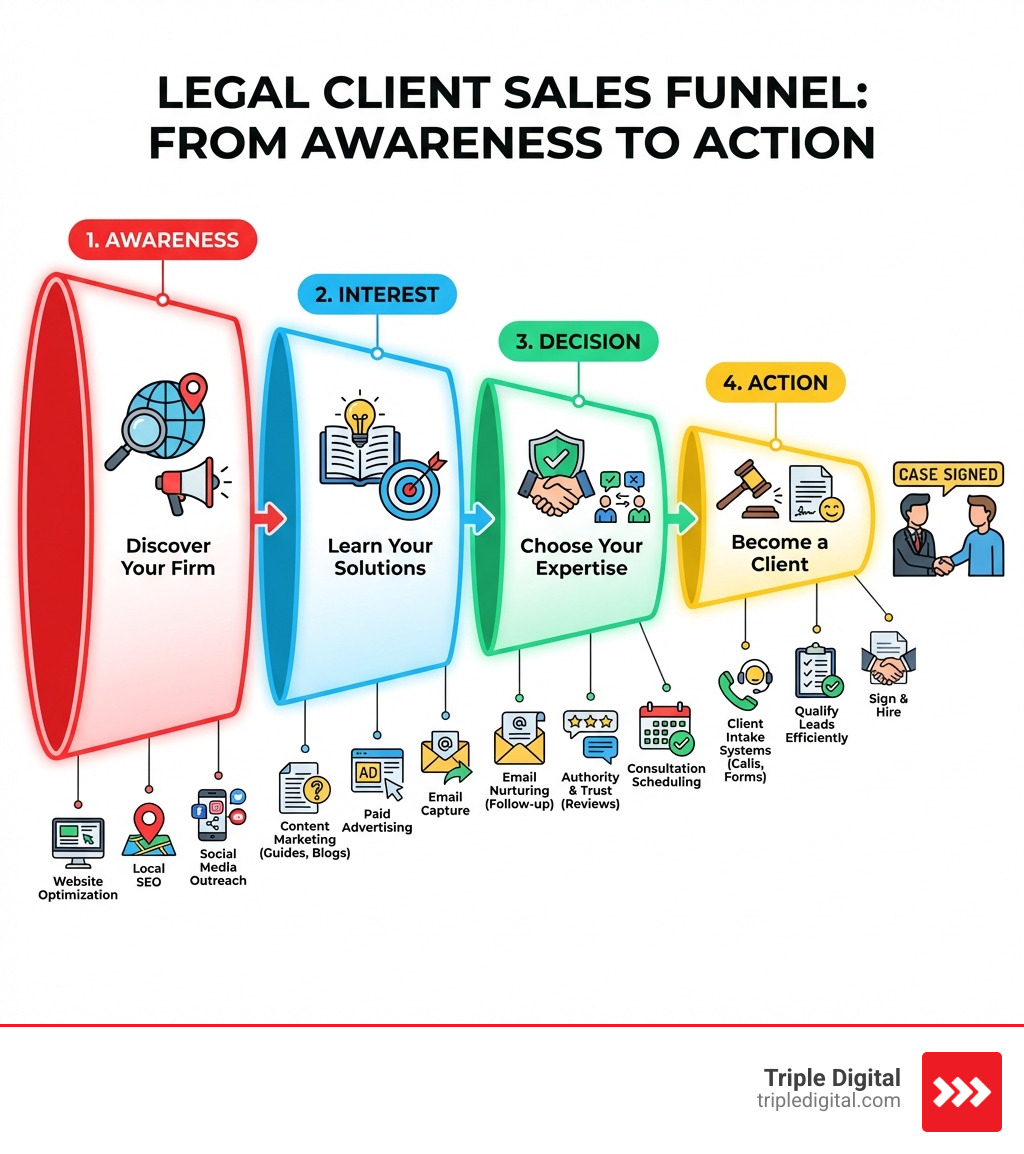
Modern law firms need a predictable system for bringing in new clients. Not just random tactics, but a complete playbook that guides prospects through each stage of the client journey:
Awareness → They find your firm exists
Interest → They learn you can solve their problem
Decision → They choose you over competitors
Action → They contact you and become clients
This isn’t about being “salesy.” It’s about making it easy for people who need your help to find you, trust you, and hire you.
The firms winning today aren’t necessarily the ones with the biggest budgets. They’re the ones with the smartest systems—combining website optimization, search visibility, targeted advertising, and automated follow-up into one cohesive machine.
What is lead generation for law firms?
A “lead” is a potential client who shows interest in your firm, often by sharing their contact information after downloading a guide, filling out a form, or calling. Effective lead generation for lawyers isn’t just collecting contact details; it’s about initiating a relationship. In a competitive space, we use inbound strategies to cut through the noise and attract individuals genuinely seeking legal help, nurturing them from initial awareness to hiring your firm.
Why is lead generation for lawyers essential for growth?
A consistent stream of new clients is vital for survival and growth. Lead generation for lawyers creates a predictable case pipeline, ensuring sustainable growth and healthier cash flow. Without it, firms are stuck in a “feast or famine” cycle. While referrals are valuable—clients are 88 percent more likely to trust them—they aren’t a scalable strategy. Proactive lead generation provides a competitive advantage, increases client prospects, and helps you focus on qualified leads to build a more resilient practice.
Building Your Foundation: The Non-Negotiable Assets

A successful lead generation strategy starts with a solid foundation: your website. It’s your digital headquarters and 24/7 client intake specialist. As your most valuable digital asset, it’s where all marketing efforts lead and where potential clients get their first impression. A well-designed website is more than a brochure; it’s a powerful tool for profitability. Learn more in our insights on How Web Design Can Make Your Business More Profitable.
Optimizing Your Law Firm Website for Conversion
A beautiful website is great, but a website that converts visitors into clients is better. Our goal is to make it effortless for potential clients to find information, trust your expertise, and take the next step.
Here’s how we optimize your law firm’s website for lead generation for lawyers:
- Client-Centered Design: Your website should be intuitive, easy to steer, and speak directly to the needs of your ideal clients.
- Speed and Mobile-Friendliness: Slow websites lose leads. Your site must load quickly and be fully responsive on all devices, especially mobile phones, where many potential clients first find your firm.
- Clear Calls-to-Action (CTAs): Guide visitors on what to do next. Whether it’s “Schedule a Free Consultation,” “Call Now,” or “Download Our Guide,” CTAs should be prominent and compelling. However, remember not to use too many or you’ll overwhelm your visitors.
- Easy Contact Forms: Simple, secure contact forms are essential. Don’t ask for too much information upfront; just enough to start the conversation.
- Live Chat/Chatbots: Offering live chat or a chatbot for lead generation can capture leads outside of business hours and answer basic questions.
- Lawyer Bios & Testimonials: People hire lawyers, not law firms. High-quality lawyer bios with professional photos build trust. Client testimonials provide social proof and demonstrate your firm’s success.
We believe that your website should do the heavy lifting in attracting and converting leads. For more on crafting an effective online presence, explore our Web Design services.
The Role of Content Marketing in Attracting Clients
Content marketing turns your website into a dynamic lead generation for lawyers machine. It builds authority, establishes trust, and answers the urgent questions your ideal clients are asking. We dig deeper into this topic in Why Do Law Firms Need a Content Marketing Strategy?.
Here’s how content marketing plays a pivotal role:
- Establishing Authority: By consistently publishing high-quality, informative content, your firm becomes a trusted resource. This helps in improving your search rankings and positions you as an expert in your field.
- Answering Client Questions: The average web user combs through three to five blogs before deciding what to do. Our content should directly address common legal queries, concerns, and problems.
- Types of Content:
- Blog Posts: Long-form articles that dive deep into specific legal topics.
- E-books & Guides: Downloadable resources that offer comprehensive information in exchange for contact details (a valuable lead magnet!).
- Webinars & Videos: Engaging visual content that explains complex legal processes and adds a personal touch.
- Unique Selling Proposition (USP): High-quality content allows you to showcase the benefits of using your firm’s services and highlight your law firm’s unique selling proposition.
- Building Topical Authority: Creating a comprehensive content hub around your practice areas turns your website into an authoritative resource trusted by readers and search engines. This is crucial for long-term SEO success.
Dominating Your Backyard with Local SEO
For many law firms, especially those focused on personal injury, family law, or criminal defense in Houston, local visibility is everything. You need to show up when potential clients in your city are searching for legal help. This is where Local SEO shines, helping to drive lead generation for lawyers in your immediate area.
- “Near Me” Searches: When users conduct a local search, 80% of them are likely to convert, and 50% are likely to visit your firm within a day. This means capturing “near me” searches is incredibly valuable.
- Google Business Profile (GBP): This is your firm’s most critical local asset. We help you claim your Google Business Profile listing, optimizing it with accurate information (Name, Address, Phone Number – NAP consistency), photos, and service descriptions.
- Online Reviews: Client reviews on your GBP and other legal directories are powerful. They build trust and significantly influence local search rankings. We help you encourage and manage these reviews.
- Local Keywords: Integrating city-specific keywords into your website content and GBP profile helps search engines understand your local relevance.
By mastering Local SEO, we ensure your firm is the first one potential clients see when they’re searching for legal services in Houston. It’s a fundamental part of our Digital Marketing Strategies Law Firm approach, and you can explore more with our ultimate local SEO checklist and learn the Reasons to Use Law Firm SEO.
The Core Channels for Lead Generation for Lawyers

A strong website and SEO are just the beginning. To maximize lead generation for lawyers, a multi-channel strategy is needed to reach potential clients throughout their journey. By combining active (paid) and passive (organic) marketing, we create a comprehensive net. Our Digital Marketing Strategies Law Firm leverages diverse channels to reach clients at every stage of the sales funnel.
Paid Advertising: The Sprint for Immediate Leads
While SEO builds long-term authority, paid advertising delivers immediate results. It’s the fastest way to get your firm in front of people with an urgent legal need, making it a powerful tool for lead generation for lawyers.
- Pay-Per-Click (PPC): These are the ads at the top of Google search results. When someone searches for “personal injury lawyer Houston,” a PPC ad can place your firm directly in their line of sight. 65% of all high-intent searches result in someone clicking on an ad.
- Google Ads: This platform allows for precise keyword targeting, ensuring your ads are shown to people actively looking for your specific services. If you’re new to this, you can read this step-by-step guide to get started.
- Remarketing: This is a way to keep your firm top-of-mind by showing ads to people who visited your website but didn’t convert on their first visit. Learn more about remarketing.
- Google Local Services Ads (LSAs): These “Google Screened” ads appear even above traditional PPC results for local service searches. They operate on a pay-per-lead model, meaning you only pay when a qualified lead contacts you. Keep an eye out for updates, as there was a New Google LSA Verification Coming Up Mar 11, 2024.
Paid advertising provides instant feedback, allowing us to test messaging and offers in real-time to find what’s most profitable for your firm.
Leveraging Social Media for Targeted Outreach
Social media is a powerful platform for targeted lead generation for lawyers, especially through paid advertising. While organic reach has decreased, paid social ads allow us to pinpoint specific demographics and interests.
- Platform Selection: The choice of platform depends on your target audience. LinkedIn is excellent for B2B legal services, while Facebook (with Almost 70 percent of US adults using it) and Instagram are effective for consumer-facing practices. We discuss this in How Can Social Media Drive Traffic to Law Firm Websites?.
- Brand Awareness: A consistent presence and engaging content on social media build brand recognition and trust.
- Targeted Ads: Social media platforms offer incredibly detailed targeting. We can reach potential clients based on age, location (Houston, TX), interests, income, and life events. An estate planning attorney, for instance, might target users by age with an offer for a free guide.
- Meta Pixel: This tool allows us to track website visitors and then retarget them with relevant ads on Facebook and Instagram, automating lead generation. Learn how to install the Meta Pixel.
- Is it a Win?: For insights into the effectiveness of Facebook Ads for law firms, check out The Verdict Is In: Are Facebook Ads a Win for Your Law Firm?.
Email Marketing: Nurturing Leads into Clients
Email marketing is a highly effective tool for nurturing leads, building relationships, and guiding them toward becoming paying clients. It’s a quiet but powerful winner in lead generation for lawyers.
- Building an Email List: This starts with offering valuable lead magnets on your website, like free guides or checklists, in exchange for an email address.
- Nurture Sequences: Automated email sequences can educate leads about your services, share client testimonials, and address common concerns over time.
- Personalization: Segmenting your email list allows for custom messaging. For example, leads interested in estate planning receive content specific to that area.
- Automation: Tools allow us to automate welcome series and educational drips, ensuring consistent follow-up without constant manual effort. As Mailchimp’s glossary explains, email automation is key.
- Impressive ROI: Email campaigns are highly effective, returning $32 for every $1 spent on marketing. That’s an ROI of more than 4400 percent!
- Client Retention: Email marketing is also fantastic for staying in touch with past clients, encouraging repeat business and valuable referrals.
From Inquiry to Intake: Managing and Measuring Your Leads
Generating leads is only half the battle. A seamless lead management and client intake process is critical to convert interest into clients and maximize your lead generation for lawyers efforts. A smooth transition from inquiry to consultation is essential. We explore this in Enhancing Client Satisfaction and Firm Profitability: Optimizing the Intake Process.
Qualifying Leads to Maximize Your Time
Not all leads are created equal. Wasting time on unqualified leads is costly, which is why pre-qualifying them is a game-changer for law firms.
- Qualified vs. Unqualified Leads: A qualified lead is a potential client who matches your ideal client profile in terms of need, budget, and timing. An unqualified lead does not meet these criteria.
- Ideal Client Profile: Define who your perfect client is. What are their demographics? What types of cases do they have? What’s their budget?
- Intake Form Questions: Implement strategic questions in your contact forms or initial phone screenings. For instance, asking “what city do you live in?” ensures potential clients are within your service area. We recommend this for our Houston-based firms. Questions like “Are you currently working with an attorney?” can help gauge their readiness.
- Lead Scoring: Assigning scores to leads based on their engagement and fit can help prioritize follow-up efforts.
- Follow-up Best Practices: Timely and effective follow-up is paramount. A follow-up email, for instance, is up to 70% more likely to move a prospect through the funnel. For more insights, refer to Best Practices for Lawyer Lead Generation.
Essential Tools and Software for Law Firms
To effectively manage the entire lead generation for lawyers process, law firms need the right technology. Here are some essential tools we recommend:
- CRM Software (Client Relationship Management): A legal-specific CRM is your central command center. It tracks client interactions, manages your pipeline, and helps automate follow-up, ensuring no potential client falls through the cracks.
- Email Marketing Platforms: Tools like Mailchimp or MailerLite facilitate building email lists and sending personalized nurture sequences.
- Analytics Tools (Google Analytics): Essential for understanding website traffic, user behavior, and the performance of your marketing campaigns.
- Call Tracking Software: Phone calls are often the highest-converting lead source. Call tracking allows us to attribute calls to specific marketing campaigns and understand keyword performance. This is why Why Tracking Numbers Are So Important to Track Leads is a must-read.
- Scheduling Tools: Integrating online scheduling tools makes it easy for qualified leads to book a consultation, reducing friction in the intake process.
How to measure success in lead generation for lawyers
Measuring the success of your lead generation for lawyers efforts is crucial for optimizing your strategy and ensuring a positive ROI. We track key performance indicators (KPIs) to understand what’s working. Our Law Firm Lead Tracking services are designed to give you clear insights.
Here are the essential metrics we focus on:
- Cost Per Lead (CPL): How much does it cost to acquire one lead? This helps us understand the efficiency of different campaigns.
- Conversion Rate: What percentage of your website visitors convert into leads? What percentage of leads convert into paying clients? Firms that used MyCase’s lead capture form saw an 18% lead conversion rate, showing the impact of optimized tools.
- Client Acquisition Cost (CAC): How much does it cost, on average, to gain a new paying client? This includes all marketing and sales expenses divided by the number of new clients acquired.
- Return on Investment (ROI): This is the ultimate measure. Are your lead generation efforts generating more revenue than they cost? A marketing budget of 5-10% of target revenue is a reliable rule of thumb, but what truly matters is the ROI. Spending $2,000 a month on a campaign that brings in $10,000 a month in new business is a home run.
By diligently tracking these KPIs, we can make data-driven decisions to continually refine and improve your lead generation strategy.
The Future of Legal Lead Gen: AI and Ethics
The landscape of lead generation for lawyers is constantly evolving, with artificial intelligence emerging as a powerful ally. However, as with any technological advancement in the legal field, ethical considerations remain paramount.
- AI Productivity Boost: AI tools are rapidly changing how law firms operate. A University of St Andrews study via The Times found that using AI can boost productivity by up to 133%. Many firms now use AI tools to draft blogs, write social captions, suggest email subject lines, or even assist with initial lead qualification, saving hours of administrative time each week. At Triple Digital, we’ve even unveiled a groundbreaking AI tool to help law firms outrank competitors online, which you can read about in Triple Digital LLC Unveils Groundbreaking AI Tool to Help Law Firms Outrank Competitors Online.
- AI in Lead Generation: AI can analyze vast amounts of data to identify ideal client profiles, predict lead quality, and personalize outreach. It can power chatbots for instant responses, automate lead scoring, and even optimize ad spend for better results.
- Ethical Considerations: While AI offers immense benefits, lawyers must remain vigilant about industry ethics standards. This includes:
- Transparency: Clearly disclosing when AI is used in communication.
- Accuracy: Ensuring AI-generated content or advice is reviewed and accurate, as AI can sometimes “hallucinate” or provide incorrect information.
- Confidentiality: Protecting client data and privacy when using AI tools.
- Supervision: Lawyers remain ultimately responsible for all client communications and marketing, regardless of AI assistance.
AI is a tool to improve human capabilities, not replace them. For more on how AI is impacting the digital landscape, explore our insights on AI Overviews.
Frequently Asked Questions about Lawyer Lead Generation
How much should a law firm spend on marketing?
Many small law firms struggle with marketing budgets. According to SmallBusiness.co.uk, 38% of UK small businesses spend under £1,000 a year on marketing, highlighting a global challenge. This makes every dollar count.
A reliable rule of thumb is to earmark 5-10% of your target revenue for marketing. We advise smaller practices to first invest in a high-converting website and a smart local SEO campaign, then layer in other strategies as the firm grows. The focus should always be on return on investment (ROI), especially since an estimated 60% of SME marketing spend is wasted. Our goal is to ensure your budget delivers tangible results. For more detailed insights, read How Much Do Small Law Firms Spend on Marketing?.
What’s the difference between SEO and PPC for lawyers?
Think of it as a marathon vs. a sprint for lead generation for lawyers:
- SEO (Search Engine Optimization): The marathon. SEO involves optimizing your site to rank organically in search results. It builds long-term authority and delivers cost-effective leads over time, though it can take 6-12 months to see significant results. Learn more about SEO.
- PPC (Pay-Per-Click) Advertising: The sprint. PPC platforms like Google Ads place your ads at the top of search results for immediate visibility and leads. It’s excellent for getting the phone to ring now.
Ideally, firms use both. PPC provides immediate leads while your long-term SEO strategy builds momentum.
Can AI write my firm’s marketing content?
Yes, AI can assist in writing marketing content, but human oversight is always required. AI tools are efficient for drafting initial content, generating ideas, and creating outlines for blog posts, social media captions, or email subject lines. We explore this topic further in The Key to AI-Written Content.
However, AI should be viewed as an assistant, not a replacement for human legal expertise. All AI-generated content must be thoroughly reviewed, fact-checked, and edited by a human to ensure accuracy, adherence to ethical guidelines, and alignment with your firm’s unique voice. AI’s role is to support, not lead, your content strategy.
Conclusion: Turn Your Leads into Lifelong Clients
Mastering lead generation for lawyers is the cornerstone of a thriving practice. It’s about guiding potential clients from awareness to becoming loyal partners. By integrating a high-converting website, powerful SEO, targeted content, paid advertising, and efficient lead management, you create a predictable engine for growth.
Success requires a results-driven mindset and a commitment to data-backed decisions. Our “less fluff, more cases” approach, leveraging AI and data mining for precise client targeting, is designed to deliver just that.
Ready to transform your prospects into partners and secure your firm’s future? Let’s build your playbook together.
Contact us today to explore how our expertise can drive your firm’s growth. Find More info about our services and how we can help you achieve your goals.