





Why Law Firms Can’t Afford to Ignore Data-Driven Lead Generation Anymore
Data-driven lead generation uses analytics and customer insights to attract, qualify, and convert potential clients, prioritizing lead quality over sheer volume.
Quick Answer: What Makes Lead Generation “Data-Driven”?
| Traditional Lead Gen | Data-Driven Lead Gen |
|---|---|
| Broad, generic campaigns | Targeted campaigns based on client behavior |
| Guessing what works | Tracking metrics to know what works |
| Same message for everyone | Personalized messaging for segments |
| Focus on lead volume | Focus on lead quality and conversion |
| Marketing and sales work separately | Teams aligned around shared data |
Many law firms spend money on marketing—ads, content, networking—without knowing which efforts bring in valuable cases. When a potential client calls, can you trace them to the specific ad or blog post that brought them in? If not, you’re flying blind.
While marketing can drive up to 30% of a typical company’s revenue, converting leads is a major challenge for law firms. The old playbook of casting a wide net wastes time and money on unqualified prospects.
A data-driven approach flips that script. You stop guessing and start knowing which channels deliver quality cases. By understanding client pain points, you can predict which leads will convert, allowing your intake team to focus on the right people.
The firms winning today aren’t just spending more on marketing; they’re spending smarter. They use data to eliminate waste, personalize outreach, and convert more prospects into clients.
What is Data-Driven Lead Generation and Why Does It Matter?
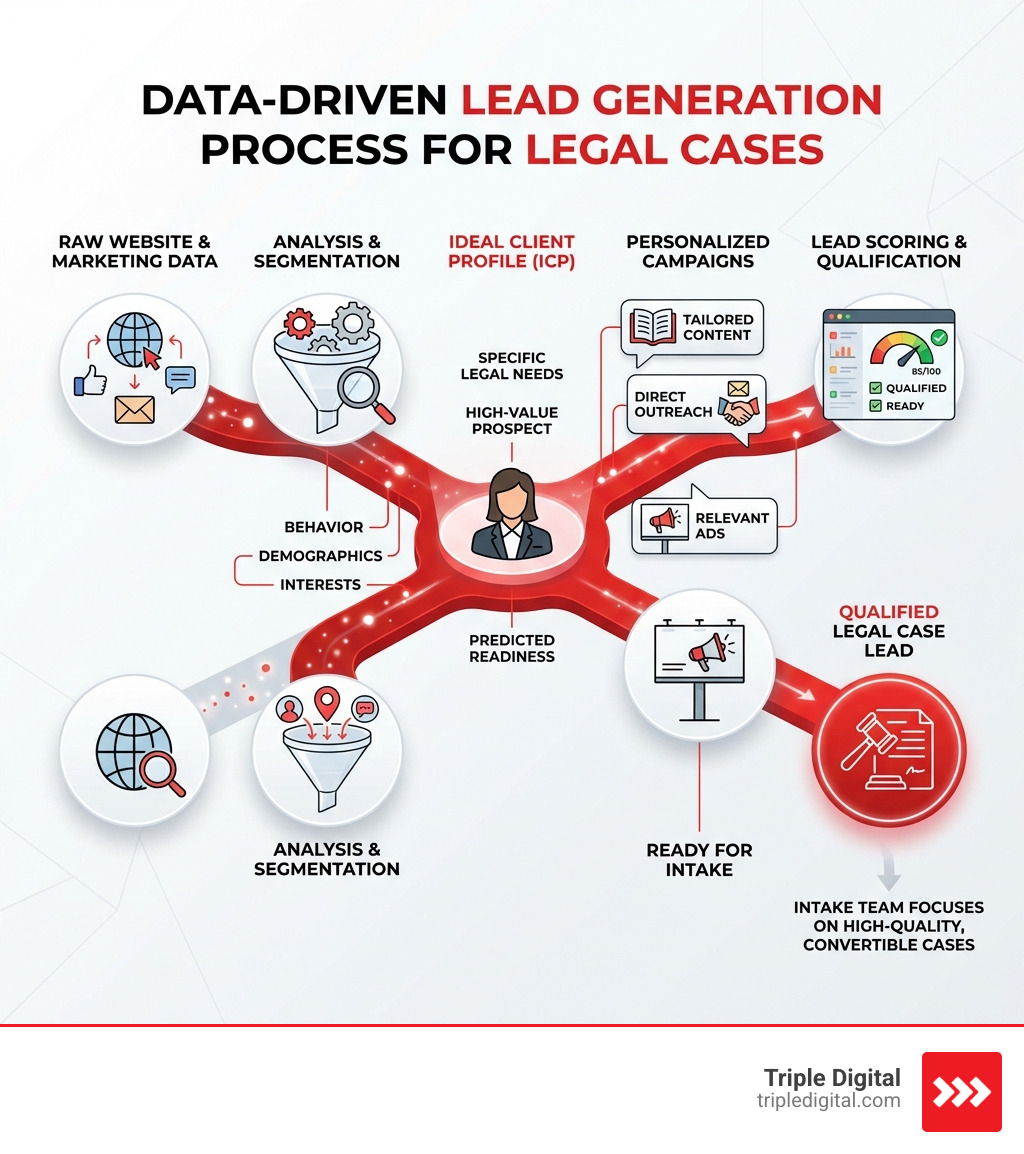
At its core, data-driven lead generation uses real data—not intuition—to find and convert clients. By analyzing audience information, we understand their needs and behaviors, which guides us in creating personalized campaigns and refining our strategies for better results.
This differs from traditional methods like newspaper ads or event sponsorships. These “scattergun” tactics aim for maximum reach but often result in low conversion rates and wasted effort on unqualified prospects.
Data-driven methods are precise and targeted. We don’t just look for any lead; we look for the right lead who needs your services and is likely to convert. This shift is crucial: 78% of businesses report that data-driven marketing improves client acquisition and lead conversion. For law firms, this means more signed cases and fewer dead ends.
| Traditional “Scattergun” Approach | Data-Driven “Sniper” Approach |
|---|---|
| Goal: Maximize reach, generate high volume of leads. | Goal: Maximize quality, generate relevant, high-intent leads. |
| Strategy: General advertising, broad messaging. | Strategy: Targeted campaigns based on specific data insights. |
| Resource Allocation: Often inefficient, high waste. | Resource Allocation: Optimized, focused on high-potential channels. |
| Measurement: Basic metrics (e.g., ad impressions). | Measurement: Advanced KPIs (e.g., ROI per lead source, conversion rates). |
| Outcome: Many unqualified leads, lower conversion. | Outcome: Fewer but higher quality leads, increased conversion. |
From Guesswork to Guaranteed ROI
A common mistake is expanding a marketing campaign without analyzing its effectiveness. If your funnel has a bottleneck where leads aren’t converting, pouring more money in won’t fix it—it just wastes budget on unqualified leads.
A data-driven lead generation strategy provides a forensic look at your marketing funnel, identifying exactly where and why leads drop off. This shifts the focus from reaching more people to reaching the right people who match your ideal client profile.
The benefits are clear:
- Reduced Wasted Ad Spend: By understanding which channels and messages resonate, we avoid throwing money at ineffective campaigns.
- Improved Efficiency: Your intake team spends less time on unqualified prospects and more time nurturing high-potential leads.
- Increased ROI: When you focus on convertible leads, your marketing efforts directly translate into signed cases and revenue. Organizations that use analytics effectively are 2.6x more likely to have a significantly higher ROI compared to their competitors.
This analytical approach ensures that your marketing budget works harder for you. For a deeper dive into optimizing your firm’s online presence, check out our insights on Digital Marketing Strategies for Law Firms.
The Critical Difference: Quality vs. Quantity
For law firms, the goal isn’t more calls; it’s more qualified calls that lead to signed cases. The distinction between lead quantity and quality is paramount.
Generating high-quality leads is a top challenge for 37% of B2B marketers. For law firms, this means avoiding calls from people who don’t fit your practice areas, can’t afford your services, or aren’t ready to pursue legal action.
Data-driven lead generation allows us to prioritize quality by:
- Focusing on the Right People: We leverage historic client data and behavior to narrow down your target market, understanding their specific legal problems, urgency, and capacity to engage your services.
- Aligning with Ideal Client Profiles (ICPs): By understanding your most profitable clients, we can identify common attributes and target similar prospects, ensuring leads are more likely to become valuable clients.
- Reducing Sales Cycle Length: When leads are pre-qualified with data, your intake team can move them through the signing process more efficiently, shortening the time from initial contact to signed retainer.
This strategic shift focuses your team’s time on high-potential prospects, leading to a more profitable practice. To learn how online visibility helps attract quality leads, explore Why SEO is Important for Attorneys.
How to Build Your Data-Powered Strategy
Building a data-powered strategy isn’t as complex as it sounds. It’s a systematic process using data insights to attract, qualify, and convert clients more effectively.

This systematic approach is your blueprint for online success. For a comprehensive guide on optimizing your firm’s online presence, consider Mastering Law Firm SEO: Your Blueprint for Online Success.
Step 1: Collect and Analyze the Right Data
The foundation of a successful data-driven lead generation strategy is the right data, collected and analyzed effectively. We look beyond surface-level metrics to truly understand your potential clients.
Here’s our approach:
- Diverse Data Sources: We gather data from multiple channels, including website analytics (like Google Analytics), your CRM, social media, and customer feedback. Each source provides a unique piece of the client puzzle.
- First-Party vs. Third-Party Data: We prioritize reliable first-party data (information you collect directly, like form submissions). We may enrich this with reputable third-party data to identify new opportunities.
- Data Quality is King: Accurate, relevant data is crucial. We regularly clean and enrich data to ensure it’s reliable and focus only on what’s actionable to avoid over-collection.
- Leveraging Analytics Tools: Tools like Google Analytics provide invaluable insights into website traffic and user behavior. Knowing that visitors who spend more than 5 minutes on your “Personal Injury” page are more likely to call indicates high intent.
By systematically collecting and analyzing this data, we paint a clear picture of your ideal client. To further improve your understanding of how search data can inform your marketing, explore How Can Google Search Console Help With Law Firm Marketing?.
Step 2: Define Your Ideal Client Profile (ICP)
With a solid data foundation, the next step is defining your Ideal Client Profile (ICP). For law firms, this is a detailed, data-backed persona of your most profitable and desirable client, going far beyond basic demographics.
We use data to understand:
- Demographics & Firmographics: This includes age, income, and location for individual clients, or company size and industry for B2B clients.
- Pain Points & Needs: What specific legal problems are they facing? Data from website searches and consultation requests reveals these critical insights.
- Behavioral Data: How do they interact with your content? Which pages do they visit? This data helps us understand their journey and what information they value.
- Psychographics: What are their motivations and fears when seeking legal counsel? This can be inferred from the language they use in inquiries.
These data-backed personas enable highly targeted messaging. We know who to talk to, what their problem is, and how you can help, ensuring your marketing attracts perfect-fit prospects. For insights on the client journey, see Enhancing Client Satisfaction and Firm Profitability: Optimizing the Intake Process.
Step 3: Personalize Your Marketing and Outreach
With a clear ICP, we use data to personalize marketing and outreach. A message custom to a client’s specific needs and journey will always outperform a generic one.
Here’s how we leverage data for personalization:
- Segmenting Your Audience: We segment potential clients based on their demographics, intent, and behavior. For example, someone who downloaded an e-book on car accidents receives different follow-up than someone who visited your estate planning page.
- Personalized Messaging: Data allows us to craft messages that speak directly to an individual’s pain points. Instead of “Need a lawyer?”, we can say, “Dealing with medical bills after your Houston car accident? We can help.”
- Custom Content: We create and deliver content that aligns with a prospect’s interests and stage in their legal journey, such as a relevant case study or FAQ.
- Dynamic Website Content: Your website can dynamically adjust its content based on a visitor’s past behavior or demographic information.
- Compelling Calls-to-Action (CTAs): Instead of a generic “Contact Us,” a data-informed CTA might be “Schedule Your Free Car Accident Consultation.” Creating compelling call-to-action buttons for your audience boosts conversion rates.
Personalizing every touchpoint helps your firm stand out and build rapport. For more on crafting connecting content, explore Why Do Law Firms Need a Content Marketing Strategy?.
Activating and Optimizing Your Lead Generation Engine
Once the groundwork is laid, it’s time to activate and optimize your data-driven lead generation engine. This involves using smart tools and systematic testing for continuous improvement.

The Role of Predictive Lead Scoring in a data-driven approach
Not all leads are equal. Predictive lead scoring helps prioritize efforts, ensuring your intake team focuses on the hottest prospects ready to sign.
Here’s how it works:
- Assigning Values to Actions: We assign scores to lead behaviors. For example, visiting your “Contact Us” page gets a higher score than briefly viewing a blog post.
- Demographic and Behavioral Scoring: Demographic scoring considers factors aligned with your ICP, while behavioral scoring evaluates engagement with your marketing materials.
- MQL vs. SQL: Scoring differentiates a Marketing Qualified Lead (MQL) from a Sales Qualified Lead (SQL). An MQL shows interest, while an SQL is ready for your intake team, indicating a high likelihood of conversion.
- Sales Readiness: The goal is to identify “sales-ready” leads who are actively seeking legal services and fit your criteria. Scoring helps assess their interest, fit, pain points, and budget.
By implementing a robust lead scoring system, we ensure that your intake team’s time is spent most effectively. To learn more about this powerful tool, read How predictive lead scoring can help your business. We also offer specialized insights into Law Firm Lead Tracking.
Improving Performance with A/B Testing
Assumptions can undermine even the best data. A/B testing is our secret weapon for continuous improvement in data-driven lead generation, allowing us to compare variations of content to find the most effective strategies.
Here’s how we use experimentation to refine your efforts:
- Testing Everything: We don’t guess; we test. This means creating two versions (A and B) of elements like website headlines, call-to-action buttons, or email subject lines.
- Measuring Impact: We show each version to a different audience segment and measure which performs better against key metrics like click-through or conversion rates.
- Iterative Optimization: If version B performs better, we implement it and then start testing another element. This creates a continuous improvement cycle, boosting your lead generation efficiency over time.
This systematic approach ensures every element of your strategy is optimized for maximum impact. To dive deeper into this technique, check out A/B testing.
Aligning Sales and Marketing Teams
In law firms, a common challenge is the misalignment between marketing and the intake (“sales”) team. Marketing may focus on lead volume while intake complains about quality. This gap hurts conversion rates.
Here’s how we ensure seamless alignment:
- Shared KPIs (Key Performance Indicators): We establish common goals, like “qualified leads converted,” that both teams are measured against.
- Service Level Agreements (SLAs): We define clear responsibilities. For example, marketing will deliver X MQLs, and intake will contact them within Y hours.
- Revenue Operations (RevOps): We adopt a RevOps mindset, connecting every action back to a measurable business outcome.
- Unified Data View: We break down data silos by implementing systems that give both teams a single, comprehensive view of each lead’s journey.
The benefits of alignment are significant:
- Improved Lead Quality: Intake feedback helps marketing refine targeting.
- Faster Follow-Up: Clear SLAs ensure prompt contact. Contacting leads within an hour makes you nearly 7 times more likely to have a meaningful conversation.
- Better Client Experience: A smooth handoff from marketing to intake is more professional.
- Increased Revenue: Aligned teams convert more leads, driving predictable growth.
Measuring Success and Leveraging Technology
Once your data-driven lead generation engine is running, we measure performance and leverage technology to improve it. This means tracking the right metrics and using tools like AI and automation.
Key Metrics for Your data-driven lead generation Dashboard
To see if our efforts are paying off, we track essential metrics that impact your bottom line, not vanity metrics:
- Cost Per Lead (CPL): The total cost to acquire one lead, calculated per channel to find the most cost-effective options.
- Lead-to-Opportunity Rate: The percentage of leads that become qualified opportunities (SQLs), indicating lead quality.
- Customer Acquisition Cost (CAC): The total cost to acquire a new paying client, a crucial profitability metric.
- LTV:CAC Ratio: Compares a client’s Lifetime Value (LTV) to their CAC. A healthy ratio (ideally >3:1) means your marketing is profitable.
- Pipeline Velocity: How quickly leads move through your intake funnel. Faster velocity means closing cases in less time.
By monitoring these metrics, we can identify what’s working and where to optimize. For an in-depth understanding of why tracking these numbers is vital, refer to Why Tracking Numbers Are So Important to Track Leads.
How AI and Automation Boost Your Efforts
AI and automation are transformative tools that improve your data-driven lead generation. For law firms, this means greater efficiency, deeper insights, and more personalized client interactions.
Here’s how AI and automation lift our approach:
- Predictive Analytics: AI analyzes data to predict which leads will convert, helping your intake team prioritize efforts by identifying high-intent prospects.
- Automated Nurturing: Automation delivers personalized content to leads based on their behavior. For example, a prospect who downloads a guide on “Wrongful Death Claims” can receive automated, relevant follow-up emails. We can automate your email campaigns to nurture leads.
- Chatbots: AI-powered chatbots engage visitors 24/7, answering questions, qualifying leads, and scheduling consultations so no lead is left waiting.
- AI-Powered Personalization: AI dynamically adjusts website content, ads, and emails in real-time for a one-to-one experience.
- Advanced Lead Scoring: AI continuously refines lead scores, providing more accurate predictions of conversion likelihood.
The integration of AI for lead generation means we can act faster and deliver more relevant experiences, leading to more signed cases. At Triple Digital, we’re at the forefront of this revolution, as highlighted by Triple Digital LLC Unveils Groundbreaking AI Tool.
Real-World Success Stories
The power of data-driven lead generation is proven by real-world results. Here are some examples that illustrate the potential for your firm:
- SaaS Company Slashes CAC: A SaaS client cut customer acquisition costs by 22% in one quarter by focusing their budget only on prospects matching their Ideal Customer Profile, eliminating wasted spend.
- Law Firm Increases Qualified Leads: A law firm used behavioral data to identify highly motivated prospects (e.g., those reading “statute of limitations” articles). With custom, rapid follow-up, they increased qualified leads by 80% in three months.
- The Impact of Rapid Lead Response: Speed matters. Leads are 7x more likely to qualify when contacted within an hour. This means law firms need systems like automated alerts and a responsive intake team to act on leads immediately.
These examples underscore a fundamental truth: combining intelligent data analysis with swift action makes your lead generation dramatically more effective.
Frequently Asked Questions about Data-Driven Lead Generation
What is the difference between a lead and a qualified lead?
A lead is any contact who has shown interest (e.g., visited your website). Their intent and fit are unclear.
A qualified lead, however, fits your Ideal Client Profile (ICP) and shows clear intent to hire a lawyer. They have been vetted through lead scoring and are ready for a conversation with your intake team. For law firms, this means they are actively seeking help, fit your practice area, and represent a viable case.
Which lead generation channels should we focus on first?
The best channels depend on your Ideal Client Profile (ICP). Ask: where do your ideal clients spend time online?
- For active searchers: Focus on inbound strategies like SEO and blogging. 90% of online searches happen on Google.
- For specific businesses or high-value cases: Use a focused outbound strategy on platforms like LinkedIn, which nearly 85% of B2B teams use.
- For quick feedback: Paid advertising generates leads fast.
Start by analyzing where your best clients came from and double down on those channels.
How quickly can we expect to see results from a data-driven strategy?
The timeline for results varies by channel:
- Paid Advertising (Google Ads, etc.): Can generate leads within days or weeks, offering quick feedback.
- Inbound Marketing and SEO: This is a longer-term strategy, typically taking 3-6 months to build momentum and deliver a consistent flow of high-quality organic leads.
- Overall Optimization: You’ll see incremental improvements across all channels as we collect data, A/B test, and refine your strategy. The true power is in sustained, long-term growth. We track key metrics from the start to ensure we’re making data-informed adjustments.
Conclusion
In today’s legal market, a marketing budget isn’t enough. To win more cases, law firms must accept data-driven lead generation. This approach moves you from guesswork to guaranteed ROI by prioritizing quality leads and creating a predictable growth engine.
By analyzing data, defining your Ideal Client Profile (ICP), personalizing outreach, and aligning your marketing and intake teams, you build an efficient machine that ensures no promising case is lost.
The future of legal marketing is intelligent and personal. Using AI and automation, we deliver hyper-personalized experiences that attract not just more leads, but the right leads—your most valuable future clients.
Don’t get left behind. Accept data to eliminate the “fluff” and focus on what matters: winning more cases. Take the first step towards a more profitable practice by exploring our lead generation services.