





Why Patent Attorneys Must Compete for Digital Visibility
Search engine optimization for patent law firms is essential for survival in a crowded legal marketplace. With millions of patent applications filed globally each year, inventors and businesses start their search for legal help on Google, not the Yellow Pages.
Quick Answer: What Patent Law Firms Need to Rank
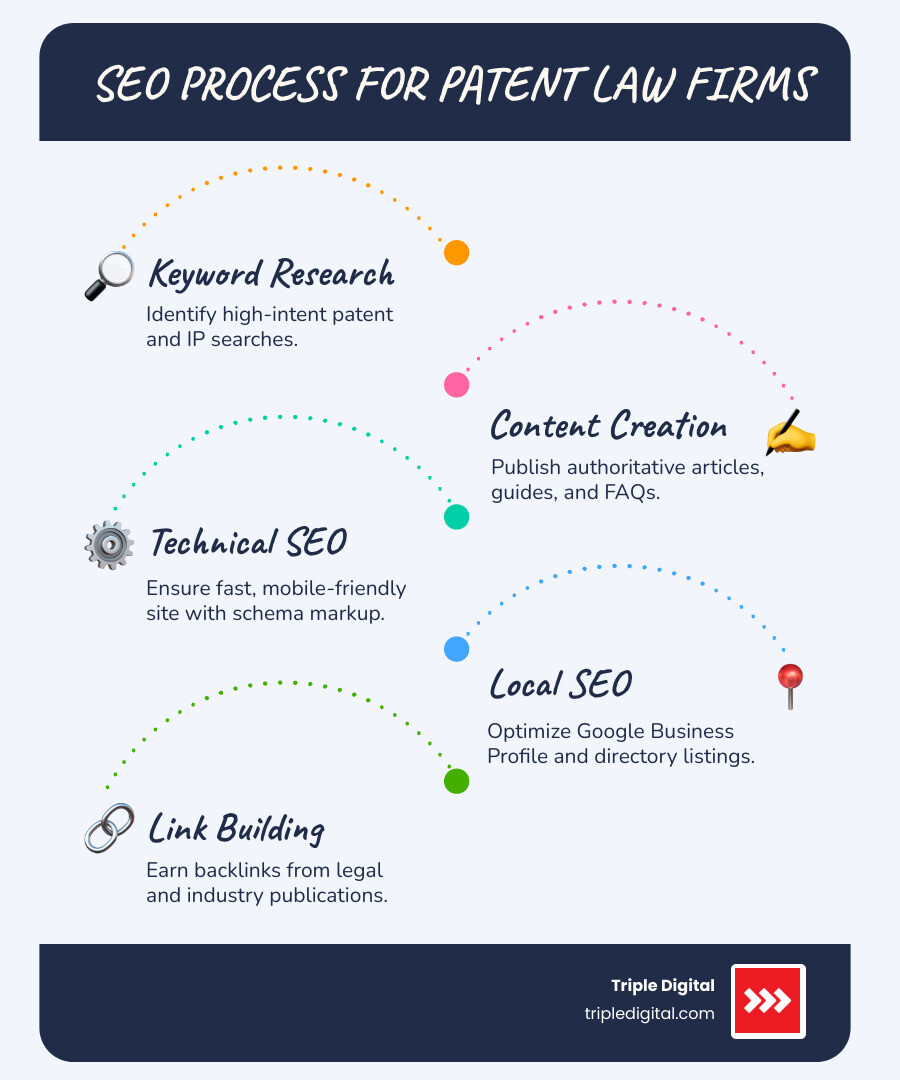
To compete for high-intent clients online, your firm needs:
- Keyword Strategy – Target specific searches like “software patent attorney” or “how to fight a copyright claim”
- Authority Content – Blog posts, FAQs, and guides that answer technical IP questions
- Technical Excellence – Fast, mobile-friendly website optimized for search engines
- Local Presence – Optimized Google Business Profile and consistent directory listings
- Quality Backlinks – Links from legal directories, industry publications, and authoritative sites
Unlike general practice firms, patent attorneys face a unique challenge. Your potential clients—inventors, startups, and businesses—conduct highly specialized searches with clear intent to hire.
The problem? Many firms rely on referrals while competitors capture these high-value clients through strategic SEO. Ranking on page one for terms like “trademark attorney [city]” provides visibility exactly when prospects need it most.
SEO builds long-term visibility without the ongoing cost of paid ads. When someone searches “how to file a patent” at 2 AM, your educational content can be the first touchpoint, establishing trust before they’re ready to hire.
The legal SEO landscape is highly competitive. However, patent law’s specialized nature creates opportunities. Hyper-specific content and targeting niche queries make SEO for IP lawyers more focused and lucrative than broader practice areas.
The Strategic Advantage: Why SEO is Crucial for Patent Attorneys
In today’s digital-first world, your law firm’s online presence isn’t just a nice-to-have; it’s a strategic imperative. For patent law firms, where clients are often innovative businesses or individuals with high-stakes intellectual property, visibility and credibility are paramount. This is where search engine optimization for patent law firms steps in as your secret weapon.
While traditional marketing methods can be a shot in the dark for a specialized audience, SEO is like a homing guide, guiding precisely those individuals who are actively searching for your expertise directly to your digital doorstep. As we’ve seen, 96 percent of people seeking legal advice begin their journey with a search engine. If your firm isn’t showing up, you’re essentially invisible to a vast pool of potential clients.
SEO offers a distinct advantage over other digital marketing strategies like Pay-Per-Click (PPC) advertising. While PPC can provide immediate visibility, it’s a bit like renting a billboard: the moment you stop paying, your visibility disappears. SEO, on the other hand, builds long-term equity. It’s an investment that compounds over time, delivering sustained visibility and a more impressive return on investment (ROI) in the long run. As one expert puts it, SEO creates “compounding visibility,” with each optimized page and backlink adding to your firm’s long-term growth engine.
Beyond just getting clicks, SEO helps build something invaluable: trust and authority. Higher search engine rankings are often associated with expertise and reliability. When Google, the world’s most trusted search engine, recommends your firm, it lends significant credibility. By emphasizing Google’s E-E-A-T signals (Expertise, Experience, Authoritativeness, and Trustworthiness) – showcasing attorney bios, case results, and thought leadership – we help establish your firm as a go-to authority in the complex world of intellectual property. This builds client trust even before they pick up the phone.
For more insights into the broader benefits, explore why SEO is important for attorneys and the specific Reasons to Use Law Firm SEO.
Understanding the Unique IP Client Journey
The journey of an intellectual property (IP) client is distinct and often more nuanced than that of clients seeking general legal services. Patent law firms, unlike family or criminal defense practices, cater to a typically narrower and highly specialized audience. This audience isn’t just looking for a lawyer; they’re often seeking a deep understanding of complex IP law, technological expertise, and strategic guidance for their innovations or brands.
High-intent clients, whether they’re seasoned inventors or burgeoning startups, often begin their search with very specific legal questions. They might be struggling with “how to patent a software invention,” “trademark infringement defense,” or “IP licensing agreements for a new tech startup.” These aren’t general queries; they signal a clear, immediate need for specialized legal counsel. Our role is to ensure your firm’s online content directly addresses these precise questions, positioning you as the expert solution.
This focus on specific, often B2B, clients means that the long-tail search intent is incredibly powerful. Long-tail keywords – those longer, more specific phrases like “intellectual property attorney for biotech startups Houston” – account for a significant portion of all search traffic, up to 70 percent. Crucially, they also boast a much higher conversion rate. While the average legal web conversion rate hovers around 2.07 percent, long-tail keywords can convert at an impressive 36 percent. This means the individuals finding your firm through these specific searches are far more likely to become paying clients.
From the initial spark of an invention idea to the critical need for legal counsel, we understand how to map your online presence to every stage of this sophisticated client journey. For a deeper dive into optimizing this path, consult our guide on Mastering Law Firm SEO: Your Blueprint for Online Success.
The Key Difference: SEO for IP vs. General Practice Firms
While the fundamental principles of SEO remain consistent, applying them to intellectual property and patent law firms requires a specialized touch. The differences in strategy compared to general practice firms are significant, largely due to the unique nature of your clientele and practice areas.
IP law firms thrive on hyper-specific content and search intent. Unlike a general law firm that might target broad terms like “lawyer near me,” you’re looking for individuals or businesses with very niche queries. Think “licensing agreement help for SaaS startups” or “copyright for mobile app developers” – these are not generic searches. This precision allows search engine optimization for patent law firms to be incredibly targeted and, frankly, more lucrative.
The content you produce is also inherently more technical. It’s not just about explaining legal processes; it’s about delving into the intricacies of technology, science, and innovation. This demands a nuanced approach to content creation that effectively communicates your firm’s deep expertise to a sophisticated audience.
Furthermore, IP law often transcends local boundaries. While a personal injury attorney might focus heavily on “Houston personal injury lawyer,” a patent firm might need to balance local presence with national or even international thought leadership. A hybrid strategy often works best: targeting broader terms like “intellectual property lawyers” for long-term authority while simultaneously optimizing for local, high-converting phrases like “patent lawyer in Houston.”
The emphasis on thought leadership is another differentiator. By consistently publishing high-quality, in-depth content that addresses complex IP challenges, your firm can establish itself as a leading voice in the field. This not only attracts clients but also lifts your firm’s reputation within the legal and business communities.
To understand how these specialized strategies fit into the broader digital marketing landscape for law firms, refer to Top 3 Digital SEO Strategies for Law Firms.
The Core Pillars of Search Engine Optimization for Patent Law Firms
Building a robust online presence for your patent law firm requires a multi-faceted approach. We view search engine optimization for patent law firms as a blueprint where each pillar supports visibility and client acquisition.
Keyword Research: Uncovering High-Intent Inventor and Business Searches
At the heart of any successful SEO strategy is meticulous keyword research. For patent law firms, this means precisely identifying the terms your ideal clients are searching. We focus on long-tail keywords—specific phrases that reveal a clear intent to seek legal help.
Think beyond “patent attorney.” Your clients are more likely to search for “how to file a patent for a medical device” or “software patent attorney Houston.” These long-tail keywords have lower competition and higher conversion rates, often converting at 36% compared to the 2.07% average for legal websites.
We also leverage competitor analysis to gain an edge, examining what keywords your competitors rank for to identify missed opportunities. Tools like SEMrush and Ahrefs allow us to analyze competitor keyword profiles and rankings.
The rise of AI has opened new avenues for keyword insights. Patent examiners at the USPTO have conducted over 1.3 million searches using AI tools, showing AI’s power in understanding complex queries. We use these insights to better understand how potential clients phrase their technical legal needs.
To conduct thorough keyword research, we use a suite of tools:
- WordStream’s Keyword Tool: Excellent for generating initial long-tail ideas from a single seed keyword.
- SEMrush and Ahrefs: These advanced platforms provide in-depth data on search volume, keyword difficulty, competitor performance, and related terms, helping us prioritize the most impactful keywords for your firm.
Content Marketing: Establishing Your Firm as an IP Authority
Once we know what clients are searching for, we create content that answers their questions and establishes your firm as an authority in IP law. Content marketing for patent law firms is about demonstrating expertise, building trust, and nurturing potential clients.
We craft a variety of high-value content, including:
- Blog posts: In-depth articles on specific IP topics, such as “Understanding Design Patents for Product Manufacturers” or “Navigating Copyright Challenges in the Digital Age.” The ideal length of a blog post, based on top Google results, is often above 2,000 words for competitive topics.
- Whitepapers and E-books: Comprehensive guides that dig into complex areas, like “A Startup’s Guide to Protecting Intellectual Property.”
- Case studies: Anonymized examples of successful client outcomes that showcase your firm’s experience and strategic prowess.
- FAQs: Dedicated sections that directly address common client questions, naturally incorporating long-tail keywords.
This strategic content attracts organic traffic and positions your attorneys as thought leaders. By providing tangible value, we help your firm earn client trust. We also repurpose content into formats like videos or infographics to maximize reach. Our own Blog is a testament to the power of consistent, valuable content.
While AI can assist in content generation, we always ensure that the final output reflects your firm’s unique voice and legal accuracy. As the USPTO’s 2024 guidance emphasizes, attorneys remain fully responsible for the accuracy of any AI-generated output.
Technical & On-Page SEO: Ensuring Your Site is Findable and User-Friendly
Even brilliant content won’t be seen if your website isn’t technically sound. Technical and on-page SEO ensure search engines can find and understand your site, and that users have a seamless experience.
A critical element is mobile-first design. With over 60% of people now searching for legal help on smartphones, your website must be mobile-responsive. Google also prioritizes the mobile version of websites for indexing, meaning if your mobile site is clunky, your rankings will suffer.
Site speed is another non-negotiable. Slow websites frustrate users and are penalized by search engines. The ideal load time is under 3 seconds. We optimize for Google’s Core Web Vitals—official ranking factors that measure user experience based on loading, interactivity, and visual stability.
We implement schema markup, a form of structured data that tells search engines exactly what information is on your page. For patent law firms, this means using “Attorney” or “LegalService” schema to highlight your expertise, and “FAQ” schema for question-and-answer sections. This can significantly increase your chances of appearing in rich snippets or improved search results.
Other crucial technical and on-page elements include:
- Clean URL structure: Making sure your website’s addresses are short, descriptive, and relevant to the page’s content.
- On-page optimization: Carefully optimizing title tags, meta descriptions, header tags (H1s, H2s, H3s), and image alt text with your target keywords.
- Image optimization: Ensuring all images are properly compressed and have descriptive alt text, which aids both SEO and accessibility.
For a deeper dive into how we monitor and improve your site’s technical health, check out How Can Google Search Console Help With Law Firm Marketing?.
Local SEO & Link Building: Dominating Your Region and Building Trust
Even for firms with a national reach, local visibility is important for initial consultations or regional filings. Local SEO helps you dominate target areas like Houston by ensuring your firm appears in “near me” searches and local map results.

Our local SEO strategy begins with your Google Business Profile (GBP). We ensure your profile is fully optimized with accurate business information, relevant categories (there are over 100 legal industry-related options!), high-quality photos, and consistent business hours. Crucially, we encourage and manage client reviews on your GBP. Reviews mentioning your services and location are gold for local search.
NAP consistency (Name, Address, Phone Number) across all online directories is vital. Google cross-references this information, and inconsistencies can hurt local rankings. Legal directories like Avvo and BestLawyers are excellent for building consistent citations.
Link building remains one of the strongest signals of authority for search engines. Think of backlinks as votes of confidence from other reputable websites. A single high-quality backlink from a relevant legal publication can be more powerful than thousands of spammy, low-quality links.
Our link-building strategies for patent law firms include:
- Legal Directories: Creating comprehensive profiles on prominent legal directories to earn valuable links.
- Guest Posting: Publishing expert articles on reputable legal blogs and industry publications, including a link back to your firm’s site.
- Digital PR: Securing media mentions and expert quotes in relevant online publications.
- Creating Linkable Assets: Developing valuable resources like guides or research papers that other sites naturally want to link to.
By combining robust local SEO with a strategic link-building campaign, we help your firm not only get found but also earn the trust and authority necessary to convert searchers into clients.
From Clicks to Cases: Measuring Success and Navigating Challenges
The beauty of digital marketing, and SEO in particular, is its measurability. We don’t just set up campaigns and hope for the best; we carefully track performance, analyze data, and continuously refine our strategies to ensure your firm sees tangible results – turning clicks into actual cases.
Our key performance indicators (KPIs) go beyond vanity metrics. We focus on:
- Keyword Rankings: Tracking your firm’s position for target keywords, especially those high-intent, long-tail phrases. Keyword ranking remains a top metric for SEO professionals.
- Organic Traffic: Monitoring the volume of visitors coming to your site directly from search engines, indicating increased visibility.
- Lead Conversions: The ultimate metric – how many website visitors are contacting your firm for consultations, filling out forms, or making direct calls. As we’ve highlighted, long-tail keywords can deliver an impressive 36% conversion rate.
The goal is clear: generating website traffic that transforms into consultations and new clients. This measurable impact is why Why SEO is Great for Your Business is a resource we stand by.
Effective Strategies for Search Engine Optimization for Patent Law Firms
Implementing a successful search engine optimization for patent law firms strategy often involves a choice: do it yourself or hire a specialized agency? Here’s a comparison to help you decide:
| Feature | DIY SEO | Specialized SEO Agency |
|---|---|---|
| Time Investment | Significant, ongoing learning curve | Minimal for your firm, handled by experts |
| Expertise | Basic understanding, prone to mistakes | Deep industry knowledge, specialized IP legal SEO |
| Tools & Tech | Free/basic tools, limited capabilities | Advanced, expensive tools and proprietary methods |
| Results | Slower, less consistent, potential for errors | Faster, more consistent, data-driven, measurable ROI |
| Compliance | Requires constant self-education | Stays updated on legal advertising rules and ethics |
| Focus | Diverts focus from practicing law | Allows attorneys to focus on core legal work |
We understand that you can tackle the basics – optimizing meta tags, publishing blog posts, or updating your Google Business Profile. However, advanced strategies like technical audits, complex link building, and managing a comprehensive law firm SEO campaign demand significant time, specialized tools, and deep experience. This is where a professional SEO team, like ours, offers immense value.
When it comes to timelines, SEO is a marathon, not a sprint. You can typically expect to see initial traction within 3-6 months. For more competitive keywords, however, it can take 6-12 months to achieve meaningful rankings. Patience and persistence are key.
Integrating AI tools is becoming increasingly important. The AI patent search market is expanding at a 21.20% CAGR, and AI can reduce patent search time by up to 80%. We leverage AI for insights and efficiency, but always with human oversight, especially given that attorneys are ultimately responsible for the accuracy of any AI-generated output.
We prioritize quality over quantity in all aspects of our SEO work. A website with just 10 solid, relevant backlinks will almost always outrank one with 10,000 low-quality, spammy links. This focus on high-quality, ethical strategies ensures sustainable growth for your firm. To learn more about our comprehensive approach, visit our Services page.
Common Pitfalls and How to Comply with Legal Advertising Rules
Navigating the digital landscape for a patent law firm comes with its share of potential traps. Avoiding these common pitfalls is crucial for maintaining your firm’s reputation and ensuring long-term SEO success:
- Keyword Stuffing: Overloading your content with keywords in an unnatural way is an outdated tactic that Google penalizes. We focus on natural keyword integration that serves both search engines and human readers.
- Buying Low-Quality Links: Acquiring backlinks from irrelevant or spammy websites can severely harm your domain authority and lead to Google penalties. We adhere to white-hat link-building strategies, prioritizing quality and relevance.
- Ignoring Mobile Users: As mentioned, over 60% of legal searches happen on smartphones. A non-mobile-friendly website will drive away potential clients and hurt your rankings.
- Neglecting Analytics: Without regularly tracking your SEO performance, you’re flying blind. We use analytics to identify what’s working, what’s not, and where to adjust our strategy to drive real cases.
- Duplicate Content: Publishing identical or near-identical content on multiple pages can confuse search engines and dilute your SEO efforts.
Crucially, all our SEO practices strictly adhere to legal advertising rules and Bar Association guidelines. Reputable law firm SEO companies, including Triple Digital, stay informed about these regulations. We ensure that all website content, metadata, and online marketing practices are ethical, accurate, and compliant, protecting your firm’s reputation while enhancing its online visibility. We avoid misleading claims and prioritize transparency in all our digital efforts.
Frequently Asked Questions about SEO for Patent Law Firms
How long does it take to see results from SEO for a patent law firm?
SEO is a long-term investment, not an overnight miracle. Typically, search engine optimization for patent law firms starts to show traction within 3–6 months. However, for more competitive keywords—especially those related to “patent attorney near me” or “intellectual property litigation”—it can take 6–12 months to rank meaningfully. It’s a continuous process of optimization and adaptation to Google’s changing algorithms.
What is the difference between SEO and paid ads (PPC) for attracting patent clients?
Both SEO and paid ads (PPC) have their place in a comprehensive digital marketing strategy. The key difference lies in their nature and longevity:
- PPC (Paid Ads): Offers immediate visibility. Your ad appears at the top of search results as long as you’re paying for it. It’s excellent for quick campaigns or testing new keywords. However, the moment your budget stops, your visibility disappears.
- SEO (Organic Search): Builds long-term, sustainable visibility. It’s about earning your spot at the top of search results through quality content, technical optimization, and authority building. SEO delivers better ROI over the long haul because it creates compounding equity for your firm. While slower to start, it continues to drive traffic and leads without direct per-click costs once established.
Interestingly, research shows that paid search ads can even improve organic performance for related keywords, and long-tail legal keywords often have lower costs in PPC campaigns, making a combined strategy powerful.
How does AI impact search engine optimization for patent law firms?
AI’s impact on SEO, particularly for patent law firms, is significant and constantly evolving. Generative AI and changes in how people interact with search engines are two of the biggest factors affecting the usefulness of attorney marketing.
Key impacts include:
- Improved Search Understanding: AI, through systems like Google’s RankBrain and Hummingbird, helps search engines better understand complex, conversational queries, which are common in patent law. This means optimizing for user intent and semantic variations is more important than ever.
- AI-Powered Search Tools: The AI patent search market is expanding rapidly, with tools capable of reducing patent search time by up to 80%. Patent examiners at the USPTO have conducted over 1.3 million searches using AI tools. While these are primarily for patent search, they influence how technical information is processed and how potential clients might formulate their search queries.
- Content Creation: AI can assist in generating content ideas, drafting outlines, and even creating initial drafts. However, for patent law, human expertise remains critical for accuracy, nuance, and legal compliance. Attorneys must remain responsible for the accuracy of any AI-generated output.
- Personalized Search Results: AI algorithms increasingly personalize search results, making user experience and relevance even more paramount.
For patent law firms, leveraging AI means staying adaptive, focusing on high-quality, authoritative content that can stand out, and ensuring technical SEO is impeccable to help AI-driven search algorithms understand and rank your specialized information.
Conclusion: Secure Your Firm’s Future with a Winning Digital Strategy
In the highly specialized and competitive world of intellectual property, a robust search engine optimization for patent law firms strategy is no longer a luxury—it’s a fundamental requirement for growth and sustainability. By focusing on hyper-specific keyword research, authoritative content creation, technical excellence, and strategic local SEO and link building, your firm can build a powerful digital presence that consistently attracts high-intent clients.
This isn’t just about getting more website visitors; it’s about building a consistent client pipeline, establishing your firm as a recognized authority, and securing your future in an increasingly digital marketplace. SEO is a long-term investment that yields compounding returns, allowing your firm to thrive without constantly chasing costly paid ads.
At Triple Digital, we specialize in crafting results-driven digital marketing strategies for law firms, right here in Houston. We combine our expertise in SEO with AI and data mining for precise client targeting, ensuring “less fluff, more cases” for your practice.
Don’t let your competitors capture the innovators and businesses that should be your clients. Take the next step toward a secure and prosperous future. Contact our experts today to build your custom digital marketing strategy for your law firm. We’re ready to help you become the undeniable authority in your field.
Learn more about why we are a Top Rated Digital Marketing Agency for Law Firms and reach out to Contact our experts to build your custom digital marketing strategy for your law firm.