 Skip to content
Why Legal Marketing Analytics Is the Competitive Edge Your Firm Is Missing
Legal marketing analytics is the practice of collecting, analyzing, and acting on data from your law firm’s marketing channels to generate more qualified leads, reduce wasted spend, and grow case volume.
Here’s what it covers at a glance:
- What it is: Measuring which marketing efforts actually bring in signed cases
- Why it matters: Firms using data-driven strategies see up to 20% higher ROI than those that don’t
- Key metrics to track: Cost Per Lead (CPL), Client Acquisition Cost (CAC), conversion rates, and ROI
- Core tools: Google Analytics 4, CRM software, call tracking platforms
- Who needs it: Any firm spending money on SEO, paid ads, social media, or content
Most law firms have no idea which part of their marketing budget is working. In fact, 80% of law firms don’t receive regular marketing performance reports — meaning the majority are making spend decisions based on gut feeling, not data.
That’s a costly problem. Without measurement, there’s no way to know if your Google Ads are burning cash, whether your SEO is actually driving consultations, or which practice areas are worth promoting more aggressively.
Running a law firm’s marketing without analytics is a bit like arguing a case without evidence. You might win sometimes — but you’re leaving a lot on the table.
The good news? The firms that do embrace data aren’t just saving money. They’re pulling ahead. Data-backed marketing strategies have helped law firms achieve a 36% increase in leads, a 48% decrease in costs, and a 56% improvement in brand strength — all by making smarter decisions with the same (or smaller) budgets.
This guide walks you through exactly how to build that kind of system for your firm.
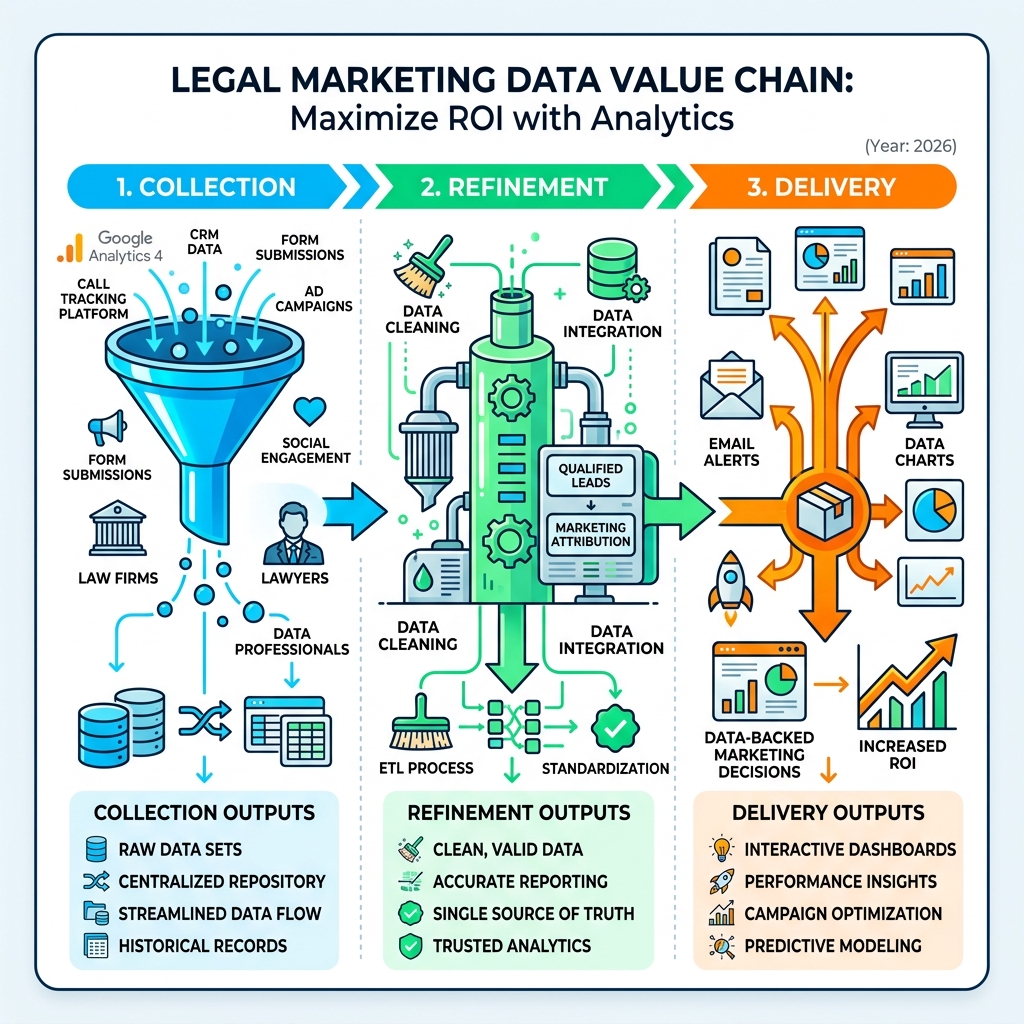
Legal marketing analytics terms simplified:
The Core Pillars of Legal Marketing Analytics
To move beyond “we think it’s working,” we need to understand the different ways data speaks to us. Analytics isn’t just a spreadsheet of numbers; it’s a hierarchy of insights that tells us what happened, what might happen next, and exactly what we should do about it.
In our work at Triple Digital, we view legal marketing analytics through four primary lenses:
- Descriptive Analytics (The Rearview Mirror): This tells us what happened in the past. How many people visited the site last month? How many forms were filled out? It’s the foundation of all reporting.
- Business Intelligence (The Diagnostic): This helps us understand why things happened. If leads dropped, was it because of a technical site error or a decrease in ad spend?
- Predictive Modeling (The Weather Forecast): This uses historical patterns and machine learning to forecast future behavior. For example, based on current search trends, how many personal injury leads can we expect in the next quarter?
- Prescriptive Actions (The GPS): This is the “holy grail.” It combines data to suggest the best course of action. If the data shows a specific keyword has a high conversion rate but low volume, prescriptive analytics might suggest reallocating budget to a similar niche.
For a deeper dive into how these numbers translate to revenue, check out our guide on Crunching Numbers, Winning Cases: Your Guide to Data-Powered Lead Gen.
Comparing Analytics Types for Law Firms
| Analytics Type | Question it Answers | Law Firm Example |
|---|---|---|
| Descriptive | What happened? | We got 50 leads from Google Ads last month. |
| Predictive | What will happen? | Based on seasonal trends, we expect a 15% spike in inquiries in January. |
| Prescriptive | What should we do? | Shift $2,000 from “General Lawyer” ads to “Truck Accident” ads to increase ROI. |
Identifying Ideal Data Sources
To get a 360-degree view of your firm’s health, you need to pull data from more than just your website. We categorize these sources into three buckets:
- Individual User Data: This comes from tools like Google Analytics 4. It tracks how individuals interact with your site, which pages they read, and where they drop off. How Can Google Search Console Help with Law Firm Marketing? It provides the “search intent” data that tells you what potential clients are actually looking for.
- Internal Billing and CRM Data: This is often the most overlooked source. By looking at your internal records, you can identify which case types are actually the most profitable. If a specific type of litigation takes 100 hours but generates low fees, your marketing should pivot away from it.
- Industry Trends and First-Party Data: This includes broader market data. For instance, knowing that search volume for “employment law” is rising in Houston allows you to get ahead of the curve.
Essential Personnel for Data Success
Building a legal marketing analytics function isn’t just a marketing job; it’s a firm-wide initiative. To succeed, we recommend involving:
- Leadership: To set the business objectives.
- IT Department: To ensure data security and handle technical integrations between your site and CRM.
- Finance: To align marketing spend with actual revenue and “signed case” data.
- Marketing-Intake Synergy: Your intake team is your “boots on the ground.” If marketing sends 100 leads but intake says they are all “junk,” your analytics need to reflect that disconnect immediately.
Essential KPIs: Measuring What Matters for Law Firm Growth
If you try to track everything, you’ll end up tracking nothing. For growth-stage law firms, we focus on the “North Star” metrics that actually impact the bottom line.
- Return on Investment (ROI): The ultimate metric. If you spend $5,000 and sign cases worth $25,000, your ROI is 400%.
- Cost Per Lead (CPL): How much does it cost to get someone to call or email? In competitive markets like Houston, CPL can vary wildly by practice area.
- Client Acquisition Cost (CAC): This goes a step further than CPL. It’s the total marketing spend divided by the number of signed cases.
- Conversion Rates: The percentage of site visitors who become leads, and the percentage of leads who become clients.
Understanding these costs is vital for budgeting. You can learn more about typical benchmarks in our articles on How Much Do Small Law Firms Spend on Marketing? and How Much Should Lawyers Pay for SEO?.
Tracking the Full Client Journey with Legal Marketing Analytics
A lead isn’t a case. One of the biggest mistakes firms make is stopping their analysis at the “form fill.” To truly optimize, you must track the full journey:
- The Click: Where did they come from? (SEO, Paid Ads, Social)
- The Inquiry: Did they call or use a form?
- The Response: How fast did your team get back to them? (Data shows that response time is a massive factor in hiring decisions).
- The Consultation: Did the lead actually show up?
- The Signed Case: Did they hire the firm?
By using Law Firm Lead Tracking, you can identify where the “leaks” in your bucket are. If you have a high CPL but a very high “consult-to-case” rate, that channel might actually be more profitable than a “cheap” lead source that never signs.
Benchmarking Against the Competition
You don’t operate in a vacuum. Your competitors are likely bidding on the same keywords and targeting the same Houston DMAs. Legal marketing analytics allows you to see how you stack up.

We look at:
- Brand Strength: How often is your firm searched for by name compared to others?
- Share of Voice: What percentage of the total search traffic in your practice area are you capturing?
- Competitor Adjustments: Are they increasing their spend on Facebook? Did they launch a new landing page for “hurricane claims”? Monitoring these shifts allows you to play offense rather than defense.
Building Your Data Infrastructure: Tools and Processes
To get reliable data, you need a “tech stack” that talks to each other. Here is the foundation we recommend for any law firm:
- Google Analytics 4 (GA4): For tracking website behavior and conversions.
- CRM Integration: (e.g., Lawmatics, Clio, or HubSpot) To track leads from the first click to the final invoice.
- Call Tracking: Tools like CallTrackingMetrics are essential. Since most legal leads come via phone, you must know which ad or keyword triggered that specific call. Why Tracking Numbers Are So Important to Track Leads explains why this is non-negotiable for ROI.
Overcoming Roadblocks in Legal Marketing Analytics Implementation
It’s not always smooth sailing. Law firms face unique challenges when building out these functions:
- Data Silos: Marketing has the lead data, but Finance has the revenue data, and they never meet. Integration is the only cure.
- Security and Ethics: Privacy is paramount in the legal world. You must ensure your tracking is compliant and that you aren’t feeding sensitive client data into public AI tools.
- Technical Debt: Old websites or clunky CRMs can make data collection a nightmare.
- The “Cookie” Problem: With Google Third-Party Cookie Tracking changes, firms must rely more on first-party data (data you own) rather than third-party tracking.
Setting a Review Cadence for Maximum ROI
Data is only useful if you look at it. We suggest a tiered review schedule:
- Weekly: Review paid search (Google Ads) and social media ads. These are high-cost channels where a small error can burn a lot of money quickly.
- Monthly: Review SEO performance and content rankings. SEO is a marathon, not a sprint, so monthly views help you see the “trend” through the “noise.”
- Quarterly: Conduct a deep dive into your strategy. Which practice areas are growing? Where should we pivot the budget for the next 90 days?
Optimizing Performance Through Behavioral Insights and Testing
Once the data is flowing, the fun begins. We use behavioral analysis to “squeeze” more value out of your existing traffic.
- A/B Testing: We test two versions of a landing page. Does a “Free Consultation” button work better in red or blue? Does a video of the lead attorney increase trust?
- Heatmaps: These show us exactly where people click and how far they scroll. If your most important information is at the bottom of the page and the heatmap shows no one scrolls that far, we move it up.
Leveraging AI and Future Trends
The future of legal marketing analytics is automated and predictive. We are already moving toward:
- Real-Time Lead Scoring: Using AI to instantly analyze an incoming lead’s data and prioritize it for your intake team.
- Predictive Churn Models: Identifying which clients might be unhappy before they leave.
- Automated Reporting: Dashboards that update in real-time, so you always know your CAC without having to run a manual report.
Real-World ROI Improvements
We’ve seen these strategies transform firms. In one instance, a firm was spending heavily on Google Ads with a CPL of $3,000. By analyzing the data, we discovered that Facebook was delivering qualified leads for just $500. By reallocating that budget, we achieved a 65% reduction in client acquisition costs.
Another firm focused on optimizing high-traffic blog pages rather than writing new ones. By adding better “trust signals” and clearer calls to action based on heatmap data, they saw a 36% increase in leads without spending an extra dollar on traffic.
Frequently Asked Questions about Legal Marketing Analytics
How do I build a business case for marketing analytics?
Focus on the “waste.” Show leadership that without analytics, the firm is likely overspending on underperforming channels. Highlight that firms using data see 20% higher ROI and that 80% of your competitors are likely flying blind.
What is the difference between a marketing plan and a data strategy?
A marketing plan is the “what” (we will post on social media, we will run ads). A data strategy is the “how we know it worked” (we will track every lead back to its source and measure the cost per signed case).
How can analytics help identify high-profit case types?
By linking your CRM/billing data to your marketing sources, you can see which channels bring in the “big” cases versus the high-volume, low-margin ones. This allows you to “laser focus” your budget on the revenue-driving activities.
Conclusion
At Triple Digital, we believe the days of “shot-in-the-dark” marketing are over. As a Houston-based agency, we’ve seen how a “less fluff, more cases” approach can change the trajectory of a law firm. By leveraging legal marketing analytics, AI, and data mining, we help firms stop guessing and start growing.
Ready to scale your firm? Explore our data-driven legal marketing services and let’s turn your data into your next signed case.