





2026 Guide to Law Firm AI Strategies
Why Law Firm AI Strategies Are No Longer Optional in 2026
Law firm AI strategies are the structured plans firms use to adopt, govern, and get results from artificial intelligence tools — covering everything from legal research and document drafting to client intake and billing.
Quick answer: The most effective law firm AI strategies include:
- Adopt legal-specific AI tools (not just general tools like ChatGPT) for research, drafting, and document review
- Create a formal AI policy with clear rules on approved tools, data handling, and human review
- Use a risk-based classification system (red/yellow/green) to manage which AI tasks need oversight
- Verify all AI output before it reaches a client or a courtroom
- Train your team on ethical use, confidentiality, and professional responsibilities
- Track ROI — time saved, billable hours recovered, and client satisfaction
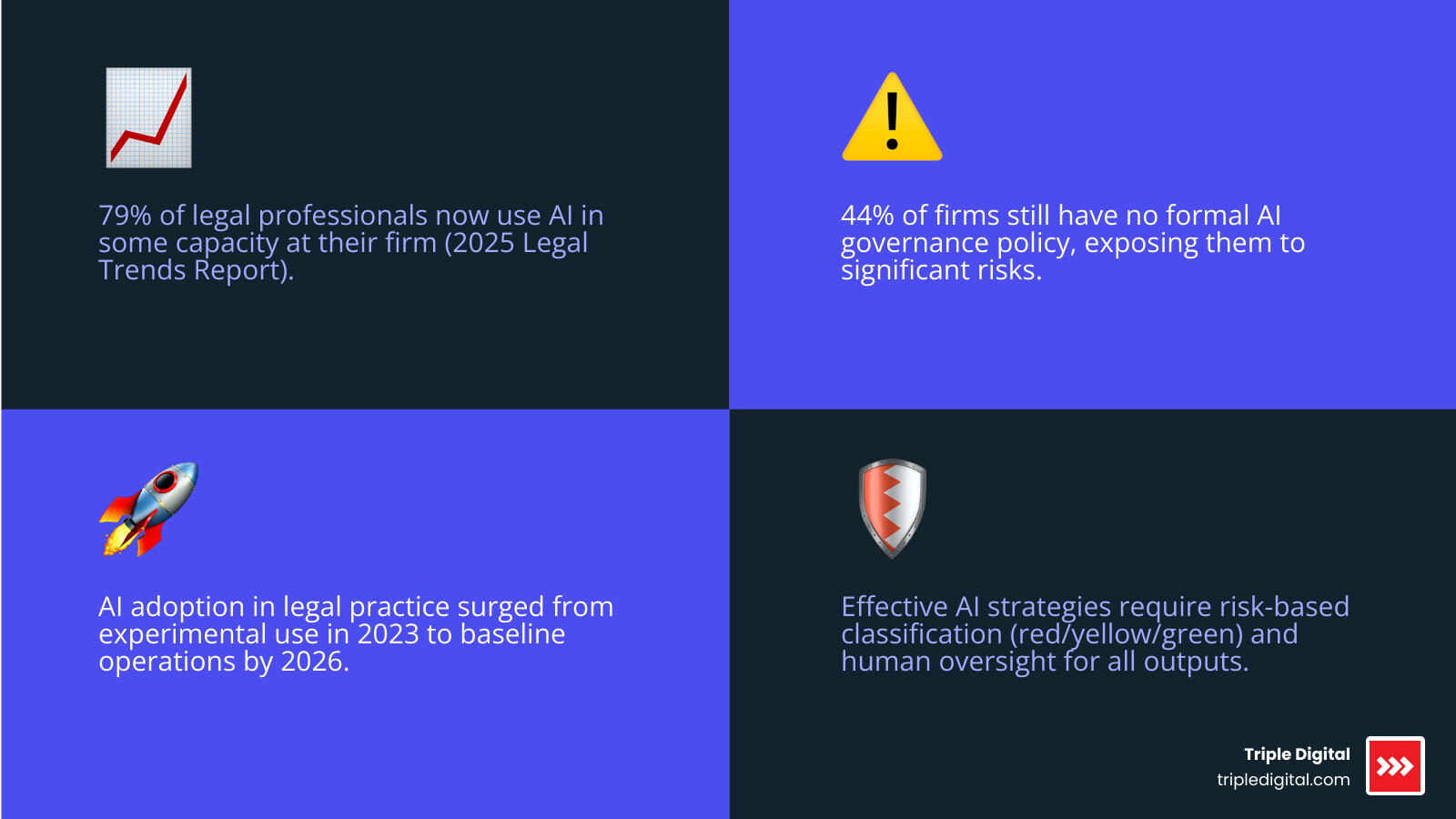
AI has moved from buzzword to baseline in legal practice. According to the 2025 Legal Trends Report, 79% of legal professionals now use AI in some capacity at their firm. That’s not a trend — that’s a shift.
And yet, 44% of firms still have no formal AI governance policy. That gap is where the real risk lives.
Firms that use AI without a strategy are flying blind. Firms that ban it entirely are falling behind. The firms winning right now are the ones treating AI as a managed tool — not a free-for-all and not a forbidden technology.
This guide breaks down exactly how to build a law firm AI strategy that actually works: the benefits, the risks, the tools, the policies, and what’s coming next.
Essential Law firm AI strategies terms:
The Core Benefits and Risks of Law Firm AI Strategies
When we talk about Law firm AI strategies, we are looking at a high-stakes balancing act. On one side of the scale, we have massive productivity gains. On the other, we have significant ethical and security risks that can’t be ignored.
The Productivity Powerhouse
The primary benefit of AI adoption is reclaimed time. Research shows that lawyers can save anywhere from 4 to 10 hours per week by automating routine tasks. For a 50-lawyer firm, that is the equivalent of reclaiming over 1,600 days of work per year. These gains manifest in:
- Legal Research: AI can scan vast databases to identify patterns and suggest related issues that manual searches might miss.
- Document Drafting: Generating initial drafts of motions, briefs, and contracts in seconds rather than hours.
- Client Service: Using AI-powered virtual receptionists to handle initial inquiries and qualify leads 24/7.
Navigating the Risks
However, even the most advanced Law firm AI strategies must account for “hallucinations”—instances where AI confidently presents fabricated case citations or non-existent statutes. Data privacy is another massive hurdle. If you feed confidential client data into a public, consumer-grade AI tool, you may be waiving attorney-client privilege.
Furthermore, algorithmic bias remains a concern. Because AI models are trained on historical data, they can inadvertently replicate past biases in legal reasoning or outcome predictions. To mitigate this, we recommend focusing on AI Digital Marketing for Law Firms that uses grounded, verified data rather than general-purpose models.
Implementing a Robust AI Governance Framework

Building a strategy isn’t just about buying software; it’s about creating a “governance framework.” This is a set of internal rules that dictate how AI is used, who oversees it, and how data is protected.
A robust framework prioritizes human-in-the-loop oversight. This means no AI output ever goes to a client or a court without a licensed attorney reviewing and signing off on it. We also look for “courtroom-grade” security, including SOC 2 Type II certification and Zero Data Retention (ZDR) policies, ensuring that your firm’s data isn’t used to train the vendor’s AI models. Understanding The Key to AI-Written Content is essential here: AI should be treated like a highly efficient junior associate who still needs a partner’s final review.
Combating Shadow AI with Clear Policies for Law Firm AI Strategies
One of the biggest dangers firms face today is “Shadow AI.” This happens when a firm has no official policy or a blanket ban, leading employees to use free, unmonitored tools like ChatGPT on their personal devices for work tasks. This creates a nightmare for confidentiality and data security.
Instead of a ban, we suggest a “traffic light” system:
- Green: Low-risk tasks like administrative scheduling or drafting internal memos using firm-approved tools.
- Yellow: Tasks requiring high oversight, such as legal research or document summarization.
- Red: Prohibited uses, such as inputting highly sensitive, privileged information into public AI models.
This approach is particularly relevant when considering Top SEO Tips for Criminal Defense Lawyers in the AI Search Era, where maintaining the integrity of sensitive case details is paramount.
Ethical Guidelines and Professional Responsibilities
As of May 2026, at least 16 state bars have issued or are planning ethics opinions regarding AI. Most of these opinions center on ABA Model Rule 5.3, which treats AI as a “nonlawyer assistant.” This means you, the supervising lawyer, are legally and ethically responsible for its “work product.”
To stay compliant, your Law firm AI strategies should include:
- Client Disclosure: Updating engagement letters to inform clients when AI is used in their matters.
- Competence: Ensuring staff are trained to understand both the capabilities and the limitations of the tools they use.
- Supervision: Implementing mandatory review protocols for all AI-generated content.
We’ve seen how these strategies can be a competitive advantage, as highlighted in our recent announcement: Triple Digital LLC Unveils Groundbreaking AI Tool to Help Law Firms Outrank Competitors Online.
Selecting and Verifying Legal-Specific AI Tools
Choosing the right tool is the difference between a successful implementation and a costly mistake. General-purpose LLMs (Large Language Models) like the standard version of ChatGPT are often unsuitable for legal work because they lack grounding in verified case law.
Evaluating Law Firm AI Strategies for Tool Integration
When selecting a platform, we look for Retrieval-Augmented Generation (RAG) architecture. RAG ensures the AI “looks up” actual statutes and cases before generating an answer, significantly reducing the risk of hallucinations.
| Feature | General-Purpose AI (e.g., ChatGPT) | Legal-Specific AI (e.g., CoCounsel, Clio Work) |
|---|---|---|
| Data Grounding | General internet data | Verified legal databases (Lexis, Westlaw, etc.) |
| Privacy | Data may be used for training | Zero Data Retention / Private Cloud |
| Citations | Often fabricated | Linked to primary sources |
| Security | Consumer-grade | SOC 2 Type II / Legal-grade |
Your evaluation should also consider how the tool integrates with your existing Practice Management Systems (PMS) or Document Management Systems (DMS). A tool that lives in a vacuum is rarely used. For more on this, check out Future-Proof Your Firm: The AI Advantage in Legal Marketing.
A 10-Step Checklist for Reviewing AI-Generated Content
To ensure your Law firm AI strategies meet professional standards, every piece of AI content should pass this 10-step verification:
- Fact-Check Accuracy: Verify all names, dates, and amounts.
- Source Verification: Click every citation to ensure the case exists and supports the point.
- Reasoning Analysis: Does the logic follow a standard IRAC/CRAC structure?
- Jurisdiction Confirmation: Is the AI using the correct state or federal laws for your specific case?
- Bias Detection: Check for language that might indicate unintended algorithmic bias.
- Formatting Check: Does it match your firm’s style guide and court requirements?
- Ethical Compliance: Does the content violate any professional responsibility rules?
- Current Law Check: Is the case law still “good law,” or has it been overturned?
- Confidentiality Scrub: Ensure no sensitive data was leaked in the output.
- Human Sign-Off: A final review by a qualified attorney.
How AI is Reshaping Law Firm Business Models
The “billable hour” has been the bedrock of the legal industry for decades, but AI is forcing a reevaluation. If a task that used to take an associate 16 hours now takes 4 minutes, the traditional pricing model starts to crumble.
The 80/20 Inversion
We are seeing what experts call the “80/20 inversion.” Traditionally, 80% of a lawyer’s time was spent on information collection and 20% on strategy. AI flips this, allowing lawyers to spend 80% of their time on high-value strategy and advocacy.
Leading firms are responding by:
- Alternative Fee Arrangements (AFAs): Shifting to flat-fee or value-based pricing for routine tasks automated by AI.
- Higher Hourly Rates: Justifying increased rates by delivering results faster and with higher quality.
- Service Expansion: 50% of AmLaw 100 firms say they would consider taking on low-margin work they previously outsourced if AI makes it profitable.
This shift isn’t just about internal efficiency; it’s about meeting client expectations. Clients in 2026 expect firms to use AI to reduce costs or, at the very least, speed up delivery times. Using Beyond the Gavel: Using AI for Predictive Analytics in Legal Proceedings can help firms offer more certain outcomes, which is a key selling point in value-based billing.
Future Trends: Agentic AI and Predictive Analytics
Looking ahead, we are moving beyond simple chatbots to Agentic AI. These are autonomous “helpers” that can break down complex legal projects into smaller steps, use multiple tools to complete them, and adjust their approach based on feedback.
Outcome Prediction and Process Reengineering
Predictive analytics will soon be a standard part of Law firm AI strategies. By analyzing thousands of past rulings, AI can predict the likelihood of a specific judge granting a motion or the probable settlement value of a personal injury case.
We are also seeing the rise of AI Overviews in search engines. This means that potential clients are getting legal information directly from AI-generated summaries on Google. Firms that optimize their content for these AI Overviews will capture leads before a user even clicks a traditional search result.
Frequently Asked Questions about Law Firm AI
Why are blanket AI bans ineffective in law firms?
Blanket bans are ineffective because AI is already embedded in the tools you use daily, such as Westlaw, Lexis+, and Microsoft 365. Furthermore, bans often lead to “Shadow AI,” where employees use unapproved, insecure tools in secret, creating massive liability for the firm.
What is the ‘traffic light’ system for AI classification?
It is a risk-management framework. Green tasks are low-risk (administrative). Yellow tasks involve legal work and require strict human review (research, drafting). Red tasks are prohibited due to extreme risk (inputting privileged data into public models).
How does AI impact the traditional billable hour model?
AI makes routine tasks significantly faster, which can reduce billable hours if firms don’t adapt. Many firms are shifting toward value-based pricing or flat fees for AI-augmented tasks, while others are increasing their hourly rates to reflect the higher-level strategic value they provide.
Conclusion
At Triple Digital, we believe that Law firm AI strategies are the key to staying competitive in a rapidly evolving market. Based in Houston, TX, our agency specializes in lead generation and case acquisition for law firms who want “less fluff and more cases.” We leverage the latest in AI and data mining to ensure our clients aren’t just keeping up—they are outranking the competition.
The legal landscape of 2026 demands more than just legal expertise; it requires technical fluency and a strategic approach to innovation. Whether you are a solo practitioner or a large firm, the time to build your AI roadmap is now.