




What Is AI Marketing for Law Firms and Does Your Practice Need It?
What is AI marketing for law firms, and why does it matter?
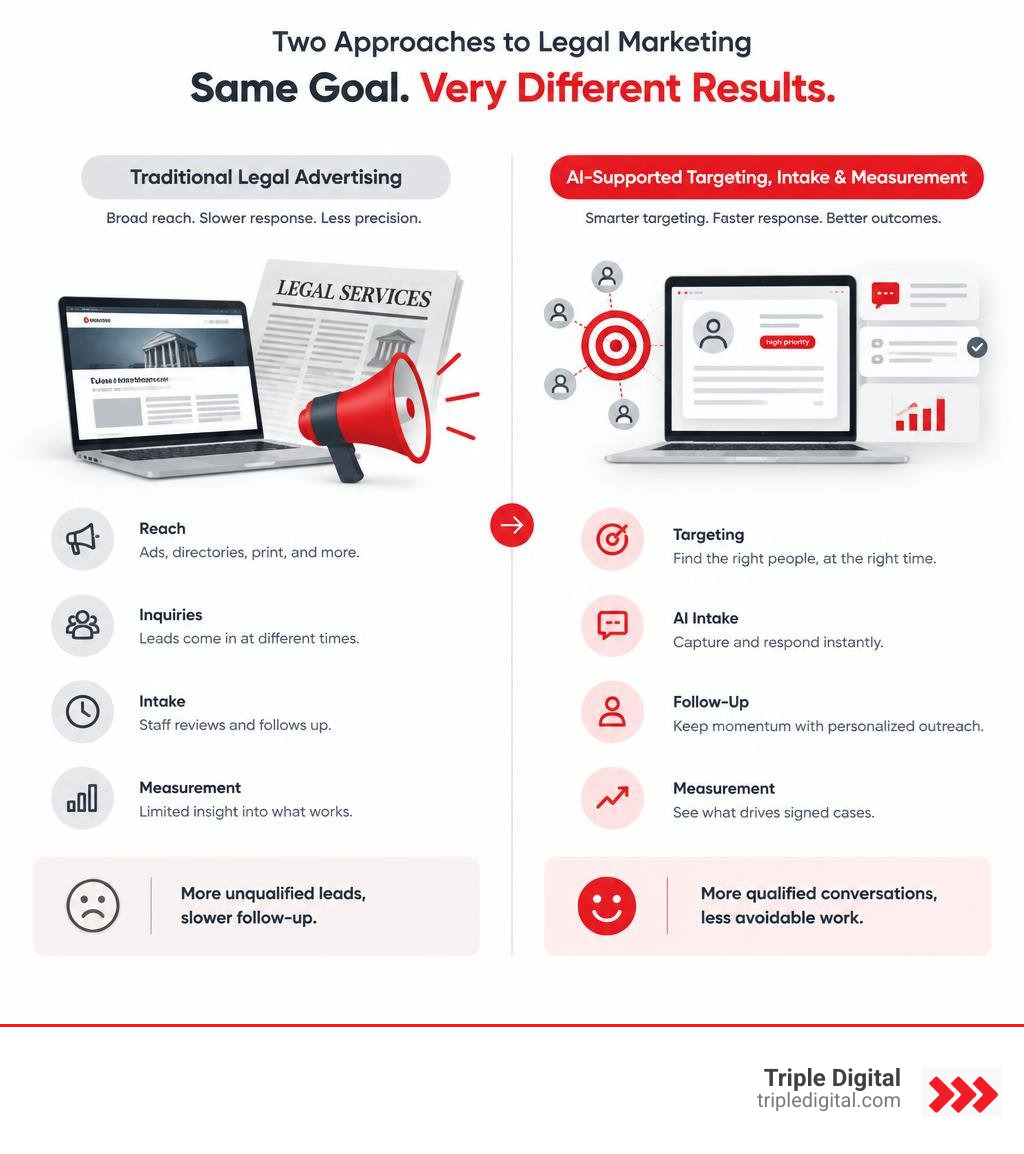
AI marketing for law firms uses data and automation to help firms find potential clients, create marketing content, respond to inquiries, and track what leads to signed cases. Unlike traditional marketing, it can help a firm act on an inquiry right away instead of waiting for staff to review it. To get started, measure how long your firm takes to answer new leads, then test one tool or workflow that helps your team respond faster. Keep an attorney responsible for reviewing content and handling legal advice.
For partners, the goal is not more activity for its own sake. It is more qualified conversations without adding avoidable work.
I’m Paul Taylor, President of Triple Digital, and I’ve spent more than 28 years helping businesses improve growth, including work on law firm lead generation and client intake. I help firm owners answer “what is ai marketing for law firms?” by focusing on the steps that turn inquiries into clients.
Glossary for what is ai marketing for law firms:
- AI digital marketing for law firms
- AI tools for law firm marketing
- Law firm AI strategies
What is AI Marketing for Law Firms and How Does It Reshape Practice Growth?
At its core, AI marketing represents a shift from static, broadcast-style promotion to dynamic, data-driven client acquisition. In traditional setups, law practices rely heavily on broad-brush advertisements, static directories, and manual intake processes. By contrast, modern systems leverage machine learning algorithms, predictive lead scoring, and dynamic audience segmentation to connect with prospective clients at the exact moment they need legal counsel.
Legal industry research reveals that at least 31% of legal professionals have found AI-powered marketing tools help with everything from generating qualified leads to measuring the return on marketing activities. By analyzing complex behavioral signals, these tools help partners future-proof their legal marketing by prioritizing high-intent individuals and scaling specific practice areas without ballooning non-billable overhead.
Defining What is AI Marketing for Law Firms vs. General Digital Marketing
General digital marketing applies universal tactics across e-commerce, software, and consumer goods. However, legal marketing operates under distinct, strict regulatory standards. Legal-specific AI tools are built around ethical marketing constraints, state bar advertising rules, and specialized data models designed for legal terminology.
Understanding why law firms benefit from AI upgrades starts with recognizing how automated workflows coordinate every touchpoint while maintaining strict compliance:
| Marketing Dimension | Traditional Legal Marketing | AI-Driven Legal Marketing Systems |
|---|---|---|
| Audience Targeting | Broad geographic and demographic estimates | Real-time predictive behavioral modeling and segmentation |
| Content Production | Manual drafting taking multiple associate hours | AI-assisted draft creation with human attorney oversight |
| Intake Response | Manual review often taking 24+ hours | Instant sub-5-minute interactive pre-qualification |
| Compliance Checking | Ad-hoc manual reviews by busy attorneys | Automated disclaimer enforcement and rule validation |
| Performance Tracking | Disconnected vanity metrics (clicks, impressions) | End-to-end attribution tied directly to signed retained matters |
Core Use Cases: From Generative Search Visibility to Lead Intelligence
The application of machine intelligence spans the entire client journey:
- Audience Behavioral Patterns: Machine learning models identify key user habits. For example, estate planning or family law practices frequently observe substantial spikes in custody and probate inquiries during weekend hours. Recognizing these patterns allows practices to adjust automated campaign delivery schedules accordingly.
- Generative Search and Visibility: Potential clients increasingly use conversational AI engines to research legal rights. Knowing how to optimize legal services for AI search ensures your practice is cited within generative answer summaries.
- Automated Social and Content Distribution: Natural language platforms help outline educational updates, practice guides, and social drafts in minutes rather than hours.
- Reputation Monitoring: Sentiment analysis algorithms continuously track public reviews, client feedback, and market intelligence across multiple directories to protect firm reputation.
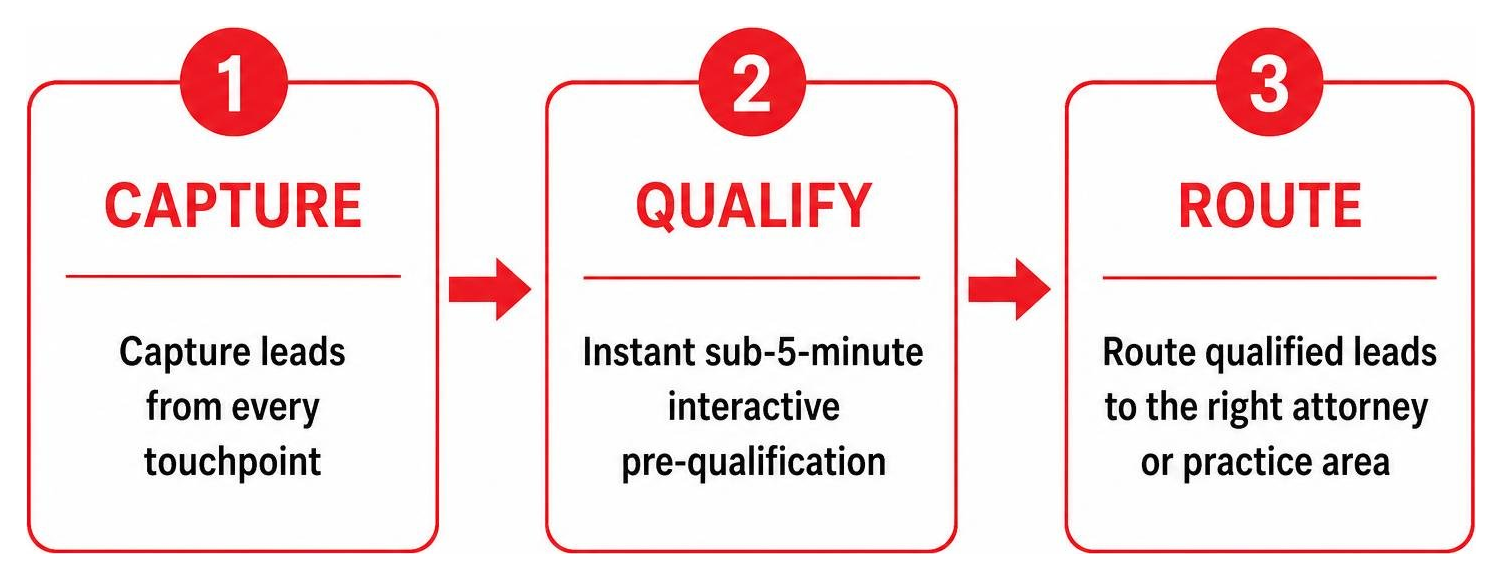
The Three Pillars of Modern AI Legal Intake: Capture, Qualify, and Route
Marketing spend is wasted if potential clients drop off before speaking with your team. According to the American Bar Association’s 2025 TechReport, fewer than one in five firms run any kind of automated after-hours intake. This gap creates severe bottlenecks when prospective clients seek assistance outside regular business hours.
Implementing comprehensive AI automation helps practices establish continuous client engagement while significantly reducing marginal intake costs.
What is AI Marketing for Law Firms Doing to Solve the 5-Minute Intake Crisis?
A common industry misconception is the “4-hour response rule,” which assumes that getting back to an inquiry within four hours is sufficient. In reality, the average law firm takes more than 24 hours to respond to a website lead, during which time most prospects have already contacted competing counsel.
Data from sales conversion studies indicates that firms responding to leads within five minutes are roughly 100 times more likely to make contact than those waiting 30 minutes, and seven times more likely to have a qualifying conversation than those waiting just one hour. Adopting effective AI lead generation tools ensures your firm achieves immediate engagement without burdening associates around the clock.
Structuring the Capture-Qualify-Route Funnel for Zero Lead Leakage
An optimized intake architecture operates across three distinct stages:
- Intelligent Capture: Conversational capture interfaces engage website visitors instantly via interactive chat or dynamic web forms, gathering core facts about the matter without friction.
- Automated Qualification: The AI evaluates basic matter details against firm-defined criteria (jurisdiction, statute limitations, practice specialty) while filtering out low-fit inquiries.
- Instant Routing & Scheduling: Once qualified, the system checks attorney availability, schedules an initial consultation directly into the firm calendar, and logs full interaction notes into the case management CRM.
Following proven strategies for automated law firm growth allows your intake team to focus exclusively on vetted, high-value consultations.
Ethical Guardrails, State Bar Rules, and Client Confidentiality
Law practices must adhere to rigorous professional standards. AI systems used in legal marketing must be engineered with explicit technical boundaries to prevent regulatory violations.
Ensuring safe AI content publication requires treating intake bots and marketing automation tools as specialized digital assistants operating under direct attorney supervision.
Protecting Privileged Communications and Preventing UPL
The primary ethical hazard in automated intake is the Unauthorized Practice of Law (UPL). State bar rules strictly prohibit non-lawyers and automated software from offering legal advice, evaluating legal merits, or suggesting case strategy.
To remain compliant:
- AI intake agents must only collect factual data (dates, locations, matter categories) rather than interpreting the law.
- Prompts must be configured to escalate any complex, advice-seeking inquiries directly to licensed attorneys.
- All public-facing educational content must undergo mandatory review by a qualified attorney before publication, maintaining proper oversight as artificial intelligence transforms legal practice.
AI Conflict Screening and Mandatory Consumer Disclaimers
Automated marketing tools must also manage initial screening checks and prospect expectations:
- Persistent Consumer Disclaimers: Web chat widgets, automated email responders, and digital forms must clearly display statements clarifying that initial intake communications do not establish an attorney-client relationship.
- Preliminary Conflict Screening: Intake tools can capture adverse party names early in the qualification flow, running automated checks before sensitive matter details are collected.
- Targeting Ethics: Compliant digital advertising avoids misleading promises, guarantees of specific financial outcomes, or intrusive data collection, aligning with best practices for attorney AI ad targeting.
The Financial Impact: Measuring Marketing ROI and Evolving Fee Structures
Adopting AI-driven marketing and intake workflows transforms firm unit economics. Rather than measuring success purely through website traffic or click-through rates, forward-thinking partners evaluate campaigns by cost per acquisition (CAC), pipeline velocity, and matter profitability.
Tracking AI search visibility helps firms evaluate these core financial metrics accurately.
Tracking Lead Velocity, Conversion Ratios, and Administrative Cost Reductions
Consider the standard operational costs associated with legal lead management:
- Outsourced human call centers typically charge $25 to $75 per qualifying intake call.
- Dedicated after-hours internal staff can add tens of thousands of dollars in annual labor overhead per junior team member.
- In substantive litigation workflows, specialized AI document systems have reduced drafting tasks from 16 hours down to 3 to 4 minutes—delivering productivity improvements exceeding 100 times.
Applying these efficiencies to client acquisition significantly lowers cost per acquired matter. Establishing a structured AI legal growth strategy provides a roadmap for tracking cost reductions alongside signed revenue.
Fixed-Fee Reengineering and the Future of the Billable Hour
The billable hour model continues to represent approximately 80% of fee arrangements across major law practices. However, AI efficiency is encouraging more firms to explore alternative fee arrangements (AFAs), fixed-fee scoping, and value-based pricing.
When administrative tasks and intake bottlenecks are streamlined, lawyers spend more time on high-impact legal counsel. Combined with strategic techniques for ranking in modern AI search engines, practices can handle higher matter volumes without scaling headcount at the same rate.
Frequently Asked Questions About Legal AI Marketing
How can smaller law firms start implementing AI marketing on a tight budget?
Small firms can begin by identifying their single largest administrative bottleneck, such as drafting initial social posts or managing after-hours website inquiries. Implementing low-cost generative tools and applying ChatGPT SEO optimization allows boutique practices to produce quality educational content and test automated messaging before investing in larger infrastructure.
Does using AI in marketing risk violating attorney advertising regulations?
AI marketing complies with state bar regulations when proper guardrails are maintained. This includes ensuring all marketing materials avoid misleading statements, state clear jurisdictional disclaimers, and pass through human attorney verification prior to publication.
What technology stack should mid-market firms buy versus build for intake?
Building a fully custom AI intake system typically requires an upfront investment of $15,000 to $60,000, plus $2,000 to $8,000 per month in maintenance and infrastructure. For most mid-market practices, the most effective approach is a hybrid model: buy proven web capture tools, integrate custom AI qualification prompts tailored to your specific practice areas, and connect them directly to your existing practice management CRM via secure APIs. To learn more about customized systems, explore our approach to AI-driven law marketing.
Building a Scalable Client Acquisition Engine
As legal markets grow more competitive, relying solely on legacy marketing channels and slow intake procedures leaves valuable cases on the table. Implementing automated capture, real-time qualification, and data-driven visibility helps forward-thinking partners build a predictable client acquisition pipeline while preserving billable focus.
At Triple Digital, our Houston-based team delivers a results-driven, “less fluff, more cases” approach to digital marketing and AI implementation for law firms. If you are ready to modernize your firm’s client acquisition and intake infrastructure, schedule a meeting with our team today to review your current systems and map out a practical growth plan.