





Which Social Media Platforms Yield the Highest Conversion Rates for Personal Injury vs Corporate Law?
Are Law Firms Big on Social Media?

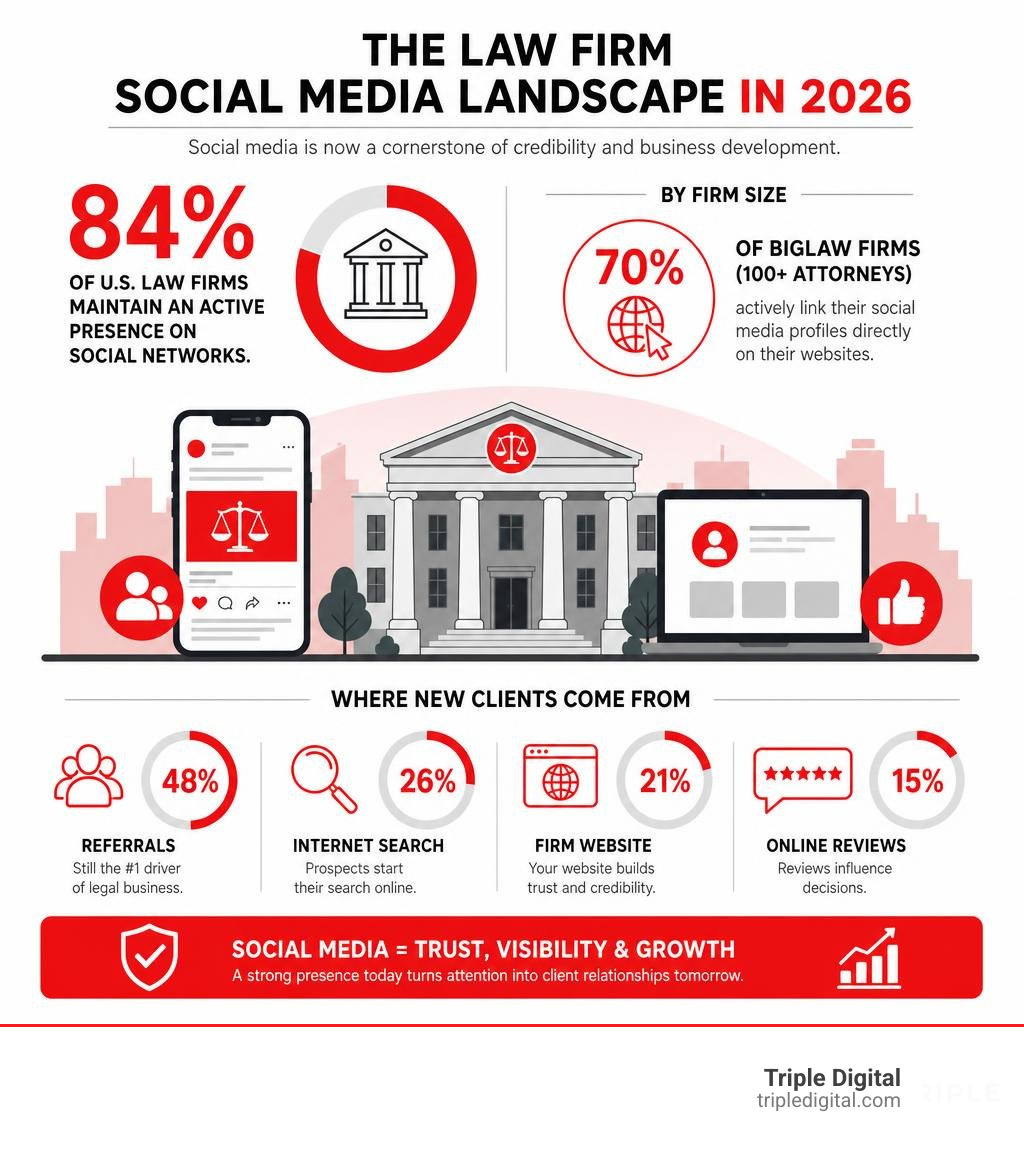
The short answer is yes: law firms are incredibly active on social media in 2026. What was once viewed as a novel, optional marketing channel has evolved into an essential pillar of professional credibility and business development. Today, an overwhelming 84% of U.S. law firms maintain an active presence on social networks.
However, social media adoption is not uniform across the legal landscape. It varies significantly based on firm size and target audience. Large, multi-practice corporate firms—often referred to as BigLaw (firms with 100+ attorneys)—have historically led the charge in terms of sheer infrastructure. Roughly 70% of BigLaw firms actively link their social media profiles directly on their websites, utilizing dedicated internal communications and marketing teams to push out global updates, practice group achievements, and lateral hire announcements.
For smaller firms and solo practitioners, the motivation to build a social media presence is often different but even more urgent. Lacking the multi-million dollar advertising budgets of massive national firms, boutique and local practices increasingly turn to organic and paid social media to level the playing field. Social media allows smaller firms to bypass traditional gatekeepers, speak directly to their local community, and build a highly visible brand without the astronomical costs of television billboards or radio campaigns.
In 2026, social media functions as a vital “trust engine” and digital proof for prospective clients. Before a client ever picks up the phone to schedule a consultation, they will almost certainly search for your firm online. They are looking for signs of life. An active, professional social media feed provides immediate validation that your firm is operational, knowledgeable, and actively engaged in helping people solve real-world problems.
The Shift from Traditional Networking to Digital Proof
The legal industry has long relied on word-of-mouth referrals as its primary lifeblood. While referrals still drive approximately 48% of legal business, they no longer operate in a vacuum. Digital channels have claimed the next three largest shares of client acquisition: internet searches account for 26%, firm websites represent 21%, and online reviews make up 15%.
This shift has transformed how referrals actually convert. When a trusted friend or colleague refers a prospective client to your firm, that prospect does not immediately call you. Instead, they perform a digital background check. They search your firm’s name on Google, visit your website, and look up your social media profiles.
Modern clients use social media to verify your active status, evaluate your expertise, and gauge your communication style. If they find a “ghost town” profile—an account with no posts for two years or a page that only shares generic holiday greetings—they may assume your firm is inactive, outdated, or simply too busy to care. Being invisible on social media directly hurts your referral conversion rates, quietly routing high-value prospects to competitors who maintain an active, engaging online presence.
Which Social Media Platforms Work Best for Law Firms?
Choosing the right platform is the difference between a highly profitable marketing campaign and wasted hours of content creation. To build an effective strategy, we must understand where different audiences gather. For a detailed breakdown of how to choose your channels, explore our guide on the Best Social Media Sites for Law Firms: Don’t Let Your Feed Be a Brief Case.
Industry data shows clear preferences among legal professionals:
- LinkedIn remains the undisputed king of professional legal networking, with 69.2% of law firms maintaining an active presence.
- Facebook is the second most popular platform, used by 40% of firms to connect with local consumers and build community trust.
- X (formerly Twitter) is maintained by 30% of firms, primarily for real-time legal news commentary and public relations.
- Instagram is used by 50% of top-performing firms to humanize their brands and showcase firm culture.
- TikTok is utilized by 6.7% of top firms, but it is growing at an exponential rate for consumer-facing practices seeking to capture younger demographics.
| Platform | Primary Target Audience | Average Engagement Rate | Best-Fit Practice Areas |
|---|---|---|---|
| B2B, Referral Partners, Corporate Clients | 3.20% | Corporate Law, IP, Employment Law, Commercial Litigation | |
| Local Consumers, Families, Community | 1.30% | Personal Injury, Family Law, Criminal Defense, Estate Planning | |
| Younger Consumers, Lateral Recruits | 1.50% | Family Law, Immigration, Personal Injury, Real Estate Law | |
| TikTok | Gen Z & Millennial Consumers | 0.90% | Criminal Defense, Personal Injury, Traffic Violations, Immigration |
| YouTube | High-Intent Searchers, Educational Audiences | High (Video Views) | All Practice Areas (FAQ Explainer Videos, Thought Leadership) |
LinkedIn: The Professional Powerhouse
LinkedIn is the ultimate B2B lead generation tool for lawyers. In fact, 89% of B2B marketers utilize LinkedIn for lead generation, and 80% of B2B leads generated on social media originate from the platform.
For attorneys, LinkedIn is not about finding immediate consumer cases; it is about building and nurturing referral networks, establishing thought leadership, and attracting top-tier talent. Corporate lawyers, intellectual property attorneys, and commercial litigators use LinkedIn to share sophisticated commentary on recent regulatory updates, court rulings, and industry trends.
To maximize this platform, firms are increasingly utilizing LinkedIn Showcase pages. These specialized sub-pages allow multi-practice firms to segment their content by niche practice areas. For example, a full-service firm can maintain a primary brand page while hosting a dedicated Showcase page specifically for its employment law group, ensuring that corporate HR managers receive highly relevant content without being distracted by unrelated litigation updates.
Facebook and Instagram: Building Local Trust and Visual Storytelling
For consumer-facing practices, Facebook and Instagram are essential tools for building local visibility and humanizing the attorney brand. Facebook’s robust local targeting and community groups make it an ideal platform for sharing client testimonials, local community involvement, and straightforward educational content.
Instagram excels at visual storytelling. Through Instagram Stories and Reels, attorneys can break down complex legal concepts into bite-sized, engaging videos. Stories, in particular, create a sense of urgency because they disappear after 24 hours. This format encourages daily engagement, and the private direct message (DM) feature allows prospective clients to ask sensitive, candid questions in a low-pressure environment.
Consider the real-world success of a consumer-focused attorney in the United States who built her entire practice by dedicating just one hour a day to Instagram content and one hour to engaging with her followers. By sharing helpful insights on everyday legal issues like prenuptial agreements and property insurance, she grew her audience to several thousand highly engaged followers and now attributes 80% to 90% of her new client acquisitions directly to Instagram.
TikTok and YouTube: Short-Form and Long-Form Video Education
TikTok has emerged as a surprise powerhouse for consumer-facing law firms. By using relevant hashtags like #LawTok, attorneys can reach millions of users with short, highly engaging videos that debunk legal myths, answer common questions, or explain public legal disputes. For personal injury, criminal defense, and family law practices, TikTok demystifies the legal process and makes attorneys feel accessible and approachable.
YouTube, on the other hand, is the premier search engine for long-form, evergreen video content. When people face a legal issue, they often search for explanations. Hosting a high-quality video library that answers frequently asked questions—such as “What happens during a legal consultation?” or “How does probate work?”—allows your firm to capture high-intent searchers and establish immediate authority.
What Are the Main Benefits and ROI of Social Media for Attorneys?
Investing time and resources into social media yields measurable business results. According to the American Bar Association, 35% of lawyers who use social media for professional purposes have directly gained clients through their efforts. For smaller, consumer-focused firms, the impact is even more pronounced: 42% of small law firms have successfully acquired new clients through social media marketing.
Beyond direct client acquisition, social media serves as a powerful engine for driving high-quality organic traffic back to your website. By sharing links to your latest blog posts, case results, and resource guides, you can guide interested users directly into your marketing funnel. For a deeper look at this mechanism, read our analysis on How Can Social Media Drive Traffic to Law Firm Websites? and discover the broader advantages in How Can Social Media Help Your Business?.
Furthermore, consistently publishing insightful content positions your attorneys as go-to authorities in their fields. This elevated profile frequently attracts media inquiries, speaking engagements, and high-value referral opportunities from other attorneys who do not practice in your specific niche.
Winning the AI and Human Trust Moments
The way consumers search for legal help is shifting rapidly. Today, 14% of consumers have already used AI tools to answer a legal question, and another 43% say they would be open to doing so.
Crucially, 53% of those who used AI for legal questions say it successfully answered their query, and 28% said the AI’s response prompted them to contact a human lawyer.
This creates a two-step search journey:
- The AI/FAQ Moment: The consumer uses AI or search engines to understand their basic legal rights or options.
- The Human Trust Moment: Once they realize they need a lawyer, they search for the human beings behind the legal advice to verify their credibility, empathy, and active status.
An active, engaging social media presence is the ultimate tool for winning this second moment. When a prospect transitions from an AI tool to your social profiles and sees educational videos, active client reviews, and community involvement, they find the human validation they need to confidently schedule a consultation.
What Are the Biggest Barriers and Ethical Risks Preventing Law Firms From Posting?
Despite the clear benefits, many law firms remain completely invisible on social media. The primary barrier is not a lack of interest, but rather a profound fear of regulatory ambiguity and ethical violations.
State bar associations enforce strict rules regarding lawyer advertising (such as ABA Model Rules 7.1, 7.2, and 7.3). Because these rules were largely drafted before the rise of modern digital platforms, applying them to social media can feel like trying to fit a square peg into a round hole. The fear of an accidental violation—which could result in public reprimands, fines, or even suspension—keeps many conservative firms from posting anything at all.
Additionally, the opportunity cost of attorney-led content creation is massive. If a partner billing at $500 per hour spends three hours a week writing social media posts, designing graphics, and scheduling content, that represents $1,500 a week in unbilled time—amounting to $78,000 to $130,000 annually in lost revenue.
To protect themselves, many large firms issue vague, overly restrictive internal social media policies. These policies often create paranoia among associates, discouraging them from sharing professional updates or building personal brands, which ultimately stifles the firm’s overall organic reach. For a comprehensive guide on navigating these challenges, see our article on How to Run Social Media Ads Without Getting Disbarred.
Navigating Compliance and Client Confidentiality
To build a compliant social media presence, law firms must adhere to several core ethical boundaries:
- Avoid Misleading Claims and Superlatives: Never refer to your firm or attorneys as the “best,” “top,” or “most successful” unless those claims are objectively verifiable by independent, third-party data.
- Do Not Guarantee Results: Sharing case outcomes is highly effective, but every post detailing a successful verdict or settlement must include a clear, prominent disclaimer stating that past results do not guarantee future outcomes.
- Protect Client Confidentiality (ABA Rule 1.6): Never reference specific client matters, display photos of clients, or share details that could identify a client without obtaining their explicit, written consent. This applies to behind-the-scenes office photos and courthouse updates as well.
- Avoid Creating an Attorney-Client Relationship: Every educational post, video, and direct message response must clearly state that the information provided is for educational purposes only and does not constitute formal legal advice or establish an attorney-client relationship.
What Are the Signs That Your Law Firm Needs Professional Social Media Help?

Many law firms attempt to handle their social media in-house, only to watch their profiles stagnate. If your firm is experiencing any of the following signs, it is time to seek professional marketing assistance:
- The “Ghost Town” Profile: Your accounts have been completely abandoned, or you only post generic, automated holiday graphics once a month.
- Abysmally Low Engagement: Your posts receive zero likes, comments, or shares. For reference, the average social media engagement rate for professional services is 3.20% on LinkedIn and 1.30% on Facebook. If you are consistently falling below these benchmarks, your content is not resonating.
- Attorneys Acting as Content Creators: Your highly paid partners or associates are spending valuable billable hours trying to write captions, design graphics, and edit videos instead of practicing law.
- Zero Tracking and Attribution: You have no idea where your social media traffic is going, how many leads are coming from your profiles, or what your actual return on investment (ROI) is.
- Inconsistent Branding: Your profiles across LinkedIn, Facebook, and Instagram use different logos, outdated attorney headshots, and completely different tones of voice.
To understand how to transition from basic posting to a strategic lead-generation system, explore our resources on Law Firm Marketing with Social Media and From Likes to Leads: Mastering Social Media for Attorneys.
The Opportunity Cost of DIY Social Media
Let’s look at the math behind the “Do-It-Yourself” approach to social media.
When an attorney attempts to manage their own social media, they are not saving money—they are actively losing it. By outsourcing your social media management to a specialized agency or utilizing compliant, AI-driven automation systems, you can reclaim those lost billable hours, focus entirely on your clients, and achieve a far higher, trackable return on your marketing investment.
How Can Triple Digital Help Scale Your Law Firm’s Social Media Presence?
At Triple Digital, we are a Houston-based digital marketing agency specializing in high-performance lead generation and case acquisition for law firms. We do not believe in vanity metrics like “likes” or “impressions” unless they directly translate to signed cases. Our core philosophy is simple: “less fluff, more cases.”
We leverage advanced AI, data mining, and precise demographic targeting to place your firm directly in front of high-intent clients at the exact moment they need your services. Whether you are looking to dominate local personal injury search results or build a robust corporate referral network, we design and execute custom digital campaigns that deliver measurable growth. To explore our full suite of marketing capabilities, visit our Triple Digital Services page, or Schedule a Meeting with Triple Digital to discuss your firm’s specific goals.
Custom Social Media Strategies Built for Case Acquisition
We don’t do cookie-cutter social media. When you partner with us, we build a tailored strategy designed to achieve your firm’s specific business development goals:
- Practice-Specific Content Creation: We draft fully compliant, highly engaging educational posts, graphics, and video scripts tailored to your specific practice areas, ensuring your firm’s expertise is communicated clearly and professionally.
- Strict Compliance Safeguards: Every piece of content we produce undergoes rigorous review to ensure absolute compliance with your state’s bar advertising rules and ethical guidelines.
- Advanced KPI Tracking and Attribution: We implement comprehensive tracking systems so you know exactly how many website visits, consultation requests, and signed cases originate from your social media channels.
What Are the Most Common Questions About Law Firm Social Media?
For a broader look at digital trends, updates, and strategies, browse our complete Category: Social Media library. Below, we address some of the most frequent questions we receive from attorneys looking to optimize their digital presence.
Is it ethical for law firms to use AI for social media content?
Yes, it is entirely ethical to use AI to assist with content ideas, drafting captions, and scheduling posts. However, AI must be used as a drafting tool, not a final publisher.
An attorney must always review and approve every piece of AI-generated content before it is published to ensure absolute accuracy, protect client confidentiality, and maintain strict compliance with state Rules of Professional Conduct.
How often should a law firm post on social media?
When it comes to social media, consistency is far more important than sheer volume. Posting ten times in one week and then disappearing for a month will hurt your reach in platform algorithms.
We recommend establishing a sustainable baseline of 3 posts per week on LinkedIn and Facebook. This frequency keeps your profiles active and visible to your audience without burning out your internal resources.
Which practice areas benefit the most from social media marketing?
The practice areas that see the highest return on investment depend entirely on the platform used:
- Consumer-Facing Practices: Personal injury, family law, criminal defense, immigration, and estate planning excel on Facebook, Instagram, and TikTok, where emotional storytelling, local community trust, and straightforward educational content drive direct client inquiries.
- B2B and Corporate Practices: Employment law, intellectual property, commercial real estate, and business litigation see the best results on LinkedIn, where professional networking, thought leadership, and industry commentary build valuable referral pipelines.
What Are the Next Steps for Your Law Firm’s Social Media Strategy?
In 2026, a passive, outdated, or non-existent social media presence is no longer an option for competitive law firms. As consumer search habits continue to evolve and incorporate AI tools, your social media profiles serve as the vital human trust engine that converts casual searchers into signed clients.
To transition your social media from a neglected chore into a highly profitable case-acquisition engine, we recommend taking the following immediate steps:
- Conduct a Profile Audit: Review all of your firm’s existing social media profiles. Ensure that your contact information, website links, logos, and attorney headshots are consistent, professional, and fully updated.
- Define Clear, Measurable Goals: Decide what you want to achieve. Are you looking to build a B2B referral network on LinkedIn, or do you want to drive direct personal injury inquiries from Facebook?
- Establish a Content Calendar: Plan your content at least two to four weeks in advance, balancing educational tips, client testimonials, and behind-the-scenes firm culture posts.
- Partner with the Experts: Stop wasting valuable billable hours trying to manage your digital marketing in-house.
Let our team of specialized legal marketers handle the heavy lifting so you can focus on what you do best: winning cases for your clients. Contact Triple Digital today to schedule a comprehensive consultation, or visit the Triple Digital Homepage to learn more about how we can help scale your practice.