





The Plain English Guide to Lawyer Search Engine Optimization
Why Most Law Firms Are Invisible Online (And How SEO Changes That)
Lawyer search engine optimization is the practice of improving your law firm’s visibility in Google and other search engines so potential clients find you — not your competitors — when they need legal help.
Here’s the quick version of what it involves:
- Keyword research — find the exact terms clients search before hiring an attorney
- On-page optimization — structure your website pages so Google understands what you do and where you do it
- Content creation — publish helpful, credible legal content that answers client questions
- Local SEO — appear in Google’s Map Pack for searches like “divorce lawyer near me”
- Link building — earn mentions from trusted legal directories and other authoritative sites
- Technical SEO — make sure your site loads fast, works on mobile, and is easy to crawl
- Measurement — track leads, rankings, and ROI so you know what’s working
Now, the bigger picture.
According to Clio’s research, 96% of people seeking legal advice use a search engine at some point. And the American Bar Association found that 37% of people who hired a lawyer in 2025 found them through online search.
Yet most law firms are still relying on referrals, print ads, or a website that hasn’t been touched in years.
The gap between where clients are looking and where most firms are showing up is enormous — and that gap is exactly what a well-executed SEO strategy closes.
The challenge? Legal SEO isn’t the same as SEO for a restaurant or a plumber. Google holds legal content to a higher standard. The competition is intense. And the keywords are among the most expensive in digital marketing — “personal injury lawyer” can cost $150–$300 per click in paid ads alone.
That’s why this guide exists: to give you a plain-English breakdown of every piece of lawyer SEO, from keyword research to local rankings to technical fixes, so you can start making smarter decisions about how your firm gets found online.
What is Lawyer Search Engine Optimization and Why Does It Matter?
At its core, search engine optimization is about making your firm the obvious answer when a potential client asks Google a question. In May 2026, the digital landscape is more crowded than ever. If your law firm isn’t on the first page of Google, you are essentially invisible to the vast majority of local searchers.
Many attorneys wonder whether they should invest their marketing budget into organic SEO or pay-per-click (PPC) advertising. While both have their place, understanding the differences is key to building a sustainable lead generation machine.
| Feature | Search Engine Optimization (SEO) | Pay-Per-Click (PPC) |
|---|---|---|
| Cost Structure | Upfront/monthly investment; traffic is free | Pay for every click; stops when budget runs out |
| Click-Through Rate | Position 1 captures 28% to 35% of clicks | Paid ads capture roughly 3% to 5% of clicks |
| Trust Factor | High; organic rankings signal authority | Lower; users often skip ads to find natural results |
| Time to Results | 3 to 12 months (compounds over time) | Instantaneous visibility |
| Long-Term ROI | High; cost-per-lead drops significantly over time | Flat; cost-per-lead remains tied to ad market prices |
For a deeper dive into why organic search is the ultimate foundation for attorney marketing, explore our guides on Why SEO is Important for Attorneys and discover the primary Reasons to Use Law Firm SEO.
The Core Differences of Lawyer Search Engine Optimization
Why can’t you just hire a generalist SEO agency that optimizes e-commerce stores or local dentist offices? Because the legal industry operates under unique rules that generalists simply do not understand.
First, Google classifies legal content under its Your Money or Your Life (YMYL) guidelines. Because bad legal advice can permanently alter someone’s life, family, or financial standing, Google applies incredibly strict standards to attorney websites. To rank, your site must demonstrate exceptional E-E-A-T (Experience, Expertise, Authoritativeness, and Trustworthiness).
Second, attorney advertising is heavily regulated. The American Bar Association (ABA) Model Rules 7.1 through 7.5 strictly govern how lawyers communicate their services. A generalist SEO agency writing thin, sensationalized, or misleading content to “rank fast” can easily land your firm in hot water with state bar disciplinary committees. Specialized lawyer search engine optimization requires a deep understanding of these professional ethics.
How Organic Search Drives High-Value Client Leads
Organic search targets the entire client funnel. Unlike traditional billboard or radio marketing, which interrupts people who probably don’t need a lawyer, search engine optimization captures people at the exact moment they are looking for help.
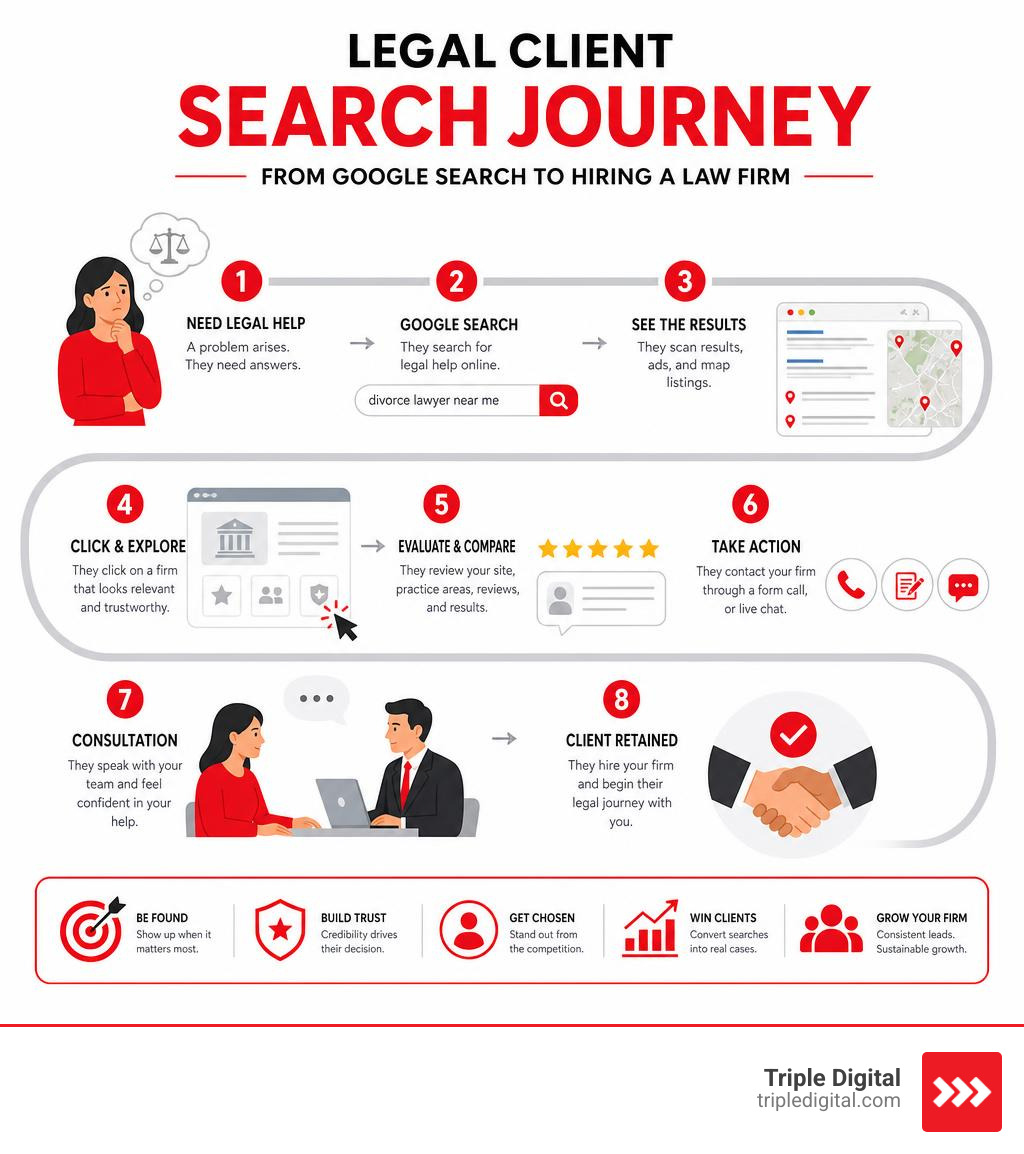
When someone is served with divorce papers, they don’t immediately hire the first lawyer they see on a billboard. They go through a search journey:
- Research Stage (Informational): They search questions like “How is child custody decided in Texas?”
- Consideration Stage (Transactional): They search “best divorce attorney in Houston” or “family law firm near me.”
By building a comprehensive SEO strategy, you capture prospects at both ends of this funnel. Over time, this builds a compounding return on investment. While PPC costs remain high and scale linearly, a mature SEO program continues to deliver highly qualified leads for a fraction of the cost.
The Core Ranking Factors for Attorney Websites
Google uses hundreds of algorithm signals to determine which websites deserve to sit at the top of the search results. For law firms, these factors boil down to three main pillars. To understand how these signals work in tandem, read our breakdown of Law Firm SEO: What Are the Most Important SEO Ranking Factors?.
Content Quality and E-E-A-T Signals
Because of Google’s YMYL classification, content quality is your single most important ranking asset. To satisfy E-E-A-T guidelines, your legal content must be:
- Written or thoroughly reviewed by credentialed experts: Google looks for clear author bylines linking to detailed attorney bio pages.
- Accurate and state-specific: Legal processes vary wildly by jurisdiction. Thin, generic legal content that fails to mention specific Texas statutes or local court procedures will not rank in Houston searches.
- Comprehensive: Google rewards pages that thoroughly answer search queries. A 300-word page about “car accidents” won’t cut it anymore; you need in-depth resources that address real client concerns.
Backlinks and Off-Page Citations
Think of backlinks (links from other websites pointing to yours) as digital votes of confidence. If a highly respected legal publication, local bar association, or university links to your website, Google views your firm as highly authoritative.
However, quality matters far more than quantity. A single backlink from an authoritative legal directory or local news outlet is worth more than hundreds of low-quality links from spammy, unrelated blogs. Building high-quality backlinks is a slow, ethical process of creating outstanding resources that other sites naturally want to reference.
Technical SEO and User Experience
You can have the best legal content in the world, but if your website takes five seconds to load on a smartphone, users will click away before reading a single word. Google tracks this user experience closely.
Your site must be fully optimized for mobile devices, secure (using HTTPS), and fast. Google evaluates speed using metrics called Core Web Vitals. If your site has confusing navigation or intrusive pop-ups, users will bounce, signaling to Google that your site shouldn’t rank highly.
Step-by-Step Execution: Keywords, On-Page Optimization, and Content
Now that you understand the framework, let’s look at how to actually execute a successful lawyer search engine optimization strategy.
To build a complete roadmap for your website, see our guide on Mastering Law Firm SEO: Your Blueprint for Online Success and explore how to create Advanced SEO & Authoritative Content.
Keyword Research and the Case-Value Framework
Most law firms make the mistake of targeting keywords based solely on search volume. For example, “personal injury” has massive search volume, but it is incredibly competitive and highly generic.
Instead, we recommend using the Case-Value Framework. This means prioritizing keywords by multiplying their search intent and traffic potential by the actual financial value of the cases they generate.
- Low Case Value / High Volume: “What is the definition of negligence?” (Informational, highly competitive, low conversion rate).
- High Case Value / Targeted Volume: “Houston commercial truck accident lawyer” (Transactional, highly specific, extremely high case value).
By segmenting your keyword list into transactional terms (e.g., “probate attorney Houston”) and informational terms (e.g., “what to expect during probate in Texas”), you can build content that meets searchers exactly where they are in their decision-making process.
On-Page Elements That Matter Most for Attorneys
On-page SEO is the process of optimizing individual web pages to help search engines understand their context. Here are the elements that require your immediate attention:
- Title Tags: Keep these between 55 and 60 characters. Use the formula:
[Primary Keyword] in [City] | [Firm Name]. For example: Car Accident Lawyer in Houston | Triple Digital Law. - Meta Descriptions: Write compelling, benefit-driven descriptions under 155 characters that encourage users to click.
- Header Tags (H1, H2, H3): Use a clean logical hierarchy. Your main title is your H1. Subsections should be H2s, and sub-points under those should be H3s. Include your target keywords naturally in these headers.
- URL Structure: Keep URLs short, clean, and keyword-rich (e.g.,
yourfirm.com/houston-car-accident-lawyerinstead ofyourfirm.com/page-id?12345).
Creating Authoritative, Client-Focused Legal Content
To convert search engine traffic into signed cases, your content must speak directly to the client’s pain points.
- Create Dedicated Practice Area Pages: Do not lump all your services onto a single page. If you practice family law, you need individual, comprehensive pages for divorce, child custody, child support, and asset division.
- Answer Real Client Questions: Look through your intake notes. What are the first five questions every client asks during a consultation? Turn those questions into detailed, helpful blog posts.
- Use Hub-and-Spoke Internal Linking: Link your informational blog posts back to your primary practice area pages. This guides users through your site and passes SEO authority to your most important, revenue-generating pages.
Dominating the Local Map Pack and AI Search Engines
For most law firms, local search is where the majority of client inquiries are won or lost. When users search for a local attorney, Google displays the “Map Pack” — three local business listings alongside a map at the very top of the search results.
To stop wasting your marketing budget on ineffective local strategies, check out our guide to Stop Wasting Money: The Ultimate Guide to Local SEO for Your Law Firm and learn how to Get Found Locally: A Lawyer’s Guide to Local SEO Success.
Optimizing Your Google Business Profile and Reviews
Your Google Business Profile (GBP) is the absolute foundation of your local SEO. To optimize it:
- Choose the Right Primary Category: This should match your highest-value practice area (e.g., “Personal Injury Attorney” rather than just “Attorney”).
- Ensure NAP Consistency: Your Name, Address, and Phone number must be 100% identical across your website, GBP, and every online directory. Even tiny discrepancies (like “Suite 100” vs. “#100”) can confuse Google’s algorithm.
- Build Review Velocity: Client reviews are the single most influential factor in getting hired. Don’t just focus on your total review count — Google cares deeply about recency and velocity (how consistently you receive new reviews). Ask clients for feedback at peak moments of satisfaction and reply to every review promptly.
Building Citations in Legal Directories
Legal directories are highly trusted by search engines and dominate the first page of search results for many competitive terms. Building consistent off-page citations in major legal directories is non-negotiable. Ensure your firm is listed accurately on:
- Avvo
- Justia
- Martindale-Hubbell
- FindLaw
These directories act as powerful citation sources that validate your business’s physical location and authority to Google’s local algorithm.
Optimizing for AI Search and ChatGPT Recommendations
The search landscape is changing. In 2026, clients aren’t just using traditional Google search; they are asking AI engines like ChatGPT, Gemini, Perplexity, and Copilot for recommendations. Furthermore, Google’s own AI Overviews now appear for a vast majority of legal-intent search queries.
AI engines recommend law firms by scanning highly trusted local databases, legal directories, and “Best Lawyer” lists. To ensure your firm is recommended by AI tools:
- Keep your directory profiles on Avvo and Justia thoroughly updated.
- Pursue local PR, bar association listings, and reputable legal awards.
- Structure your website content with clear, direct answers to common questions, allowing AI crawlers to easily parse and cite your pages.
Technical SEO and Measuring Campaign Success
Without a solid technical foundation, even the best content can struggle to rank. Let’s look at the technical essentials and how to measure your return on investment.
To make sure your technical foundation is rock-solid, read Rank Higher, Get More Clients: Essential Website SEO for Attorneys and learn How Can Google Search Console Help with Law Firm Marketing?.
Technical Foundations: Speed, Mobile-First, and Schema Markup
- Mobile-First Indexing: Google primarily evaluates and ranks websites based on their mobile versions. If your site is difficult to navigate on a phone, your desktop rankings will suffer too.
- HTTPS Security: A secure site is a basic trust signal for both users and search engines. Ensure your SSL certificate is properly configured.
- Schema Markup: This is a specialized code added to the backend of your website that helps search engines understand your content. For law firms, you should implement Attorney Schema, LegalService Schema, and FAQ Schema to help Google display your office hours, location, and reviews directly in the search results.
Tracking Key Performance Indicators (KPIs)
You cannot manage what you do not measure. To track the health of your lawyer search engine optimization campaign, monitor these key metrics monthly:
- Organic Sessions: The number of unique visitors coming to your site via organic search.
- Local Pack Visibility: Your rankings in the Google Map Pack for your primary target keywords.
- Conversion Rate: The percentage of website visitors who take action (fill out a contact form, call your office, or start a live chat).
- Cost Per Lead (CPL): Total monthly SEO spend divided by the number of qualified leads generated.
To calculate your actual SEO ROI, use this straightforward formula:
$$\text{ROI} = \frac{\text{Revenue Attributed to Organic Leads} – \text{SEO Investment}}{\text{SEO Investment}} \times 100$$
Deciding When to Hire a Lawyer Search Engine Optimization Expert
Some solo practitioners or boutique firms start by handling SEO themselves. If you have the technical interest and the spare time, writing your own blog posts and managing your Google Business Profile is a great way to start.
However, if you are practicing in a highly competitive market like Houston, or if you are trying to scale a multi-attorney firm, DIY SEO quickly becomes a bottleneck. Technical optimization, ethical link building, and continuous content updates require specialized expertise and dozens of hours of work each month.
When evaluating an agency partner, look for transparency, clear reporting on signed cases (not just vanity traffic metrics), and a deep understanding of legal marketing ethics. For a detailed breakdown of costs, check out our guide on How Much Should Lawyers Pay for SEO?.
Frequently Asked Questions About Legal SEO
How long does SEO take to show results for a law firm?
Most law firms begin seeing measurable improvements in organic traffic and local search visibility within 3 to 6 months. However, significant, consistent lead generation and high-value case acquisitions typically mature between months 6 and 12. SEO is a compounding long-term investment, not an instant switch.
What is the difference between local SEO and organic SEO for lawyers?
Local SEO focuses entirely on ranking in Google’s Map Pack and driving geographical, high-intent actions (like phone calls and driving directions) from users in your immediate city. Organic SEO focuses on ranking your website’s pages in the standard search results below the map pack, which is ideal for capturing informational searches, building broad authority, and ranking across a wider geographic region.
How much should a law firm budget for SEO services?
SEO budgets vary depending on your practice area competitiveness and geographic market size. Solo practitioners in smaller markets may spend between $2,000 and $4,000 per month, while mid-sized firms or those in highly competitive metropolitan markets (like personal injury firms in Houston) typically invest $5,000 to $15,000+ per month to outrank established competitors.
Conclusion
Building a prominent online presence doesn’t happen overnight, but the long-term rewards are undeniable. When you rank at the top of organic search and local map packs, you build a sustainable, trusted lead generation asset that consistently brings high-value clients to your door.
At Triple Digital, we specialize in cutting through the digital noise. Based in Houston, Texas, we deliver a results-driven, “less fluff, more cases” approach to legal marketing. By leveraging advanced data mining and optimizing your firm for emerging search trends, we help you get found exactly when clients need you most.
Ready to dominate your local market? Explore our specialized strategies for AI Overviews and let us help you turn search traffic into signed cases.