




The No-Nonsense Guide to Hiring Top PPC Companies
The Best PPC Companies in 2026: What You Need to Know Before You Hire
PPC companies are not all built the same — and for law firms trying to grow their caseload, picking the wrong one is an expensive mistake.
Here is a quick look at how different types of PPC companies specialize to meet business needs in 2026:
| Agency Type | Best For | Notable Strength |
|---|---|---|
| Enterprise PPC Agencies | Multi-location & global brands | Large-scale campaign management & AI visibility |
| Full-Funnel Paid Media Agencies | Growth-stage brands | Multi-channel integration & creative testing |
| Specialized Legal PPC Agencies | Law firms & attorneys | High-intent legal lead generation & case acquisition |
| E-commerce PPC Specialists | Online retailers | Feed management, shopping ads & ROAS optimization |
The average business earns $8 in revenue for every $1 spent on Google Ads. That stat sounds great. But it only holds true when the right agency is managing your budget.
Most law firms come to PPC after trying referrals, billboards, or SEO alone — and finding those channels too slow or too unpredictable. Paid search offers something different: immediate visibility in front of people actively looking for legal help right now.
The challenge? The market is flooded with agencies. Some are genuinely excellent. Many are not.
This guide cuts through the noise. We break down how to evaluate PPC companies, what they actually cost, and which ones are worth your time in 2026.
Ppc companies helpful reading:
Understanding PPC and Its Value in 2026
Pay-per-click (PPC) advertising is a digital marketing model where you pay a fee each time someone clicks your ad. Instead of waiting months to earn organic traffic through Search Engine Optimization (SEO), PPC lets you buy highly targeted visits to your website almost instantly.
While SEO is a long-term play focused on building domain authority, PPC is an immediate faucet. Turn it on, and you appear at the very top of search engine results pages (SERPs).
In 2026, the paid media landscape has changed dramatically. Artificial intelligence, predictive analytics, and machine learning bidding are now standard tools for top PPC companies. It is no longer just about bidding on a keyword and hoping for the best. Modern paid search relies heavily on data mining, server-side conversion tracking, and multi-channel attribution to ensure every dollar spent directly impacts your bottom line.
For instance, agencies are seeing massive shifts in how users search. Recent industry data shows that optimized campaigns are capturing substantial traffic from generative search engines, with leading agencies reporting up to a 5,556% increase in traffic from AI platforms, a 1,078% boost in ChatGPT visibility, and over 400% growth from Google Gemini.
To make sense of this changing landscape, you must understand how different platforms work. Our Beginner’s Guide to Paid Advertising Options breaks down these platforms so you can choose the best starting point for your budget.
Why Law Firms Need Specialized PPC Companies
If you run a law firm, generalist marketing agencies can quickly drain your budget. Legal keywords are among the most expensive in the world. Bidding on search terms like “car accident lawyer” or “personal injury attorney” can cost over $100—sometimes even $300—per single click.
If your campaigns are set up incorrectly by an agency that doesn’t specialize in legal marketing, you can waste thousands of dollars on junk clicks in a matter of days.
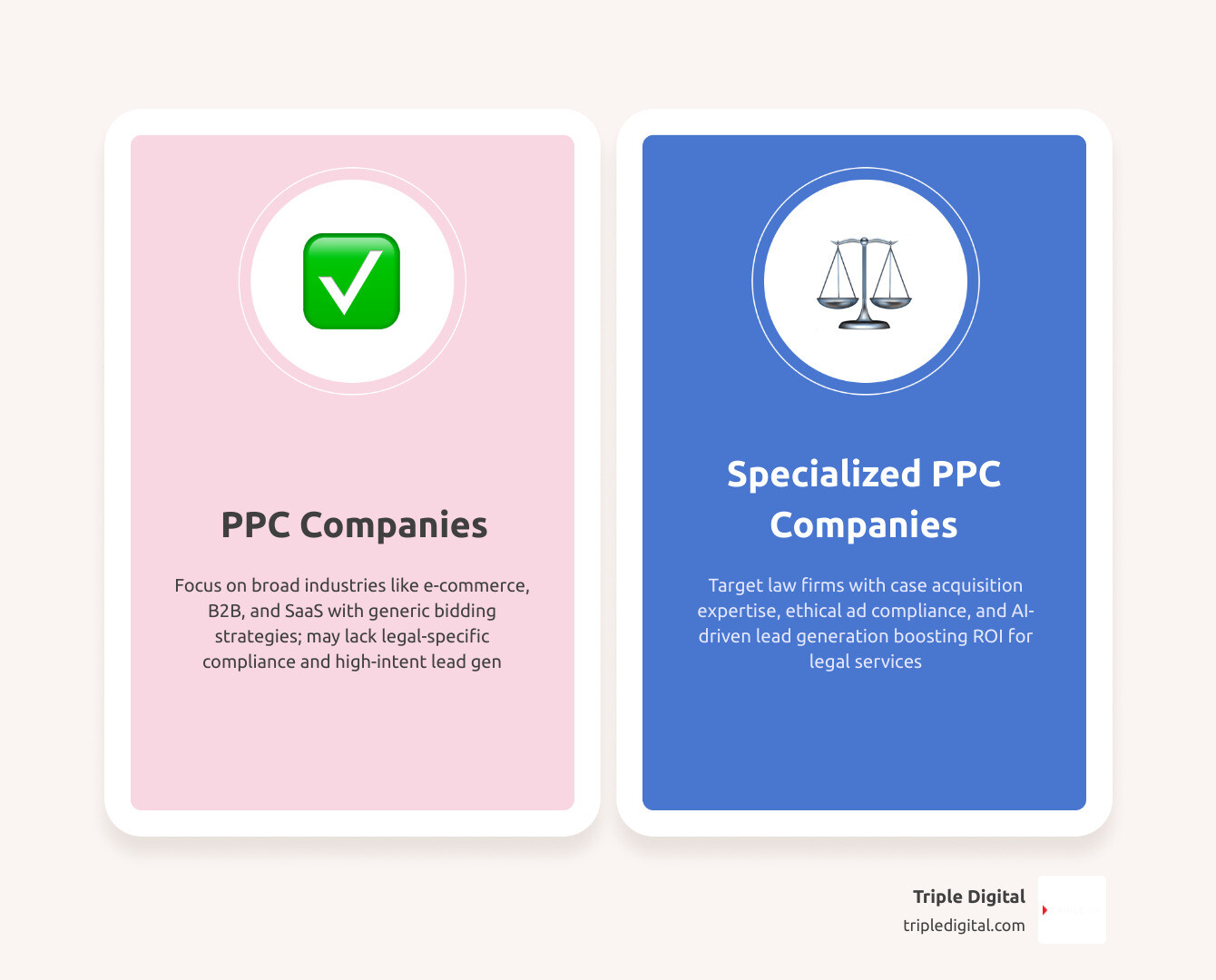
Specialized PPC companies understand the nuances of case acquisition. They know that a click is not the same thing as a signed case. They focus on high-intent search queries, local service ads (LSAs), and strict negative keyword lists to filter out people looking for free advice or unrelated services.
To see how specialized paid strategies can transform your firm, explore The Definitive Guide to Paid Advertising for Lawyers. Working with experts who understand legal compliance, intake processes, and high-value case targeting ensures that your ad spend turns into signed cases, not just high click-through rates.
Different Types of Paid Ad Campaigns
A well-rounded paid media strategy rarely relies on a single ad format. Depending on your goals, your agency should leverage several campaign types:
- Search Ads: Text-based ads that appear at the top of Google or Bing when someone searches for your services. These capture users with high search intent.
- Display Ads: Visual banner ads placed across millions of websites. Ideal for brand awareness and retargeting people who have already visited your site.
- Shopping Ads: Product-focused ads that display images, prices, and store names directly in search results. Essential for e-commerce brands.
- Social Media Ads: Targeted ads on platforms like Meta (Facebook and Instagram), LinkedIn, and TikTok. These use demographic and behavioral data to build awareness and generate leads.
For a deeper look at how to structure these campaigns for maximum performance this year, check out our guide on Paid Ad Campaigns 2026.
Key Criteria for Evaluating Top PPC Companies
Choosing a partner to manage your hard-earned marketing budget requires careful vetting. You shouldn’t just hire the first agency that promises to double your leads.
When evaluating potential partners, look for these key indicators of quality:
- Certifications and Partnerships: Verify if the agency is a certified Google Partner or Google Premier Partner. This status proves they meet rigorous ad spend thresholds, deliver consistent client growth, and maintain up-to-date certifications.
- Case Studies and Proven Results: Ask for case studies within your specific industry. For example, a successful campaign for an online garden store that generated over €400K in revenue with a 6.22x return on ad spend (ROAS) is impressive, but if you are a law firm, you need to see how they lower cost-per-case, not just e-commerce ROAS.
- Data Transparency: You should always retain 100% ownership of your ad accounts. If an agency builds your campaigns inside a “walled garden” account that they own, walk away. If you part ways, you will lose all of your conversion history and campaign data.
- Reporting Dashboards: Top agencies provide real-time dashboards (using tools like Looker Studio) that pull data directly from Google Ads and your CRM. You should be able to see exactly where every dollar goes and which campaigns are driving actual business revenue.
To compare top providers and see what a high-performing agency looks like, refer to The Ultimate List of Pay Per Click Marketing Companies to Boost Your ROI.
Red Flags to Avoid When Vetting PPC Companies
As you interview agencies, keep an eye out for these common warning signs:
- “Black Box” Reporting: If the agency only sends you a monthly PDF summary with vanity metrics like impressions and clicks, but refuses to give you direct login access to your Google Ads account, they are likely hiding something (or marking up your ad spend).
- Media Markups: Some agencies charge a percentage of your ad spend and mark up the cost of the media itself. This incentivizes them to spend more of your money, even if it doesn’t improve your performance. Look for agencies that use a flat-fee or pass-through billing model where you pay the ad platforms directly.
- Guaranteed Rankings or Leads: No one can guarantee a specific cost-per-lead or a #1 position on Google Ads. Bidding is a real-time auction influenced by competitor budgets, quality scores, and search trends.
- No Focus on CRM Integration: If an agency claims success based on “form fills” but doesn’t track whether those leads actually turn into paying clients, they are optimizing for the wrong metric.
How Modern Agencies Leverage AI and Automation
The best PPC companies do not fight AI; they guide it. Modern paid media management relies on a hybrid approach—combining machine learning bidding algorithms with human strategy.
- Smart Headlines and Creative Testing: AI tools can automatically generate and test hundreds of ad headline and description combinations, serving the highest-performing variations to searchers. For example, travel brands using automated headlines have seen click-through rates (CTR) jump by up to 37%.
- Predictive Bidding: Algorithms analyze historical search patterns, device types, locations, and times of day to adjust bids in real-time, placing your ads in front of users most likely to convert.
- Server-Side Tracking: With third-party cookie deprecation and privacy updates (like iOS 14+) blocking up to 30% of standard web tracking, advanced agencies implement server-side tracking (such as Google Enhanced Conversions or Meta Conversions API). This routes conversion data directly from your server to the ad platform, preserving attribution accuracy and keeping smart bidding algorithms fed with clean data.
The Real Cost of PPC Management Services
PPC agency pricing varies widely based on campaign complexity, your monthly ad spend, and the agency’s expertise. Understanding how these models work will help you choose a partner aligned with your financial goals.
| Pricing Model | How It Works | Best For | Pros & Cons |
|---|---|---|---|
| Flat Monthly Fee | You pay a set monthly fee (e.g., $1,500 to $5,000+) regardless of your ad spend. | Small to mid-sized businesses with stable budgets. | Pros: Highly predictable costs. Cons: Agency may not prioritize scaling your account. |
| Percentage of Ad Spend | The agency charges a percentage of your monthly budget (typically 10% to 20%). | High-spend accounts ($20k+/month). | Pros: Scales naturally as your business grows. Cons: Agency is incentivized to increase your spend. |
| Media Pass-Through (Fixed Fee) | You pay the ad platforms directly at cost. The agency charges a flat management fee. | B2B, SaaS, and professional services. | Pros: Zero conflict of interest; complete budget transparency. Cons: Higher upfront cost for smaller budgets. |
To understand how these pricing structures fit into an overall marketing budget, read our breakdown of How Much Do Small Law Firms Spend on Marketing?.
Frequently Asked Questions about PPC Agencies
What is the difference between a Google Premier Partner and a standard agency?
A standard Google Partner has certified employees and meets basic performance requirements. A Google Premier Partner represents the top 3% of participating agencies in a given country.
To earn Premier status, an agency must manage significant ad spend, demonstrate sustained client growth, and show advanced expertise across search, display, shopping, and video campaigns.
For more answers to common questions about legal marketing and paid media, read our Digital Marketing FAQ for Lawyers 2026 Edition.
How do PPC strategies differ for B2B vs. B2C companies?
B2B and B2C campaigns have completely different goals, audience behaviors, and sales cycles:
- B2B PPC: Focuses on lead generation, long sales cycles, and high transaction values. Campaigns target niche audiences using platforms like LinkedIn Ads and Google Search, optimizing for metrics like cost-per-demo-booked or pipeline-to-spend multiples.
- B2C PPC: Focuses on high-volume transactional sales, short decision-making windows, and lower average order values. Campaigns rely heavily on visual platforms like Google Shopping, Meta, and TikTok to drive immediate purchases, optimizing for direct return on ad spend (ROAS).
How long does it take to see measurable ROI from paid ads?
Unlike SEO, which can take six to twelve months to build momentum, PPC can drive traffic and leads on day one. However, expect a “learning phase” of 14 to 30 days.
During this initial period, your agency gathers conversion data, refines keyword targeting, builds negative keyword lists, and runs A/B tests on ad copy. Most campaigns reach optimal, predictable performance within 90 days.
Drive Scalable Growth with a High-Performance Paid Media Partner
At the end of the day, you don’t need more clicks, more impressions, or flashy reports filled with marketing jargon. If you run a law firm, you need signed cases.
At Triple Digital, we take a “less fluff, more cases” approach to paid media. Based in Houston, Texas, we specialize in high-intent lead generation and case acquisition for law firms. By combining deep legal industry expertise with advanced data mining and AI-driven targeting, we build high-converting campaigns that cut through the noise and deliver measurable business outcomes.
We don’t hide behind complicated fee structures or “black box” reporting. You retain full ownership of your accounts, your data, and your results.
To learn more about how we help firms scale their caseloads in 2026, read our insights on the Top Law Firm Marketing Agency: How Firms Will Get More Cases in 2026 and Beyond.
Ready to stop wasting ad spend and start winning more cases? Schedule a consultation to scale your firm’s cases today and let’s build a campaign that actually moves the needle.