





7 Critical Signs Your Practice Needs a Lawyer Website Redesign
When Your Firm Needs a Lawyer Website Redesign
A lawyer website redesign is worth doing when your site no longer earns trust, explains why clients should choose your firm, or turns visits into consultation requests. Start by auditing what is working now, then plan the redesign around three priorities:
- Clear positioning: Define two or three real, provable reasons a client should hire your firm.
- Content and search protection: Plan practice-area pages, preserve valuable URLs, and map redirects before design begins.
- Conversion paths: Make it simple for the right prospective client to call, submit a form, or request a consultation on any device.
A modern legal website is not just a cleaner visual wrapper. It is part of your client-acquisition system. It must build confidence quickly, answer urgent questions, and help people take the next step.
The risk of treating a redesign as a design-only project is real. Poorly planned launches can cause an organic traffic decline of 30% to 50%, while only about one in 10 site migrations improves rankings. A successful redesign begins with strategy, content, and search planning – not a template choice.
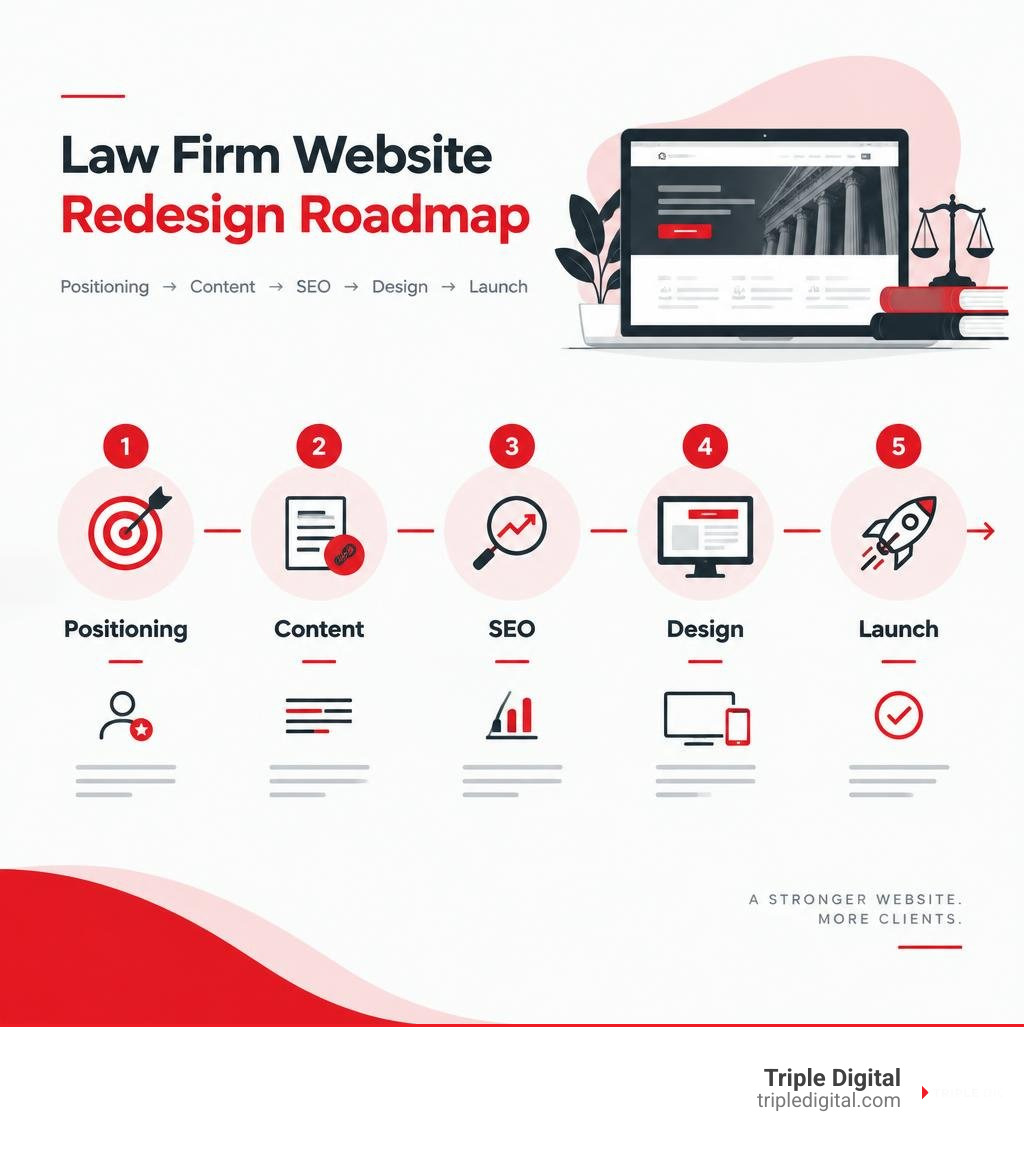
Lawyer website redesign terms to remember:
Why Most Law Firm Redesigns Fail and How to Avoid Traffic Loss
The legal industry is full of cautionary tales where a firm spends months polishing an elegant visual layout, only to see inbound leads drop off a cliff within weeks of launch. When sites undergo a refresh without dedicated technical oversight, they can lose 30–50% of organic traffic almost overnight. Industry data shows that only about 1 in 10 migrations actually improve search rankings. When migrations go wrong, the organic recovery period averages well over a year.
Why does this happen? Most redesign failures stem from treating the overhaul as an art project rather than a technical migration. When URLs are renamed without redirects, metadata is wiped clean, high-performing legacy content is deleted, or internal link structures are severed, search engines are forced to reassess your entire domain from scratch.
To safeguard your search visibility, you must create a meticulous 301 redirect map before a single line of production code is deployed. Every single legacy URL that generates traffic, holds backlinks, or serves as a landing page must point directly to its exact new equivalent.
| Redesign Metric | Unplanned Aesthetic Overhaul | Strategic, SEO-Led Redesign |
|---|---|---|
| Post-Launch Traffic Impact | 30% to 50% drop overnight | Maintained or improved rankings |
| Recovery Timeline | 12 to 18+ months of cleanup | Seamless transition (0 downtime) |
| URL Structure | Broken links and missing 404s | Comprehensive 301 redirect matrix |
| Conversion Focus | Visual aesthetics only | Intentional conversion pathways |
| Search Engine Equity | High risk of lost backlink equity | Fully preserved authority and indexing |
At Triple Digital, our Houston-based team knows that a pretty website that nobody can find generates zero cases. Implementing strategic web design for law firms requires equal parts creative branding, data mining, and technical preservation.
Settle Positioning and Differentiators Before Your Lawyer Website Redesign
Before selecting fonts, color palettes, or layout templates, you must clearly define your market positioning. Design without positioning is like a suit without a tailor: it might look fine on the hanger, but it won’t fit your firm properly.
Many law firms fall into the trap of using generic legal clichés: “Aggressive representation,” “Dedicated to justice,” or “We treat you like family.” Prospective clients see dozens of competing firms making identical claims. Instead, identify two or three true, provable differentiators:
- Specific Case Track Records: Highlight concrete niches, such as commercial truck collisions along major regional freight corridors or complex cross-border intellectual property disputes.
- Direct Attorney Access: Explain how client communication works, whether clients speak directly to lead counsel, and how quickly inquiries are addressed.
- Unique Fee Structures or Technology: Outline transparent billing models, client-facing portals, or proprietary evidentiary discovery methods.
Establish a clear audience hierarchy. Are you speaking to distressed individuals seeking immediate counsel, or corporate general counsel evaluating outside retainers? Build your value proposition around the exact needs of your target audience before building page layouts.
How Content Planning Dictates Your Lawyer Website Redesign Architecture
A common bottleneck in website projects is treating written content as an afterthought. Waiting until the visual layouts are finalized to write your copy almost always forces expensive wireframe rebuilds and pushes launch deadlines back by months.
Your firm must take on the role of editor-in-chief. Whether your managing partner drafts the raw insights, an in-house marketing director oversees the editorial calendar, or your practice teams supply the underlying facts, content requirements must dictate the layout—never the other way around.
When you plan content ahead of time, practice area pages are structured around how prospective clients actually search for legal help. You determine the necessary depth, trust badges, video explanations, and client testimonials before designing the user interface. Exploring custom lawyer web design solutions helps ensure your interface naturally accommodates comprehensive legal guides, attorney bios, and targeted practice hubs.
Core Phases of a Successful Lawyer Website Redesign
Executing an effective overhaul requires an organized sequence of strategic steps. Skipping steps or rushing into visual design leads to friction and missed conversion opportunities. To build a platform that wins cases, follow this step-by-step framework:
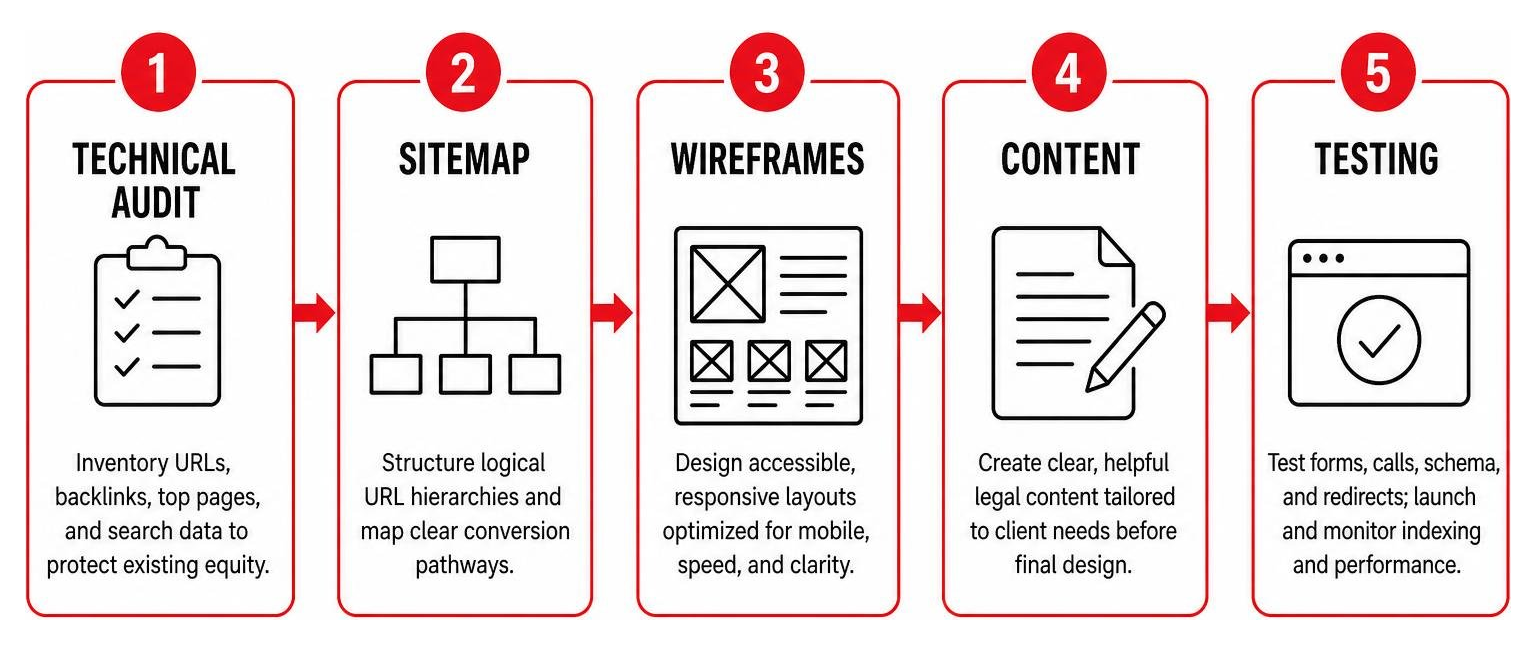
- Comprehensive Technical Audit: Inventory every existing URL, backlink profile, top-converting landing page, and historical search query to protect existing equity.
- Sitemap Architecture & Conversion Pathways: Structure clean, logical parent-child URL hierarchies (e.g.,
/practice-areas/car-accidents/) and chart frictionless pathways toward contact touchpoints. - Content Strategy & Production: Draft clear, helpful legal copy tailored to prospective clients before moving to high-fidelity graphics.
- UX/UI Wireframing & Responsive Prototyping: Build accessible, modern layouts optimized for mobile devices, high-speed performance, and clear readability.
- Quality Assurance, Redirect Mapping, & Launch: Verify structured schema data, test forms and click-to-call links, execute server-side 301 redirects, and monitor live indexing.
Learning how to design high-converting law firm websites ensures your digital infrastructure is geared toward generating signed retainers from day one.
Integrating SEO and Generative Engine Optimization Early
Search behavior has evolved. Modern legal marketing requires optimizing not only for traditional organic search engines but also for generative AI engines (Generative Engine Optimization or GEO) that summarize answers directly in search interfaces.
To capture search visibility across both ecosystems, integrate search specialists into your sitemap and architecture planning sessions from the very beginning:
- Search Intent Alignment: Structure pages to answer foundational legal questions immediately. Users searching for general legal guidance need direct clarity regarding processes, documentation, and statutes of limitations.
- Structured Data and Schema Markup: Implement advanced
LegalService,Attorney, andFAQPageschema. This helps search models and AI parsers understand your jurisdictions, attorneys, and core service offerings. - Information Architecture Continuity: Retain top-performing URLs whenever possible. If you must adjust URL structures for better categorization, ensure seamless one-to-one redirects to maintain historical equity.
Establishing Realistic Timelines and Single Decision-Maker Governance
A complete, high-performance law firm website redesign typically takes between 12 to 20 weeks. Rushing the process leads to cut corners in technical validation, while unmanaged revisions can stall a launch indefinitely.
The most effective way to keep your project on schedule is establishing a single internal decision-maker. Design by committee is where timelines go to die. When five partners with varying aesthetic preferences must approve every layout, button color, and headline, progress grinds to a halt.
Appoint one project lead—such as the managing partner or marketing director—with the sole authority to approve milestone deliverables. Set strict review windows, maintain clear project scopes, and preserve team momentum.
Balancing Brand, Technology, and Search Performance

A successful digital platform sits at the intersection of brand identity, modern technology, and search performance. When one pillar is prioritized to the exclusion of the others, the overall system falters:
- Brand Without Search: A stunning, cinematic website that receives zero organic visitors is just an expensive digital business card.
- Search Without Brand or CRO: High search engine rankings that drive visitors to an uninspiring, difficult-to-navigate page result in immediate bounces.
- Technology Without Usability: Complex, bloated code and heavy animations slow down page speeds and drive prospective clients away on mobile networks.
Your choice of content management system (CMS) and technology stack directly influences page speed, accessibility, and conversion rates. Using targeted tactics to increase conversion rates for law firms ensures your site turns traffic into signed cases with prominent intake options, clear value messaging, and fast loading speeds.
When evaluating agency partners, look for teams with demonstrated legal domain experience. Reviewing our guide on choosing the right legal web design partner will help you ask the right questions about data protection, SEO migration protocols, and conversion optimization before signing an agreement.
Frequently Asked Questions About Redesigning a Legal Practice Website
How long does a comprehensive law firm website overhaul take?
A full-scale legal website redesign typically takes between 3 to 5 months (12 to 20 weeks). This timeline allows for in-depth strategic planning, technical audits, content creation, UX wireframing, responsive development, 301 redirect mapping, and comprehensive quality assurance testing.
How do legal practices prevent search ranking drops after a launch?
Firms prevent ranking drops by performing thorough pre-launch SEO audits, maintaining historical URL structures whenever feasible, implementing a comprehensive 1:1 301 redirect matrix for any changed URLs, and ensuring all on-page metadata and schema markups are migrated correctly. Continuous post-launch indexing and rank monitoring are also essential during the first 60 days.
What is the most critical mistake partners make during a revamp?
The most damaging mistake is focusing purely on visual aesthetics while delaying content production and ignoring technical migration protocols. When content is treated as an afterthought and committees stall approvals, sites often launch with missing technical foundations, broken links, and vague brand positioning that fails to convert visitors into consultations.
Elevate Your Firm’s Digital Case Acquisition
A successful website revamp is an investment in your firm’s growth and intake pipeline. By grounding your project in clear positioning, prioritizing content before code, and protecting your hard-earned search equity, your new website will serve as a reliable source of qualified client inquiries.
At Triple Digital, our results-driven, “less fluff, more cases” approach combines modern technical development, AI-driven targeting, and conversion design tailored specifically for legal practices. When you are ready to upgrade your practice’s online presence, schedule a strategy meeting to evaluate your redesign and build a digital asset that consistently drives firm revenue.