




How to Hire the Best Attorney Ghostwriting Services Without Losing Your Voice
Understanding Attorney Ghostwriting Services in Modern Practice
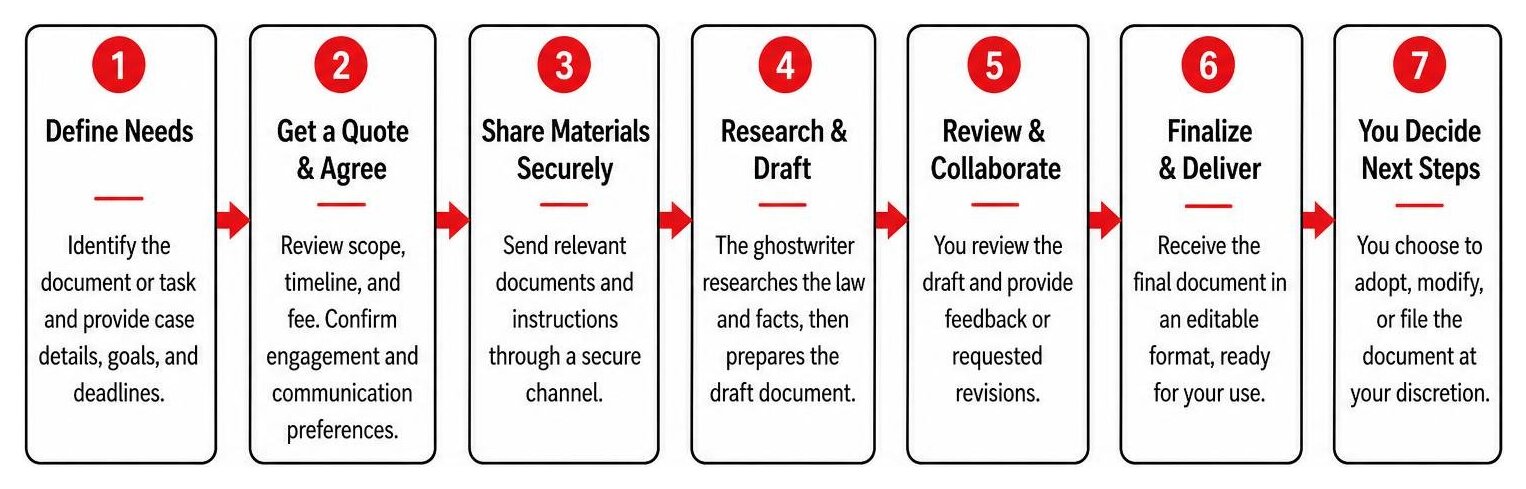
Legal practice in 2026 demands efficiency, precision, and agility. Attorney ghostwriting services fill a vital role by unbundling standard legal representation into targeted, document-specific assistance. Instead of taking over a matter from start to finish, a ghostwriter researches law, analyzes case facts, and drafts pleadings, dispositive motions, or digital thought leadership behind the scenes.
Scope of Work vs. Standard Legal Representation
Standard legal representation involves full scope advocacy. An attorney files an appearance, manages discovery, speaks directly to opposing counsel, and presents arguments inside the courtroom. Under Model Rule 1.2(c) of the American Bar Association (ABA) Model Rules of Professional Conduct, lawyers can limit the scope of representation if the limitation is reasonable under the circumstances and the client provides informed consent.
Ghostwriting functions entirely as limited-scope representation. The drafting attorney prepares court filings, research memos, or settlement demand letters, but does not sign court papers or enter a formal notice of appearance. The client retains total autonomy, choosing whether to adopt, modify, or file the prepared text. For law firms producing client-facing publications, Write Your Way To Clients Effective Legal Content Strategies highlights how legal teams maintain control over published analysis while delegating initial research and drafting.
Key Benefits of Attorney Ghostwriting Services for Litigants
For self-represented (pro se) parties, unbundled legal writing expands access to justice. Full litigation retainers routinely cost tens of thousands of dollars, placing court advocacy out of reach for middle-income individuals. By purchasing legal assistance on a project or flat-fee basis, litigants gain access to well-reasoned briefs and structured motions without paying for ongoing trial representation.
For law firms, outsourcing law-and-motion work unlocks immediate billable capacity. Litigation partners and trial attorneys often find their time consumed by depositions, client calls, and courtroom appearances. Hiring specialized legal ghostwriters ensures that complex summary judgment motions, demurrers, and appellate briefs receive rigorous legal analysis without burning out internal team members.
Ethical Standards, ABA Rules, and State Disclosure Guidelines
The ethical landscape governing legal document drafting rests on a delicate balance between expanding legal access and protecting tribunal integrity.
In 2007, the ABA issued Formal Ethics Opinion 07-446, which substantially reshaped the legal ethics discussion. The ABA concluded that an attorney may provide ghostwriting assistance to a pro se litigant without disclosing their identity or assistance to the court. According to the ABA, a ghostwritten pleading does not violate Model Rule 3.3 (Candor Toward the Tribunal) or Model Rule 8.4 (Conduct Involving Deceit or Misrepresentation) because the pleading is evaluated on its legal merits, not on who drafted it.
However, state bar associations maintain varying stances that do not always align with ABA guidance.
State Disclosure Requirements Across U.S. Jurisdictions
State rules governing legal document ghostwriting fall into four distinct categories:
- Permissive Nondisclosure (18 states and D.C.): Attorneys may draft pleadings without revealing their identity or assistance, provided there is no explicit local court rule requiring disclosure.
- Fact of Assistance Disclosed (9 states): Filings must state that the document was “Prepared with assistance of counsel,” but the specific attorney’s name and bar number remain undisclosed.
- Substantial Assistance Threshold (7 states): Disclosure is required only if the lawyer provides “substantial” or “extensive” drafting help.
- Full Mandatory Disclosure (9 states): Any attorney drafting a court filing must include their full name, bar registration number, and contact information directly on the pleading.
| Disclosure Requirement Category | Number of Jurisdictions | Key Principle for Filing |
|---|---|---|
| Permissive Nondisclosure | 18 States + D.C. | No requirement to disclose attorney involvement |
| Fact of Assistance Only | 9 States | Must note document was drafted with legal counsel |
| Substantial Assistance Standard | 7 States | Disclosure required only if drafting assistance is extensive |
| Full Mandatory Disclosure | 9 States | Must include attorney name and bar details on filing |
Client Confidentiality, Intellectual Property, and Contracts
Whether outsourcing court pleadings or thought-leadership content, maintaining attorney-client privilege and client confidentiality is mandatory. Any ghostwriting contract must incorporate robust non-disclosure provisions.
When law firms hire ghostwriters for client alerts, practice area articles, or legal guides, establishing clear intellectual property rights is equally critical. U.S. copyright law treats authors and purchasing entities differently based on contract language. Without a formal work-for-hire agreement or explicit copyright assignment, the writer may retain underlying rights to the drafted content. To learn more about structuring client communications effectively, see our resource on content creation for attorneys.
Federal Courts vs. State Courts: Rulings and Sanction Risks
While state ethics commissions have moved toward permitting unbundled ghostwriting, federal courts consistently take a stricter stance.

An empirical study examining 179 court opinions revealed that 67% of ghostwriting rulings originated from U.S. District Courts, 12% from bankruptcy courts, and 8% from circuit courts. Federal judges frequently oppose undisclosed ghostwriting, relying on local rules and Federal Rule of Civil Procedure 11.
Judicial Objections and the Undue Advantage Argument
Federal judges raise three primary objections against undisclosed legal ghostwriting:
- Violation of Rule 11: Rule 11 requires an attorney of record to sign every court document, certifying that factual assertions have evidentiary support and legal claims are grounded in existing law. Undisclosed ghostwriting allows an attorney to shape litigation without subjecting themselves to Rule 11 certifications.
- Undue Advantage and Liberal Pleading Standards: Courts grant pro se litigants liberal pleading standards under established federal doctrine. Federal judges argue that if a licensed attorney secretly writes a complaint, granting that party pro se leniency creates an unfair advantage over the opposing side.
- Disruption of Judicial Proceedings: Courts note that ghostwritten submissions can lead to inconsistent litigation strategies when a pro se party fails to understand or explain the legal theories presented in drafted filings.
Mitigating Rule 11 Sanctions and Malpractice Liabilities
Despite widespread judicial opposition in federal cases, the empirical study showed that 54% of judges chose not to sanction the ghostwriter or litigant, opting instead for warnings or orders to show cause. However, when sanctions occur, they include financial penalties, striking the ghostwritten pleadings, or referrals to state bar disciplinary boards.
To manage malpractice exposure and sanction risks:
- Always check local district court standing orders before preparing unbundled submissions.
- Ensure limited-scope client agreements clearly detail that representation ends upon delivery of the drafted document.
- Verify all factual representations provided by the client prior to drafting to avoid submitting frivolous arguments.
For law firms exploring digital marketing strategies alongside litigation support, our breakdown on why do law firms need a content marketing strategy offers clear insights on building authority safely.
How to Choose Attorney Ghostwriting Services That Preserve Your Voice
Outsourcing legal writing — whether for court filings or practice-area articles — should elevate your practice without compromising your authentic professional voice.
Vetting Technical Writing Competence and IP Controls
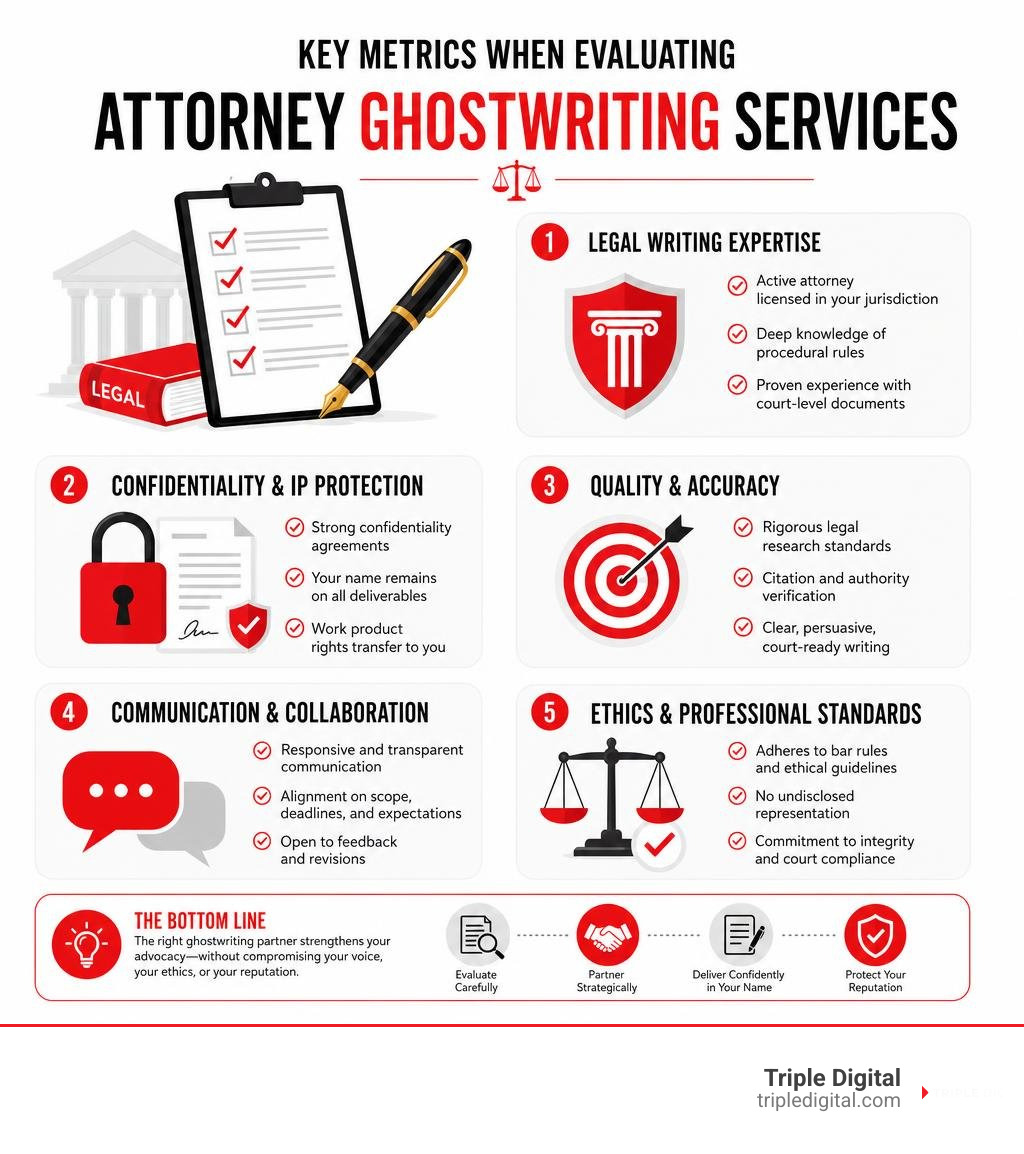
When choosing an attorney ghostwriting service, evaluate writers against strict legal standards:
- State Bar Admissions: Ensure the legal writer is a active licensed attorney familiar with your jurisdiction’s procedural rules.
- Practice Area Specialization: Legal writing requires domain knowledge. A complex motion to dismiss under Federal Rule 12(b)(6) demands different expertise than drafting an estate planning white paper.
- Data Security Standards: Verify that the provider uses end-to-end encryption (AES-256) and explicit no-AI-training guarantees to protect proprietary legal research and client details.
- Voice Calibration Workflows: Premium providers review your prior briefs, published articles, or court filings to match your stylistic rhythm, tone, and citation habits.
If your firm uses automated tools to draft marketing material, reviewing the key to AI written content helps ensure human editorial oversight remains paramount.
Ethical Marketing Practices for Legal Writing Services
Promoting ghostwritten legal content online requires strict compliance with Federal Trade Commission (FTC) guidelines and state bar advertising rules. Under Model Rule 7.1, lawyer communications regarding legal services cannot be false or misleading.
When publishing ghostwritten blog content or thought leadership:
- Ensure all legal statements, case citations, and statutory references are fully accurate and verified before publication.
- Avoid guaranteed case outcome claims or unverifiable comparative assertions (“the best litigator in Houston”).
- Maintain editorial approval so every piece published under your name reflects your genuine legal opinion.
To build a consistent online publication schedule, explore the ultimate guide to blog writing for law firms for detailed practical advice.
Frequently Asked Questions About Legal Drafting Support
Is attorney ghostwriting legal under state and federal court rules?
Yes. Attorney ghostwriting is legal across the United States, but rules governing disclosure vary significantly. While the ABA permits undisclosed ghostwriting under Formal Opinion 07-446, individual federal district courts and state bar associations enforce specific local rules regarding attorney identification.
Must clients disclose that an attorney ghostwrote court pleadings?
It depends on the court. Eighteen states allow total nondisclosure, nine states require full attorney identification, nine require disclosing the fact of assistance without naming the lawyer, and seven require disclosure only for substantial drafting help. Most federal courts require explicit disclosure.
How can lawyers maintain their voice when outsourcing legal content creation?
Lawyers maintain their authentic voice by providing writing samples, defining firm style guides, running structured briefing calls, and conducting final editorial reviews before any content goes live. For advanced SEO strategies on legal publications, check out our guide on advanced SEO authoritative content.
Scale Your Practice with Strategic Legal Marketing
Finding reliable attorney ghostwriting services allows you to deliver polished, accurate legal work while preserving precious hours for client advocacy and firm growth. Whether you need courtroom brief support or authoritative digital content that attracts high-value clients, delegation is key to scaling a law practice.
At Triple Digital, we specialize in helping law firms drive consistent case acquisition through targeted digital marketing, content strategies, and precise client acquisition channels. If you are ready to expand your firm’s reach without losing your authentic voice, explore our comprehensive services, learn more about our approach on our homepage, or read Pillar Content And Beyond Crafting A Law Firm Content Strategy.
Ready to take the next step? Schedule a Strategy Session with our team or contact us today. You can also find our location directly via Google Maps at Triple Digital Google Business Profile.