





Everything You Need to Know About Content Creation for Attorneys
Why Most Law Firms Are Invisible Online (And How Content Changes That)
Content creation for attorneys is the process of producing blog posts, videos, FAQs, and practice area pages that help potential clients find your firm online — and trust you enough to call.
Here’s a quick breakdown of what effective attorney content creation looks like:
| Content Type | Primary Purpose | Time to Create |
|---|---|---|
| Short FAQ video (2 min) | Build trust, answer client questions | 15-20 minutes |
| Blog post from transcript | SEO traffic, long-tail keywords | 10 minutes (AI transcription) |
| Practice area page | Rank for high-intent searches | 2-4 hours |
| Social media clip | Visibility and brand awareness | 5 minutes from existing video |
| Google Business Profile post | Local search rankings | 5-10 minutes |
Here’s a number that should get your attention: 74% of legal consumers check a law firm’s online presence before making contact. If your firm isn’t publishing helpful, visible content, those potential clients are finding your competitors instead.
Most attorneys didn’t go to law school to become content creators. But the firms showing up at the top of Google aren’t always the best lawyers — they’re simply the ones who figured out how to show up consistently online.
The good news? You already have everything you need.
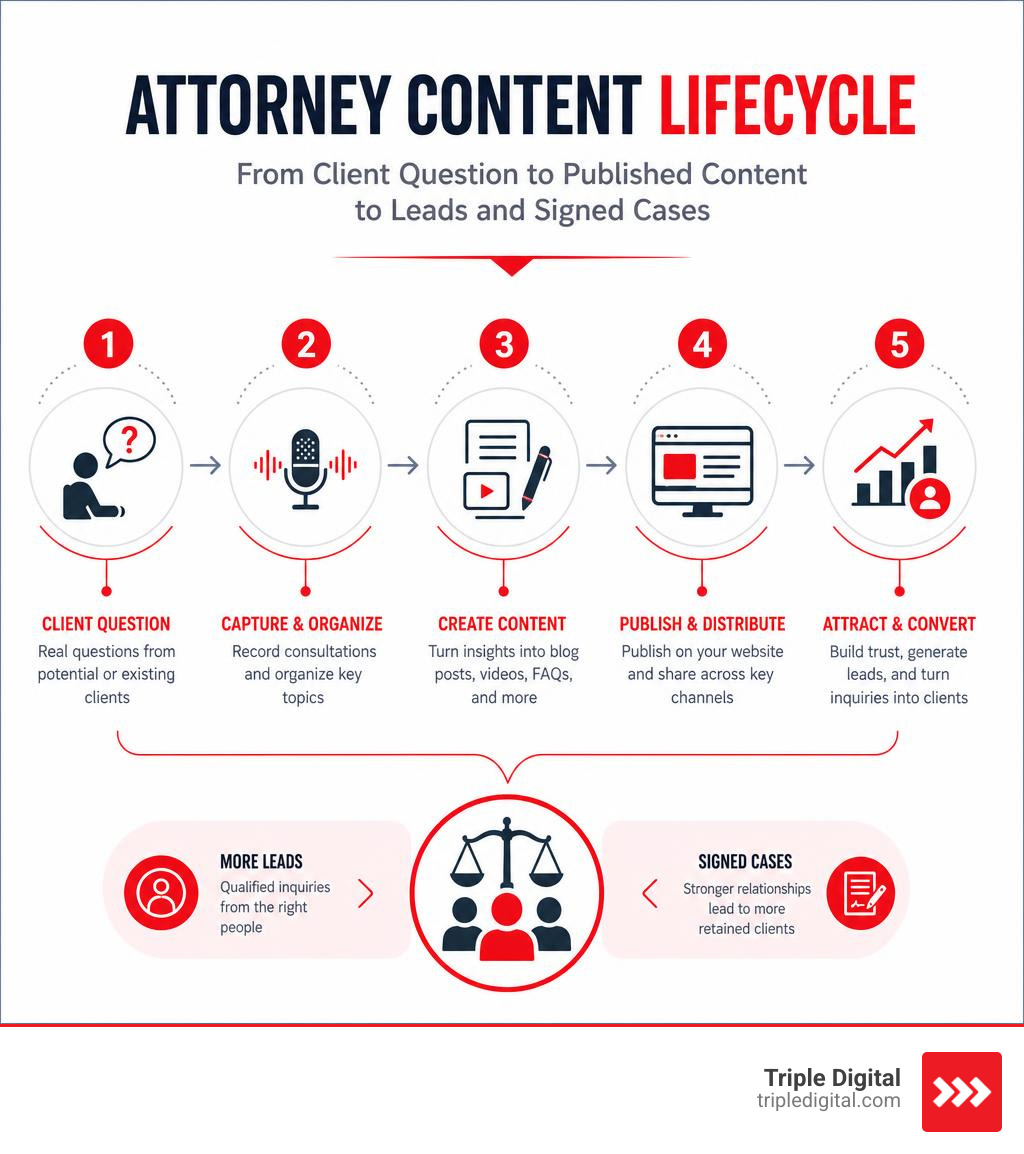
Every week, you answer the same questions from anxious clients. You explain processes, clear up misconceptions, and build trust through conversation. That knowledge is content. It just hasn’t been published yet.
This guide covers exactly how to fix that — without burning out or handing everything off to an agency that doesn’t understand your practice.
Why Attorney-Led Content Creation Outperforms Outsourced Agency Writing
Many law firms believe the easiest solution to their marketing problem is to hire an outside agency to write their blog posts. However, traditional agency-written content often falls flat. It tends to be generic, filled with legal jargon that alienates readers, or so watered down that it fails to demonstrate true expertise.
When you take the lead in your firm’s content creation, you establish both an intellectual and emotional connection with potential clients that an outside writer simply cannot replicate. You understand the exact emotional state of a client seeking help in Houston. You know their fears, their confusion, and the specific relief they need.
This personal touch is not just great for building trust with humans; it is also exactly what search engines look for. Google evaluates web content using a framework known as E-E-A-T (Experience, Expertise, Authoritativeness, and Trustworthiness).
Because legal topics directly impact a person’s life, finances, and freedom, Google classifies law firm websites under the “Your Money or Your Life” (YMYL) category. According to Google’s Search Quality Rater Guidelines, YMYL content undergoes the highest level of scrutiny. To rank well in May 2026, your content must show real, first-hand experience.
When we help firms build out their digital presence, we emphasize that authentic, attorney-reviewed, and first-person content is the ultimate trust signal. If you want to dive deeper into how search engines evaluate your authority, read our guide on Advanced SEO: Authoritative Content.
The 20-Minute Workflow for Content Creation for Attorneys
The most common reason lawyers avoid content creation for attorneys is a lack of time. Between managing active cases, court dates, and client consultations, spending hours drafting 1,500-word articles seems impossible.
The secret is to stop writing from scratch. Instead, transition to a low-friction, video-first workflow that allows you to produce high-value content in under 20 minutes.
| Step | Action | Tools Needed | Time Required |
|---|---|---|---|
| 1. Record | Answer one common client question on video | Smartphone or 4K webcam | 2-3 minutes |
| 2. Transcribe | Convert the video audio into clean text | AI transcription tool | 2 minutes |
| 3. Format & Edit | Clean up the transcript into a readable blog post | AI drafting assistant | 10 minutes |
| 4. Publish | Post the video and written text to your website | Website CMS (WordPress) | 5 minutes |
This workflow relies on recording short videos answering questions you already know by heart. Set up a simple recording space in your office with a clean backdrop, natural window light, a high-quality smartphone camera, and a wireless microphone.
Once you record a 2-minute video, run the audio through an AI transcription tool. You can then use the transcript as the foundation for a highly detailed blog post. For a complete breakdown of how to ethically and effectively use these tools to speed up your drafting process, check out our insights on The Key to AI Written Content.
Turning Client FAQs into High-Value Content Creation for Attorneys
To make this workflow successful, you need to know exactly what to talk about. The easiest way to find topics is to keep a running list of the questions your clients ask you every week.
When you answer these questions online, you are directly matching the search intent of users who are looking for immediate clarity.
To maximize your search visibility, always structure the written version of these answers using FAQ schema markup. FAQ-rich legal pages get 2-3x more organic clicks than standard pages because they often appear as featured snippets at the very top of search results.
To learn how to structure your articles so they convert readers into clients, read our guide on Write Your Way to Clients: Effective Legal Content Strategies.
Repurposing One Core Asset to Maximize Reach Without Burnout
Creating content consistently doesn’t mean you need to come up with new ideas every day. Instead, you should build a “repurpose content machine.” By taking one core asset — like a 5-minute video answering a complex legal question — you can easily spin it out into multiple formats:
- Video: Upload the full-length video to YouTube and embed it at the top of a relevant practice area page.
- Written Article: Convert the transcript into a structured blog post.
- Social Media Clips: Cut the video into 60-second vertical clips for platforms like LinkedIn, Instagram, or TikTok.
- LinkedIn Newsletter: Share the written insights directly on your personal LinkedIn profile to build professional authority.
- Google Business Profile: Publish a short summary of the video along with a link to your website to boost your local SEO map rankings.
- Email Newsletter: Send the helpful explanation to your email list to keep your firm top-of-mind for past and prospective clients.
Best Practices for Writing Search-Optimized and Compliant Legal Content
While utilizing AI and transcription tools speeds up the process, you must ensure that your final published content is optimized for search engines, easy for readers to digest, and fully compliant with legal ethics.

First, keep your writing simple. The average American reads at an 8th-grade level. Legal jargon and complex legalese will cause visitors to leave your site immediately. Since most website visitors only read about 20% of the content on a page, use clear headings (H2 and H3 tags), short paragraphs (3 sentences or less), bulleted lists, and bold text to make your pages highly skimmable.
Second, optimize for local SEO. If your firm is located in Houston, Texas, you want to make sure your content naturally mentions your local geographic area. Use local landmarks, county court names (like the Harris County Civil Courthouse), and regional terms naturally in your text so search engines understand exactly which local communities you serve.
For a step-by-step framework on dominating local search, explore Mastering Law Firm SEO: Your Blueprint for Online Success.
Finally, you must remain compliant with the State Bar of Texas and ABA Model Rules 7.1 through 7.3. Keep these compliance rules in mind:
- Never Make Guarantees: Avoid promising specific outcomes or settlements.
- Protect Client Confidentiality: When sharing case examples, anonymize all names, dates, and identifying details.
- Include Clear Disclaimers: Always state that your content is for informational purposes only and does not establish an attorney-client relationship.
Balancing DIY Content Creation with Professional Marketing Services
While recording quick FAQ videos is an excellent, low-friction way to keep your website active, a successful digital presence requires a balance between DIY content and professional marketing oversight.
Attorneys are best equipped to provide the raw, expert perspective that builds trust with human readers. However, a professional digital marketing agency handles the technical heavy lifting that ensures your content is actually found.
This hybrid model allows you to focus on sharing your legal expertise while professionals handle:
- Technical SEO: Ensuring your website loads in under 3 seconds and is perfectly optimized for mobile devices.
- Schema Markup: Implementing advanced code that helps search engines index your pages correctly.
- High-Authority Link Building: Earning secure, high-quality backlinks from reputable legal directories and publications to boost your domain authority.
- Conversion Rate Optimization (CRO): Designing clear calls-to-action (CTAs) and contact forms that turn casual readers into signed cases.
Your marketing success should not be measured by vanity metrics like page views or social media likes. True ROI is measured by signed cases, qualified leads, and a lowering cost-per-lead (CPL).
Frequently Asked Questions About Content Creation for Attorneys
Is it ethical for lawyers to use AI in content creation for attorneys?
Yes, using AI as a drafting assistant is highly effective and ethically permissible, provided that a licensed attorney reviews, edits, and approves every single piece of content before it goes live. AI should be treated like a junior associate: it can draft the initial outline, but your professional oversight ensures accuracy and compliance.
How long does it take to see ROI from legal content marketing?
Most law firms begin to see measurable organic growth and consistent lead generation within 3 to 6 months of consistent publishing. Unlike paid advertising, which stops generating leads the moment you stop paying, the results of high-quality content marketing compound over time, providing long-term value for years to come.
What are the must-have pages for a law firm website?
Every authoritative law firm website should include:
- Homepage: A clear introduction to who you are, what you do, and who you serve.
- Practice Area Pages: Detailed, 1,500+ word pages explaining your primary legal services.
- Attorney Bios: Personalized profiles highlighting your credentials, experience, and local community involvement.
- FAQ Pages: Dedicated Q&A resources targeting common client concerns.
- Testimonials/Client Success Stories: Social proof that builds immediate trust.
- Contact Page: Multiple clear ways for prospective clients to get in touch.
Let us Handle Content Creation for Attorneys
Creating high-performing digital content doesn’t require hours of painful writing or massive agency retainers. By leveraging your daily client conversations, recording quick videos, and utilizing smart AI transcription tools, you can build a powerful digital presence in just 20 minutes a week.
At Triple Digital, we believe in a results-driven, “less fluff, more cases” approach. Based in Houston, Texas, we specialize in helping law firms dominate local search, optimize their technical SEO, and turn website traffic into signed cases.
Ready to scale your firm’s online presence without the headache? Get started with professional legal marketing services today.