





The Verdict Is In: 19 Lawyer Blog Writing Tips That Actually Win Clients
Why Most Law Firm Blogs Fail (And How to Fix Yours)
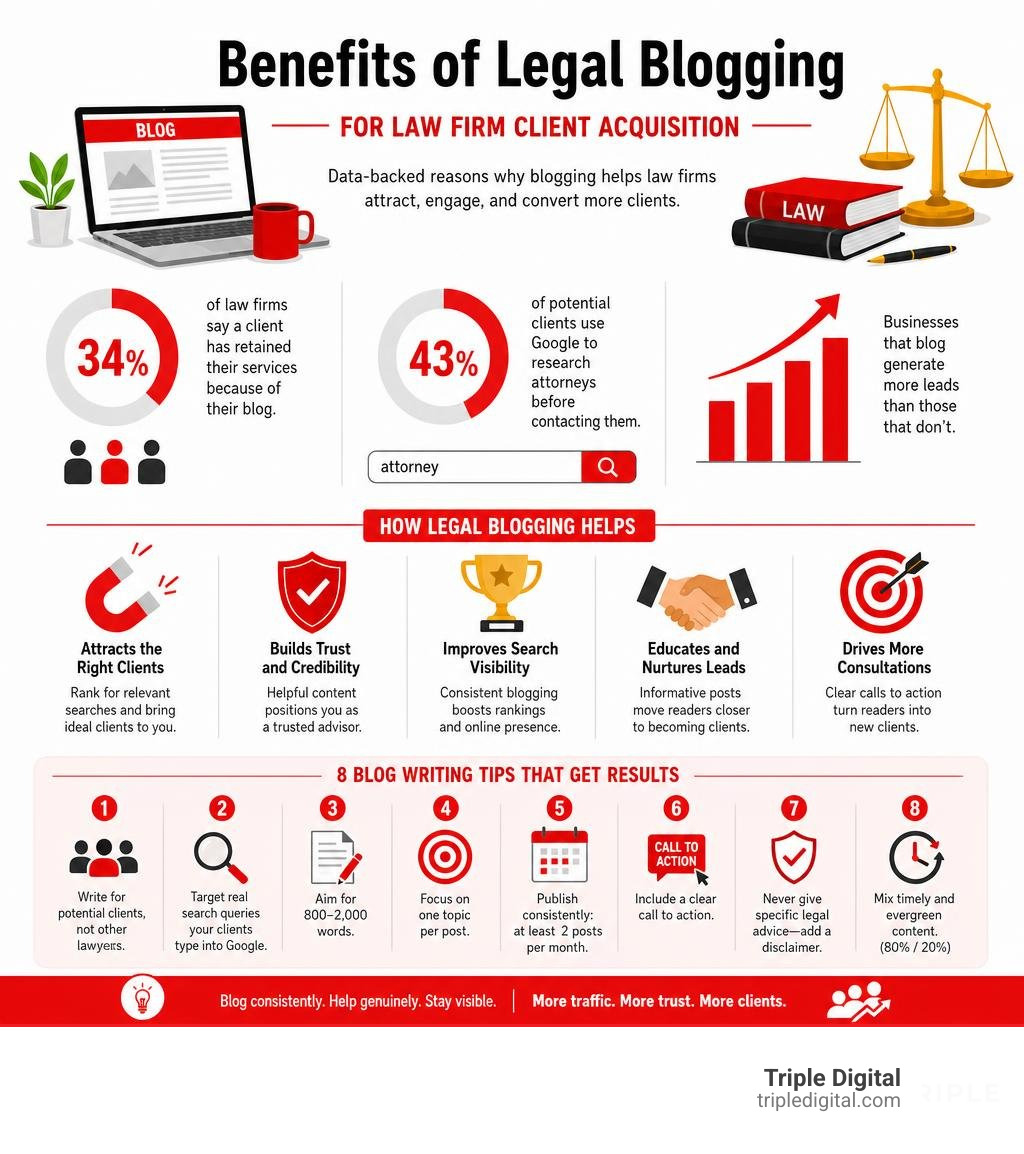
If you’re looking for lawyer blog writing tips that actually bring in clients, here’s a quick summary of what works:
- Write for potential clients, not other lawyers — use plain English, not legalese
- Target real search queries — use long-tail keywords your clients type into Google
- Aim for 800–2,000 words — long-form content ranks better and builds more trust
- Focus on one topic per post — depth beats breadth every time
- Publish consistently — at least 2 posts per month to build momentum
- Include a clear call to action — tell readers exactly how to contact you
- Never give specific legal advice — keep content informational and add a disclaimer
- Mix timely and evergreen content — roughly 80% evergreen, 20% news-driven
Blogging is one of the most cost-effective marketing tools available to law firms today. Yet most law firm blogs are underperforming — or sitting completely dormant.
The numbers tell a clear story. About 34% of law firms report that a client has retained their services directly because of their blog. And roughly 43% of potential clients use Google to research attorneys before ever picking up the phone.
Despite this, the majority of legal blogs miss the mark. They’re written in dense legal jargon. They cover topics clients don’t search for. They’re published once in a blue moon and then forgotten.
The good news? The bar is low. A firm that blogs strategically — with the right topics, the right structure, and the right consistency — can stand out quickly.
This guide walks you through exactly how to do that.
Lawyer blog writing tips helpful reading:
Why Law Firms Need a Strategic Blog
Blogging is not just about sharing news or announcing a new associate at your firm. When done correctly, a legal blog is a powerful engine for business development, client relations, and digital visibility.
According to the ABA TechReport, only about one-third of all law firms maintain an active blog. However, that number rises dramatically to 60% for firms with over 100 attorneys, and to over 67% for firms with more than 500 attorneys. The largest, most successful firms in the country invest in blogging because they know it works.
When a potential client is facing a legal hurdle, they rarely search for a law firm’s name. Instead, they type their problem into a search engine. If your blog answers their specific questions clearly, you instantly position your firm as the solution to their problem. This is why a solid content strategy is so vital. For a deeper look into the mechanics behind this, read about Why Do Law Firms Need a Content Marketing Strategy? to understand how digital presence directly translates to client acquisition.
Timely vs. Evergreen Content
To build a high-performing blog, we must strike a balance between two main types of content: timely posts and evergreen posts. We recommend aiming for an 80/20 content ratio, where 80% of your blog consists of evergreen topics and 20% covers timely updates.
- Timely Content (20%): These posts address breaking news, recent legislative changes, or landmark court decisions. To capitalize on the search volume generated by news events, timely posts should be published within a tight 24-to-72-hour window. While these posts drive rapid spikes in traffic, their relevance fades quickly.
- Evergreen Content (80%): These are educational posts that remain relevant for years. Topics like “How to prepare for a business contract negotiation” or “What to expect during a estate planning consultation” do not go out of style. Evergreen content can be shared repeatedly over time, generating three to four times the traffic of breaking news posts.
By structuring your blog around these two pillars, you create a library of resources that consistently attracts search traffic while proving that your firm is actively engaged in current legal updates. For more guidance on balancing these formats, check out Write Your Way to Clients: Effective Legal Content Strategies.
Building Long-Term Thought Leadership
Consistent blogging does more than boost search rankings; it manages your firm’s reputation and builds authority. In the legal industry, trust is the ultimate currency.
Google evaluates web content using two strict frameworks: E-E-A-T (Experience, Expertise, Authoritativeness, and Trustworthiness) and YMYL (Your Money or Your Life). Because legal guidance can profoundly affect a reader’s financial stability, safety, and overall well-being, Google categorizes legal blogs as YMYL. This means search algorithms hold legal content to the absolute highest standards of accuracy and quality.
To satisfy these standards, your blog posts must demonstrate deep professional authority. You can build trust by:
- Linking to authoritative, non-competitive external sources (like state statutes or official government portals).
- Including clear author bylines that link to detailed attorney bios.
- Writing with a voice of calm precision, backing up every claim with verified facts.
When you consistently publish accurate, high-quality information, you signal to both Google and potential clients that your firm is a trustworthy guide. To learn how to integrate these authority-building practices into your broader marketing efforts, explore Beyond Billable Hours: Your Online Marketing Playbook for Legal Success.
Essential Lawyer Blog Writing Tips for High-Impact Content
Many lawyers struggle with blogging because they write for the wrong audience. In law school, we are trained to write for judges, senior partners, and opposing counsel. We use complex sentence structures, Latin phrases, and dense legal citations.
But your blog readers are not judges. They are ordinary people—business owners, families, and individuals—who are feeling stressed, confused, and overwhelmed by a legal situation. If they land on your blog and are met with a wall of legalese, they will hit the “back” button immediately.
The most important of all lawyer blog writing tips is this: Write in plain English. Keep your focus narrow. Each post should address a single, specific topic or question. If you try to cover the entire history of Texas contract law in one post, you will overwhelm your reader. Instead, break complex topics down into digestible, single-topic guides. For a comprehensive look at how to draft these client-friendly posts, review our resource on Content Creation for Attorneys.
Actionable Lawyer Blog Writing Tips for Readability
Writing for the web is highly visual. Most readers do not read online articles word-for-word; they skim. To make your posts easy to read and highly engaging, use these formatting best practices:
- Keep Paragraphs Short: Limit paragraphs to two or three sentences. Frequent line breaks create white space, making the text feel approachable.
- Use Active Voice: Instead of writing “The contract was signed by the business owner,” write “The business owner signed the contract.” Active voice is punchier and easier to follow.
- Incorporate Visual Cues: Break up long blocks of text with descriptive subheadings (H2 and H3 tags), bullet points, and numbered lists.
- Write for a Conversational Reading Level: Aim for an 8th- or 9th-grade reading level.
To help maintain this readability, we highly recommend utilizing editing tools like Hemingway Editor (to check reading levels and highlight passive voice), Grammarly (to catch grammatical slip-ups), and legal-specific editing software like WordRake or PerfectIt to trim unnecessary fluff.
Ethical Guardrails and Avoiding Legal Advice
When sharing your legal knowledge online, you must protect both your readers and your firm. It is critical to balance helpful, educational information with strict compliance to legal ethics.
- Avoid Specific Legal Advice: Keep your content general. Frame legal concepts using hypothetical scenarios rather than speaking directly to a reader’s individual situation.
- Include Mandatory Disclaimers: Every blog post should feature a clear, conspicuous disclaimer stating that the content is for informational purposes only and does not establish an attorney-client relationship.
- Protect Client Confidentiality: Never write about active cases or share specific details that could identify a client, even if you change their name. Keep examples broad and illustrative.
- State Media-Friendly Quotes: If you are writing about a major public decision, write clearly and precisely. Assume that a journalist might read your post, and write sentences that you would be comfortable seeing quoted in the news.
How to Identify, Structure, and Optimize Client-Focused Topics
Finding great blog topics is easier than you think. You do not need to invent topics out of thin air. Instead, look at the questions your clients are already asking.
Keep a running list of questions that arise during initial consultations, client phone calls, and intake logs. If three different business owners ask you how to handle a vendor contract delay, you have your next blog topic.
You can also repurpose materials you already have. Look at your Continuing Legal Education (CLE) presentation slides, seminar outlines, or internal memos. By stripping away the dense legal citations and translating the core concepts into plain language, you can quickly build highly valuable blog posts. Additionally, setting up free Google Alerts for your practice areas allows you to stay on top of local legal developments that your clients might be searching for. To discover how modern tools and structured planning can streamline this process, read about The Key to AI Written Content.
Integrating Lawyer Blog Writing Tips with Search Intent
To attract search engine traffic, we must align our blog posts with search intent—the underlying reason why someone is typing a query into Google.
For legal blogging, we generally want to target informational search intent using long-tail keywords. Long-tail keywords are highly specific phrases (e.g., “how to update business partnership agreement in Texas”) rather than broad terms (e.g., “Texas business lawyer”). While broad terms have higher search volumes, they are highly competitive and rarely convert. Long-tail queries attract highly qualified leads who are looking for immediate answers.
When optimizing your posts, keep these key SEO practices in mind:
- Interchange “Lawyer” and “Attorney”: Potential clients search for both terms. Use them interchangeably throughout your titles, headings, and body copy to capture all search variations.
- Prioritize Local SEO: Legal services are highly geographic. Naturally incorporate your city, state, or county (e.g., “Houston, TX” or “Harris County”) to ensure your content ranks for local searches.
- Avoid Keyword Stuffing: Never force keywords into sentences where they do not belong. Write for the reader first; search visibility will naturally follow.
To illustrate how to transform legal concepts into user-friendly search topics, review the comparison table below:
| Legalese (Avoid in Headings) | Client-Friendly Search Term (Use in Headings) |
|---|---|
| “Analyzing the doctrine of force majeure in commercial leases” | “Can you pause commercial rent payments during a major disaster?” |
| “Statutory guidelines for intestate succession in Texas” | “Who inherits your property if you die without a will in Houston?” |
| “Mitigating liability via robust non-compete covenants” | “How to protect your business secrets with a Texas non-compete agreement” |
Crafting Sticky Headlines and Clear CTAs
Your headline is the single most important element of your blog post. If your headline is boring or confusing, no one will click to read the rest of your draft.
We recommend writing your headlines last, after you have completed the draft. This ensures the title perfectly matches the finished content. Write headlines in an active, “front-page news” style that clearly promises value. Instead of “Texas Contract Law Update,” write “3 Crucial Contract Clauses for Texas Business Owners in 2026.”
Once a reader finishes your post, do not leave them hanging. Tell them exactly what to do next with a clear, compelling Call to Action (CTA).
An effective legal CTA should be welcoming, direct, and low-pressure. Avoid aggressive sales pitches. Instead, offer a clear next step:
- “If you have questions about updating your business contracts, contact our Houston office today to schedule a consultation.”
- “Read our related guide on commercial lease agreements to learn more about protecting your business interests.”
Ensure you use an internal linking strategy to connect your blog posts to your primary practice area pages and contact forms, guiding the reader smoothly through their search journey.
Frequently Asked Questions
How long should a legal blog post be?
While there is no single “magic” word count, search engines heavily favor thorough, comprehensive content that completely answers a user’s query. As a general rule, aim for posts between 800 and 2,000 words.
The ideal length depends on the format of the post:
- FAQ Posts: 800 to 1,200 words. These should provide direct, clear answers to specific, narrow questions.
- How-To Guides: 1,500 to 2,500 words. These break down multi-step legal processes simply.
- Comprehensive Guides: 2,500 to 4,000 words. These serve as deep-dive pillar pages on major practice topics.
How often should law firms publish blog posts?
Consistency is far more important to Google and your readers than raw volume. Publishing ten posts in one week and then going silent for three months will hurt your search performance.
The minimum effective frequency is 2 posts per month. This keeps your website active and signals to search engines that your site is consistently updated. The sweet spot for growing firms is 1 post per week (4 posts per month). This frequency allows you to build steady organic traffic without overwhelming your legal team.
How do you measure the success of a law firm blog?
To ensure your blogging efforts are delivering a return on investment, you should track performance using tools like Google Analytics and Google Search Console. Focus on these key metrics:
- Traffic Metrics: Monitor unique page views, traffic sources (organic search vs. social media), and new vs. returning visitors.
- Engagement Metrics: Track “time on page” to see if readers are actually reading your content, and analyze bounce rates to ensure your posts are matching search intent.
- SEO Metrics: Keep an eye on keyword rankings, impressions, and click-through rates (CTR) in Search Console.
- Conversion Tracking: The ultimate metric is lead generation. Track how many readers click your CTAs, fill out consultation forms, or call your office directly from a blog page.
Conclusion
Blogging is a long-term investment that builds a compounding marketing asset for your law firm. A single, well-written evergreen post published today can continue to attract qualified clients to your firm for years to come.
To maximize the value of every post you write, we recommend adopting the C.O.P.E. philosophy: Create Once, Publish Everywhere. Do not let your blog posts sit isolated on your website. Repurpose them across multiple marketing channels:
- Turn a comprehensive blog post into a series of short, engaging social media updates.
- Share your latest helpful articles in a monthly email newsletter to past and current clients.
- Use your blog outline as a script for a quick, informative video on your firm’s YouTube channel.
At Triple Digital, we help law firms cut through the marketing noise. Based in Houston, Texas, we are a digital marketing agency specializing in lead generation and case acquisition for ambitious law firms. We take a results-driven, “less fluff, more cases” approach, helping firms build powerful digital strategies that convert searchers into long-term clients.
If you want to grow your firm’s digital presence and attract more cases without the headache of managing content yourself, Explore Triple Digital’s legal marketing services and let us build a high-performing blog strategy for your practice.