



Get Paid to Drive: The Ultimate Guide to Car Wrap Advertising
How Vehicle Wrap Programs Work: Formats and Earnings
Car wrap advertising operates on a simple premise: businesses want high-visibility exposure at a fraction of the cost of traditional billboards, and drivers want passive income. By matching corporate marketing budgets with daily driving routes, wrap platforms turn personal vehicles into high-converting mobile advertisements. If you want to get paid to advertise on your car, understanding the format options and payout models is your first step.
| Wrap Format | Vehicle Coverage | Typical Monthly Pay | Ideal Driver Profile |
|---|---|---|---|
| Full Wrap | 100% (Entire vehicle body) | $300 – $800 | Full-time rideshare/delivery drivers; high urban mileage |
| Partial Wrap | 30% – 70% (Sides, doors, hood) | $174 – $450 | Daily suburban-to-urban commuters |
| Rear Window Decal | Rear window only (Perforated vinyl) | $50 – $500 (Often gift cards) | Everyday drivers seeking zero app tracking |
| Digital Smart Screen | Rooftop mounted LED display | $200 – $300 | High-hour gig workers (40+ hours/week) |
If you are evaluating how these programs align with broader promotional concepts, check out our Beginners Guide to Paid Advertising Options to see how mobile out-of-home media compares to online channels.
How to Get Paid to Advertise on Your Car with Different Wrap Types
The format applied to your vehicle directly dictates your earning potential. Here is how the primary formats function:
- Full Wraps: Covering the entire painted exterior of the car, full wraps provide maximum advertiser visibility. Because they require professional application and yield up to 70,000 daily impressions, companies pay top tier rates ($300 to $800 per month) for full wraps.
- Partial Wraps: These cover strategic panels such as side doors, side panels, and the hood. They take less time to install and offer a balance between earnings and subduing your vehicle’s appearance, usually paying between $174 and $450 monthly.
- Window Decals: Utilizing specialized perforated vinyl, rear-window decals display full-color graphics to traffic behind you while allowing crystal-clear visibility from inside your rear-view mirror. Programs using rear decals, such as Stickr, pay between $50 and $500 monthly—often paid out in popular restaurant or retailer gift cards, offering up to $2,400 annually.
- Digital Displays & Rooftop Screens: High-tech LED displays are mounted directly onto roof-friendly racks without drilling. Networks like Firefly deploy these digital smart screens, which dynamically cycle through geo-targeted ads as you drive. Digital displays typically pay between $200 and $300 per month in direct deposit earnings.
Factors That Impact Your Monthly Vehicle Advertising Earnings
Advertisers do not distribute campaigns randomly; they pay for targeted eyes. Several critical factors influence whether you secure a campaign and how much you earn:
- Driving Location and Route Density: Urban areas like Houston with heavy highway congestion yield far higher impressions than rural backroads. Drivers commuting through densely populated business districts or commercial corridors are prioritized.
- Weekly Mileage and Time on Road: Most platforms require background GPS tracking. The more hours you spend on major roads during peak traffic hours, the higher your compensation tier.
- Geographic Brand Demand: Campaigns launch based on specific corporate client initiatives. A healthcare network or university seeking local exposure in Texas will only bid on vehicles operating within those precise ZIP codes.
- Campaign Duration: Programs can run from a single 4-week blitz around a major event up to multi-year contracts lasting 12 to 36 months.
Qualification Standards to Get Paid to Advertise on Your Car
Not every vehicle or driver qualifies for a paid campaign. Brands protect their image by placing strict standards on the vehicles carrying their logos.

Vehicle Eligibility, Age Limits, and Excluded Models
To successfully get paid to advertise on your car, your vehicle must meet strict baseline criteria:
- Model Year Requirements: Platforms like Carvertise require vehicles to be model year 2015 or newer, while Firefly accepts model year 2011 or newer.
- Body & Paint Condition: Vehicles must possess intact factory-applied paint free of major rust, fading, dents, or deep scratches. Cars repainted within the last 9 months are typically rejected due to risks of paint peeling during wrap removal.
- Excluded Models: Certain vehicle styles are systematically excluded across the industry due to extreme panel curves, textured plastic cladding, or installation difficulty. Common excluded models include Hummers, Jeep Wranglers, PT Cruisers, Chevy HHRs, VW Beetles, motorcycles, commercial vans, and RVs.
- Verification Photos: During onboarding, you must submit four clear, daytime photos (front, back, left side, right side) with your license plate visible to verify vehicle condition.
Understanding client acquisition standards is critical in any marketing field; dive deeper into targeted campaign strategies with Ad-Vantage: Mastering Paid Advertising for Law Firms.
How to Get Paid to Advertise on Your Car by Maximizing Selection
Demand for wrap campaigns frequently exceeds available corporate budgets, resulting in waitlists ranging from three weeks to six months. You can jump ahead of the line by optimizing your driver profile:
- Enable Always-On App Permissions: Car advertising apps rely on continuous GPS location data and “Motion & Fitness” permissions. Drivers who maintain active tracking are prioritized when advertisers launch local campaigns.
- Maintain High Driving Volume: Gig-economy workers (Uber, Lyft, DoorDash drivers) logging 40+ hours per week have the highest acceptance rates. Firefly explicitly requires drivers to log 40 or more hours per week over a 3-week evaluation period to qualify for display mounting.
- Drive Peak Suburban-to-Urban Routes: Consistently driving routes near shopping hubs, sports arenas, and downtown business centers increases your desirability to prospective advertisers.
Step-by-Step Guide to Getting Started and Wrapped
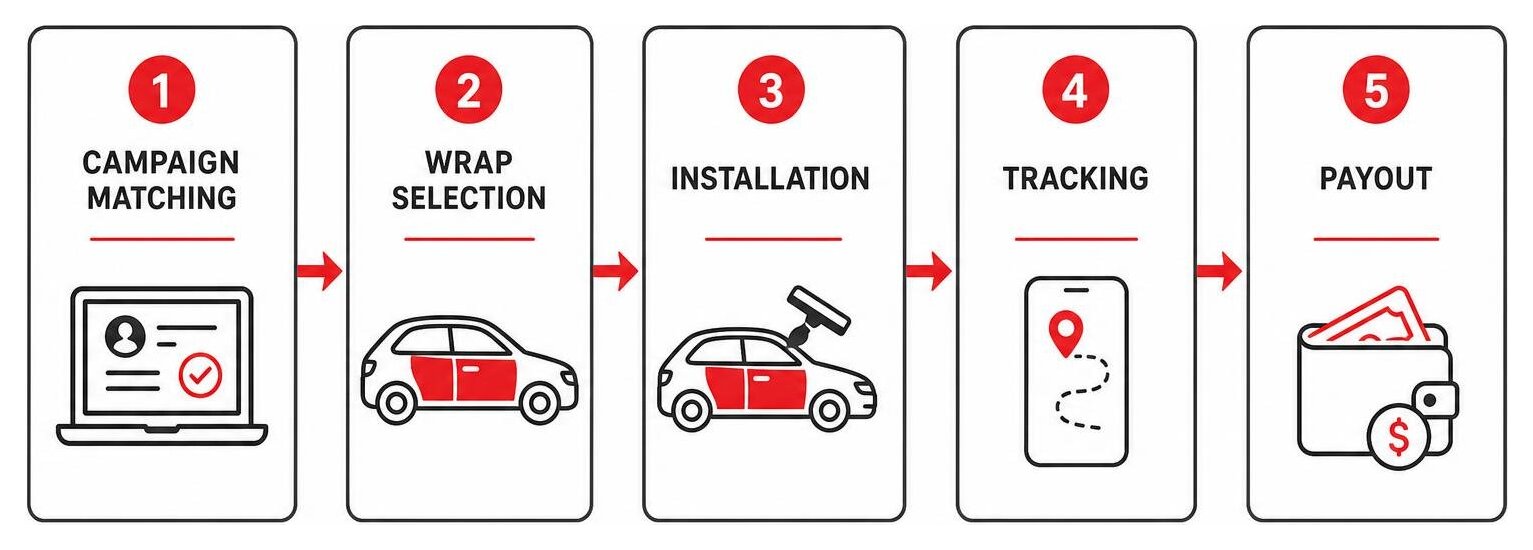
Getting your car wrapped and collecting passive income involves a standardized step-by-step onboarding sequence.
The Step-by-Step Onboarding Process
- Download the Driver App & Create Profile: Register on verified driver apps (e.g., Carvertise, Wrapify, or Firefly) and complete your background demographic details.
- Submit Verification Documents: Upload a valid driver’s license, current auto insurance proof, vehicle registration, and complete a digital W-9 form.
- Pass the Qualification Period: Keep background tracking turned on while completing your normal driving routine to establish your route patterns.
- Accept Campaign Matches: When an advertiser selects your route profile, review the campaign terms, payout rate, and duration, then accept the offer.
- Schedule Professional Wrapping: Take your vehicle to an authorized local wrap shop. Installation takes between 1 and 4 hours for static wraps, or under an hour for digital rooftop displays. Platforms like Carvertise even offer reimbursements up to $75 for rideshare rides or up to $150 for certified rental cars while your vehicle is in the shop.
- Submit Post-Installation Photos: Take four clean, daytime photos of the newly wrapped vehicle showing all sides and license plates, then upload them to the app to initialize monthly payouts.
Installation, Paint Safety, and Wrap Removal
A common concern among drivers looking to get paid to advertise on your car is paint damage. Legitimate car wrap companies exclusively use original equipment manufacturer (OEM) safe vinyl installed by certified professionals.
- Paint Safety: High-grade vinyl actually acts as a protective shield against minor road debris, ultraviolet rays, and light scratches.
- Car Wash Protocols: Vehicles with traditional vinyl wraps can safely pass through standard automated car washes. However, vehicles equipped with high-tech digital LED smart displays must strictly use touchless automated washes or gentle hand-washing to prevent water or brush damage to the digital components.
- Wrap Removal & Guarantees: Professional removal at the end of a campaign is 100% free. In the rare event of paint damage during removal, reputable companies offer repair coverage (for example, Carvertise provides up to $200 toward paint repairs).
Tax Responsibilities and Payment Schedules for Drivers
Earning income from vehicle wrap advertising carries specific tax obligations:
- Independent Contractor Status: Drivers are classified as 1099 independent contractors. If you earn $600 or more in a calendar year, the platform will issue a Form 1099-NEC for tax reporting.
- Payout Schedules: Payouts occur on fixed bi-weekly or monthly schedules (often on the 1st and 15th of each month).
- Payment Methods: Earnings are distributed via direct bank deposit or secure third-party digital wallet vaults like ONBE Payment Vault.
- Tax Deductions: As an independent contractor, you can track campaign-related driving expenses to offset taxable earnings.
How to Spot and Avoid Car Wrap Scams
Because the concept of getting paid simply to drive is highly appealing, internet scammers frequently impersonate well-known national retail brands to steal money from job seekers.
Red Flags of Fraudulent Vehicle Advertising Offers
To protect your finances, review these common warning signs associated with fake check wrap scams:
- Unrealistic Earnings Guarantees: Offers promising exorbitant payouts—such as $700 per week just for placing a small sticker on your car—are almost always scams. Legitimate base rates typically average $100 to $500 per month.
- Upfront Fees or Direct Check Payments: Legitimate car wrap platforms never charge application fees, sign-up fees, or decal printing fees.
- The Fake Check Specialist Scam: In a classic fake check scheme, scammers mail you a cashier’s check for $2,000 to $3,000. They instruct you to deposit the check, keep $500 as your “first week’s pay,” and wire the remaining funds via Zelle, Venmo, or wire transfer to a fake “decal installation specialist.” Days later, the deposited check bounces, leaving you personally liable to your bank for thousands of dollars.
- Communication via Unverified Channels: Be suspicious of offers arriving via unsolicited texts, Telegram, or third-party blogs rather than official mobile apps or verified corporate domains.
Learn more about maintaining brand integrity and ethical advertising guidelines by reading Stay Clean, Stay Green: Your Guide to Ethical Legal Ads.
Frequently Asked Questions About Car Advertising
Can car wrap advertising damage my vehicle’s original paint?
No, as long as your vehicle features undamaged, factory-applied paint. Certified wrap companies use OEM-grade vinyl designed specifically for automotive applications. When professionally installed and removed, the wrap will not damage your factory coat and actually protects the underlying paint from minor chips and UV damage. However, if your vehicle was repainted within the past 9 months or has pre-existing peeling paint, wrapping is not recommended.
How much can you realistically get paid to advertise on your car each month?
Realistically, drivers earn between $100 and $800 per month in direct cash compensation, depending on the format and platform. Decal programs offer $50 to $500 monthly (often in gift card value), digital cartop displays average $200 to $300 monthly, and full vehicle wraps in high-density markets yield between $300 and $800 monthly. Exceptional campaign earnings including referral bonuses can reach up to $1,500 over a full campaign lifecycle.
Are there any upfront costs or fees to start advertising on your car?
No. Legitimate car advertising companies never charge drivers application, registration, shipping, or installation fees. The advertiser covers all material, professional installation, and end-of-campaign removal costs 100%. If any company asks you to pay money upfront or send funds to an installer yourself, it is a scam.
Turn Your Commute Into Cash with Proven Marketing Strategies
Monetizing your daily drive through vehicle wrap advertising demonstrates the immense power of high-impact, physical advertising routes. Just as moving billboards capture high-volume real-world attention on crowded roadways, strategic digital campaigns capture high-intent digital traffic across competitive online channels.
At Triple Digital, we help businesses dominate their local markets with data-driven, results-oriented marketing campaigns that eliminate unnecessary fluff and focus entirely on generating measurable leads and qualified cases. Whether you want to scale your brand presence across Texas or dominate online search results, choosing the right partner makes all the difference.
If you are ready to expand your reach and maximize your marketing return on investment, discover how to select the ideal strategy in our comprehensive guide, Don’t Just Advertise, Dominate: Picking Your Perfect Legal Marketing Partner. You can also visit our local team directly through Triple Digital to start driving real business growth today.