




Is Your Employment Discrimination Marketing Attracting the Right High-Value Clients?
The Anatomy of High-Value Workplace Bias Claims in 2026
Law firms can attract high-value employment discrimination clients by targeting complex, high-damage scenarios—such as systemic pay disparities, executive retaliation, and algorithmic screening bias—through intent-driven search content and automated intake filtering. This approach separates actionable, high-damage claims from routine workplace grievances before they consume attorney time.
Workplace discrimination litigation continues to shift rapidly as corporate structures evolve and automated systems influence personnel decisions. While individual workplace disputes occur daily, high-value employment claims typically involve systemic bias, executive-level disparities, or substantial economic losses. For law firms, distinguishing between routine grievances and actionable, high-damage claims begins with understanding the empirical realities of workplace inequality.
Decades of labor market research illustrate how deeply ingrained workplace bias remains. Landmark audit and correspondence studies show that identical résumés featuring white-sounding names receive 50% more callbacks than those with Black-sounding names—an advantage mathematically equivalent to roughly eight additional years of work experience. Furthermore, higher-quality résumés increase callback rates by 30% for white candidates while providing virtually no statistically significant boost for minority candidates. In low-wage labor markets, matched field experiments reveal that Black applicants with clean criminal histories fare no better than white applicants recently released from prison.
Despite these clear disparities, research indicates that roughly 80% of workers who encounter discriminatory practices never take formal legal steps to enforce their rights. This massive reporting gap represents an opportunity for firms that master attorney-client targeting through strategic, educational outreach.
High-damage claims typically emerge from corporate reorganizations, retaliatory terminations following protected whistleblowing, major executive compensation discrepancies, or automated screening mechanisms that create disparate impacts across entire employee classes. By focusing acquisition strategies on these specific patterns, law firms can better allocate internal intake resources.
| Low-Value Single-Incident Grievances | High-Damage Systemic Discrimination Claims |
|---|---|
| Isolated interpersonal conflict with limited documentation | Documented pattern of shifting performance standards across a protected class |
| No measurable economic loss or denied promotion | Substantial lost wages, equity forfeiture, or executive severance disputes |
| Employer below Title VII or state statutory thresholds | Corporate or enterprise-level employer with institutional liability exposure |
| Claim filed outside EEOC or state filing windows | Timely administrative charge with preserved statutory rights |
| Limited written evidence or witness support | Internal communications, performance reviews, and corroborating witness statements |
How to Build a Modern Employment Discrimination Marketing Engine
Building a reliable client acquisition framework requires balancing informative digital education with refined lead qualification. A successful digital marketing engine does not merely drive clicks; it filters prospects early in the discovery phase, setting clear expectations regarding statutory timelines and administrative prerequisites under Title VII of the Civil Rights Act of 1964 and state-level protections.
A comprehensive acquisition engine integrates three foundational components:
- High-intent organic search content addressing complex employment scenarios
- Strictly compliant paid advertising campaigns targeting active search queries
- Structured intake screening systems designed to identify viable claims quickly
Executing this framework successfully requires implementing effective legal marketing lead generation across all digital touchpoints to capture prospects at their exact moment of need.
Structuring High-Converting Employment Discrimination Marketing Funnels
An effective intake funnel guides prospective clients from initial problem identification to a private, confidential case review. The funnel must address key procedural requirements, such as Equal Employment Opportunity Commission (EEOC) charge filing deadlines, while maintaining complete privacy for employees still navigating active workplace environments.
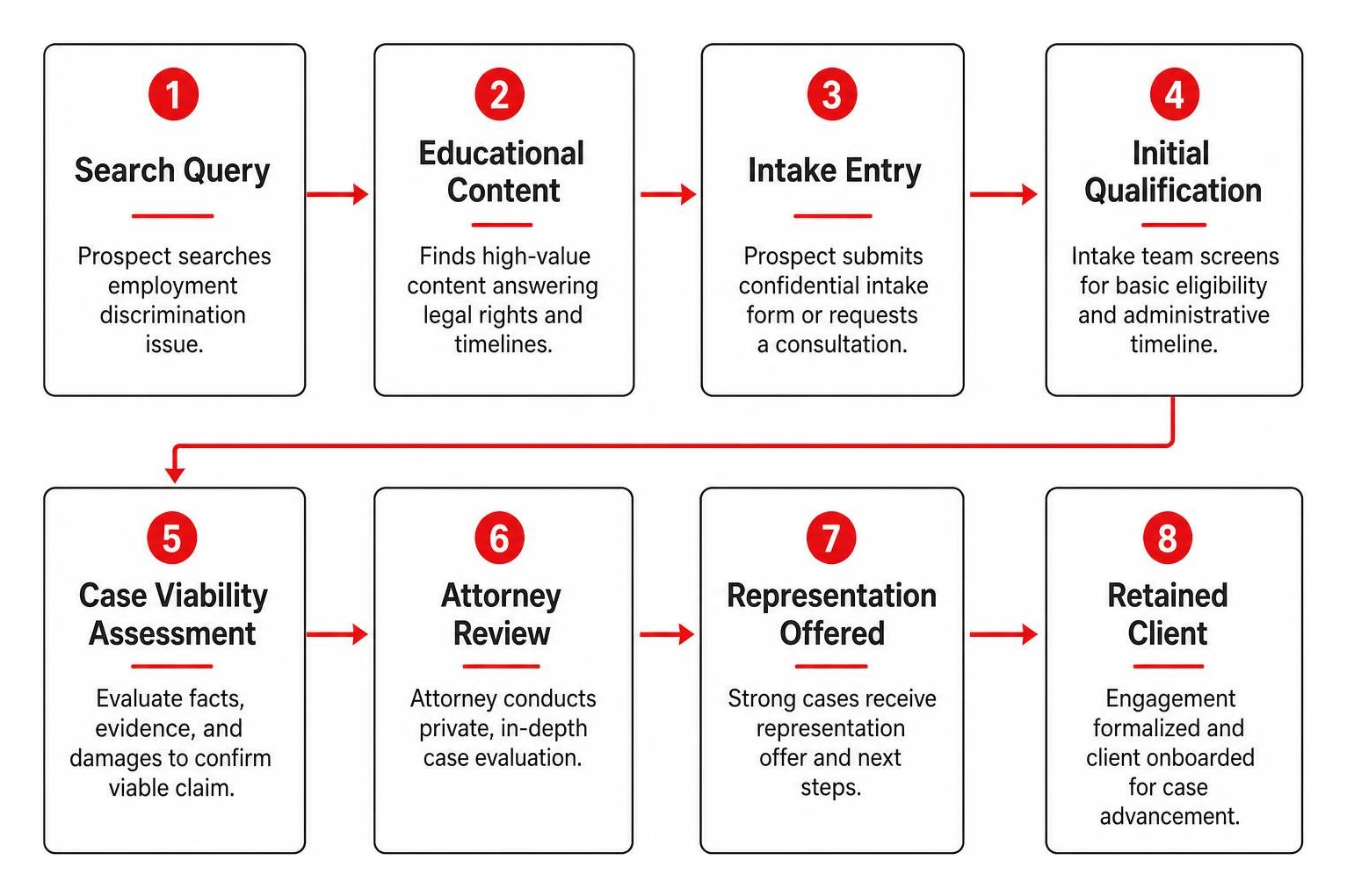
Educational resources are critical at top-of-funnel stages. By providing clear guidance on topics like severance negotiation, corporate dispute timelines, and workplace rights documentation, firms establish necessary trust. Investing in professional content creation for attorneys allows your practice to answer nuanced questions regarding statutory protections without providing generic or unhelpful advice.
Leveraging Paid Search and Social While Maintaining Ad Compliance
Running paid campaigns for employment law requires navigating stringent platform policies and civil rights statutes. Federal and state regulations prohibit discriminatory targeting in employment, housing, and credit advertisements. While law firms are marketing legal services rather than employment opportunities, ad platforms frequently restrict audience parameters to prevent bias.
Effective campaigns focus on user intent rather than demographic microtargeting. Bidding on high-intent search queries ensures ads reach individuals actively researching workplace disputes, severance disputes, or administrative remedies. Deploying structured paid advertising ensures that campaigns remain fully compliant with platform terms while generating relevant inquiries.
Beyond search campaigns, firms should consider privacy-conscious remarketing sequences that deliver educational content to users who have already engaged with intake resources. These sequences reinforce authority without relying on protected-class targeting parameters. Similarly, social media campaigns can highlight firm resources on executive severance evaluation, internal complaint documentation, and statutory filing windows—topics that naturally attract professionals evaluating high-stakes employment transitions.
Pinpointing High-Damage Claims Through Data-Driven Intake and SEO
Maximizing organic search performance requires identifying the exact language prospective clients use when experiencing complex workplace issues. Individuals facing systemic bias or executive displacement rarely search for broad legal terms; they search for information regarding specific scenarios, such as compensation disparities, algorithmic hiring bias, restructuring practices, or post-complaint retaliation.

At Triple Digital, our team utilizes data-driven research to help firms capture high-value search queries. Implementing modern law firm SEO positions your firm directly in front of professionals navigating enterprise-level disputes. Additionally, firms handling corporate-scale matters can leverage employment-based immigration marketing to broaden their overarching employment practice.
Scaling Organic Reach for Systemic and Retaliation Claims
Scaling organic reach involves developing structured topic clusters centered around actionable workplace scenarios. Rather than relying on generic service pages, law firms should create content analyzing:
- Documented patterns of shifting standards during performance evaluations
- Retaliatory actions taken after internal human resources reports
- Disparate impact resulting from automated AI résumé screening software
- Executive severance package disputes and equity compensation forfeiture
- Age-based displacement during corporate restructuring or merger integration
- Class-wide compensation audits revealing protected-class pay disparities
Structuring content around these specific topics ensures high organic visibility for searches containing meaningful economic stakes and clear liability indicators. Long-tail queries such as “executive severance retaliation after HR complaint” or “algorithmic hiring bias disparate impact” signal users who are further along in the decision-making process and more likely to retain counsel.
Overcoming Intake Bottlenecks in Employment Discrimination Marketing
The primary challenge in employment discrimination client acquisition is managing lead volume without overwhelming intake staff. Because workplace grievances are widespread, an unoptimized marketing campaign can easily flood a practice with unqualified inquiries or claims that lack legal merit.
Automated intake solutions resolve this challenge by implementing pre-screening questionnaires before scheduling consultations. These questionnaires evaluate critical criteria including:
- Current employment status and date of adverse action (to ensure claims fall within statutory filing windows)
- Type and size of the employer (confirming Title VII or state threshold applicability)
- Documented economic losses, such as lost wages, stock vesting disruptions, or denied promotions
- Presence of written communications, performance reviews, or witness statements
- Prior internal complaints or EEOC charge history indicating protected activity
Automating these initial questions ensures attorneys spend their time evaluating prospective clients whose claims align with the firm’s caseload capacity. Damage tiering further refines this process by categorizing inquiries based on estimated economic exposure, allowing intake teams to prioritize executive-level and systemic claims while routing lower-value matters to appropriate referral networks.
Frequently Asked Questions About Employment Discrimination Legal Marketing
What types of employment discrimination cases yield the highest return on marketing investment?
Executive pay equity claims, systemic pattern-and-practice disputes, and whistleblower retaliation matters involving substantial wage and equity losses generally offer the highest value. These claims feature clear financial documentation, higher potential back-pay and front-pay damages, and institutional liability that supports favorable resolution terms. Class action discovery in pattern-and-practice cases can also uncover broad organizational liability, multiplying case value across affected employee groups.
How do law firms ethically target executives and professionals facing workplace bias?
Firms reach executive and professional audiences by focusing on content marketing related to severance agreements, executive employment contracts, bonus clawbacks, and non-disclosure provisions. Prioritizing search engine optimization for business-focused queries and ensuring complete digital confidentiality encourages high-earning professionals to reach out discretely. Privacy-first intake mechanisms, such as encrypted contact forms and direct attorney review before staff screening, further support discrete engagement from senior professionals.
Why do most employment discrimination ad campaigns generate low-value leads?
Most campaigns underperform because they rely on broad match keywords (such as “bad boss” or generic “workplace unfairness”) and provide unsegmented intake forms. Without clear qualification criteria and targeted ad messaging, campaigns attract individuals with general workplace frustrations rather than actionable statutory violations backed by economic damages. Unsegmented ad copy that fails to distinguish between routine grievances and high-damage scenarios compounds the problem by setting unclear expectations before the first consultation.
Transforming Your Employment Law Client Acquisition
Successfully growing an employment law practice requires a strategic marketing framework that separates routine workplace disputes from high-damage claims. By building educational content, adhering to strict advertising compliance, and implementing data-driven intake screening, your firm can attract and retain clients with substantial, viable claims.

Triple Digital works with law firms to build focused, high-performing acquisition engines that eliminate wasted spend and improve intake quality. To discover how our team can help scale your practice, explore our comprehensive digital marketing strategies today.