




7 Actionable Steps for Smarter Sales Funnel Optimisation
How to Improve Sales Funnel Conversion
Start by finding where qualified prospects stop moving forward. Track how many people reach each stage, how many take the next step, and how long that step takes. Then fix the biggest source of friction: a hard-to-use form, slow follow-up, unclear pricing, or a proposal that leaves questions unanswered.
For law firms, sales funnel optimisation is not just about getting more enquiries. It is about helping the right people move from research to consultation to signed client. Many prospects will compare their options before they call. Clear service pages, answers to common questions, and a simple booking path can help them act when they are ready.
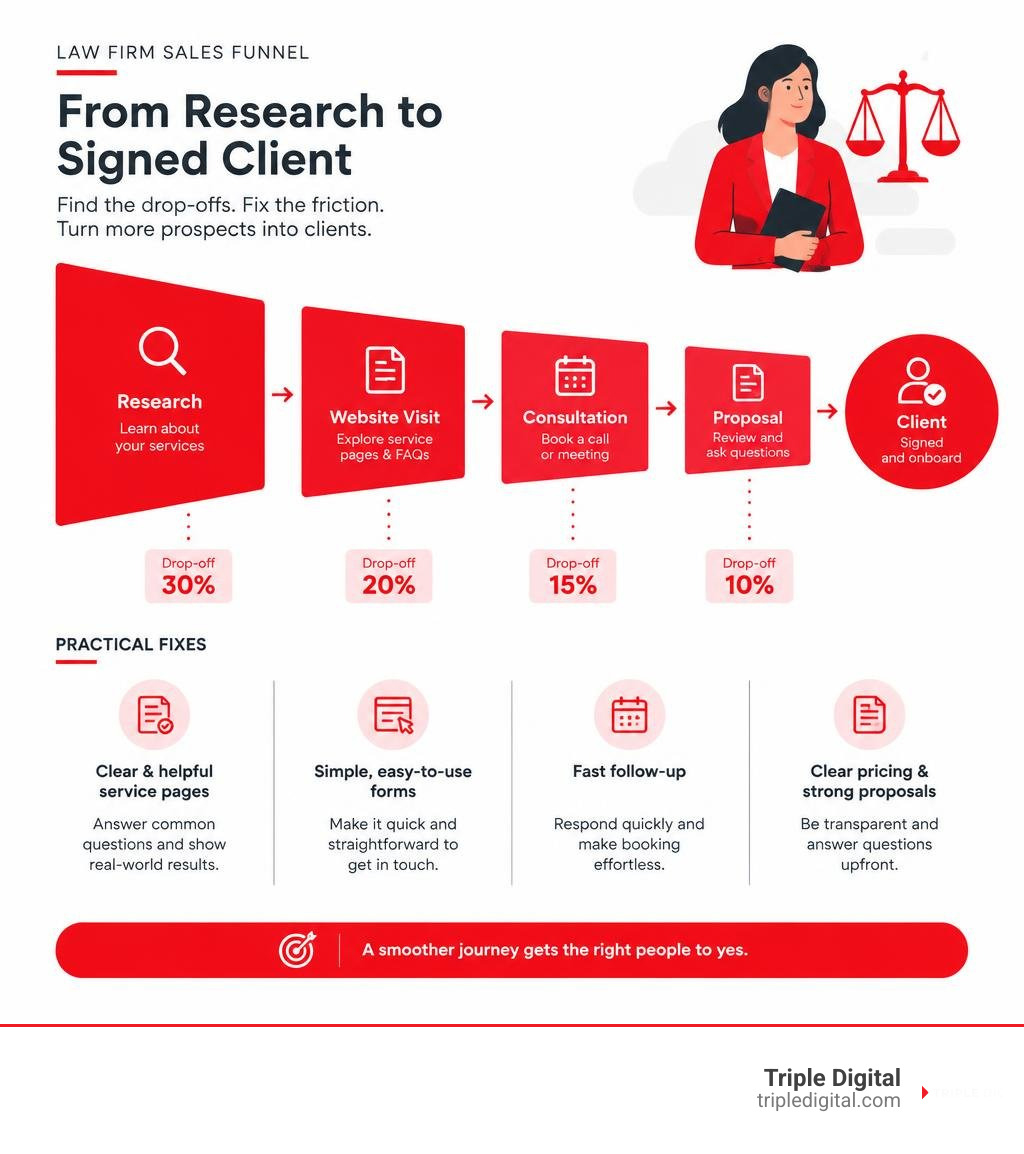
Sales funnel optimisation terms you need:
The Strategic Value of Sales Funnel Optimisation in 2026
In 2026, revenue generation is an engineering discipline, not a guessing game. When pipeline slows down, many businesses instinctively dump more budget into top-of-funnel ads. Yet pouring fresh water into a leaky bucket merely drives up customer acquisition costs while burning out your team.
Industry benchmarks reveal that the average B2B funnel converts roughly 2.3% to 2.9% of website visitors into leads. When you look deeper into the funnel, a staggering 86% of purchases stall during the buying evaluation. Rather than endlessly inflating lead volume, optimizing the progression between each stage unlocks compounding revenue gains.
Improving individual stage conversion rates by just a few percentage points delivers a multiplicative lift across the entire lifecycle. When you double your mid-funnel conversion efficiency, you effectively double your downstream client acquisition without spending an extra dollar on traffic. Systemic funnel architecture lowers acquisition costs, shortens sales cycles, and establishes revenue predictability.
Sales Funnel Optimisation vs. Isolated Conversion Tactics
It is easy to confuse full sales funnel optimization with isolated conversion tactics. Standalone conversion rate optimization (CRO) often zeroes in on a single user action—such as testing a call-to-action button color or tweaking a headline on an intake page. While valuable, these localized tactics cannot fix structural pipeline failures if unqualified leads are passed to intake staff or proposals fail to address key client decision criteria.
Our guide to conversion optimization demonstrates how holistic optimization orchestrates the entire journey from initial awareness through retained client.
| Dimension | Standalone Conversion Strategy | Holistic Sales Funnel Optimisation |
|---|---|---|
| Primary Scope | Point-in-time actions (forms, button clicks, single landing pages) | End-to-end customer journey from discovery to retention |
| Core Objective | Maximizing immediate conversion percentage on a page | Maximizing total pipeline velocity, revenue yield, and client value |
| Team Involvement | Marketing specialists or web designers in isolation | Unified alignment between marketing, intake, sales, and operations |
| Data Focus | Page-level metrics (bounce rates, click-through rates) | Lifecycle metrics (stage transition rates, pipeline velocity, cost per acquisition) |
| Friction Resolution | Cosmetic interface and user experience tweaks | Removing decision blockers, qualifying fit, and addressing evaluation risk |
Navigating AI-Mediated Buyer Journeys and Self-Serve Demands
Buyer behavior has undergone a profound shift. Today, 75% of B2B buyers prefer a rep-free, self-serve evaluation experience, and 61% prefer self-educating entirely before engaging directly with a firm or vendor. Buyers complete around 70% of their evaluation process before ever submitting an inquiry.
Furthermore, over 72% of buyers utilize AI overviews during preliminary research, with 90% clicking through to verify sources directly. In this landscape, gated PDFs and aggressive initial sales pitches create immediate abandonment. To capture high-value opportunities, businesses must provide transparent, high-authority information upfront. Implementing tactics to optimize for conversions and lower acquisition costs ensures your firm satisfies self-directed research while establishing direct trust early.
Diagnosing Leaks: How to Pinpoint Pipeline Bottlenecks
You cannot optimize what you do not accurately measure. Effective diagnosis requires treating your sales funnel as a series of measurable state transitions rather than a single linear stream.
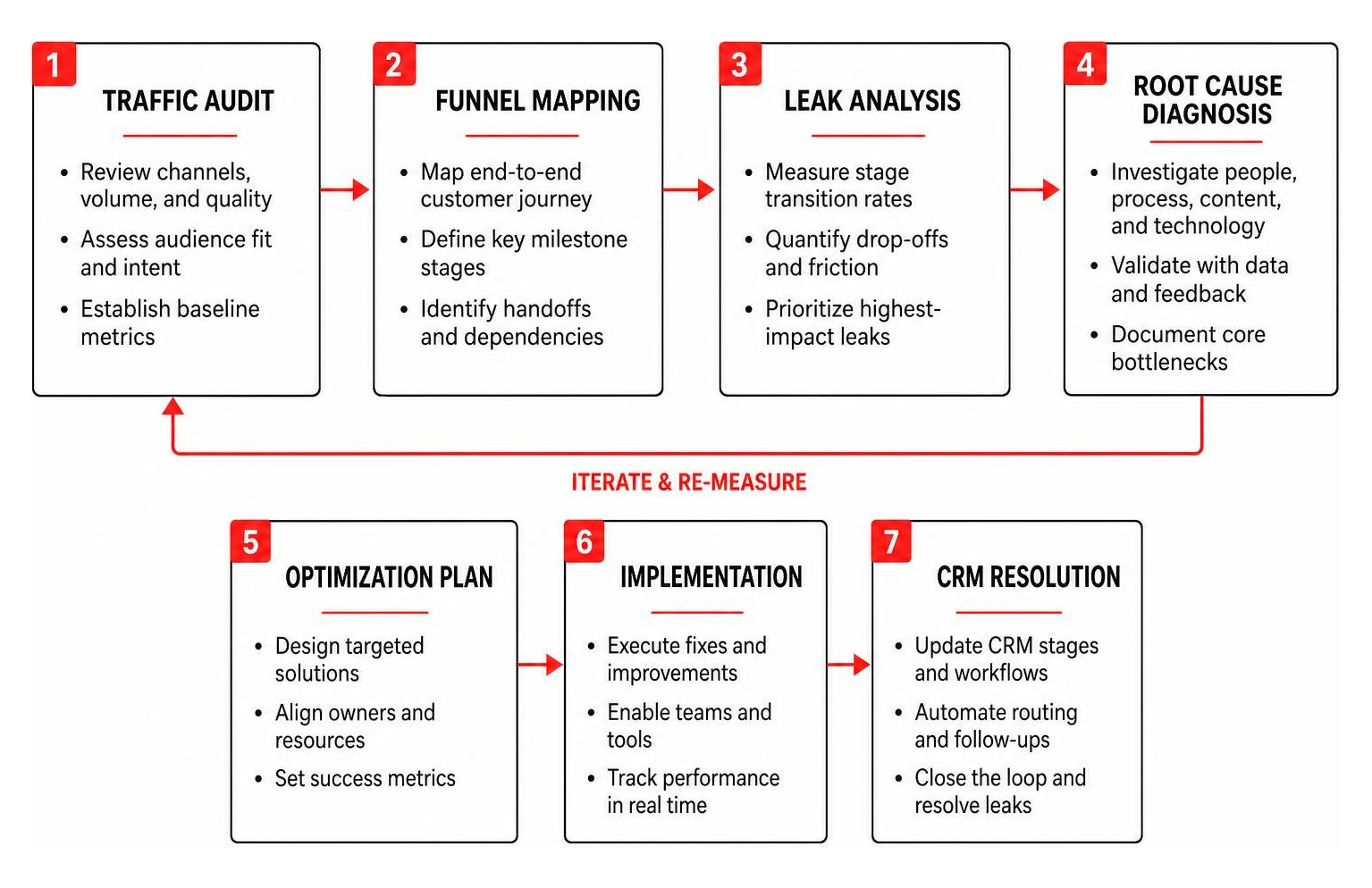
Auditing Stage Transitions and Drop-Off Points
Diagnosing bottlenecks begins with a rigorous audit of transition rates across key milestone stages:
- Visitor to Lead: Website engagement transitioning into an initial consultation or intake request.
- Lead to Marketing Qualified Lead (MQL): Validation that the prospect fits your ideal client profile (ICP).
- MQL to Sales Qualified Lead (SQL): Intake review confirming matter fit, budget, and actionable urgency.
- SQL to Opportunity/Consultation: The prospect attends the initial consultation or discovery session.
- Opportunity to Signed Agreement: The client signs the engagement agreement and pays the retainer.
Across standard B2B motions, the median MQL-to-SQL conversion sits near 13%, while top-quartile performers achieve 28%. When discovery sessions are executed with precision, SQL-to-opportunity conversions average 30% to 35%, reaching up to 50% for high-performing practices.
If your drop-off happens between inquiry and the initial consultation, your intake response time or booking process is likely broken. If drop-offs spike after proposals are delivered, your team is failing to establish an internal champion or clearly articulate the risk of inaction. You can stop leaking leads with a better B2B marketing funnel by isolating your primary constraint before applying targeted operational fixes.
The Data Layer: Enrichment, CRM Hygiene, and Intent Signals
Pipeline diagnosis breaks down when underlying data is inaccurate. CRM databases naturally decay by roughly 30% each year due to job changes, outdated contact details, and incomplete field entries.
At Triple Digital, our Houston team relies on clean data architecture and active pipeline intelligence to drive real business results. Maintaining reliable data hygiene requires strict protocols:
- Automated Enrichment: Implement automated tools to append firmographic, industry, and demographic data upon initial submission.
- Strict Deduplication: Consolidate records across form fills, live chats, and phone inquiries to eliminate fragmented communication.
- Lifecycle Timestamps: Record exact timestamps for every stage transition to accurately measure sales velocity and SLA compliance.
- Intent Signal Monitoring: Track high-intent digital behaviors, such as repeated visits to detailed pricing or service structure pages, to trigger timely outreach.
Reviewing our better B2B lead generation funnel guide will help your team implement progressive profiling that gathers crucial client context without adding unnecessary form friction.
Seven Actionable Steps for Smarter Sales Funnel Optimisation
A stronger funnel does not come from one isolated conversion tactic. It comes from improving the journey in a deliberate order, from attracting the right prospects to helping qualified buyers make a confident decision.
Step 1: Define the Prospects You Can Best Serve
Start with clear qualification criteria. Identify the matter types, business characteristics, urgency signals, and decision-makers that indicate a strong fit. This keeps marketing and intake teams focused on enquiries your firm is positioned to convert.
Step 2: Attract High-Intent Traffic
Build service pages, educational content, and paid campaigns around the problems prospective clients are actively researching. Relevant traffic matters more than raw visitor volume because misaligned visits consume intake time without creating viable opportunities.
Step 3: Make the First Conversion Easy
Every landing page should give visitors a clear next action, such as requesting a consultation or completing an intake form. Use direct value propositions, credible proof, and short forms that ask only for the information needed to begin a useful conversation.
Step 4: Qualify and Route Enquiries Quickly
Introduce practical qualification questions early, then route high-intent enquiries to the right team member with the relevant context. Fast, informed follow-up reduces the chance that a prospect will continue comparing alternatives while waiting for a response.
Step 5: Support Evaluation With Self-Serve Resources
Prospects often need to build confidence before they speak with a firm. Provide helpful resources, including process overviews, case examples, comparison guides, and answers to common concerns, so they can understand the value of taking the next step.
Step 6: Address Decision Barriers During Consultation and Proposal Review
When a prospect reaches the consultation or proposal stage, uncover the concerns that may delay action. Clarify scope, timing, responsibilities, likely outcomes, and the consequences of waiting. Give internal champions concise materials they can use to explain the decision to other stakeholders.
Step 7: Review Funnel Data and Improve the Biggest Bottleneck
Track stage-to-stage movement, response time, consultation attendance, proposal acceptance, and time to signed agreement. Review the largest drop-off first, test one focused improvement to increase conversion rates, and measure its effect before moving to the next constraint.
Following these seven stages gives firms a practical way to turn scattered marketing and intake activity into a more consistent client-acquisition process. For related conversion guidance, explore our landing page optimization tips to turn clicks into customers and conversion optimization guide.
Aligning Revenue Teams and Data Systems for Long-Term Lift
A well-architected funnel requires seamless operational handoffs between marketing, intake, and executive teams. When internal incentives and communication channels are misaligned, deals inevitably fall through the cracks.
Sales-Marketing SLAs and Joint Pipeline Governance
Studies show that organizations with tightly aligned marketing and sales operations achieve 38% higher sales win rates, grow 19% faster, and maintain 15% higher profitability. Yet 23% of revenue leaders still identify sales-marketing misalignment as their top operational blocker.
Achieving lasting alignment requires establishing formal Service Level Agreements (SLAs):
- Standardized Qualification Definitions: Establish clear, shared definitions for what constitutes an MQL, SQL, and qualified opportunity across all teams.
- Strict Response-Time Protocols: Research demonstrates that responding to qualified inbound inquiries within 5 to 15 minutes dramatically improves connection and booking rates compared to delayed outreach.
- Automated Lead Routing: Ensure high-intent submissions are routed directly to the appropriate team member with complete contextual notes.
- Weekly Joint Pipeline Reviews: Host structured weekly pipeline audits where revenue and marketing teams review conversion drop-offs, assess lead quality, and refine targeting criteria collaboratively.
Connecting these systems creates a unified path that guides prospects smoothly from clicks to clients across every touchpoint.
Key Metrics for Measuring Sales Funnel Optimisation Success
To ensure sustainable growth, RevOps teams must move beyond vanity metrics and monitor key operational indicators:
- Stage Conversion Rate: The percentage of prospects advancing from each specific milestone to the next.
- Pipeline Velocity: A comprehensive measure of how rapidly opportunities move through your funnel to generate revenue. Pipeline velocity equals the number of qualified opportunities multiplied by the win rate and average deal value, divided by the average sales cycle length in days.
- Sales Cycle Length: The average calendar days required to guide a lead from initial capture to a signed agreement.
- Opportunity Win Rate: The percentage of qualified consultations or proposals that convert into retained clients.
- Customer Acquisition Cost (CAC): Total sales and marketing expenditures divided by the total number of newly acquired clients over a set timeframe.
Partnering with an experienced conversion rate optimization agency can help your team establish robust tracking dashboards and uncover hidden opportunities throughout your client journey.
Frequently Asked Questions About Funnel Optimization
What is the primary difference between a sales funnel and a sales pipeline?
A sales funnel represents the customer-centric buying journey, measuring the volume of prospects and their conversion efficiency between awareness, evaluation, and decision stages. In contrast, a sales pipeline reflects the internal, seller-centric process, tracking active deals, individual deal stages, and operational milestones managed by your team.
Why do most B2B deals stall after the proposal stage?
Proposals typically stall because they fail to engage all key stakeholders or lack a clear internal champion equipped to drive consensus. Additionally, proposals that provide too many complex options or fail to quantify the immediate cost of inaction introduce decision fatigue, leading prospects to defer their choice indefinitely.
How often should revenue teams conduct a full funnel audit?
Revenue teams should review high-level conversion rates and lead response times on a weekly basis, conduct deep-dive CRM data hygiene audits quarterly, and perform a comprehensive review of lifecycle stage definitions and self-serve content assets every six to twelve months.
Transform Your Funnel into a Predictable Revenue Engine
Optimizing your sales funnel is not a one-time initiative—it is an ongoing operational commitment. By systematically identifying pipeline bottlenecks, providing valuable self-serve evaluation assets, and uniting your revenue teams around clear SLAs, you replace unpredictable deal flow with dependable revenue growth.
At Triple Digital, our Houston-based team cuts through marketing noise with a focused “less fluff, more cases” approach. Using data intelligence and modern conversion engineering, we help professional practices build efficient, high-converting client acquisition engines. When you are ready to identify hidden pipeline leaks and accelerate your client acquisition, schedule a meeting with our growth strategists to audit your sales funnel.