





GEO, AEO and SEO for Lawyers: The Verdict on Ranking Higher
Why SEO for Lawyers Is the Engine of Modern Law Firms
SEO for lawyers is the process of optimizing your law firm’s website and online presence so potential clients find you on Google — before they find your competitors.
Here’s what law firm SEO covers at a glance:
| Component | What It Does |
|---|---|
| Keyword research | Targets searches your ideal clients actually use |
| On-page optimization | Makes each page clear and relevant to search engines |
| Local SEO | Gets your firm into Google’s Map Pack for location-based searches |
| Content strategy | Builds trust and answers client questions before first contact |
| Technical SEO | Ensures your site loads fast, works on mobile, and gets indexed |
| Authority building | Earns backlinks and credibility signals Google rewards |
| E-E-A-T signals | Proves your attorneys have real expertise and are trustworthy |
Think about how your clients find you today. Referrals? Print ads? Cold outreach?
Now consider this: 96% of people seeking legal help turn to a search engine first. They’re not asking friends. They’re not flipping through directories. They’re typing “divorce lawyer near me” or “personal injury attorney in [city]” — and hiring from the first page of results.
If your firm isn’t there, someone else gets the case.
Traditional marketing methods — billboards, Yellow Pages, TV spots — are losing ground fast. The firms growing their client base in 2026 are the ones treating their website as a lead generation engine, not just a digital business card.
That’s exactly what a smart SEO strategy does. It puts your firm in front of high-intent prospects at the exact moment they need legal help — and guides them from first search to first call.
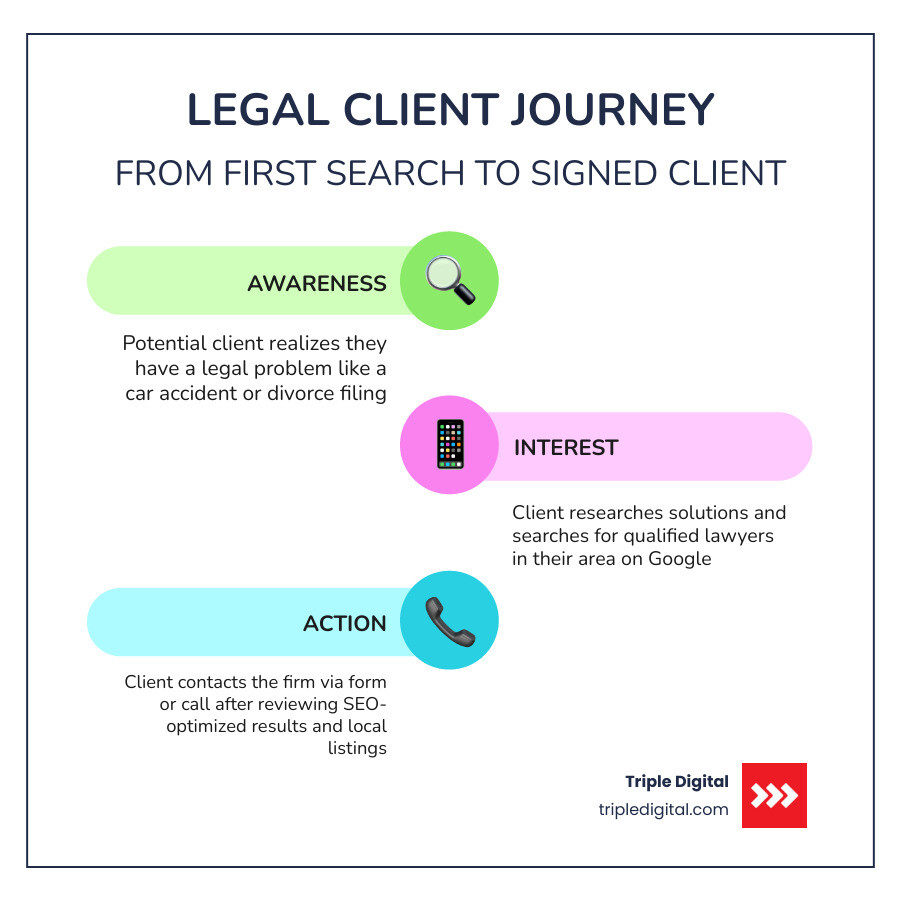
The AIDA Model: How SEO Functions as a Lead Generation Engine
In the legal world, we often think of marketing as a simple “call me” button. But the reality of seo for lawyers is much more sophisticated. We use the AIDA model to capture prospects at every stage of their journey:
- Awareness: A potential client realizes they have a legal problem (e.g., “What to do after a car accident?”).
- Interest: They start looking for solutions and information (e.g., “Texas car accident laws”).
- Desire: They decide they need professional help and look for the best firm (e.g., “Best personal injury lawyer in Houston”).
- Action: They take the final step to contact you.
By creating content for each stage, you aren’t just selling; you’re educating. This builds massive trust before the first consultation even happens. For a deeper dive into this, check out Why SEO Is Important for Attorneys.
SEO vs. PPC: The Battle for ROI
Many firms ask us if they should just stick to Google Ads (PPC). While PPC is great for immediate visibility, it’s also expensive. In 2026, personal injury keywords can cost upwards of $200–$700 per click. Once you stop paying, the leads stop flowing.
SEO, on the other hand, is a long-term investment. Research shows that SEO leads often cost $50–$100 compared to the $150–$400 cost per lead of PPC. Over 24 months, firms using a dedicated SEO strategy see 40% lower client acquisition costs. It’s the difference between renting space on page one and owning it. You can see more about this in our guide on Reasons to Use Law Firm SEO.
The 5 Pillars of a High-Performance Legal SEO Strategy
Effective seo for lawyers isn’t about “tricking” Google. It’s about providing the best possible answer to a user’s problem. To do that, we focus on five core pillars that ensure your firm stays at the top of the search results.
- Technical SEO: This is the foundation. If your site is slow or doesn’t work on a phone, 88% of people will leave and never come back. We ensure your “Core Web Vitals” (Google’s speed and stability metrics) are perfect.
- On-Page Optimization: This involves structuring your pages so Google knows exactly what you do. It includes optimizing title tags, headers (H1s, H2s), and internal linking.
- Local Search: If you practice in Houston, you need to show up for people in Houston. This is the “Map Pack” strategy.
- Authority Building: Google wants to see that other reputable sites trust you. We do this through high-quality backlinks from legal directories and bar associations.
- Conversion Optimization: Traffic is great, but signed cases are better. We optimize your site’s layout and call-to-actions (CTAs) to turn visitors into clients.
If you’re curious about which of these moves the needle most, read Law Firm SEO: What Are the Most Important SEO Ranking Factors?.
Local seo for lawyers: Dominating the Google Map Pack
For most firms, local clients are the lifeblood of the practice. 85% of people use online maps to find legal services in their area. If you aren’t in the “Local 3-Pack” (the three firms listed under the map), you’re missing out on 42% of all clicks.
To dominate local search, you need:
- An Optimized Google Business Profile (GBP): This means having a verified address, accurate business hours, and—most importantly—high-quality photos and videos.
- NAP Consistency: Your Name, Address, and Phone number must be identical across the entire web. If one directory says “Suite 100” and another says “Ste 100,” Google gets confused and may lower your ranking.
- Reviews: Reviews are a primary ranking factor. Google looks at the number of reviews, the star rating, and how recently they were posted. Pro tip: Always respond to your reviews—both good and bad—to show Google you are active and engaged.
For a step-by-step roadmap, see Stop Wasting Money: The Ultimate Guide to Local SEO for Your Law Firm and Get Found Locally: A Lawyer’s Guide to Local SEO Success.
Content Strategy: High-Intent Keywords for seo for lawyers
In 2026, “commodity content” is dead. Google’s AI can spot thin, generic legal articles from a mile away. To rank, your content must provide “Information Gain”—meaning it offers unique insights that aren’t found on every other site.
When we conduct keyword research, we don’t just look for search volume; we look for case value. A keyword like “what is a tort” might get thousands of hits, but it rarely leads to a client. However, “commercial truck accident lawyer in Houston” has high intent and high case value.
Types of content that work best for lawyers:
- Practice Area Pages: These should be deep (1,500–3,000 words) and cover everything from local court procedures to specific types of damages.
- Educational Blogs: Answer the “What happens next?” questions.
- FAQ Sections: Use schema markup to help these questions appear directly in Google’s search results.
For more on building a content plan that actually converts, check out Rank Higher, Get More Clients: Your SEO Playbook for Law Firms and our specialized SEO for Immigration Lawyers Guide.
Building Authority through E-E-A-T and Quality Backlinks
Google categorizes legal websites as “Your Money or Your Life” (YMYL). This means they hold law firms to the highest possible standards because bad legal advice can literally ruin a person’s life.
To satisfy Google, your site must demonstrate E-E-A-T:
- Experience: Show your real-world trial experience.
- Expertise: Display your credentials, bar admissions, and awards.
- Authoritativeness: Build a reputation as a go-to source in your field.
- Trustworthiness: Use secure (HTTPS) connections, clear privacy policies, and visible contact info.
One of the best ways to build this authority is through quality backlinks. A single link from a high-authority site like a state bar association or a major legal publication is worth more than 100 generic directory links. We focus on “Digital PR”—getting your attorneys cited in the news or published in legal journals. This builds a “moat” around your firm that competitors find very hard to cross.
Learn more about this in our article on Advanced SEO: Authoritative Content or see how it applies to specific niches in Family Law SEO: A Complete Guide for Divorce Attorneys.
Navigating AI Search: AEO and Generative Engine Optimization
The biggest shift in seo for lawyers in 2026 is the rise of AI-powered search. About 75% of legal queries now trigger an “AI Overview” at the top of the page. This has led to a rise in “zero-click” searches, where users get their answer without ever clicking a website.
Does this mean SEO is dead? Absolutely not. It just means the game has changed.
We now optimize for AEO (Answer Engine Optimization) and GEO (Generative Engine Optimization). The goal is to ensure that when an AI like Google Gemini or ChatGPT answers a legal question, it cites your firm as the source.
How to win in the AI era:
- Be the Authority: AI models are trained on authoritative data. If you have the most comprehensive guide on a topic, you’re the one they’ll cite.
- Use Structured Data: We use “Schema Markup” to tell search engines exactly what your content is (an FAQ, a review, or a legal service).
- Focus on Information Gain: AI is great at summarizing existing info, but it can’t provide new, first-hand insights. Your case studies and trial experiences are your “AI-proof” assets.
Stay ahead of the curve with our Top SEO Tips for Criminal Defense Lawyers in the AI Search Era.
Frequently Asked Questions about Law Firm SEO
How long does it take to see results from legal SEO?
SEO is a marathon, not a sprint. Most firms start seeing measurable traffic improvements within 3 to 6 months. However, significant lead generation and consistent page-one rankings typically take 8 to 12 months. The good news? Once that momentum builds, it’s much cheaper and more sustainable to maintain than paid ads.
What is the difference between law firm SEO and general SEO?
Law firm SEO is significantly more competitive and regulated. You have to deal with strict State Bar advertising rules (like avoiding “best” or “expert” claims in certain jurisdictions) and the “YMYL” scrutiny from Google. General SEO strategies often fail for lawyers because they don’t account for the high-intent, high-stakes nature of legal searches.
How much should a law firm spend on SEO per month?
In 2026, a professional SEO retainer for a solo or small firm in a mid-sized market typically ranges from $2,500 to $5,000 per month. For mid-sized firms or those in highly competitive markets (like personal injury in Houston), budgets often range from $8,000 to $15,000+. While this sounds like a lot, the ROI—often $5.20 for every $1 spent—makes it the most cost-effective way to grow a practice long-term.
Conclusion
The legal landscape in 2026 is digital-first. If your firm isn’t visible where your clients are looking, you’re essentially invisible.
At Triple Digital, we don’t believe in “fluff” or vanity metrics like clicks that don’t convert. Based in Houston, TX, we are a results-driven agency that specializes in lead generation and case acquisition for law firms. We leverage AI and advanced data mining to find your ideal clients and ensure your firm is the one they call.
Ready to turn your website into a lead-generating powerhouse? We can help you navigate the complexities of seo for lawyers and build a strategy that delivers real cases, not just “visibility.”
For more help choosing the right path, read Finding Your Digital Partner: A Guide to Attorney SEO Companies or start building your own plan with Mastering Law Firm SEO: Your Blueprint for Online Success.