 Skip to content
Why Paid Ads for Lawyers Are the Fastest Path to New Cases
Paid ads for lawyers are one of the fastest ways to put your firm in front of people who are actively searching for legal help right now.
Here’s a quick breakdown of how they work and what to expect:
- What they are: You pay to show your firm at the top of search results. You only pay when someone clicks (Google Search Ads) or contacts you (Local Services Ads).
- Where they appear: Above all organic results on Google — the most visible spots on the page.
- Who sees them: People with high intent, searching terms like “car accident lawyer near me” or “DUI attorney in Chicago.”
- What they cost: Anywhere from $5–$500+ per click depending on your practice area and location.
- What you get: Phone calls, form fills, and booked consultations — often within days of launching.
Over $2.5 million is spent on legal ads every single day in the US. That number isn’t an accident. It reflects a simple truth: the firms that show up at the top of search results get the cases. The ones that don’t, don’t.
The legal industry is one of the most competitive paid advertising spaces online. Keywords like “personal injury lawyer” can cost $150 or more per click. A single search result page might show three or four paid placements before a single organic result appears.
That’s the challenge — and the opportunity.
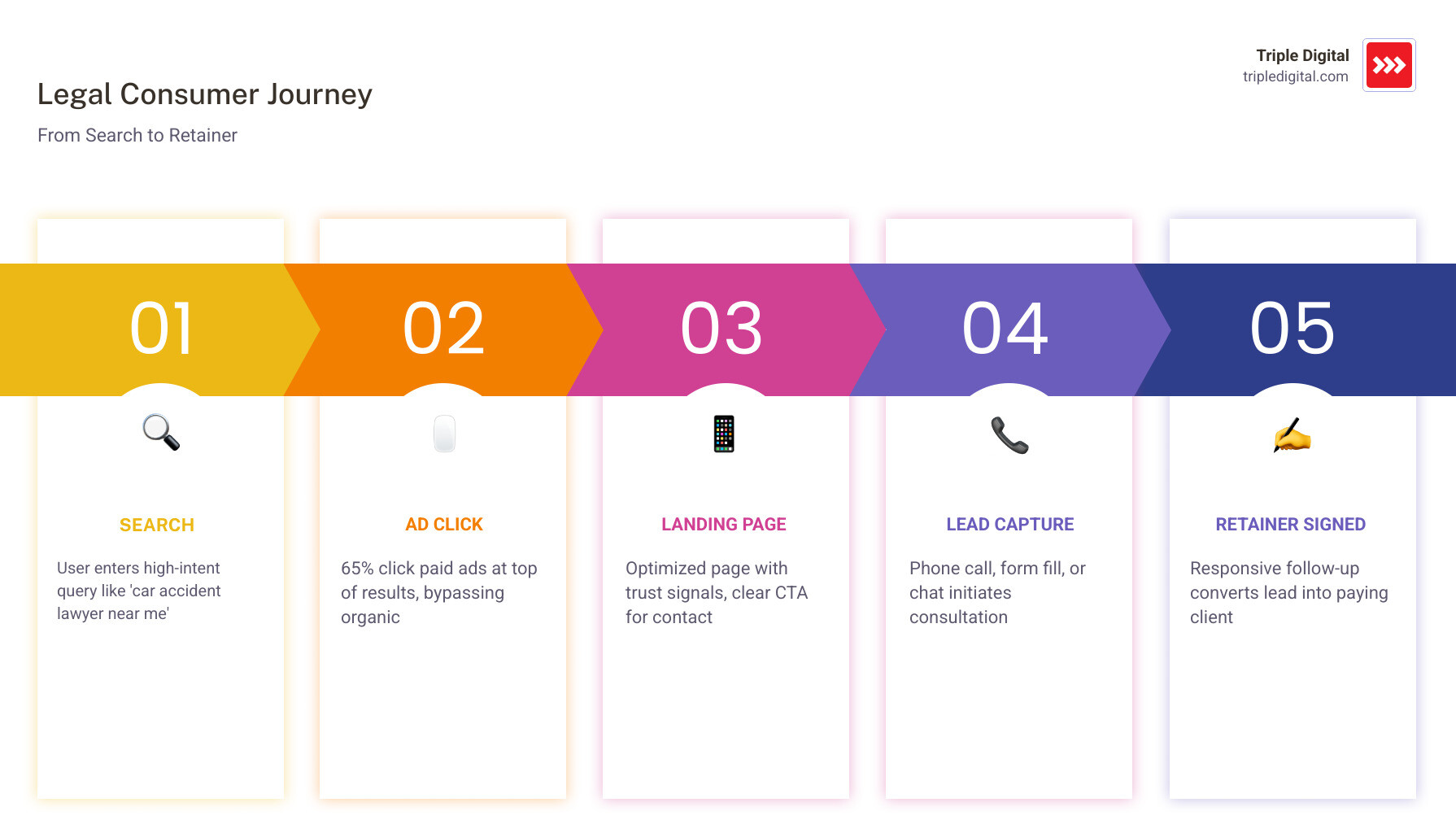
65% of high-intent legal searches result in a click on a paid ad. If your firm isn’t in those top spots, a competitor is. And they’re signing the cases that could have been yours.
This guide walks you through everything you need to run paid ad campaigns that actually generate cases — not just clicks.
Basic paid ads for lawyers terms:
The Core Ecosystem of Paid Ads for Lawyers
To dominate your local market, you need to understand that “paid ads” isn’t just one thing. It is an ecosystem of different platforms, each serving a specific purpose in the client’s journey. When someone needs a lawyer, they usually start with Google, but they might also be influenced by what they see on social media or YouTube.
In the legal world, the most prominent players are Google Search Ads and Local Services Ads (LSAs). These appear at the very top of the Search Engine Results Page (SERP). Below them, you might find the “Map Pack,” and below that, the organic results. Because 70% of daily legal ad spend goes to the top three positions, being in that upper “sponsored” section is non-negotiable for growth.
Beyond search, we also look at:
- YouTube Ads: Great for building brand authority through video testimonials or educational content.
- Display Network: These are the banner ads that follow users around the web (retargeting), keeping your firm top-of-mind.
- Social Media: Platforms like Facebook and Instagram are excellent for “interruption marketing.” The Verdict is In: Are Facebook Ads a Win for Your Law Firm? The answer is often yes, as Facebook advertising can bring significant traffic to your website by targeting users based on demographics and interests rather than just search terms.
Dominating Search with Google Paid Ads for Lawyers
Traditional Pay-Per-Click (PPC) through Google Ads is the “heavy lifter” of legal marketing. It works on a bidding system where we tell Google how much we are willing to pay for a click on a specific keyword.
However, it’s not just about who has the biggest wallet. Google uses a Quality Score to determine your ad rank. This score is based on:
- Ad Relevance: Does your ad actually answer the searcher’s question?
- Expected Click-Through Rate (CTR): How likely are people to click your ad?
- Landing Page Experience: Is your website fast, mobile-friendly, and relevant?
By optimizing these factors, we can often get our clients into the top spots for a lower price than competitors who have messy websites. We also utilize ad extensions—those extra bits of info like phone numbers, office locations, and links to specific practice areas—which can boost CTR by up to 15%. In a mobile-first world, call-only ads are particularly effective for criminal defense or personal injury cases where the user needs help immediately.
Building Trust with Local Services Ads (LSAs)
If Google Search Ads are about “clicks,” Local Services Ads are about “leads.” These are the boxes at the very top of the page that feature a Google Screened badge.
The benefits of LSAs are massive:
- Pay-Per-Lead (PPL): You only pay when a potential client actually calls or messages you through the ad.
- Trust Signals: The Google Screened badge tells users that Google has verified your bar license and background check.
- Proximity Ranking: Google prioritizes firms that are physically close to the searcher.
- Lead Disputes: If a “lead” turns out to be a telemarketer or someone looking for a practice area you don’t handle, you can dispute the charge and get your money back.
For firms in competitive areas like Houston, combining LSAs with traditional paid ads for lawyers creates a “wall” of visibility that is hard for competitors to break through.
| Feature | Google Search Ads (PPC) | Local Services Ads (LSA) |
|---|---|---|
| Payment Model | Pay-per-click | Pay-per-qualified-lead |
| Placement | Below LSAs, above organic | Very top of the page |
| Verification | None required | Background & license check |
| Control | High (keywords, landing pages) | Low (Google controls display) |
| Best For | Specific keyword targeting | High-trust local phone calls |
Strategic Targeting and ROI Optimization
Throwing money at Google without a strategy is the fastest way to drain your marketing budget. To see a real return on investment (ROAS)—which averages around 4.8x for well-managed legal campaigns—we use surgical targeting.
Geofencing and radius targeting allow us to show ads only to people within a specific distance from your office or in high-value zip codes. We don’t want to pay for a click from someone three hours away if you only handle local cases.
We also focus on long-tail keywords. Instead of just bidding on “lawyer” (which is expensive and vague), we bid on “car accident lawyer near me” or “probate attorney for contested wills.” These have lower competition and higher intent. Equally important is the negative keyword list. We proactively block terms like “free legal advice,” “pro bono,” or “law jobs” to ensure your budget isn’t wasted on people who will never become paying clients.
Social media also plays a huge role in this strategy. Social media can drive significant traffic to law firm websites by keeping your firm in front of people before they even realize they need a lawyer. Mastering social media for attorneys involves using a retargeting pixel. If someone visits your website but doesn’t call, we can show them a follow-up ad on Facebook or Instagram to remind them of your expertise. Since 98% of website visitors leave without contacting you the first time, retargeting is essential.
Maximizing ROI through Practice-Specific Paid Ads for Lawyers
Not all practice areas are created equal in paid ads for lawyers. The “cost of entry” and the potential “payout” vary wildly:
- Personal Injury: This is the most competitive niche. Cost-per-click (CPC) can range from $70 to $500+. However, a single high-value case can cover the ad spend for an entire year.
- Criminal Defense: High urgency. People searching for “DUI lawyer” often need to talk to someone now. These campaigns require 24/7 monitoring and quick response times.
- Family Law: High emotional intent. Targeting focuses on specific life events and geographic stability.
- Estate Planning: Demographic-heavy. We use social media marketing for law firms to target specific age groups and wealth brackets.
Advanced Conversion Tactics for Legal Campaigns
Getting the click is only half the battle. If your landing page is just your firm’s homepage, you are likely wasting 40% of your budget. We build dedicated landing pages for every campaign. A conversion-optimized page includes:
- Trust Signals: Badges from the Bar Association, Super Lawyers, or Five-Star reviews.
- Clear CTAs: A “Call Now” button and a simple contact form that stays visible as the user scrolls.
- Practice-Specific Content: If the ad was about truck accidents, the landing page should be about truck accidents—not general personal injury.
Finally, we look at your intake process. If we generate 100 leads but your receptionist doesn’t answer the phone, the ROI is zero. We advocate for 24/7 lead response, live chat integration, and CRM synchronization to ensure every lead is tracked from the first click to the signed retainer.
Navigating Costs, Compliance, and Performance Metrics
How much do paid ads for lawyers actually cost? It depends on your goals. For a solo practitioner in a smaller market, $1,500–$3,000 a month might be enough. For a personal injury firm in Houston looking to dominate, budgets often exceed $20,000 a month.
The metrics that actually matter are:
- Cost-Per-Click (CPC): What you pay for the initial visit.
- Cost-Per-Lead (CPL): Total spend divided by the number of calls/forms.
- Cost-Per-Signed-Case: The ultimate metric. This tells you exactly how much it costs to acquire a new client.
Compliance and Ethics
Lawyers must follow strict ethical rules set by the ABA and state bars. In our campaigns, we ensure:
- No Unsubstantiated Claims: We avoid terms like “the best” or “expert” unless the attorney is board-certified in that specialty.
- Disclaimers: Every ad and landing page includes the necessary “Attorney Advertising” and “Prior results do not guarantee a similar outcome” language.
- Transparency: We never promise specific results or settlement amounts in ad copy.
Scaling Your Firm: DIY vs. Professional Management
Many lawyers try to run their own Google Ads to save money. Usually, they end up spending more on “junk clicks” than they would have spent on an agency fee. Modern PPC involves complex algorithms, constant updates, and AI-driven bidding strategies that require daily management.
Should you hire a marketing agency to run your law firm? If you are spending more than $2,500 a month, the answer is almost certainly yes. A specialized agency can reduce your cost-per-lead by 45% simply by eliminating wasted spend.
As we look toward the future, the top law firm marketing agencies are moving toward full-funnel management. This means not just getting the click, but using data mining and AI to predict which searchers are most likely to have high-value cases. At Triple Digital, our services are built around this “less fluff, more cases” philosophy.
Frequently Asked Questions about Legal Advertising
How long does it take to see results from paid ads?
You can see your first phone call within hours of the campaign going live. However, it typically takes 30 to 60 days to fully optimize the “machine”—gathering enough data to know which keywords are leading to signed cases and which are just wasting money.
What is a realistic monthly budget for a small law firm?
For a smaller firm or a solo practitioner, we recommend starting with $2,000 to $5,000 per month for Search Ads. This provides enough data to see what’s working without overextending your finances. For Local Services Ads, you can often start even lower, as you only pay for the leads you receive.
Do paid ads help my organic SEO rankings?
Not directly. Google keeps its paid and organic algorithms separate. However, there is an indirect benefit: the traffic and brand recognition you get from ads can lead to more direct searches for your firm name, which is a positive signal for SEO. Most successful firms use both—PPC for immediate leads and SEO for long-term authority.
Conclusion
Mastering paid ads for lawyers is about more than just bidding on the right keywords; it’s about creating a frictionless path from a person’s moment of crisis to your firm’s intake desk. In a market as competitive as Houston, you can’t afford to guess.
At Triple Digital, we move beyond the “vanity metrics” of clicks and impressions. Our results-driven approach uses AI-driven targeting and deep data mining to ensure your budget is spent on the cases that actually grow your firm. We focus on the “Ad-vantage”—using technology to find high-value clients before your competitors do.
If you’re ready to stop paying for clicks and start signing cases, it’s time to master your growth strategy with a team that understands the local legal landscape. Let’s put your firm at the top of the page where it belongs.