 Skip to content
The Best Social Media Sites for Law Firms: Quick Answer
The best social media sites for law firms are, ranked by professional value and adoption:
- LinkedIn – Best overall for thought leadership, B2B leads, and referrals
- Facebook – Best for local client reach, community building, and paid ads
- YouTube – Best for long-form educational video content
- Instagram – Best for humanizing firm culture and visual storytelling
- TikTok – Best for reaching younger audiences with short-form legal content
- X (Twitter) – Best for real-time legal commentary and industry networking
- Threads/Bluesky – Best emerging options for informal thought leadership
Most law firms already know they should be on social media. But knowing which platforms are actually worth your time? That’s where things get complicated.
Here’s the reality: 84% of law firms now maintain a social media presence. Yet many are spreading themselves thin across every platform, posting inconsistently, and seeing little return.
The firms winning new clients through social media aren’t doing more — they’re doing less, better.
According to ABA data, 35% of lawyers who use social media for professional purposes have gained clients from it — jumping to 42% for small firms. That’s a significant number. But only if you’re on the right platforms, with the right strategy.
This guide cuts through the noise. We’ll show you exactly which platforms deserve your attention in 2026, which ones you can skip, and how to build a presence that actually generates leads — not just likes.
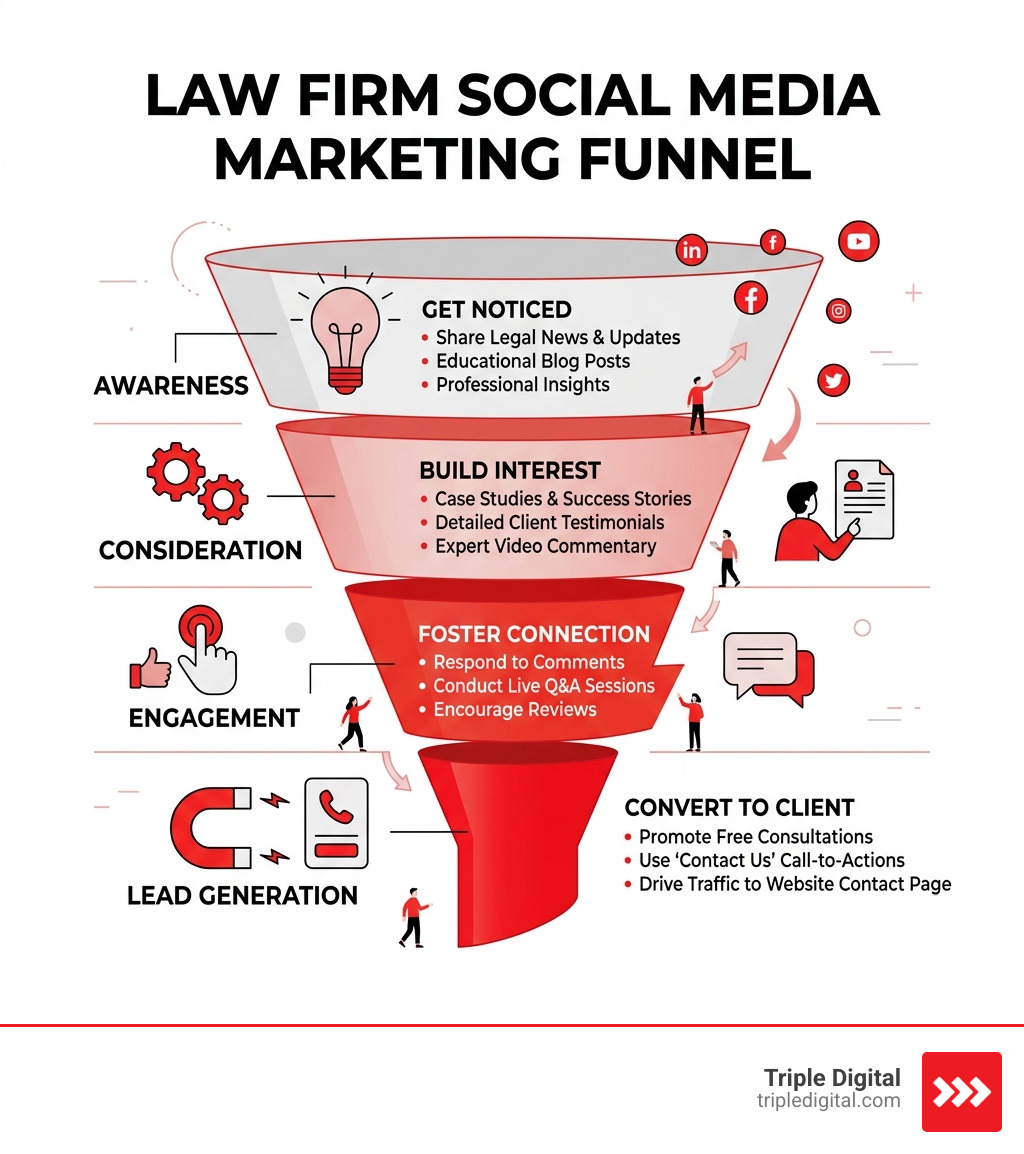
Why Social Media is Essential for Law Firms in 2026

In 2026, a law firm without a social media presence is like a law firm without a sign on the door. It’s the digital handshake that happens before a client even picks up the phone. With over 66% of legal clients performing online research before hiring an attorney, your social feeds often serve as your first impression.
But beyond just “being there,” social media offers tangible business advantages. At Triple Digital, we see social media as a critical pillar of a modern lead generation strategy. It builds brand authority by allowing you to showcase your expertise in real-time. When you share a breakdown of a new Houston regulation or a recent case victory, you aren’t just posting; you’re proving your value.
Furthermore, social media provides essential SEO signals. While a tweet might not rank like a blog post, the traffic and engagement generated from social platforms can drive traffic to law firm websites, which search engines definitely notice. It’s a virtuous cycle: social engagement leads to site visits, which boosts your search authority.
From a practical standpoint, social media helps your business in three key areas:
- Recruitment: Attracting top-tier legal talent who want to work for a forward-thinking, visible firm.
- Referral Networks: Staying top-of-mind with other attorneys who can refer cases your way.
- Direct Lead Generation: Capturing the attention of individuals or businesses actively seeking legal counsel.
The Best Social Media Sites for Law Firms: A Ranked Breakdown
Choosing the right platform is about matching your firm’s goals with where your clients actually hang out. A personal injury firm in Houston has very different needs than a global corporate litigation powerhouse.
The best social media sites for law firms aren’t necessarily the ones with the most users, but the ones with the highest “intent.” Law firm marketing with social media requires a surgical approach.
For solo practitioners and small firms, focus is your best friend. You don’t have a 20-person marketing team, so picking one or two high-impact platforms—like LinkedIn for networking or Facebook for local leads—is much more effective than having five “ghost town” accounts. Large firms, on the other hand, can leverage a multi-channel approach to dominate thought leadership and recruitment across the board.
LinkedIn: The Gold Standard for Professional Networking
If you only have time for one platform, make it LinkedIn. It is the undisputed heavyweight champion for the legal profession. Approximately 69.2% of law firms maintain a presence on LinkedIn, and for good reason.
LinkedIn is where B2B leads are born. It’s where 63% of in-house counsel go to research outside counsel. When an executive or business owner needs a lawyer, they don’t just look at your website; they look at your LinkedIn profile to see who you know and what you know.
Mastering LinkedIn for legal professionals involves more than just a static profile. It’s about:
- Thought Leadership: Publishing long-form articles on industry shifts.
- Referral Building: Engaging with other lawyers to foster a “give and get” referral relationship.
- Recruitment: Using the “Life” tab to show off your firm’s culture and attract associates.
Facebook: Building Community and Local Leads
Facebook remains a powerhouse for consumer-facing law firms (Family Law, Personal Injury, Criminal Defense). With nearly 3 billion active users, it is the best place to reach the general public in your local Houston community.
The real magic of Facebook lies in its advertising and community features. Facebook ads can be a win for your law firm because they allow for incredibly precise targeting. You can show ads to people based on their location, interests, and even life events.
Furthermore, Facebook advertising drives traffic to your website through remarketing. Have you ever visited a site and then seen their ad on Facebook ten minutes later? That’s remarketing, and it’s one of the most effective ways to convert a “maybe” into a “yes.”
YouTube and TikTok: Leveraging Video for the Best Social Media Sites for Law Firms
Video is no longer optional. By 2026, short-form video has become the preferred way for clients to consume information.
YouTube acts as the world’s second-largest search engine. If you create a video titled “What to do after a car accident in Houston,” you are creating an evergreen asset that can generate leads for years.
TikTok, once dismissed as an app for teenagers, has evolved into “LawTok.” It’s a space where lawyers can use visual storytelling to explain complex statutes in 60 seconds. The key here is authenticity. People don’t want a “billboard” on TikTok; they want a human being who can answer their questions without the legalese.
Emerging Platforms and Niche Networks for Legal Professionals
While the “Big Three” (LinkedIn, Facebook, YouTube) are essential, 2026 has seen the rise of decentralized and niche networks. Staying ahead of the curve can give you an “early adopter” advantage, allowing you to build a following before the space becomes crowded.
- Threads & Bluesky: These platforms are becoming the go-to for real-time legal commentary. Threads, in particular, offers a more informal, conversational space than LinkedIn, perfect for humanizing your partners.
- LawUno: This is a purpose-built network exclusively for the legal ecosystem. Unlike generic sites, LawUno verifies user roles, ensuring you are connecting with actual professionals, firms, and tech-savvy law students in a spam-free environment.
Exploring these social media categories allows firms to find niche communities where they can stand out as specialized experts rather than generalists.
Best Practices and Ethical Compliance
Success on the best social media sites for law firms isn’t just about posting; it’s about posting correctly. We recommend the 80/20 Rule: 80% of your content should provide value (education, news, community highlights), and only 20% should be a direct “pitch” for your services.
To move from likes to leads, consistency is key. A dormant profile looks worse than no profile at all. Use scheduling tools to maintain a steady cadence, but don’t forget the “social” part of social media—respond to comments and engage with your followers.
Common Mistakes to Avoid:
- The “Billboard” Approach: Only posting self-promotional content.
- Ignoring the Audience: Failing to reply to messages or comments.
- Inconsistency: Posting ten times in one week and then disappearing for a month.
- Being “Fake”: Using overly polished, robotic language that lacks personality.
Strategic Content Planning for the Best Social Media Sites for Law Firms
Your content should be built around “pillars.” For a Houston firm, these might include:
- Educational: “How to read a police report.”
- Community: “Proudly sponsoring the Houston Food Bank.”
- Firm Culture: “Welcome our new associate, Sarah!”
- Thought Leadership: “My take on the recent Supreme Court ruling.”
By varying your content, you keep your feed interesting while reinforcing your brand voice.
Staying Compliant with Legal Ethics Rules
This is the “scary” part for many lawyers, but it doesn’t have to be. Ethical compliance is simply about applying the same rules you use in the courtroom to your keyboard.
- Confidentiality: Never discuss case details without express written permission.
- Expertise Claims: Avoid calling yourself the “best” or an “expert” unless you hold a specific, recognized certification in your jurisdiction. Use terms like “experienced” or “focused on” instead.
- Disclaimers: Always include a disclaimer stating that social media interactions do not constitute an attorney-client relationship.
- Jurisdiction: Be clear about where you are licensed to practice to avoid claims of unauthorized practice of law in other states.
Frequently Asked Questions about Law Firm Social Media
Which platform is the best starting point for a law firm?
For most firms, LinkedIn is the best starting point. It has the lowest “risk” and the highest professional reward. Once you have a polished LinkedIn presence, you can expand to Facebook for local reach or YouTube for educational authority.
How do law firms stay compliant with ethics rules on social media?
The best way is to create a written social media policy for your firm. Ensure all posts are reviewed for “advertising” triggers, avoid making guarantees about outcomes, and never give specific legal advice in a public comment section.
How should law firms measure the ROI of their social media efforts?
Don’t just look at “vanity metrics” like likes. Look at:
- Website Traffic: How many people clicked through to your site?
- Lead Conversions: Did someone fill out a contact form after seeing a post?
- Referrals: Are other attorneys mentioning your social media content when they call you?
Conclusion
Social media for law firms in 2026 isn’t about being “famous”—it’s about being found. It’s about building a digital footprint that proves your competence, humanizes your practice, and ultimately drives cases. By focusing on the best social media sites for law firms like LinkedIn and Facebook, and experimenting with video, you position your firm as a leader in a competitive market.
Social media is just one part of the puzzle. It works best when integrated with other strategies, like email marketing, to nurture the leads you capture.
At Triple Digital, we help Houston law firms cut through the “fluff” and get straight to the results. If you’re ready to turn your social media feeds into a lead-generating machine, we’re ready to help.