 Skip to content
Why Most Law Firm Websites Fail to Turn Visitors Into Clients
Conversion optimization techniques for law firm websites are the specific strategies used to turn more of your existing website visitors into consultation requests, phone calls, and paying clients — without spending more on ads or SEO.
Here are the most impactful techniques to start with:
- Place a clear CTA above the fold — use action-driven language like “Schedule Your Free Case Review”
- Optimize for mobile — over 70% of law firm visits happen on mobile devices
- Speed up your pages — a one-second delay can cut conversions by up to 7%
- Add trust signals — testimonials, bar credentials, awards, and case results
- Simplify intake forms — limit fields to name, phone, email, and case type
- Use multi-step forms — they reduce perceived effort and increase completions
- Install live chat or a chatbot — live chat carries a 92% satisfaction rate
- Create practice-area landing pages — match the page content to what the visitor searched for
- Add attorney intro videos — 60-90 second videos build trust fast
- Run A/B tests continuously — even small changes can produce dramatic conversion lifts
Most law firm websites have a serious problem that has nothing to do with design.
They get traffic. Sometimes a lot of traffic. But the phone doesn’t ring.
The average law firm website converts just 2-4% of visitors into consultation requests. High-performing firms hit 8-12%. That gap is enormous — and it’s almost entirely a conversion problem, not a traffic problem.
Think about what that means in practice. If your firm spends $10,000 a month on paid ads and converts at 3%, you’re generating a fraction of the leads a competitor generates at 9% — from the exact same ad spend. They’re not spending more. They’ve just built a better conversion machine.
The difference between a law firm website that looks good and one that consistently brings in qualified clients is almost never about aesthetics. It’s about removing friction, building trust fast, and making it dead simple for a stressed-out person to take the next step.
That next step is what this guide is about.
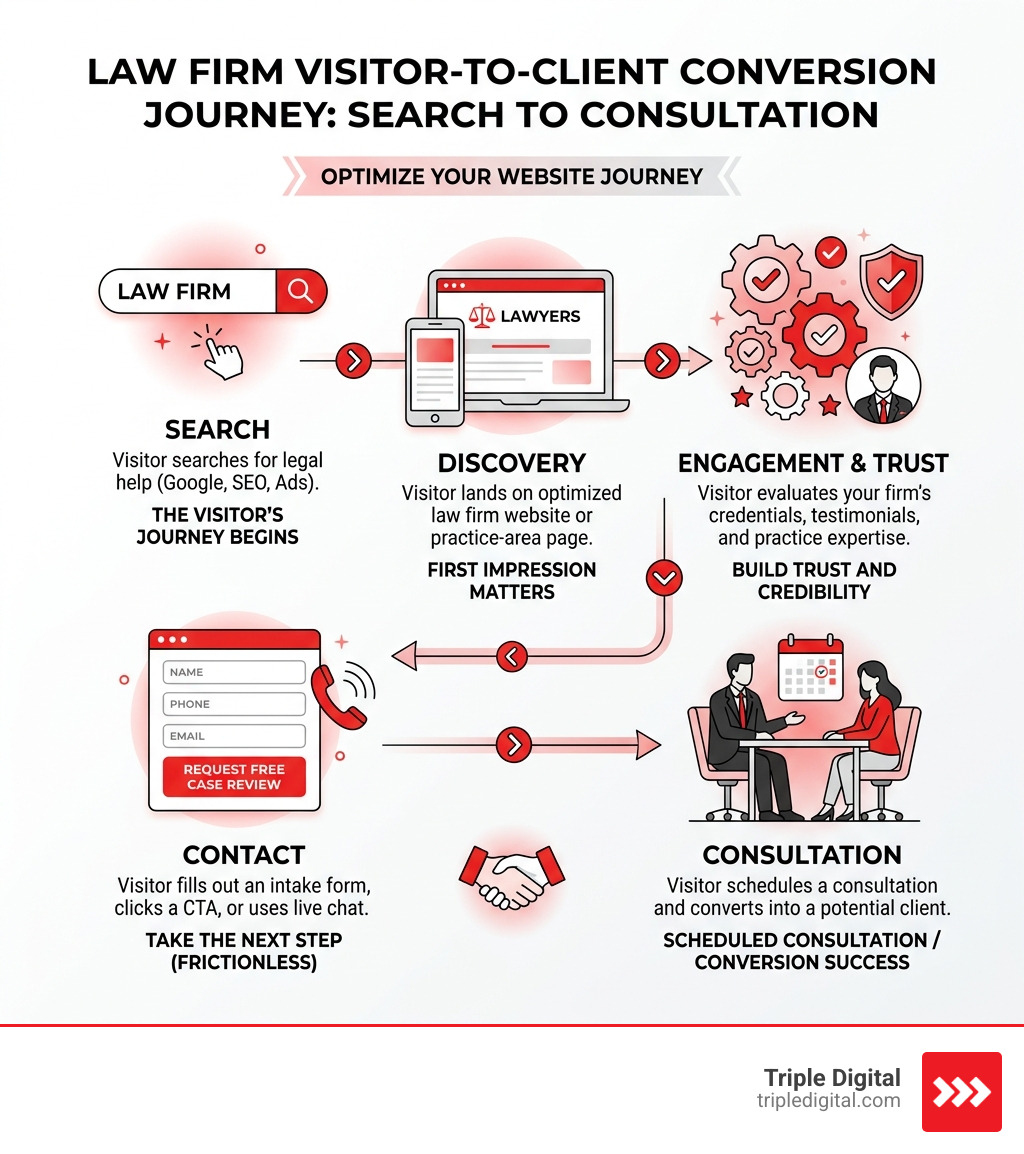
Core Conversion Optimization Techniques for Law Firm Websites
At Triple Digital, we’ve seen that driving traffic is only half the battle. If your website is a “leaky bucket,” you are essentially throwing your marketing budget away. Conversion Rate Optimization (CRO) is the process of patching those leaks.
In April 2026, the legal market is more competitive than ever. To win, your site must immediately answer three questions for the visitor: What do you do? How can you help me? What do I do next?
The foundation of any high-converting legal site is “above-the-fold” design. This refers to the content a user sees before they start scrolling. If your value proposition—the unique reason why a client should choose you over the firm down the street—isn’t visible within the first three seconds, nearly half of your visitors will bounce. We focus on how web design can make your business more profitable by ensuring these elements are front and center.

High-Impact Call-to-Action (CTA) Strategies
A “Call to Action” isn’t just a button; it’s a psychological nudge. Many firms use passive language like “Submit” or “Contact Us.” These are friction words. In 2026, high-performing firms use action-oriented, benefit-driven language.
Effective CTA strategies include:
- Action Verbs: Use words like “Get,” “Claim,” or “Schedule.”
- Specific Phrasing: “Schedule Your Free Case Review” or “Request a Confidential Consultation” outperforms generic text.
- High-Contrast Design: Your CTA button should pop. If your site is blue, try an orange or gold button.
- Strategic Repetition: Don’t just put one button at the top. Repeat your CTA after major sections of educational content.
We’ve found that maximizing your legal website’s potential often comes down to making the path to contact so obvious that the user doesn’t have to think.
Optimizing Landing Pages for Specific Practice Areas
One of the biggest mistakes we see is firms sending all their paid traffic to the homepage. If someone searches for “Houston car accident lawyer,” they shouldn’t land on a general homepage that talks about family law and estate planning. They need a dedicated landing page that matches their search intent.
Message matching is critical. If your ad promises a “Free Injury Evaluation,” the landing page headline should say exactly that. Use emotional triggers that resonate with the searcher’s current state—anxiety, seeking justice, or financial worry. By providing essential website SEO for attorneys, you ensure that the content is not only findable but also highly relevant to the user’s specific problem.
Building Trust and Authority Through Social Proof
In the legal world, trust is the primary currency. People aren’t just buying a service; they are seeking a protector for their rights, family, or business.
Your website must act as a digital handshake. This is where social proof comes in. Trust signals—like bar memberships, “Super Lawyers” badges, and “5,000+ Cases Won” callouts—provide immediate external validation.
Attorney bios are some of the most visited pages on any law firm site. Don’t just list where you went to law school. Use professional, high-quality headshots and write about your results and your empathy. A bio that mentions you’ve resolved over 300 custody disputes is far more persuasive than one that simply says you “practice family law.”
Leveraging Video and Testimonials for Conversion Optimization Techniques for Law Firm Websites
Video is no longer optional in 2026. Consumers now spend over 100 minutes a day watching online videos. For law firms, a 60-90 second “Introduction to the Firm” video can build more trust than 2,000 words of text.
Testimonials are equally powerful, but they must be authentic. Use actual quotes from happy clients (with their permission) and, if possible, video testimonials. Seeing and hearing another person talk about how you saved their business or helped them through a divorce creates an emotional connection that “hard sell” copy cannot replicate. Effective law firm lead tracking allows you to see exactly which of these videos are driving the most consultation requests.
Integrating Google Business Profile and Local Trust Signals
For firms in Houston, TX, your Google Business Profile (GBP) is often the first thing a client sees. The “Map Pack” dominates mobile search. To convert these searchers, you need:
- Review Management: Respond to every review, both positive and negative.
- NAP Consistency: Ensure your Name, Address, and Phone number are identical across the web.
- Local Authority: Mentioning community involvement and local landmarks helps Google—and clients—see you as a local fixture.
We emphasize why tracking numbers are so important to track leads on your GBP. It allows you to distinguish between a call from a random search and a call from someone who specifically found your optimized local listing.
Technical Performance and Frictionless Intake Systems
You can have the best copy in the world, but if your site takes five seconds to load, you’ve already lost the client. Data shows that sites loading in one second see conversion rates up to five times higher than those taking five seconds.
| Page Load Speed | Conversion Rate Impact |
|---|---|
| < 1 Second | 5x Higher than 5s sites |
| 2 Seconds | Standard benchmark |
| 3 Seconds | 40% Abandonment rate starts |
| 5+ Seconds | Significant revenue loss |
Mobile-first design is the only way to build in 2026. Since over 70% of visits are mobile, your buttons must be “tap-friendly,” and your phone numbers must be “click-to-call.” We also prioritize ADA compliance; making your site accessible to everyone isn’t just a legal requirement—it’s a way to ensure you aren’t accidentally blocking potential clients from contacting you. This is a core part of optimizing the intake process.
Streamlining Intake Forms and Lead Capture
The “Contact Us” form is where most conversions go to die. Every field you add to a form reduces the conversion rate. We recommend asking for only the essentials: Name, Email, Phone, and Case Type.
If you must ask more questions, use a multi-step form. These show a progress bar (e.g., “Step 1 of 3”). Psychologically, once a user starts a process, they are much more likely to finish it.
Implementing Chatbots and Live Chat for 24/7 Engagement
Legal emergencies don’t just happen during business hours. If a prospect visits your site at 11 PM and can’t get an answer, they will move to the next firm. Live chat has a 92% satisfaction rate because it provides immediate gratification.
AI-powered chatbots can now qualify leads, answer basic FAQs about your practice areas, and even book consultations directly into your calendar. This 24/7 responsiveness ensures you never miss a high-value case because you were asleep.
Advanced Recovery Tactics and Continuous Testing
What happens to the 90% of people who leave your site without calling? Without conversion optimization techniques for law firm websites, they are gone forever.
Advanced tactics include:
- Exit-Intent Popups: A small window that appears only when a user moves their cursor to leave the page, offering a free guide or a “Wait! Schedule a call now.”
- Retargeting Ads: Showing ads to people who visited your site but didn’t convert as they browse other parts of the internet.
- Heuristic Reviews: Having experts (like our team at Triple Digital) manually audit your site for “friction” and “anxiety” points.
Data-Driven Conversion Optimization Techniques for Law Firm Websites
We don’t guess; we test. Using tools like heatmaps and scroll maps, we can see exactly where people are clicking and where they are losing interest. If a scroll map shows that 80% of users stop reading halfway down your “About Us” page, we know we need to move the CTA higher or change the content.
A/B testing is the gold standard. We might run two versions of a landing page—one with a blue button and one with a red button—to see which one generates more cases. Over time, these small wins compound into massive ROI.
Measuring Success and Financial Impact
To know if your CRO is working, you must track the right metrics.
- Cost Per Lead (CPL): How much does it cost to get one person to fill out a form?
- Conversion Rate: The percentage of visitors who take action.
- Retention Ratio: How many leads actually turn into signed cases?
If you spend $10,000 on ads with a 3% conversion rate, you might get 30 leads. If you optimize that site to a 9% conversion rate, you get 90 leads for the same $10,000. Your cost per lead just dropped by 66%. This is how mastering law firm SEO and CRO together creates a dominant market position.
Frequently Asked Questions about Law Firm CRO
What is a good conversion rate for a law firm website in 2026?
While the industry average hovers around 2.35%, we consider a “good” rate to be between 5% and 8%. High-performing firms that have fully optimized their landing pages and intake systems can often reach 10% to 12%. These numbers vary by practice area; criminal defense often has higher conversion rates due to the urgency of the matter compared to estate planning.
How long does it take to see results from CRO implementations?
You can often see “quick wins” within 24 to 48 hours by simply changing a button color or moving a phone number to the header. However, a full CRO strategy—including A/B testing and behavioral analysis—typically takes 30 to 60 days to generate statistically significant data and measurable increases in case volume.
Should law firms use gated content to capture leads?
Gated content (like an eBook or a checklist that requires an email address) is a great “soft conversion.” Not everyone is ready to hire a lawyer today. By offering a “Car Accident Survival Guide,” you capture the email addresses of people who are in the research phase, allowing you to nurture them via email until they are ready to book a consultation.
Conclusion
At Triple Digital, we believe that your website should be your firm’s hardest-working employee. Based in Houston, we specialize in a “less fluff, more cases” approach. By combining conversion optimization techniques for law firm websites with our proprietary AI and data mining systems, we help firms target high-value clients with surgical precision.
Don’t let another qualified lead slip through the cracks of a poorly optimized website. Maximize your firm’s ROI with expert conversion optimization services and turn your traffic into a steady stream of new cases today.