




Stop Leaking Leads with a Better B2B Marketing Funnel
Why Most B2B Lead Generation Funnels Leak — and What It’s Costing You

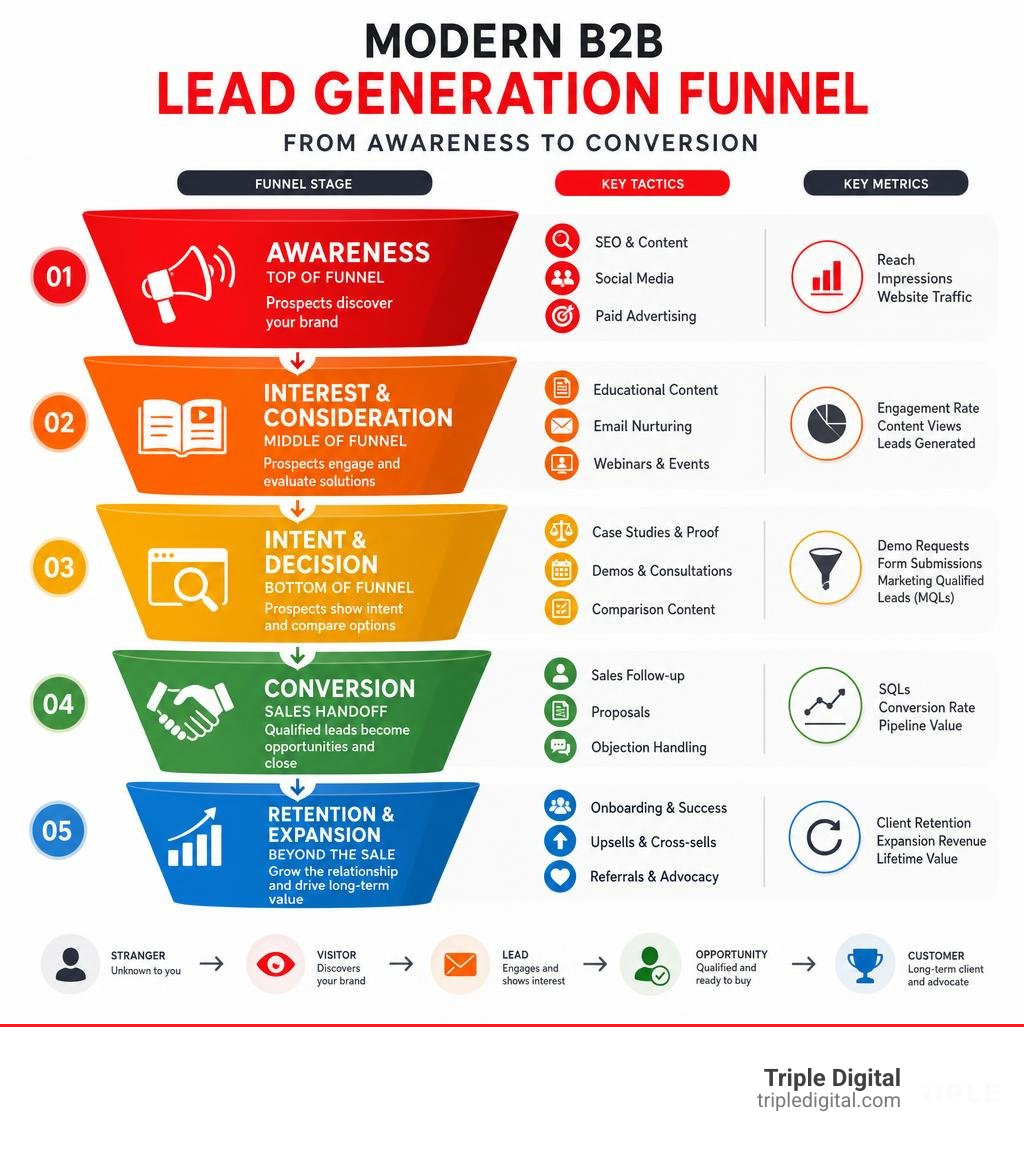
A B2B lead generation funnel is the structured path that moves a potential business buyer from first discovering your firm to becoming a qualified, sales-ready opportunity. Here’s a quick breakdown of how it works:
- Awareness (TOFU) – Prospects discover you through search, social, or ads
- Interest & Consideration (MOFU) – They engage with your content and evaluate their options
- Intent & Decision (BOFU) – They compare vendors, request demos, or reach out directly
- Conversion – A qualified lead is handed to sales and closed
- Retention & Expansion – The relationship grows through upsells, referrals, and renewals
Most law firms and professional services businesses already have some version of this in place. The problem isn’t the funnel concept — it’s the leaks.
Leads go cold because no one follows up fast enough. Prospects drop off because the content isn’t relevant to where they are in their decision. Marketing and sales argue about what counts as a “qualified lead.” Sound familiar?
The numbers are blunt: 78% of B2B buyers purchase from the first vendor that responds. And nearly 80% of marketing leads never convert to sales without proper nurturing. That’s not a traffic problem. That’s a funnel problem.
In 2026, the challenge is compounded by how buyers actually behave. They self-educate in private channels, arrive with shortlists already formed, and are often 70% through their decision before they ever contact you. By the time a prospect fills out your form, they’ve already done their research — and if your funnel wasn’t working during that invisible phase, you likely weren’t even on their list.
This guide is built to help you fix that.
What is a B2B Lead Generation Funnel?
At its core, a b2b lead generation funnel is an operating system for your growth. It is a systematic framework designed to map out the entire customer journey, starting from a prospect’s initial anonymous discovery and ending with long-term client retention.
Historically, companies viewed marketing and sales as separate silos. Marketing threw leads over the wall, and sales complained they were garbage. A modern B2B funnel acts as a bridge, aligning both departments under shared revenue goals, standardized definitions, and automated data flows.
For professional services, such as law firms handling commercial litigation or corporate clients, this process must be managed with extreme precision. Business buyers do not make impulsive decisions. They are looking for strategic partners, which is why your lead generation engine must focus heavily on establishing trust and authority early. For a deeper dive into why traditional approaches fail and how to fix them, check out our guide on B2B Lead Gen for Skeptical Marketers.
How B2B Funnels Differ from B2C Models
If you have ever bought a pair of shoes online, you know the B2C funnel is fast, emotional, and often completed in a single session. B2B transactions are entirely different animals. They involve higher contract values, extensive research, and logical, ROI-driven validation.
| Feature | B2C Funnel | B2B Funnel |
|---|---|---|
| Target Audience | Individual consumers | Buying committees (average of 13 stakeholders) |
| Sales Cycle | Hours to days | Months to over a year |
| Transaction Value | Low to moderate | High to enterprise-grade |
| Decision Drivers | Emotion, style, immediate need | Logic, ROI, risk mitigation, compliance |
| Key Funnel Stage | Direct purchase | Extensive independent appraisal & validation |
Because of these differences, B2B funnels require a heavy emphasis on trust signals. Buyers will cross-reference your claims on third-party review sites, look up your attorneys or consultants on LinkedIn, and download multiple resources before they ever agree to an introductory call.
The Influence of Modern Thought Leadership Frameworks
The way we design a b2b lead generation funnel has evolved dramatically over the last century. While the classic AIDA model (Awareness, Interest, Desire, Action)—invented by Elias St. Elmo Lewis in 1898—still serves as a foundational concept, it assumes a linear buyer journey that simply does not exist in 2026.
Modern frameworks recognize that the buyer’s journey is highly non-linear:
- SiriusDecisions Demand Waterfall: Introduced a structured, multi-stage lead tracking process that clearly defined the boundaries between Marketing Qualified Leads (MQLs) and Sales Accepted Leads (SALs).
- Forrester Revenue Waterfall: Re-envisioned the waterfall model to focus on accounts rather than isolated individual leads, matching the reality of B2B buying committees.
- Gartner Multichannel Buyer Journey: Describes the buying process as a complex, non-linear web where buyers loop back through problem identification, solution exploration, and requirements building.
Today, your funnel must function like a spider web rather than a straight pipeline. It needs to accommodate intent spikes, sudden departures of key stakeholders, and re-entry points for accounts that went cold six months ago.
Key Stages of the Customer Journey
To build a funnel that actually converts, we divide the customer journey into three broad, manageable phases: Top-of-Funnel (TOFU), Middle-of-Funnel (MOFU), and Bottom-of-Funnel (BOFU). Each phase requires distinct goals, tactics, and strict exit criteria to ensure no one is pushed to sales before they are ready.

Top-of-Funnel (TOFU): Building Awareness and Interest
The primary goal of the TOFU stage is discovery. You want to attract the right eyes to your firm and turn anonymous web traffic into identifiable prospects.
To succeed here, we combine organic search (SEO), targeted LinkedIn campaigns, paid lead forms, and high-value webinars. In 2026, generic blog posts no longer capture attention. Business buyers want deep, search-visible content that addresses specific operational pains.
For instance, if your firm provides corporate legal services, your TOFU content should focus on emerging regulatory changes, compliance risks, or industry-specific case studies. To understand how to position your firm to attract these high-value accounts, read our comprehensive resource on Finding Your Next Client: A Guide to Lead Generation Services.
Middle-of-Funnel (MOFU): Nurturing Consideration and Intent in the B2B Lead Generation Funnel
Once a prospect has engaged with your TOFU content, they enter the MOFU stage: consideration and appraisal. Here, the buyer knows they have a problem, and they are actively evaluating potential solutions.
This is the leakiest part of the entire b2b lead generation funnel. Nearly 80% of marketing leads never convert because companies fail to nurture them. To prevent this, you must deploy targeted email sequences, whitepapers, and webinars that address specific objections.
We also recommend utilizing progressive profiling on your landing pages. Instead of asking for a prospect’s entire life history on their first visit, ask for their name and email first. On their next visit, your forms can dynamically ask for their company size, job role, or current software stack. This keeps conversion friction low while continuously enriching your CRM database. For proactive strategies to keep your pipeline full of high-intent cases, read our guide on how to Don’t Just Wait for Cases: Strategies for Proactive Legal Lead Generation.
Bottom-of-Funnel (BOFU): Driving Decisions and Conversions
At the BOFU stage, the prospect is on the verge of making a decision. They are comparing your firm directly against your competitors, reviewing pricing structures, and evaluating the risk of working with you.
Tactics at this stage must be direct and highly personalized. This is where you offer interactive calculators, detailed competitor comparison pages, live demos, or free strategic consultations.
Speed-to-lead is absolutely critical at this phase. If a high-intent buyer requests a consultation, your sales team must respond within minutes. A delay of even one hour can decrease your conversion likelihood dramatically. To learn how to convert these late-stage prospects into long-term partners, check out From Prospects to Partners: The Lawyer’s Playbook for Lead Gen.
Defining Your ICP and Aligning Marketing and Sales
A beautiful funnel is completely useless if it targets the wrong people. Generating a thousand clicks from the wrong crowd will only waste your ad budget and frustrate your sales team.
To build a high-converting funnel, we must first define an Ideal Customer Profile (ICP). Your ICP is not a vague target like “businesses in Houston.” It must be a highly detailed definition built from your best current clients, incorporating:
- Firmographics: Industry, company size, annual revenue, and geographic location (strictly focused on Houston, TX and the United States).
- Technographics: The software, CRM, or IT infrastructure they currently use.
- Trigger Events: Leadership changes, rapid hiring phases, expansion into new markets, or recent funding rounds.
- Exclusions: Clear criteria for who you will not work with to protect your team’s time.
Once the ICP is locked in, you must map out the individual buyer personas within that account. In B2B sales, you are rarely selling to a single person. You must craft tailored messaging for the economic buyer (who signs the check), the technical buyer (who evaluates security and integration), and the end user (who actually uses your service).
Establishing Clear Lead Qualification and Handoff Criteria
To prevent friction between departments, marketing and sales must agree on exact, objective definitions for lead stages. We use a strict behavioral qualification framework:
- Marketing Qualified Lead (MQL): A contact who fits the ICP and has shown active interest by downloading gated assets or attending webinars.
- Sales Accepted Lead (SAL): A lead that sales has reviewed and verified as a perfect fit for the pipeline.
- Sales Qualified Lead (SQL): A lead that has passed qualification criteria and has actively agreed to a discovery call or meeting.
Rather than relying on subjective opinions, we implement behavior-weighted scoring. For example, downloading a basic whitepaper might add 5 points to a lead’s score, while visiting your pricing or contact page adds 30 points. Once a lead crosses a predetermined threshold, it is automatically routed to sales. To see how structured tracking can revolutionize your client acquisition, read our playbook on Law Firm Lead Tracking.
Leveraging Automation and CRM Integrations for Speed-to-Lead
When a high-intent lead fills out a form, every second counts. If you rely on manual data entry or weekly CSV exports, your leads will go cold before your team ever reaches out.
By connecting your lead capture sources directly to your CRM using automation tools like LeadsBridge or Zapier, you can route leads to the right representative instantly. Here is what a fully integrated CRM setup delivers for your firm:
- Instant Lead Routing: Automatically assigns leads to specific representatives based on geography, practice area, or company size using round-robin distribution.
- Real-Time Data Syncing: Ensures sales reps have complete context, including which blog posts the prospect read and which lead magnets they downloaded, before making the first call.
- Automated Follow-Up Triggers: Instantly sends a personalized email or SMS confirmation to the prospect, confirming receipt and offering a direct scheduling link.
- Decreased Lead Leakage: Eliminates manual handoff errors, ensuring no prospect falls through the cracks of a messy inbox.
Optimizing and Measuring Funnel Performance
Building your b2b lead generation funnel is only the first step. To drive consistent, predictable revenue growth, you must continuously diagnose leaks, optimize conversion rates, and run targeted experiments.
We recommend conducting a monthly funnel audit. If your visitor-to-lead conversion rate is below the industry benchmark of 1.4%, your landing pages or copy are likely failing to connect. If your MQL-to-SQL conversion rate is low, your qualification criteria are too loose, or your middle-of-funnel nurturing is weak. To master the art of turning traffic into actual revenue, explore our Guide to Conversion Optimization.
Essential Metrics and KPIs for the B2B Lead Generation Funnel
To measure the true health of your pipeline, you must look beyond vanity metrics like page views or social media likes. We focus on four core categories of data:
- Cost Per Lead (CPL): Total campaign spend divided by the number of leads generated.
- Customer Acquisition Cost (CAC): The total cost of marketing and sales required to acquire a single paying client.
- Pipeline Velocity: How fast prospects move through your funnel from initial touchpoint to closed-won.
- Stage-to-Stage Conversion Rates: The percentage of prospects moving from TOFU to MOFU, and MOFU to BOFU.
Tracking these metrics gives you a clear, data-driven view of your marketing ROI, allowing you to allocate budget to the channels that produce the highest-value cases. For a detailed guide on setting up your analytics infrastructure, read Measure Up: How Analytics Can Transform Your Legal Marketing.
Advanced Optimization Tactics: AI, Personalization, and Retargeting
Once your foundational funnel is running smoothly, you can deploy advanced tactics to maximize performance.
First, leverage AI-powered lead scoring. Traditional rule-based scoring systems can be rigid, but machine learning models can analyze years of CRM data to identify subtle behavioral patterns that correlate with closed-won deals.
Second, implement dynamic personalization. In 2026, buyers expect tailored experiences. By utilizing intent data from platforms like G2 or Bombora, you can dynamically adjust your website copy, landing pages, and email content based on the prospect’s industry or company size.
Finally, run highly targeted retargeting campaigns. Since B2B sales cycles are long, retargeting allows you to stay top-of-mind. If a prospect visits your commercial litigation service page but doesn’t convert, you can serve them high-authority case studies or client testimonials on LinkedIn and Google Search. To learn how to integrate these advanced conversion strategies into your digital presence, read From Clicks to Clients: The Ultimate Law Firm CRO Strategy.
Frequently Asked Questions about B2B Funnels
What is the difference between a lead generation funnel and a sales funnel?
The lead generation funnel is owned by marketing and focuses on attracting anonymous visitors, capturing their contact details, and educating them through automated nurturing. The sales funnel begins after a lead has been qualified as an SQL. It is owned by sales and involves direct human-to-human interactions, custom proposals, contract negotiations, and closing the deal.
How long does a typical B2B sales funnel take to convert?
The length of a B2B sales cycle varies widely based on deal size and complexity. For mid-market professional services ($10k to $50k deals), the average sales cycle is roughly 75 days. For enterprise-grade contracts, the process can take anywhere from 120 to 270 days due to the need for consensus across large buying committees.
What are the most common mistakes that kill B2B funnel conversions?
Even the most experienced marketing teams can fall into traps that quietly drain their pipeline. Here are the most common mistakes we see:
- Over-reliance on a single channel: Relying solely on Google Ads or cold email leaves your pipeline highly vulnerable to algorithm changes or deliverability drops.
- Failing to follow up quickly: Letting warm inbound leads sit in an inbox for hours (or days) drastically reduces your chances of conversion.
- Weak qualification criteria: Sending unqualified “calendar fillers” to your sales team wastes resources and damages sales-marketing trust.
- Gating every piece of content: Forcing buyers to fill out a long form to read a basic blog post creates unnecessary friction and drives prospects away.
Conclusion
Building a high-converting b2b lead generation funnel is not a one-time project. It is a continuous process of auditing, testing, and refining your messaging, targeting, and technology stack. By aligning your marketing and sales teams around a tight ICP, clear qualification criteria, and automated real-time data flows, you can eliminate lead leakage and build a predictable engine for revenue growth.
At Triple Digital, we help law firms and professional services businesses cut through the marketing fluff to build high-performing, data-driven lead generation engines that deliver actual cases and clients.
If you are ready to stop leaking leads and start scaling your firm with confidence, explore our specialized services and invest in growth with the best lead generation services for lawyers. Let’s build a pipeline that works as hard as you do.