





The Ultimate Guide to Conversion Optimization 2026
Why Most Websites Leave Revenue on the Table (And How to Fix It)
Conversion optimization is the process of increasing the percentage of website visitors who take a meaningful action — like calling your firm, submitting a contact form, or booking a consultation.
Here’s a quick breakdown:
| Term | What It Means |
|---|---|
| Conversion | A visitor completes a desired action (call, form, sign-up) |
| Conversion Rate | Conversions ÷ Total Visitors × 100 |
| CRO | The systematic process of improving that percentage |
| Why It Matters | More clients from the same traffic, without spending more on ads |
Think about this: on average, only 1.7% of website visitors across all industries convert. That means roughly 98 out of every 100 people who land on your site leave without becoming a lead.
For law firms, that gap is costly.
Most firms focus almost entirely on getting more traffic — more ad spend, more SEO effort, more social posts. But if the website isn’t built to convert that traffic into inquiries, the extra spend is largely wasted.
This guide covers everything you need to know — from calculating your conversion rate and diagnosing what’s going wrong, to running valid tests and building a system that consistently turns visitors into clients.
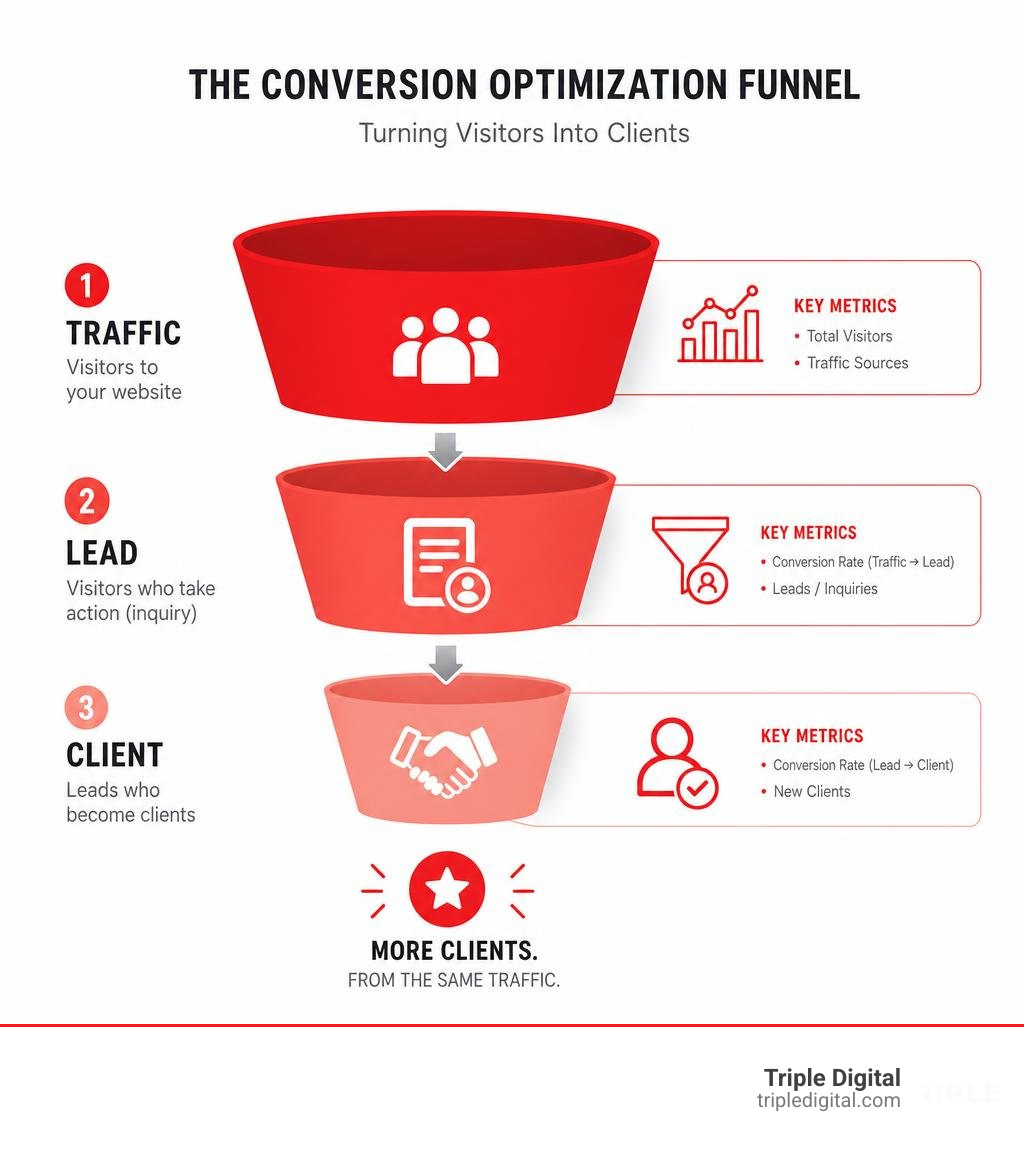
What is Conversion Optimization and Why It Matters in 2026
If you think of your website as a physical storefront, traffic is simply the number of people walking through the door. But if your store has a confusing layout, unhelpful signs, and a checkout line that stretches out the door, those visitors will walk right back out.
Conversion optimization (often called Conversion Rate Optimization or CRO) is the science of rearranging that digital storefront to make taking action as easy, intuitive, and compelling as possible.
In June 2026, optimization is no longer a luxury or a “nice-to-have” add-on. It has become a core survival strategy.
With the widespread rollout of AI Overviews in search engines, click-through rates (CTRs) for standard organic listings have declined. Searchers are getting their answers directly on search engine results pages, which means the traffic that does click through to your website is highly intent-driven but harder to earn.
Because traffic acquisition costs are rising and sheer volume is harder to secure, we must extract more value from every single visitor.
This is where the math gets exciting. If you improve your conversion rate from 2% to 3%, you don’t just get a modest bump in business—you reduce your cost per lead by 33% and increase your total conversions by 50% without spending a single extra dollar on traffic. To explore how this applies directly to legal practices, see our guide on From Clicks to Clients: The Ultimate Law Firm CRO Strategy.
Calculating Conversion Rates and Industry Benchmarks
Before you can optimize your conversion rate, you need to know exactly how to calculate it. The basic formula is straightforward:
$$\text{Conversion Rate} = \left( \frac{\text{Conversions}}{\text{Total Unique Visitors}} \right) \times 100$$
However, a healthy optimization program looks at two distinct types of conversions:
- Macro Conversions: These are your primary business goals. For a law firm, this is a completed case evaluation form, a signed retainer, or a direct phone call.
- Micro Conversions: These are smaller, relationship-building actions that indicate a visitor is moving down your funnel. Examples include downloading a free guide, spending more than three minutes on a key practice area page, or interacting with a chat widget.
While the universal average conversion rate sits at a modest 1.7%, performance benchmarks vary wildly by industry.
| Industry | Average Conversion Rate |
|---|---|
| Skincare | 2.7% |
| Food & Beverage | 2.2% |
| General Apparel | 1.9% |
| Legal & Professional Services (Average) | 2.35% |
| Legal & Professional Services (Top 10% of Sites) | 11.45%+ |
| Home Furniture | 0.7% |
| Luxury Apparel | 0.4% |
In highly competitive service spaces like legal marketing, average firms hover around 2% to 3%, while top-performing sites cross the 11% threshold.
Consider this: in e-commerce, the average cart abandonment rate is 70%. In the legal sector, form and phone abandonment rates can be equally punishing. If your intake forms are too long or confusing, users will abandon them just as quickly as a shopper drops a retail cart.
How SEO and Conversion Optimization Work Together
There is a common misconception that search engine optimization (SEO) and conversion optimization are at war with one another. Some fear that adding optimized copy for search engines makes a page unreadable, or that adding conversion-focused pop-ups hurts search rankings.
In reality, they are two sides of the same coin.
SEO focuses on understanding user search intent and driving high-quality traffic to your site. CRO focuses on understanding post-click user behavior and guiding that traffic to take action.
When aligned, they create a compounding growth loop:
- Better Search Intent Matching: When you optimize a landing page for conversion, you naturally make it clearer and more helpful, which search engines reward with higher rankings.
- Higher Traffic Quality: By analyzing which pages convert best, you can direct your SEO content strategy to target keywords that bring in actual clients, not just casual browsers.
- Compounded Page Value: Adding prominent, context-aware call-to-actions (CTAs) within high-ranking blog posts can skyrocket your leads. For example, text-based CTAs styled as native subheadings within informative articles generate up to 93% of lead sign-ups compared to just 6% from traditional sidebar banner ads.
To learn more about tracking these performance metrics, explore our breakdown on Measure Up: How Analytics Can Transform Your Legal Marketing.
The Core Components of a Modern CRO Strategy
An effective optimization strategy isn’t built on guesswork or “best practices” copied from other websites. It is a scientific, repeatable process rooted in data.
A modern CRO framework balances two types of data:
- Quantitative Analysis: The what. This involves looking at hard data from platforms like Google Analytics. It tells you which pages have high bounce rates, where users drop off in your forms, and which devices convert poorly.
- Qualitative Insights: The why. This involves looking at heatmaps, session recordings, and user surveys. It reveals that users are clicking on non-clickable elements, ignoring your primary CTA, or getting confused by industry jargon.
By combining these two datasets, you can build personalized experiences based on actual user behavior. To make sure you are capturing this data accurately, check out our guide on Law Firm Lead Tracking.
Diagnosing Low Conversion Rates and Friction Points
Friction is the enemy of conversions. It is any element on your website that causes cognitive fatigue, frustration, or hesitation.
When we run friction analyses on business websites, we consistently find the same conversion-killing culprits:
- Checkout and Form Complexity: Studies show that 18% of users abandon purchases or sign-ups due to checkout and form complexity. Yet, 64% of leading websites perform mediocre or worse in checkout and form UX.
- Excessive Form Fields: Every extra field you add to a contact form can reduce your conversion rate. Asking for unnecessary information upfront is an open invitation for users to leave.
- Lack of Validation and Autocomplete: Roughly 47% of sites lack address validators or real-time inline validation. If a user fills out a long form, hits submit, and the page reloads with a generic “error occurred” message without pointing out where the mistake is, they rarely try a second time.
- Frustrating Security Hurdles: Standard CAPTCHAs have an 8% failure rate, which climbs to a staggering 29% if they are case-sensitive.
To pinpoint where these leaks are happening in your lead generation pipeline, read our analysis on Why Tracking Numbers Are So Important to Track Leads.
Enhancing User Experience, Trust, and Accessibility
To convert a modern web visitor, your site must excel in three areas: convenience, trust, and accessibility.
1. Convenience is King
A striking 77% of consumers rate convenience as ‘important’ to their buying and hiring experiences. If a user has to search through multiple menu layers to find your contact details, or if your page takes more than three seconds to load, they will click away.
2. Trust Signals and Social Proof
Before someone contacts a business—especially a law firm—they need to know you are competent. This means placing high-impact trust signals at key decision points.
- Highlight verifiable case results and representative matters.
- Showcase client testimonials and third-party badges.
- Address common objections directly in your copy before they reach the contact form.
3. Accessibility is Non-Negotiable
Shockingly, 94% of the largest e-commerce sites are not accessibility compliant. Inclusive design is not just a legal and ethical responsibility under the ADA; it is a massive business opportunity. If your site is built with proper keyboard navigation, screen-reader-friendly image alt text, and clear visual contrast, you instantly open your doors to a wider audience that your competitors are actively shutting out.
To see how optimizing these touchpoints transforms your bottom line, read about Enhancing Client Satisfaction and Firm Profitability: Optimizing the Intake Process.
Designing Valid Experiments: A/B Testing and Prioritization
Once you have identified friction points on your website, the next step is to test solutions. This is where A/B testing comes in.
An A/B test (or split test) compares your current page (the control) against a modified version (the variation) to see which one performs better. While it sounds simple, running statistically valid tests requires discipline.
The reality of experimentation is humbling: only 12% of experiments run actually produce a winning result. That means 88% of your ideas might result in a draw or a loss.
But a “losing” test is not a failure—it is an invaluable lesson. It tells you exactly what your audience doesn’t respond to, saving you from rolling out site-wide changes that could hurt your business.
To run valid tests, you must:
- Calculate Sample Size First: You need enough traffic and conversion volume to ensure your results are due to the changes you made, not random chance.
- Achieve Statistical Significance: Never end a test early because one version looks like it is winning after a few days. “Peeking” at results early inflates false-positive rates from a standard 5% to over 26%.
- Test One Major Change at a Time: If you change the headline, the button color, and the hero image all at once, you won’t know which element caused the shift in performance.
Prioritizing Optimization Opportunities
If you have dozens of pages and ideas, where do you start? We recommend using the PIE Framework to score and prioritize your testing roadmap:
- Potential: How much improvement can be made on this page? (e.g., a page with a 1% conversion rate has more room for growth than one converting at 8%).
- Importance: How valuable is the traffic coming to this page? (e.g., your primary landing pages and pricing pages are far more important than an outdated blog post).
- Ease: How difficult will it be to implement this test? (e.g., rewriting a headline takes ten minutes; redesigning an entire interactive intake flow takes weeks).
When prioritizing, remember the CRO Strategy Hierarchy. Copy-driven changes (Tier 1)—such as rewriting headlines, clarifying your value proposition, and matching the user’s exact language—consistently produce 50% to 200%+ conversion lifts.
On the other hand, minor design tweaks (Tier 2 and 3), like changing button colors or swapping out background icons, typically yield minor 0% to 3% lifts. Start with the copy; it is your highest-leverage asset.
Building a Culture of Conversion Optimization
CRO is not a one-time project that you “complete” and check off your list. It is an ongoing business practice.
Building an internal culture of experimentation requires securing stakeholder buy-in. Instead of debating design preferences or relying on the “Highest Paid Person’s Opinion” (HiPPO), let data make the decisions. Frame tests as low-risk experiments: “We aren’t permanently changing the homepage; we are running a two-week test to let our visitors tell us which version they prefer.”
Over time, shift your focus from surface-level conversion metrics to deep business metrics:
- Customer Acquisition Cost (CAC): How much cheaper are you acquiring clients?
- Customer Lifetime Value (LTV): Are the leads you are converting turning into long-term, high-value clients?
- Overall Firm Profitability: How is your digital marketing spend directly impacting your bottom line?
Frequently Asked Questions about Conversion Optimization
What is the difference between CRO and SEO?
SEO focuses on search visibility, keyword rankings, and driving traffic volume to your website. CRO focuses on post-click user behavior, removing friction, and turning that existing traffic into leads and clients. SEO gets them to the door; CRO gets them to walk in and take action.
How much traffic do I need to run valid A/B tests?
To run statistically significant A/B tests, you generally need a high volume of traffic and conversions—typically at least 1,000 conversions per variation or a minimum of 5,000 unique visitors per week. If your site has lower traffic, you can still optimize by focusing on qualitative research (user testing, heatmaps) and implementing high-impact copy upgrades rather than running slow split tests.
What are the most common mistakes in conversion optimization?
The most common pitfalls include:
- Testing without data: Making changes based on personal opinions rather than user research.
- Changing too many elements at once: Running messy tests that make it impossible to isolate what worked.
- Stopping tests too early: Declaring a winner before reaching statistical significance.
- Ignoring mobile users: Designing a beautiful desktop experience while ignoring the mobile layout, where over 60% of your traffic likely originates.
Conclusion
At the end of the day, traffic is only half of the digital marketing equation. If you are pouring resources into SEO and paid campaigns without optimizing your conversion paths, you are letting valuable leads slip through the cracks.
At Triple Digital, we believe in a results-driven, “less fluff, more cases” approach. We leverage AI, data mining, and advanced behavioral research to help law firms target, engage, and convert high-value clients with precision.
Are you ready to stop leaving revenue on the table and start turning your website visitors into signed cases? Explore our data-driven marketing programs and book your consultation by visiting Triple Digital Services.