
Why Understanding Current Legal Trends Matters for Your Firm’s Growth

Current legal trends are reshaping how law firms operate, compete, and win cases. The legal industry is experiencing unprecedented change driven by artificial intelligence, evolving client expectations, and new regulatory challenges. If you’re struggling to attract clients through traditional methods, understanding these shifts isn’t just academic—it’s essential for survival.
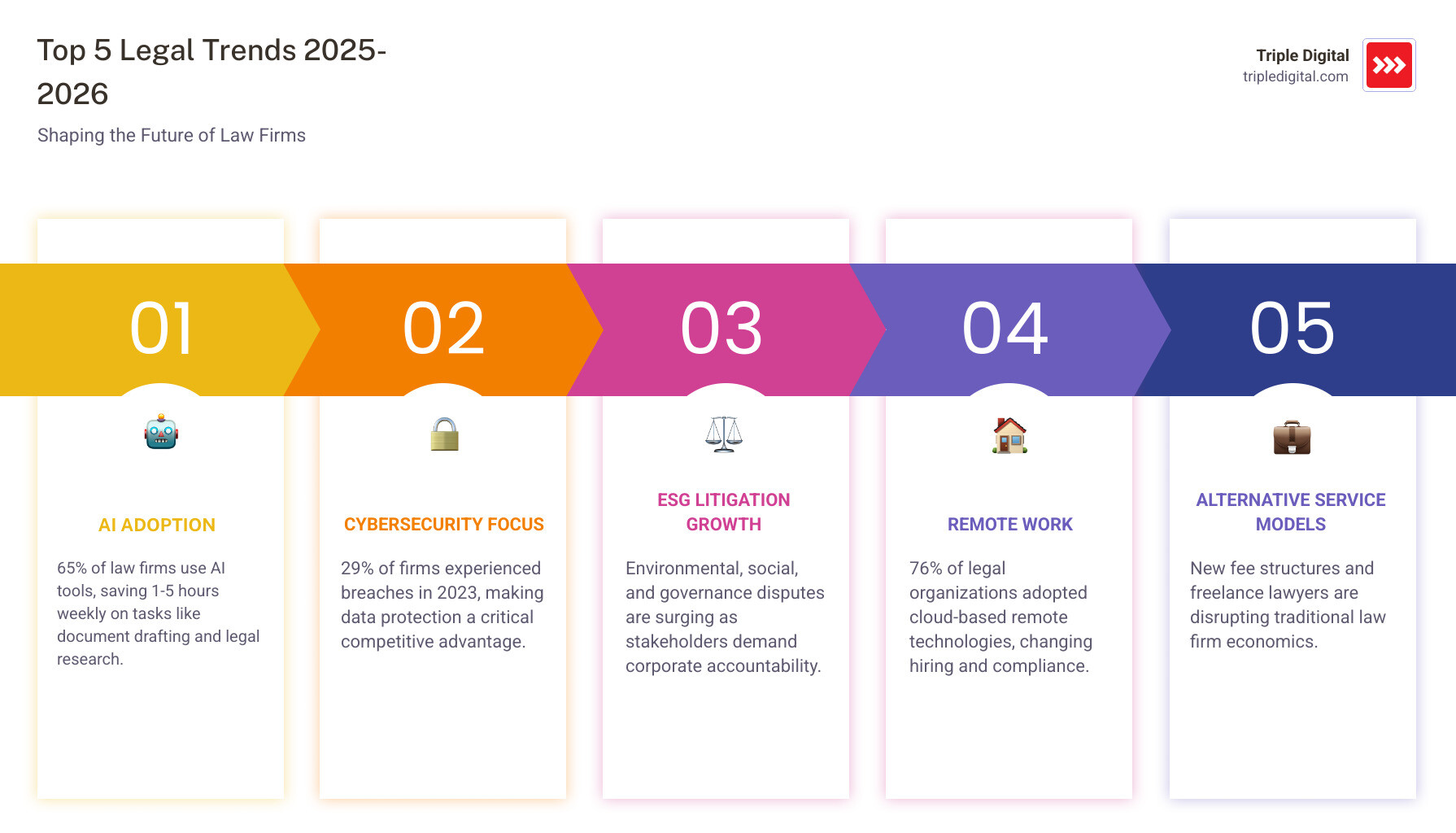
Here are the most critical legal trends changing the industry in 2025-2026:
- AI adoption – 65% of law firms report AI tools save 1-5 hours weekly on tasks like document drafting and legal research
- Cybersecurity focus – 29% of firms experienced security breaches in 2023, making data protection a competitive advantage
- ESG litigation growth – Environmental, social, and governance disputes are surging as stakeholders demand corporate accountability
- Remote work change – 76% of legal organizations adopted cloud-based remote technologies, changing hiring and compliance
- Alternative service models – New fee structures and freelance lawyers are disrupting traditional law firm economics
The global legal technology market now exceeds $37 billion, and nearly half of corporate counsel expect lawsuits and regulatory investigations to increase this year. These aren’t distant trends—they’re immediate pressures affecting your bottom line today.
Law firms that adapt to these changes see measurable results: higher settlements, less attorney burnout, and more efficient operations. Those that don’t risk losing market share to more digitally savvy competitors. The gap between firms embracing modern technology and those relying on outdated methods is widening rapidly.
This guide breaks down exactly what’s happening in the legal landscape and what it means for your practice. You’ll learn which trends demand immediate attention and which you can safely monitor from a distance.
The AI Revolution: How Artificial Intelligence is Redefining Legal Practice
We’re not just talking about chatbots anymore. Artificial Intelligence (AI) and Generative AI (GenAI) are profoundly impacting legal practice, shaping the industry in 2025 and 2026. This isn’t a futuristic fantasy; it’s our present reality. Law firms are leveraging AI for sophisticated applications, including predictive analytics, legal research, and case strategy development. The global legal technology market, projected to exceed $37 billion, is a clear indicator of this growth.
The question isn’t if AI will change your firm, but how you’ll adapt. AI is changing daily workflows, from automating tedious administrative tasks to enhancing decision-making and improving client communication. This shift is freeing up our legal professionals to focus on the complex, strategic work that truly requires human expertise.

Generative AI’s Impact on Legal Tasks and Efficiency
GenAI is rapidly becoming our digital junior associate, making significant contributions to core legal tasks. Imagine the time savings when AI can analyze contracts, draft documents, and conduct legal research with remarkable speed. Indeed, studies show that 65% of law firms find that generative AI tools save them one to five hours a week. The most common task? Drafting correspondence.
These efficiency gains aren’t just about speed; they’re about accuracy and freeing up valuable billable hours. AI tools can:
- Automate Document Drafting: Generate first drafts of demand letters, settlement agreements, legal briefs, and even website content. This significantly reduces the time spent on repetitive writing tasks. For example, EvenUp focuses on automating demand packages, crafting demand letters, medical chronologies, and case summaries for personal injury law. Jasper is a writing assistant that can produce website content and match your firm’s brand voice.
- Improve Legal Research: Quickly summarize relevant case law, organize citations, and interpret complex legal documents. Tools like CoCounsel function like a digital junior associate, handling legal research, drafting memos, and checking citations against trusted legal databases. Perplexity Pro offers an optimized model for accurate research, helping us find source-backed answers quickly.
- Improve Client Relationship Management: Platforms like Lawmatics are client relationship managers built specifically for the legal industry, automating case intake forms, email follow-ups, and task reminders. Levitate helps law offices stay in touch with clients by drafting personalized emails and organizing contacts. Smith.ai combines human receptionists with smart technology to handle calls, chats, and scheduling, screening potential clients with strategic intake questions.
- Optimize Firm Operations: From automating time tracking and billing to predicting case outcomes, AI helps us make data-driven decisions.
The key to open uping these benefits lies in understanding The Key to AI-Written Content—it’s about smart prompting and integrating these tools effectively into our existing workflows.
Current legal trends in AI: Challenges and opportunities
While the opportunities presented by AI are vast, they come with emerging legal challenges that demand our attention. The rapid advancement of GenAI has outpaced existing legal frameworks, creating a critical need for new regulations focusing on data privacy, intellectual property, and ethical implications.
- Authorship and Intellectual Property Rights: Who owns AI-generated content? This is a hot topic. We’re seeing a rise in AI and intellectual property litigation developments, particularly concerning copyright infringement, fair use rulings for AI training data, and claims of output-based infringement. Courts are starting to rule on these complex issues, with some finding AI training as fair use, while others are open to claims that AI outputs infringe existing copyrights. This is leading to coordinated actions by large IP holders and significant class certification battles.
- Ethical Considerations: Algorithmic bias, data privacy, and the potential for AI “hallucinations” (making up facts or cases) are serious concerns. We’ve already seen instances of lawyers getting into trouble for citing cases that AI programs made up. This underscores the critical need for human oversight and rigorous verification of all AI-generated content.
- Class Certification Battles and ‘Kitchen-Sink’ Complaints: AI developers are increasingly facing broad “kitchen-sink” complaints that include numerous state-law claims alongside federal IP claims. However, courts are often rejecting these state-law theories, particularly when they are preempted by federal copyright law. This means AI litigation strategy needs to be precise and focused.
- The Challenge of AI Overviews: As search engines integrate AI-generated summaries, understanding how to optimize our content for these AI Overviews becomes crucial for online visibility and client acquisition.
These challenges highlight the need for law firms to establish clear policies for AI use, invest in training, and maintain a “human-in-the-loop” approach to ensure accuracy and ethical compliance.
The Regulatory Horizon for Artificial Intelligence
The legal landscape for AI is still forming, but regulatory developments are emerging. Governments and legal bodies are struggling with how to govern AI, particularly GenAI, to ensure responsible development and use. This includes discussions around data privacy regulations, AI ethics compliance, and intellectual property protections.
For law firms, this means navigating an environment of regulatory uncertainty. We must stay abreast of technological developments and regulatory updates to effectively guide our clients and ensure our own practices remain compliant. This demand for specialized knowledge is even leading to the emergence of new legal units focused solely on AI law. As we look to the future, tools like Triple Digital LLC Unveils Groundbreaking AI Tool to Help Law Firms Outrank Competitors Online become vital for firms to maintain a competitive edge, not just in legal practice but also in digital visibility.
The Digital Firm: Key Technology and Security Trends for 2026
The modern law firm is increasingly a digital firm. Technology isn’t just a support function; it’s central to our operations, client service, and competitive advantage. Adapting our tech stack, embracing cloud computing, leveraging data analytics, and prioritizing cybersecurity are no longer optional—they are fundamental to thriving in today’s legal environment. This digital change directly impacts our ability to attract and retain clients, making our Law Firm SEO: What Are the Most Important SEO Ranking Factors? more important than ever.
Upgrading the Tech Stack for a Competitive Edge
To improve efficiency and reduce administrative burdens, law firms are rapidly upgrading their technology stacks. Cloud-based solutions are at the forefront of this change:
- Cloud Adoption: A significant 76% of legal organizations have already adopted cloud-based remote working technologies. This shift isn’t just about remote access; it’s about scalability, flexibility, and improved security. Many firms are embracing private cloud tech usage among law firms for its dedicated infrastructure and robust security measures.
- Remote Work Tools: The most commonly adopted remote working tools include video conferencing (79%), e-signature (78%), and e-filing (76%). The use of cloud-based financial tools has also surged, increasing from 50% to 69% in just two years. These tools are crucial for maintaining productivity and collaboration in a distributed workforce.
- Blockchain and Smart Contracts: Beyond traditional tools, blockchain technology and smart contracts are reshaping legal agreements and transactions. They offer improved transparency, immutability, and security, paving the way for self-executing contracts and more efficient legal processes. While still emerging, these technologies hold immense potential for streamlining complex transactions.
Investing in these technologies reduces administrative loads, minimizes human error, and allows our teams to focus on higher-value tasks. This efficiency not only makes us more profitable but also improves client satisfaction. A strong digital presence, bolstered by robust technology, is why Why SEO is Great for Your Business.
Cybersecurity as a Core Business Function
Cybersecurity has evolved from a technical concern to a core business function and a significant competitive advantage for law firms. Handling sensitive client data means we are prime targets for cybercriminals.

- Rising Threats: A recent cybersecurity survey from the ABA revealed that roughly 29% of all survey respondents reported experiencing a security breach in 2023, a slight rise over the previous year. This trend underscores the urgent need for robust data protection.
- Essential Security Features: For law firms, implementing essential security features is paramount. This includes multi-factor authentication, zero-trust security models, and comprehensive data encryption. Investing in these measures isn’t just about compliance; it’s about building client trust and safeguarding our reputation.
- Data Protection and Privacy: With evolving regulations and the increasing scrutiny of how personal data is handled, such as the ongoing shifts around Google Third-Party Cookie Tracking, law firms must ensure their systems and practices are watertight. Firms that can demonstrate superior data protection capabilities will stand out in the market.
For us, cybersecurity isn’t just a defense mechanism; it’s a commitment to our clients and a testament to our professionalism.
Current legal trends in law firm operations: Adapting for the future
The shift to remote and hybrid work models, accelerated by recent global events, has fundamentally changed how law firms operate and manage their workforce. While offering flexibility, these models also introduce complex compliance challenges.
- Remote and Hybrid Work Models: A significant 66% of respondents view remote work technology as part of their long-term strategic business continuity plan. However, these models create compliance challenges related to data protection, employment law, and tax regulations across different jurisdictions. Firms must develop policies that comply with these disparate laws while safeguarding company and employee interests.
- Cross-Jurisdictional Talent Acquisition: Remote work has opened up new opportunities for legal recruiting, allowing firms to tap into a broader, cross-jurisdictional talent pool. This means we can attract top legal talent regardless of their physical location. However, it also necessitates a thorough understanding of licensing and practice regulations across states.
- Tech-Enabled Dispute Resolution: Technology is also changing how we resolve disputes. Online platforms, AI, and even blockchain are being integrated into mediation and arbitration processes, making dispute resolution faster, more cost-effective, and more accessible. This is changing the landscape of how we approach conflict resolution.
Navigating these operational shifts requires careful planning, investment in appropriate technology, and deep legal expertise. Our ability to adapt these aspects of our firm’s operations directly impacts our client satisfaction and profitability, much like Enhancing Client Satisfaction and Firm Profitability: Optimizing the Intake Process helps us streamline our initial client interactions.
The Most Significant Current Legal Trends in Litigation and Regulation
The litigation and regulatory landscape is becoming increasingly complex, with corporate counsel bracing for a busy period. Our 2025 Annual Litigation Trends Survey reveals that nearly half of corporate counsel expect the number of lawsuits and regulatory investigations impacting their organizations to increase in the year ahead. This means that law firms need to be acutely aware of these shifts to effectively advise their clients and steer potential legal challenges.
The Growing Impact of ESG on Corporate Strategy and Litigation
Environmental, Social, and Governance (ESG) factors are no longer just buzzwords; they are becoming a pivotal area of legal focus and a significant driver of litigation. Stakeholders—from investors to advocacy groups—are increasingly holding companies accountable for their public promises and commitments related to ESG.
- Regulatory Pressure and Investor Demands: This trend is fueled by a combination of regulatory pressure (e.g., climate disclosure rules), investor demands for sustainable practices, and public advocacy for corporate responsibility. Companies are being scrutinized for everything from their carbon footprint to their diversity and inclusion policies.
- ESG-Driven Litigation: We’re seeing a rise in “greenwashing” claims, where companies are accused of making misleading environmental claims, as well as lawsuits related to social issues like workplace conditions and governance failures. This means that our clients’ corporate strategies must integrate robust ESG considerations, and we, as their legal advisors, must be prepared to handle complex ESG-driven litigation.
For law firms, understanding the nuances of ESG and helping clients develop clear, defensible strategies is crucial. It also means we need to ensure our own communications are clear and strategic, reinforcing why Why Do Law Firms Need a Content Marketing Strategy?.
The Rise of Labor, Civil Rights, and Digital Privacy Litigation
Beyond corporate governance, we’re seeing a significant uptick in litigation related to labor, civil rights, and digital privacy, particularly concerning the ethical implications of AI.
- Digital Privacy and AI Ethics: Litigation surrounding labor and civil rights is on the rise, especially in areas involving digital privacy and ethical concerns in litigation around artificial intelligence. Legal disputes are increasingly centered on issues like workplace automation, algorithmic bias, and the handling of personal data.
- Workplace Automation and Algorithmic Bias: As AI tools become more prevalent in hiring, performance evaluations, and management, questions of algorithmic bias and discrimination are coming to the forefront. Firms must advise clients on how to implement AI responsibly to avoid potential civil rights litigation.
- Employee Classification and Gig Worker Laws: The evolving nature of work, with the rise of the gig economy and remote work, is also leading to complex legal challenges around employee classification. We’re seeing more disputes over whether workers should be classified as employees or independent contractors, impacting benefits, wages, and legal protections.
These areas require specialized legal expertise to steer the intersection of technology, human rights, and employment law.
The Evolving Business of Law: New Models for Profitability and Growth
The traditional law firm model is being challenged and reshaped by new approaches to legal service delivery, talent acquisition, and specialized practice areas. Firms that accept these evolving business models are finding new avenues for profitability and growth, and our agency is here to help them stand out as a Top Rated Digital Marketing Agency for Law Firms.
The Expanding Role of ALSPs and Freelance Lawyers
Alternative Legal Service Providers (ALSPs) and freelance lawyers are no longer niche players; they are becoming integral to the legal ecosystem, impacting fee structures and service offerings.
- Alternative Legal Service Providers (ALSPs): The role of Alternative Legal Service Providers (ALSPs) is continuing to grow and adapt. More law firms and corporate clients are turning to these providers to handle intricate legal work, going beyond basics like document review to offer legal data analytics and AI-powered contract evaluation. This trend is leading to new fee structures, including value-based pricing, subscription models, and performance-based fees, moving away from the traditional hourly rate.
- Freelance Lawyers: The rise of freelancing lawyers is reshaping the legal profession. Driven by sophisticated technology, budget-conscious clients, and the desire for remote work, skilled attorneys are breaking away from traditional firm structures. This offers both smaller and larger law firms opportunities to collaborate with specialists, improve efficiency, and reduce operating costs without the overhead of full-time hires.
These models allow firms greater flexibility and access to specialized expertise, while also providing clients with more cost-effective and custom legal solutions.
Modernizing Legal Recruiting and Talent Acquisition
The legal profession’s approach to recruiting and talent acquisition is undergoing a significant change, with social media playing an increasingly vital role.
- Social Recruiting Strategies: Social recruiting will shape the future of the legal profession moving forward. Examples include identifying candidates on LinkedIn, using direct messages on platforms like Facebook, and creating marketing videos to showcase firm culture. This allows us to connect with a wider pool of potential candidates and assess cultural fit more effectively. Our Law Firm Marketing with Social Media strategies often include these elements.
- Cross-Jurisdictional Talent: As remote work becomes more ingrained, firms are increasingly looking for talent beyond local geographical boundaries. This cross-jurisdictional talent acquisition requires careful navigation of licensing and practice regulations but significantly expands the pool of available legal professionals, especially those proficient in emerging technologies like AI and blockchain.
Recruiting strategies must evolve to attract tech-proficient lawyers who are not only skilled in law but also adept at leveraging modern legal technologies.
The Emergence of New Law Firm Specialties
Technological advancements and societal shifts are creating entirely new areas of law, leading to the emergence of specialized law firm practices.
- Metaverse Law: As virtual worlds and digital economies expand, “metaverse law” is becoming a nascent but rapidly growing specialty. This includes legal issues related to non-fungible tokens (NFTs), virtual contracts, digital currencies, data ownership, and intellectual property within virtual environments.
- AI Law: The complexities surrounding artificial intelligence—from data privacy and ethical AI development to IP infringement and regulatory compliance—are giving rise to dedicated AI law practices. These firms advise on everything from AI development to litigation stemming from its use.
- Blockchain Law and Smart Contracts: The legal implications of blockchain technology, including the enforceability of smart contracts and the regulation of cryptocurrencies, are also forming distinct specialties.
These new specialties require a forward-thinking approach and an understanding of cutting-edge technologies. For firms entering these areas, a strong Online Presence Digital Marketing Agency is essential to reach clients navigating these uncharted legal waters.
Frequently Asked Questions about Legal Industry Trends
What is the single biggest legal trend affecting law firms today?
The integration of Artificial Intelligence, particularly Generative AI, is the most transformative trend. It’s revolutionizing everything from legal research and document drafting to case strategy and client communication, forcing firms to adapt to remain competitive.
How is remote work permanently changing the legal industry?
Remote work has fundamentally altered law firm operations by expanding talent pools beyond geographic limits, increasing the need for robust cybersecurity, and creating complex cross-jurisdictional compliance challenges related to employment law, data privacy, and tax regulations.
Why is ESG becoming a major source of litigation?
ESG (Environmental, Social, and Governance) litigation is growing because stakeholders, investors, and regulators are increasingly holding companies accountable for their public commitments. This leads to lawsuits over alleged greenwashing, failures in diversity and inclusion, and poor governance practices.
Conclusion: Navigating the Future of Law
Adapting to these current legal trends is no longer optional—it’s essential for survival and growth. The strategic integration of technology like AI, a proactive stance on cybersecurity, and an understanding of new litigation frontiers are key. For firms looking to not just adapt but thrive, leveraging these trends in their client acquisition is the next step. Triple Digital helps law firms translate these industry shifts into powerful, data-driven marketing campaigns that attract more cases. Learn how to future-proof your firm’s growth by exploring our Digital Marketing Strategies for Law Firms.