





The Verdict Is In: Your Law Firm Needs a Better Blog Strategy
The Law Firm Blog Strategy Most Firms Are Getting Wrong
A strong law firm blog strategy in 2026 looks very different from what worked five years ago. Here’s what it takes to compete now:
- Publish consistently – 2 to 4 high-quality posts per month at minimum
- Write for clients, not lawyers – answer the questions people actually search for
- Structure posts for AI citation – direct answer in the first paragraph, H2s phrased as questions, specific numbers and named statutes
- Build topical authority – use the content pillar model with interconnected cluster articles
- Byline every post with a named attorney – Google’s YMYL standards require verifiable author credentials
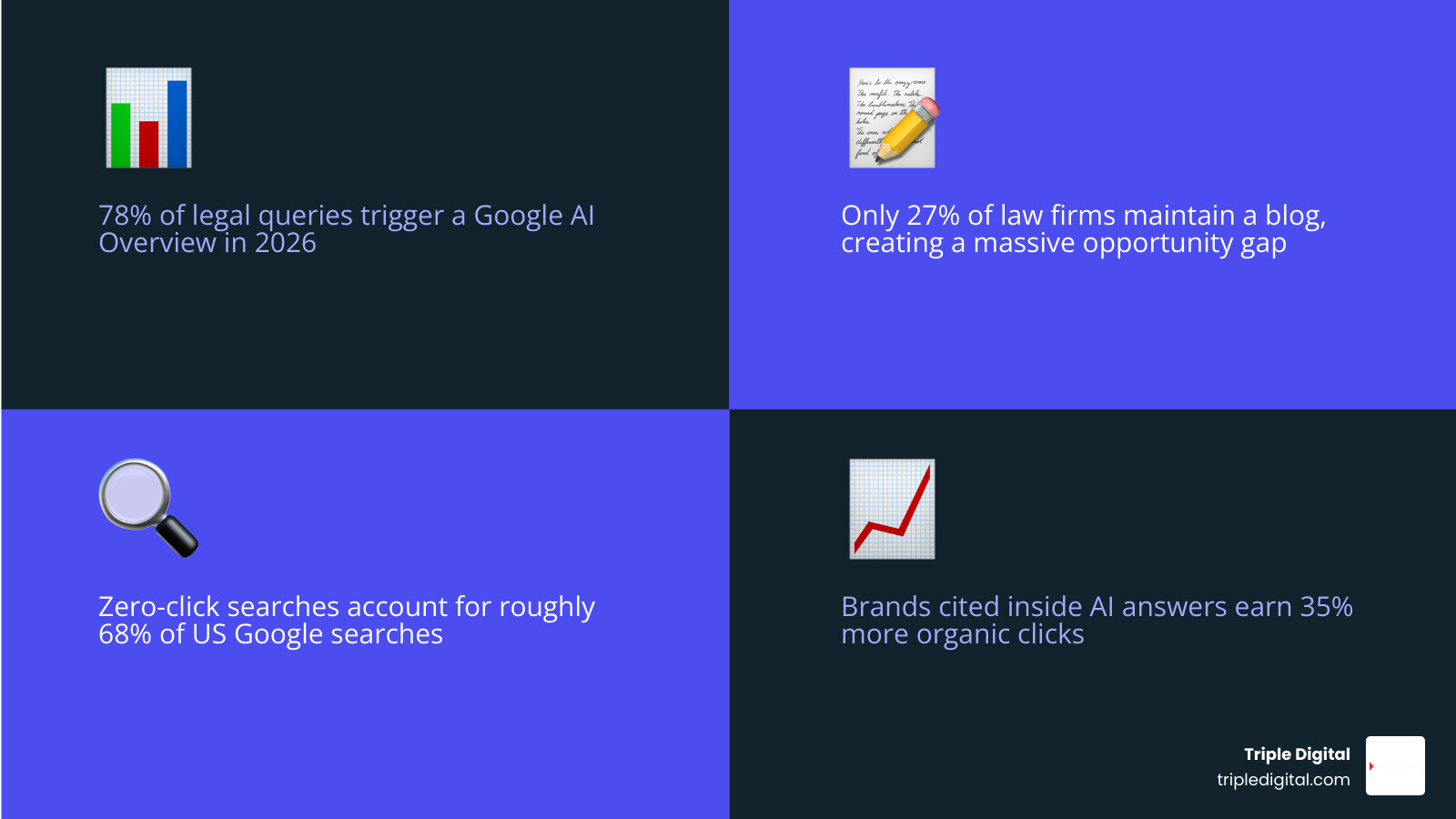
- Track citations, not just clicks – zero-click searches now account for roughly 68% of US Google searches
Pull up your law firm’s blog right now. How many posts have you published in the last 90 days?
For most firms, that number is embarrassingly low — or wildly inconsistent. And that inconsistency is expensive.
Nearly 100% of legal consumers begin their search online. But only 27% of law firms maintain a blog, and only 23% have a documented content strategy. That gap is a real opportunity — if you know how to close it.
The problem isn’t that blogging stopped working. The problem is that the scoreboard moved.
In 2026, 78% of legal queries trigger a Google AI Overview. Zero-click searches are eating into direct traffic. Firms that keep writing the same generic, skim-worthy posts they published in 2020 are watching their numbers fall and blaming the channel.
The firms winning new cases from content? They’ve adapted. Their blogs don’t just rank — they get cited by AI engines. And brands cited inside AI answers earn 35% more organic clicks than those left out.
This guide shows you exactly how to build that kind of blog strategy — even with a small team and limited time.
Law firm blog strategy word roundup:
Why Blogging is Your Most Powerful Law Firm Blog Strategy in 2026
Many managing partners look at their declining organic referral traffic and wonder if they should pull the plug on writing. If search engines are answering user questions directly on the results page, why spend hours writing authoritative legal articles?
The reality is that your blog is no longer just a destination for human readers; it is a vital training ground and reference library for the AI engines that power today’s search landscape.
When we look at Why Do Law Firms Need a Content Marketing Strategy?, the answer in 2026 centers on visibility and authority. Search engines classify legal queries under Google’s strictest quality standard: Your Money or Your Life (YMYL). Because legal advice directly impacts a person’s financial stability and freedom, algorithms are highly selective about the sources they trust.
By regularly publishing in-depth, accurate legal content, your firm builds the Experience, Expertise, Authoritativeness, and Trustworthiness (E-E-A-T) signals required to satisfy these strict standards. This trust is what convinces both search algorithms and prospective clients that your firm is the premier authority in your practice area.
Adapting to Answer Engine Optimization (AEO)
The traditional SEO play was optimizing for keywords to win a blue link on page one. Today, we must optimize for Answer Engines—such as ChatGPT, Perplexity, and Google AI Overviews. This shift is called Answer Engine Optimization (AEO).
AI engines do not generate legal information out of thin air. They scan the web, extract data from highly credible sources, synthesize an answer, and cite their sources.
If your blog lacks clear, extractable facts, the engines will bypass your site entirely and cite your competitors. To win these coveted citations, your content must act as a structured source library that AI models can easily parse, verify, and reference.
The Shift from Clicks to Citations in Your Law Firm Blog Strategy
With zero-click searches reaching roughly 68% of US Google searches by early 2026, the traditional metric of “raw website clicks” is no longer the sole indicator of success. The new gold standard is citation share.

When an AI engine references your firm in an Overview or chat response, it builds massive brand trust. Readers who see your firm cited as the authority are highly primed to convert.
In fact, brands cited in Google AI Overviews earn 35 percent more organic clicks and 91 percent more paid clicks than brands absent from the same answer. Your blog strategy must shift from chasing vanity traffic to securing these high-intent AI citations.
The Content Pillar Model: Building Compounding Topical Authority
To build a blog that commands search engine trust, you cannot write random, disconnected articles. You must demonstrate topical authority. This is achieved through the content pillar model—a structured architecture of interconnected pages that signal comprehensive expertise.
To understand how this functions, look at Pillar Content and Beyond: Crafting a Law Firm Content Strategy. Instead of publishing a grab-bag of legal updates, you construct a centralized “pillar” page that covers a broad practice area, supported by a web of highly specific “cluster” articles.
| Feature | Pillar Page | Cluster Article |
|---|---|---|
| Scope | Broad, comprehensive overview of a major practice area | Highly specific, deep dive into a single subtopic |
| Word Count | 2,000 to 3,000+ words | 800 to 2,000 words |
| Target Keywords | High-volume, competitive terms (e.g., “Houston probate process”) | Long-tail, specific queries (e.g., “probate executor duties in Harris County”) |
| Primary Goal | Establish foundational authority and capture broad search intent | Answer specific client questions and earn precise AI citations |
| Linking Strategy | Links out to all supporting cluster articles | Links back to the main pillar page (bidirectional linking) |
Designing Your First Practice Area Topic Cluster
To build your first cluster, start by mapping out a highly competitive, high-value practice area. For example, a Houston family law firm might establish “Divorce in Texas” as their primary pillar page.
From there, you design 10 to 15 supporting cluster articles addressing specific, long-tail questions that clients frequently ask during consultations. Every cluster article must include a bidirectional link: the cluster page links back to the main pillar page, and the pillar page links directly to the cluster.
This internal linking structure acts as a roadmap for search crawlers and AI scrapers. It proves to search engines that your site doesn’t just have one good article on divorce, but rather a complete, authoritative library on the entire subject.
High-Converting Content Types for Your Law Firm Blog Strategy
Not all blog posts are created equal. To drive actual cases rather than just casual readers, focus on content formats that match the search intent of users who need immediate legal assistance. Refer to The Ultimate Guide to Blog Writing for Law Firms for detailed guidance, but prioritize these three key types:
- Step-by-Step Process Guides: Explain exactly what happens during a legal process (e.g., “What happens at a Texas probate hearing?”). These clear, chronological guides are highly citable and keep readers on your page longer.
- Cost and Financial Posts: Address the elephant in the room by discussing court fees, filing costs, and average expenses. While you cannot give exact quotes, providing realistic cost ranges establishes immense trust and outranks competitors who hide behind “it depends.”
- Local Legal Context: Write about specific local court structures, regional office locations, and local county rules. Since legal procedures are highly localized, writing about Harris County-specific court structures helps you capture high-intent local cases before national legal directories can intercept them.
Structuring Individual Posts for Maximum AI and Search Visibility
To win the citation game, you must format your content so that AI engines can easily extract the answers they need. If your articles are formatted as long, unbroken walls of legal jargon, AI crawlers will look elsewhere.
When developing your content, utilize the strategies outlined in Content Creation for Attorneys to ensure your structural layout is optimized for both human readers and search crawlers.

The Anatomy of an AI-Citable Legal Blog Post
To maximize your chances of being cited in AI Overviews and chat answers, structure every single blog post with the following elements:
- Answer-First Format: Put the direct answer to the title’s question in the very first paragraph (within the first 40 to 60 words). Keep it bold, clear, and concise. AI engines look for immediate answers to pull into their summaries.
- Question-Based H2 Subheadings: Phrase your subheadings as actual questions that clients type into search engines. Beneath each H2, provide a direct, immediate answer in the first sentence before expanding with context.
- Specific Numbers and Named Statutes: Instead of saying “you have a limited time to file,” write “Under Texas Civil Practice and Remedies Code Section 16.003, the statute of limitations is two years.” AI engines prioritize concrete facts, numbers, and specific statutory citations.
- Optimal Word Count: Keep supporting cluster articles between 800 and 2,000 words. Anything under 500 words lacks the depth to signal authority, while posts exceeding 2,500 words can dilute the core answer and make it harder for AI models to extract cleanly.
Satisfying Google YMYL and E-E-A-T Guidelines
Because legal content falls under the YMYL umbrella, search engines heavily scrutinize who wrote the article. Anonymous blog posts or articles signed off by “Admin” or “Marketing Team” are actively penalized in search rankings.
Every post must feature a named, bar-admitted attorney as the author. This author profile must link to a detailed attorney bio page that highlights their credentials, education, bar admissions, and legal experience.
Additionally, implement Author Schema markup in your site’s code. This technical metadata explicitly tells Google and AI engines that the content was written and reviewed by a licensed legal professional, solidifying your E-E-A-T signals.
Overcoming Operational Bottlenecks and Ethical Risks
The two biggest obstacles to a successful law firm blog strategy are operational execution and ethical compliance. Attorneys are busy, and billable hours will always take priority over content creation. However, treating blogging as a sporadic chore rather than a systematic process is why most legal blogs fail.
To build momentum, you need a realistic system. In Write Your Way to Clients: Effective Legal Content Strategies, we emphasize that consistency is far more valuable than sheer volume. Publishing two high-quality, citable posts per month consistently will yield compounding SEO returns, while publishing ten rushed, thin posts in a single week before abandoning the blog for six months achieves nothing.
Executing a Sustainable Plan with Limited Resources
If you are a solo practitioner or a small firm in Houston, you do not need a full-time in-house marketing team to execute this strategy. You can bypass the “writing vs. billing” bottleneck using a simple interview-to-blog workflow:
- The Interview Method: Schedule a 30-minute monthly recording session. Have a team member or a specialized legal content writer ask you 3 to 4 common client questions. Speak naturally, record the audio, and have it transcribed.
- Drafting and Editing: Provide the raw transcripts to a professional legal writer. They can clean up the conversational tone, structure the text into the answer-first format, insert the proper subheadings, and draft 2 to 3 highly optimized blog posts.
- Attorney Review: Spend 15 minutes reviewing the drafts for legal accuracy and compliance before publishing. This method allows you to generate a month’s worth of highly authoritative content with less than an hour of your personal time.
Managing the Ethical Risks of AI-Generated Content
With the rise of generative AI tools, it is tempting to let ChatGPT write all your blog posts in seconds. However, doing so without strict human oversight is a recipe for ethical, professional, and search ranking disaster.
Under the American Bar Association’s (ABA) Formal Opinion 512, lawyers hold ultimate ethical responsibility for all content published under their firm’s name, including AI-generated text. AI models are prone to “hallucinations”—fabricating case law, misrepresenting local Texas statutes, or applying community property rules incorrectly. Publishing these errors can lead to severe bar association disciplinary action and malpractice claims.
Furthermore, search engines are highly adept at identifying and filtering out low-effort, unedited AI content. To protect your firm’s reputation and search visibility, always use AI tools strictly for outlining, brainstorming, or initial drafting. Every sentence must be vetted, refined, and approved by a licensed attorney. Finally, always include a clear disclaimer at the bottom of your blog posts stating that the content is for informational purposes only and does not establish an attorney-client relationship.
Measuring What Matters: Tracking True Blogging ROI
If you are measuring the success of your blog solely by looking at raw website traffic, you are missing the bigger picture. In 2026’s search environment, a drop in raw page views does not necessarily mean your blog is failing. It often means your audience is getting their answers directly from AI Overviews where your firm is cited.
To understand the true return on investment (ROI) of your content, you must look beyond vanity metrics and track high-intent indicators.
Moving Beyond Raw Website Traffic Metrics
To measure what actually drives revenue and cases to your firm, set up tracking in Google Analytics 4 (GA4) and Google Search Console (GSC) for these key metrics:
- Citation Share: Use search tracking tools to monitor how often your blog posts are cited in Google AI Overviews and major AI search engines for your target practice area queries.
- Branded Search Volume: When people see your firm cited in AI answers, they often search for your firm name directly. An increase in branded searches is a direct indicator of growing authority.
- Consultation Source Mix: Update your intake process to ask every single lead, “How did you hear about us?” Track how many signed cases cite your blog, an AI search answer, or a specific educational guide as their first point of contact.
- Time on Page and Scroll Depth: High dwell times prove that readers are actually consuming your content, which signals to search engines that your site provides genuine value.
Frequently Asked Questions About Legal Blogging
How often should a law firm publish new blog posts in 2026?
For most small to mid-sized law firms, publishing 2 to 4 high-quality, citable posts per month is the sweet spot. Consistency matters far more than volume. It is highly preferable to publish two thoroughly researched, structurally optimized, and attorney-reviewed posts every month than to publish daily posts that lack depth and proper formatting.
What are the most common reasons law firm blogs fail?
Most law firm blogs fail because they lack a documented content strategy. Only 23% of firms have one. Other common pitfalls include writing highly technical articles meant for other lawyers rather than answering practical client questions, failing to format posts for AI readability, neglecting internal linking, and omitting clear, personalized calls to action (CTAs) that guide readers on how to take the next step.
Can law firms use AI to write their blog content?
AI can be incredibly useful for brainstorming topics, structuring outlines, and generating initial rough drafts. However, you must never publish raw, unedited AI content. Doing so violates ethical guidelines under ABA Formal Opinion 512, risks severe malpractice issues due to AI hallucinations, and will likely result in your content being filtered out by search engines prioritizing genuine human expertise.
Take the Gavel: Partner with Triple Digital for a High-Impact Content Strategy
Building a compounding, AI-optimized blog strategy requires precision, data mining, and consistent execution. If you are ready to stop wasting time on generic content and start capturing high-value cases in the Houston market, we are here to help.
At Triple Digital, we specialize in lead generation and case acquisition for law firms. Our “less fluff, more cases” approach cuts through the marketing noise to deliver measurable, bottom-line results. We leverage advanced data mining and AI targeting to build content engines that position your firm as the undisputed authority.
Don’t let your competitors claim the top spots in AI search answers. Schedule a consultation with our team today, and let’s discuss how we can turn your blog into your firm’s most profitable asset.