





7 Essential Law Firm Social Media Management Tips
Why Most Law Firms Are Leaving Clients on the Table in 2026
Law firm social media management is the process of planning, creating, publishing, and tracking content across social platforms to build your firm’s reputation, attract potential clients, and drive consistent case inquiries.
Here’s a quick overview of the 7 essential tips this guide covers:
| Tip | What It Means |
|---|---|
| 1. Choose the right platforms | Focus on the networks that match your practice area, audience, referral sources, and content style. |
| 2. Build credibility and trust | Use consistent, human, plain-English content to show that your firm is active, approachable, and reliable. |
| 3. Stay compliant with ethics rules | Review posts for attorney advertising rules, confidentiality, disclaimers, and jurisdiction-specific requirements. |
| 4. Create useful content consistently | Mix education, firm culture, video, and light promotion on a sustainable posting schedule. |
| 5. Measure ROI beyond vanity metrics | Track traffic, consultations, qualified leads, signed cases, and referral engagement instead of only likes or followers. |
| 6. Decide what to outsource vs. keep in-house | Match your social media workflow to your team’s time, legal input, approval process, and growth goals. |
| 7. Avoid common social media mistakes | Prevent inconsistency, generic content, over-promotion, ignored messages, and weak lead tracking. |
If you’re a law firm relying on referrals and word-of-mouth alone, you’re likely missing a large share of potential clients. Here’s why that matters right now.
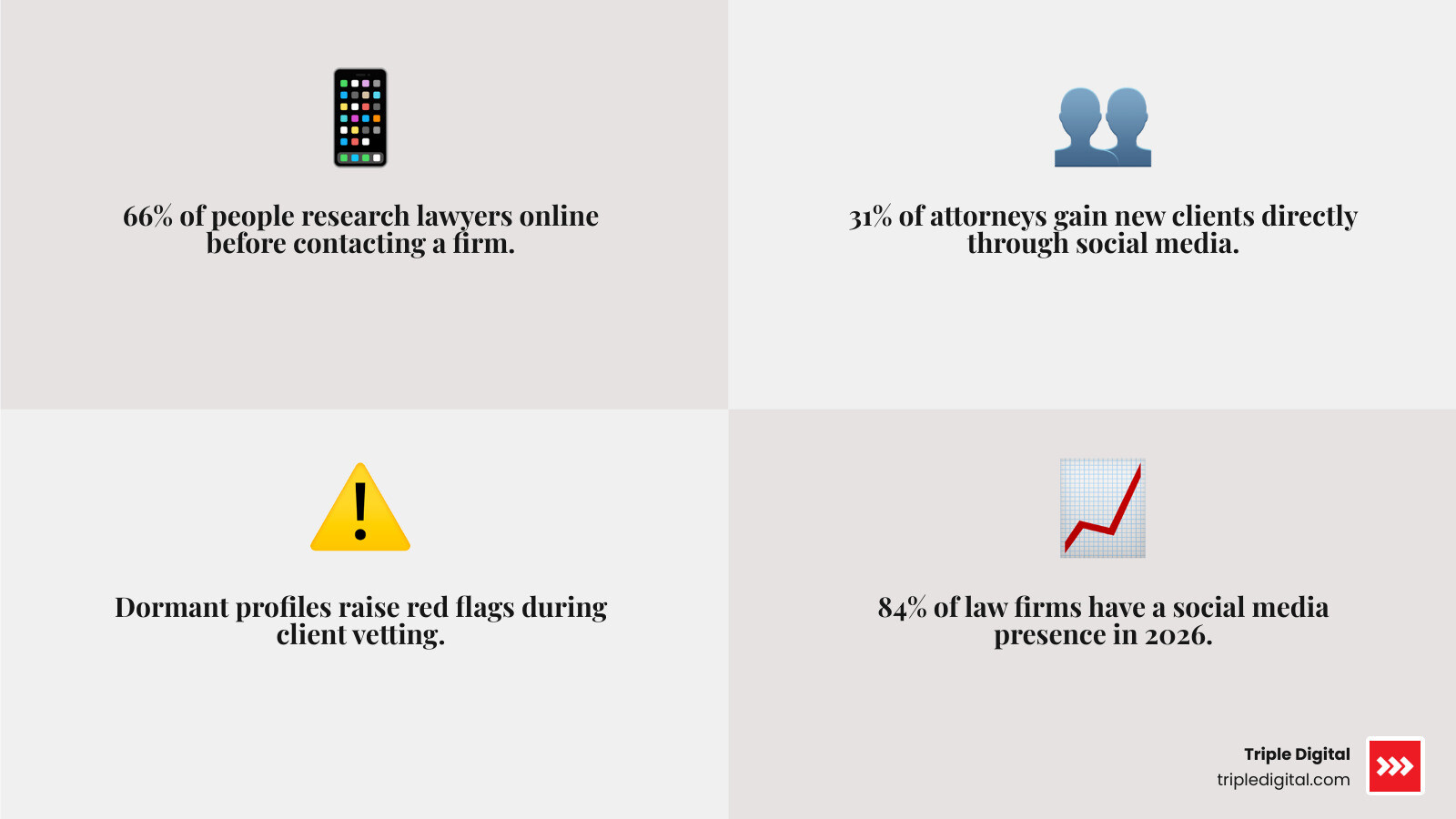
66% of people research lawyers online before making contact. Meanwhile, 31% of attorneys report gaining new clients directly through social media. Yet many firms still treat their social profiles as an afterthought — posting sporadically, reusing generic content, or worse, going dark for months at a time.
A dormant profile doesn’t just fail to attract clients. It actively raises red flags. When someone Googles your firm and finds an Instagram page with a post from two years ago, they move on.
The good news? You don’t need to be a content creator or spend hours a week online to fix this. You need a clear, repeatable system — and that’s exactly what this guide walks you through.
Tip 2: Build Credibility and Trust Through Social Media
In 2026, social media is not optional for most firms. It is part of the client vetting process, part of your reputation, and part of your lead generation system.
The data backs that up:
- 84% of law firms maintain a presence on social networks
- 69.2% of law firms are on LinkedIn, making it the most widely used platform among lawyers
- 40% maintain a presence on Facebook
- 31% of lawyers acquire new clients through social media
- 66% of legal clients research online before hiring a lawyer
That means your prospects are checking your website, your reviews, and your social profiles before they ever call. A strong presence signals that your firm is active, credible, and engaged. A weak one does the opposite.
Good social media management also supports broader marketing goals:
- It builds familiarity before a consultation
- It keeps your firm top of mind with referral partners
- It can drive traffic back to key website pages
- It reinforces your brand authority
- It gives search engines more signals that your business is active and relevant
If you want a broader look at how social channels support visibility and growth, see our guide on how social media can help your business.
Most legal clients do not hire the first lawyer they find. They compare. They scroll. They look for signs that your firm is legitimate, approachable, and current.
Social media helps build that trust in ways your website alone cannot:
- Showing attorneys as real people, not just headshots and bios
- Highlighting community involvement and local events
- Sharing plain-English legal education
- Demonstrating consistency and professionalism
- Reinforcing positive client experiences where ethically permitted
This matters because social media is often less about first discovery and more about validation. A prospect may find you through Google, a referral, or a directory, then check your LinkedIn, Facebook, or Instagram before deciding whether to contact you.
That is why consistent posting matters so much. An active profile says, “We’re here, we’re paying attention, and we know what we’re doing.” An abandoned one says, well… not that.
For more on turning posts into website visits and inquiries, read how social media can drive traffic to law firm websites.
Tip 1: Choose the Right Platforms for Your Practice Area
One of the biggest mistakes we see is firms trying to be everywhere at once. You do not need to dominate every platform. You need to show up where your audience actually spends time.
Here is the simple rule: choose platforms based on your ideal client, referral sources, content style, and internal resources.
Platform-Specific Strategies
Below is a practical platform comparison for law firms.
| Platform | Best For | Why It Works | Best Fit Practice Areas |
|---|---|---|---|
| Professional visibility, referrals, B2B relationships | Strongest lawyer adoption and ideal for thought leadership | Business law, employment, estate planning, commercial litigation | |
| Local community reach, reviews, retargeting | Huge user base and strong local engagement | Personal injury, family law, criminal defense, estate planning | |
| Brand personality, visual storytelling, short video | Great for humanizing attorneys and office culture | Family law, criminal defense, personal injury, immigration | |
| TikTok | Reach and awareness through short-form video | Good for educational, personality-driven content | Criminal defense, personal injury, family law, consumer-facing practices |
| YouTube | Evergreen educational content and search visibility | Ideal for explainers, FAQs, and high-trust content | Estate planning, personal injury, business law, immigration |

A few practical notes:
- LinkedIn is usually the best starting point for firms that rely on professional referrals.
- Facebook remains valuable for local visibility and paid targeting.
- Instagram works best when you have photos, Reels, and behind-the-scenes content.
- TikTok is not for every firm, but it can work very well when attorneys are comfortable on camera.
- YouTube is a strong long-term asset because people search for answers there.
For a deeper platform breakdown, visit Best Social Media Sites For Law Firms Dont Let Your Feed Be A Brief Case and Law Firm Marketing With Social Media.
As a quick practice-area guide:
- Personal injury: Facebook, Instagram, YouTube
- Family law: Facebook, Instagram, TikTok
- Criminal defense: Instagram, TikTok, YouTube
- Estate planning: LinkedIn, Facebook, YouTube
- Business law: LinkedIn, YouTube
- Immigration: Facebook, Instagram, YouTube
The best platform is not always the trendiest one. It is the one that reaches your clients and fits your firm’s communication style.
Tip 3: Navigate Ethics and Compliance in Law Firm Social Media Management
This is the part where social media gets less fun but more important.
Law firms cannot manage social media like e-commerce brands or lifestyle influencers. Attorney advertising rules, confidentiality obligations, and state bar regulations all matter. Every post should be reviewed through that lens.
At a minimum, your firm should have internal rules covering:
- Who can publish or approve content
- What disclaimers are required
- How client stories may be shared
- How direct messages are handled
- What claims about results or expertise are prohibited or restricted
Key compliance issues include:
- Avoiding misleading statements
- Not guaranteeing outcomes
- Not implying an attorney-client relationship through casual replies
- Protecting confidential or identifying client information
- Following jurisdiction-specific advertising rules
A simple disclaimer can help, such as stating that content is for informational purposes only and does not create an attorney-client relationship. That disclaimer should not replace legal review, but it is a smart baseline.
Paid campaigns require extra care. Ad targeting, testimonial use, and claims about past results all need close review. For more guidance, see How To Run Social Media Ads Without Getting Disbarred.
Avoiding Ethical Pitfalls
Here are the most common social media ethics mistakes law firms make:
- Calling attorneys “experts” or “specialists” without proper certification
- Posting case results without context or required disclaimers
- Answering specific legal questions publicly in ways that sound like legal advice
- Sharing photos or stories that reveal client identity
- Reposting trends or memes without checking tone, accuracy, or copyright
- Using targeting so aggressively that the message feels misleading or inappropriate
This is where process matters. We recommend a simple approval workflow:
- Draft the post
- Check facts and citations
- Review for confidentiality and tone
- Confirm jurisdictional compliance
- Approve and schedule
Targeting is powerful, especially when combined with AI and data-driven audience research, but it must still stay compliant. For more on ethical precision in audience targeting, check out Social Media Pinpoint Targeting.
Tip 4: Create High-Performing Content and Posting Schedules
The best-performing legal content usually does not look like advertising. It looks like help.
That means your content should answer real questions, reduce confusion, and make your firm feel approachable. If every post sounds like “Call now for a free consultation,” your audience will tune out fast.
A smart content mix for most firms is the 70-20-10 formula:
- 70% educational content
- 20% behind-the-scenes or firm culture
- 10% promotional content
That balance keeps your feed useful without making it feel like a billboard.
High-performing content types for law firms include:
- Frequently asked questions
- Myth vs. fact posts
- Short legal explainers
- Community news or event recaps
- Attorney introductions
- Office culture and team spotlights
- Simple infographics
- Blog post summaries
- Answers to common intake questions
- Process explainers like what happens after an accident or how probate generally works
Keep the language simple. Legalese may impress opposing counsel, but it does not usually help a stressed prospect on Facebook at 9:30 p.m.
Here is a realistic posting rhythm for many firms:
- LinkedIn: 2-3 times per week
- Facebook: 3-4 times per week
- Instagram: 3-4 times per week
- TikTok: 2-3 times per week
- YouTube: 1 long-form video or 1-2 Shorts per week
For most small and midsize firms, posting 3-5 times per week across core platforms is the sweet spot. Consistency beats intensity. A manageable schedule for six months is better than a heroic burst for nine days.
Use a monthly content calendar to plan:
- Themes by practice area
- Seasonal topics
- FAQs from intake calls
- Firm news
- Video shoots
- Calls to action
- Compliance review dates
Need more ideas? Explore our social media resource category.
The Role of Video in Law Firm Social Media Management
Video deserves its own section because it keeps winning.
Research shows that 81% of social media users wanted more video content in 2025, and that preference has not gone away in 2026. For law firms, video works especially well because legal topics are easier to understand when a real person explains them.
Video helps you:
- Humanize your attorneys
- Build trust faster
- Increase retention of educational content
- Repurpose one idea across multiple platforms
- Stand out in crowded feeds
The most effective legal videos are usually short and straightforward:
- “What to do after a car accident”
- “What happens during the divorce process”
- “Do I need a will if I own a home”
- “3 mistakes to avoid after an arrest”
- “What business owners should know before signing a contract”
You do not need a studio. A quiet office, decent lighting, clear audio, and a lawyer who sounds like a human being are enough. Fancy is optional. Clear is mandatory.
Short-form options like Instagram Reels, TikTok, Facebook video, and YouTube Shorts are especially useful for top-of-funnel visibility. Longer YouTube videos are better for deeper education and search visibility.
For more on turning social attention into business results, read From Likes To Leads Mastering Social Media For Attorneys.
Tip 5: Measure ROI and Decide What to Outsource
Likes are nice. Cases are nicer.
To know whether your law firm social media management is working, you need to track more than vanity metrics. A growing follower count means very little if it never leads to consultations.
The best KPIs for law firms usually include:
- Reach and impressions
- Engagement rate
- Link clicks
- Website traffic from social
- Landing page conversions
- Consultation requests
- Qualified leads
- Signed cases tied to campaign source
- Referral partner engagement on LinkedIn
The key is connecting social activity to the rest of your marketing system. That means using:
- UTM tracking links
- Intake forms with source fields
- Call tracking where appropriate
- CRM or case intake reporting
- Retargeting pixels for paid campaigns
A simple ROI path might look like this:
- Prospect sees an educational Reel
- Clicks to your website
- Reads a relevant page or blog post
- Fills out a consultation form
- Intake team qualifies the lead
- Signed case is attributed back to social
When you review performance each month, ask:
- Which platform generated the most qualified traffic?
- Which content themes got the most saves, clicks, or inquiries?
- Did video outperform static graphics?
- Did referral-focused LinkedIn posts create introductions?
- Which posts contributed to actual consultations?
This is where our data-first approach matters. At Triple Digital, we focus on lead generation and case acquisition, not fluff metrics that look pretty in a report but do not move the business.
Tip 6: Decide What to Outsource vs. Keep In-House
Should you outsource or keep social media in-house? The honest answer: it depends on your time, team, and growth goals.
In-house can work well if:
- You have a dedicated marketing coordinator
- Attorneys are available for content input
- Someone can consistently manage approvals and posting
- Your firm already has clear brand and compliance processes
Outsourcing often makes more sense if:
- Social posting is inconsistent
- Attorneys are too busy to manage content
- Your team struggles with strategy or analytics
- You want faster execution and better creative consistency
- You need stronger lead tracking and paid social integration
A hybrid model is often the best option. Your team provides legal insight, approvals, and occasional on-camera time. We handle strategy, content production, scheduling, optimization, and reporting.
That setup usually gives firms the best of both worlds: accuracy and efficiency.
Tip 7: Avoid Common Social Media Mistakes
Most social media problems for law firms are not caused by bad intentions. They are caused by inconsistency, unclear strategy, or trying to sound too much like a brochure.
Here are the biggest mistakes to avoid:
- Posting only when someone remembers
- Making every post promotional
- Ignoring comments and messages
- Using generic content that looks like every other law firm
- Letting profiles sit inactive for months
- Writing captions in dense legal jargon
- Copying the same post word-for-word across every platform
- Failing to track leads and conversions
- Skipping compliance review
- Choosing too many platforms too early
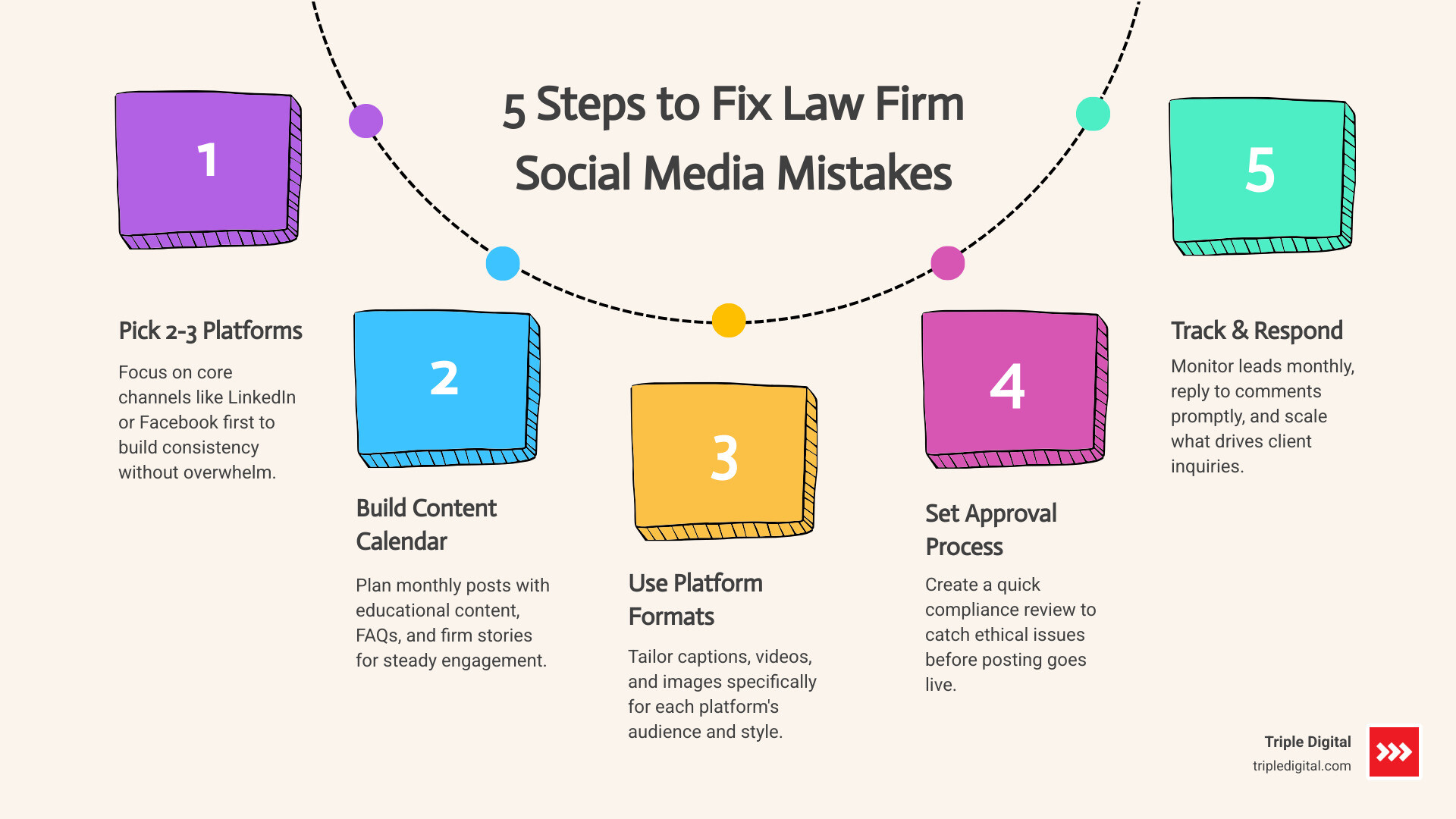
The fix is usually simple:
- Pick 2-3 core platforms first
- Create a monthly content calendar
- Use platform-specific formats
- Build a lightweight approval process
- Respond to engagement promptly
- Review results monthly
- Double down on what actually brings in leads
And please, do not treat your intern as your entire strategy. Social media is important, but it needs direction.
Frequently Asked Questions about Law Firm Social Media Management
How often should my law firm post on social media?
For most firms, 3-5 posts per week is a strong baseline. Platform-specific frequency matters too:
- LinkedIn: 2-3 times weekly
- Facebook: 3-4 times weekly
- Instagram: 3-4 times weekly
- TikTok: 2-3 times weekly
- YouTube: weekly if possible
The ideal schedule is one your firm can maintain consistently without sacrificing quality or compliance.
Can social media really help my law firm get more cases?
Yes, when it is managed strategically. Social media helps law firms earn trust, stay visible, drive website traffic, and convert interest into consultations. Research shows 31% of lawyers acquire new clients through social media, and 35% of lawyers using social professionally have gained clients, rising to 42% for small firms.
The key is not just posting. It is connecting content to landing pages, intake systems, and follow-up.
What is the best social media platform for personal injury lawyers?
For most personal injury firms, Facebook, Instagram, and YouTube are the strongest mix.
- Facebook is strong for local visibility, community reach, and retargeting
- Instagram helps humanize the firm and showcase short-form video
- YouTube is excellent for educational explainers and search-based discovery
LinkedIn can also support referral relationships with medical providers and other professionals, but for direct consumer reach, the first three are usually stronger.
Conclusion
Strong law firm social media management is not about posting just to stay busy. It is about building trust, staying visible, and turning attention into signed cases.
In 2026, potential clients expect to find active, credible law firms online. They compare profiles, watch videos, read posts, and decide whether your firm feels current and trustworthy. When your social media is strategic, compliant, and tied to real business goals, it becomes a true growth channel.
That is exactly how we approach it at Triple Digital. We combine creative execution with AI-driven targeting, data mining, and a less-fluff-more-cases mindset built for law firm growth.
If you want help building a social media system that supports referrals, client acquisition, and long-term brand authority, contact Triple Digital for expert law firm marketing services.