




Estate Planning Client Targeting for Law Firms: Win High-Value Retainers
Why Law Firms Need Smarter Estate Planning Client Targeting
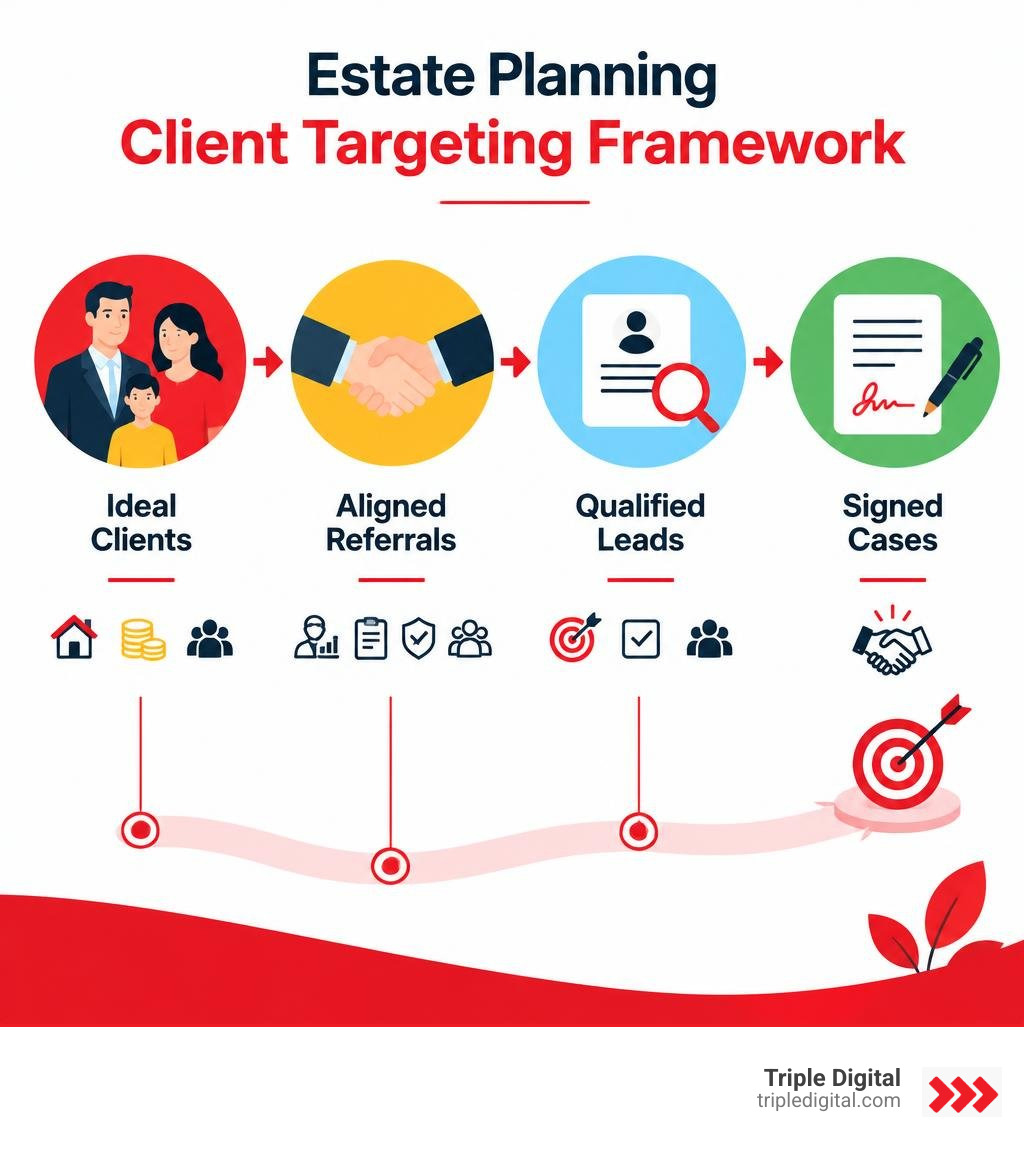
Estate planning client targeting helps law firms attract the right estate planning leads, not merely more inquiries. Start with the firm’s best past clients: identify the assets, family needs, and planning work they had in common. Then assess which referral partners and marketing channels generate more prospects with those characteristics. Track signed matters, not just inquiries, so marketing investment supports qualified cases.
Consider Katherine, an estate planning attorney with 23 years of experience and 41 professional contacts who send her almost no work. Her case shows why a large network is not the same as a relevant one. With an estimated $124 trillion set to transfer through 2048, firms seeking high-net-worth retainers need to reach families whose needs fit their skills.
I’m Paul Taylor, president of Triple Digital, where I help law firms turn marketing data into signed cases. My 28-plus years in growth and lead generation shape the approach to estate planning client targeting covered below.
Diagnosing the Growth Bottleneck: Marketing Volume vs. Estate Planning Client Targeting
Many attorneys believe they are simply one marketing breakthrough away from doubling their practice revenue. When new retained matters slow down, the default reaction is usually to spend more on broad advertising, attend more local networking breakfasts, or blast out generic brochures. Yet, as Katherine’s practice illustrates, adding more volume to an unfocused funnel only creates operational noise.
Katherine maintained a $2.1 million practice with more than two decades of technical expertise. On paper, her referral network was impressive: 41 financial planners, CPAs, insurance agents, and fellow attorneys. In reality, those 41 relationships sent her almost zero consequential matters each quarter.
She did not have an awareness problem or a technical skill problem. She had a client targeting problem. Rather than waiting passively for unpredictable walk-ins, law firms need strategies for proactive legal lead generation to attract clients who actually match their service capabilities.
| Factor | Friendly Networking Contacts | Relevant Strategic Referral Partners |
|---|---|---|
| Target Client Profile | Serves low-asset or general consumer tiers | Exclusively advises high-net-worth (HNW) families & business owners |
| Workflow Alignment | Ad-hoc, informal conversations over coffee | Structured case coordination, data sharing, and joint planning milestones |
| Referral Reciprocity | Expects volume without clear client criteria | Shares identical target client thresholds and complementary service value |
| Average Client Value | Basic statutory will preparation ($1,000–$2,500) | Complex trusts, tax mitigation, and wealth transfers ($8,000–$25,000+) |
The Ideal Behavior × Ideal Target Equation
A successful legal practice can be modeled as a simple relationship: Practice Success = Ideal Behavior × Ideal Target.
Ideal behavior represents your technical legal acumen, responsive communication, bedside manner, and ethical integrity. Ideal target represents the exact profile of the client whose wealth, family dynamics, and legal needs match your service model.
When an attorney exhibits outstanding professional behavior but focuses on the wrong target, they become a practitioner whom everyone respects and likes, but nobody hires for high-stakes, lucrative work. Technical skill alone does not command five-figure retainers if your marketing reaches consumers who only require a basic, single-document will.
Auditing Friendly vs. Relevant Center of Influence (COI) Networks
Research from Kitces indicates that Center of Influence (COI) marketing delivers a 3:1 return on investment, with referrals from accountants and financial advisors generating substantial annual revenue per client. However, that return only materializes when your professional network serves your ideal market tier.
To audit your network, take your top five most profitable, seamless estate planning matters from the past two years. Next, list your five most active professional referral sources. Compare the two lists side-by-side:
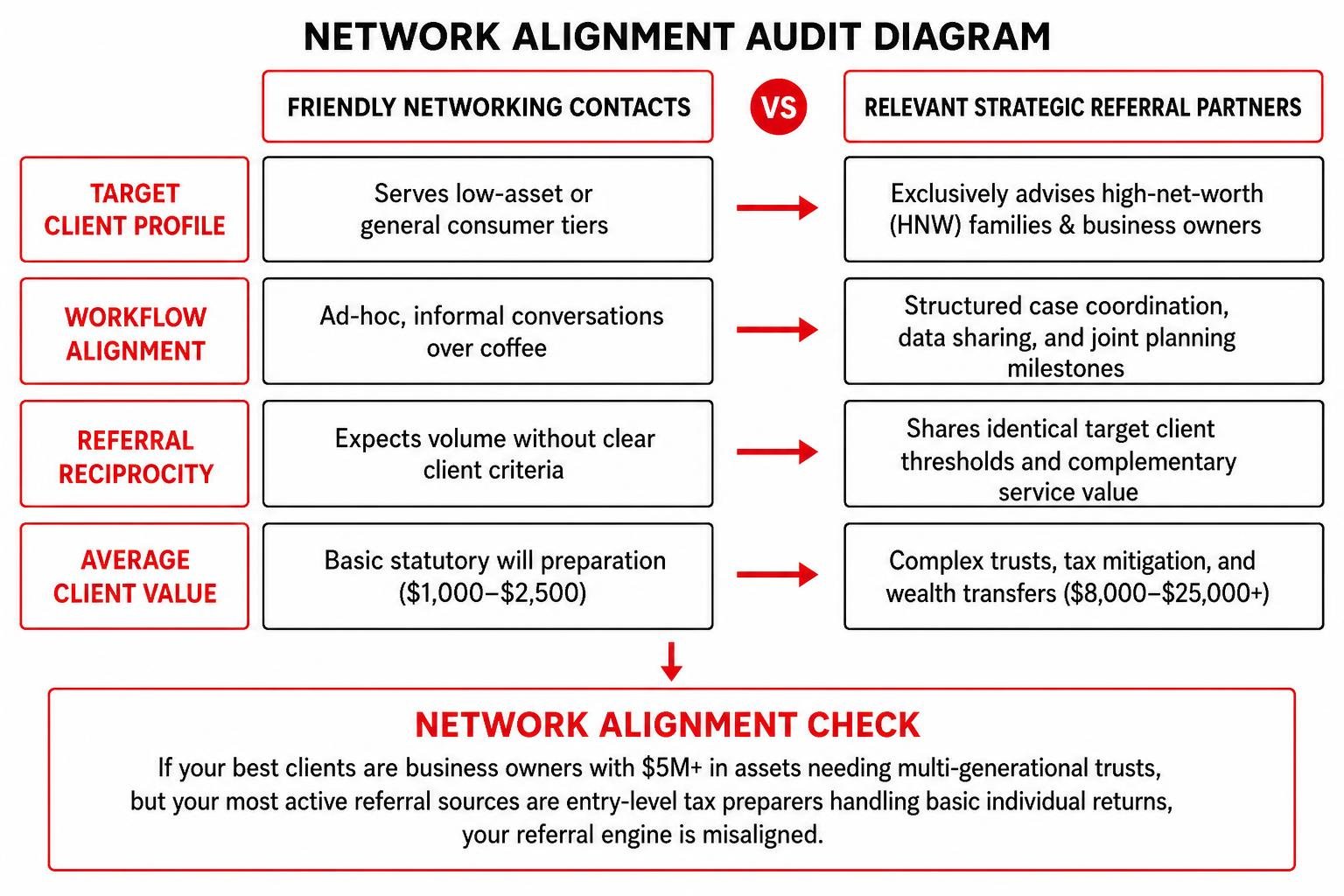
If your best clients are business owners with $5M+ in assets needing multi-generational trusts, but your most active referral sources are entry-level tax preparers handling basic individual returns, your referral engine is misaligned. You must shift your attention to professionals who already manage the exact balance sheets you want to protect. Exploring exclusive leads that transform your practice can help bridge this gap while you reposition your partner network.
Defining the Ideal Client Profile Across Wealth and Complexity Tiers
Not every estate planning matter warrants the same time or resources. Effective targeting begins by establishing precise asset, demographic, and psychological filters before investing in outreach.

According to FindLaw’s U.S. Consumer Legal Needs Survey, estate planning is the single most common legal need in the country, maintaining a 30% incidence rate, with over half of consumers hiring an attorney to resolve it. However, the most profitable segment of this demographic typically shares specific baseline traits:
- Age 55 and older with settled assets, commercial real estate, or closely held business interests.
- Significant non-probate wealth (brokerage accounts, retirement assets, life insurance policies) that require coordinated beneficiary design.
- A desire for privacy, probate avoidance, and asset preservation rather than simple statutory document filing.
Attorneys can streamline their intake workflows by applying a probate leads filter to separate routine document requests from high-value estate planning and trust administration matters.
Complexity-Based Segmentation: From Blended Families to Family Offices
Client targeting must account for the emotional and structural complexity of the household. Each segment presents different planning hurdles:
- Married Couples with Adult Biological Children: The lowest structural complexity tier. The primary goal is usually asset distribution and probate avoidance.
- Parents with Minor Children: Moderate structural complexity, but high emotional friction. The primary reason parents delay estate planning is decision paralysis around minor guardianship nominations.
- Blended Families and Childless Married Couples: High complexity. Childless couples fear that outright transfers to a surviving spouse might permanently disinherit their biological bloodline if the survivor remarries or alters their documents later in life.
- Business Owners & Real Estate Investors: High technical complexity requiring business succession provisions, buy-sell agreement integration, and asset protection trusts.
Advanced Estate Planning Client Targeting for Multi-Generational Wealth
Cerulli Associates projects that $124 trillion in wealth will transfer across generations through 2048, with $105 trillion flowing directly to heirs. Yet, data shows that 43% of heirs plan to switch wealth and legal service providers immediately after inheriting wealth, even when 92% of the older generation reported high satisfaction with their current team.
Why do heirs leave? The top reasons cited are lack of communication (25%), unfamiliarity with the advisors (26%), and unaligned values (33%). Conversely, those who stay cite excellent communication (53%) and established trust (44%).
Retaining and capturing this transitioning wealth requires offering family wealth meetings and multi-generational planning sessions. In fact, 89% of high-net-worth advisory firms rank regular family meetings as their most effective retention strategy.
Building High-Converting Acquisition Channels for High-Net-Worth Retainers
Attracting high-value clients requires evaluating your acquisition channels based on signed retainers rather than raw clicks. Reviewing past channel performance allows you to cut low-performing campaigns and double down on proven sources to succeed at building a sustainable pipeline of high-value estate planning leads.

Tailoring Educational Seminars to High-Intent Demographics
Educational workshops remain one of the most reliable channels for reaching motivated older demographics when executed correctly:
- Direct Mail Benchmarks: Direct mail for educational seminars yields an average 1% response rate. To secure 60 confirmed registrants, plan to mail roughly 6,000 invitations to households aged 55+ within a strict 15-minute drive radius of the venue.
- Avoid the “Free Dinner” Trap: Skip steakhouse dinner seminars. Providing expensive free meals frequently attracts attendees seeking a free night out rather than serious legal counsel. Choose clean, accessible venues such as library conference rooms, local college lecture halls, or community centers.
- Focus on Education, Not Hard Selling: Deliver a 60- to 75-minute presentation addressing probate costs, family conflict avoidance, and incapacity risks, followed by 15 minutes of structured Q&A.
- Immediate Consultation Booking: Provide physical consultation booking sheets at each seat and have staff on-site to confirm appointments before attendees leave the room.
Digital Touchpoints and Multi-Channel Estate Planning Client Targeting
High-net-worth individuals and their adult children will thoroughly research your digital footprint before confirming a consultation. Implementing modern digital marketing strategies for lawyers ensures your firm appears authoritative across all touchpoints.
- Search Visibility: Optimize your local presence for high-intent search terms. Adapting your content for winning high-value estate leads in AI search helps capture sophisticated queries from prospective clients researching complex trusts.
- Google Business Profile & NAP Consistency: Ensure your Name, Address, and Phone number (NAP) are identical across Google, legal directories, and social platforms to maintain search rank and avoid prospect drop-off.
- Targeted Social Proof: Maintain active, professional profiles on LinkedIn and Facebook. Highlight verified client testimonials and educational video explainers that answer common estate questions without complex jargon.
Aligning Client Nurturing and Post-Matter Retention Workflows
Acquiring an estate planning client should never be treated as a one-time transaction. Because family situations, tax laws, and asset values evolve constantly, proactive client communication is essential for long-term retention.
Life-Event Triggers and Systematic Review Cadences
Estate planning documents are living instruments. Establish systematic review touchpoints to keep plans up to date:
- Families with Minor Children: Schedule an estate plan review every 2 to 3 years to account for changing guardians, educational milestones, and new assets.
- Mature Estates: Schedule reviews every 3 to 5 years to verify asset titling, assess tax code changes, and review fiduciary designations.
- Trust Funding Audits: The single most common point of failure in estate planning is an unfunded trust. Regularly remind clients to coordinate newly acquired brokerage accounts, real estate, and business interests with their legal trust structures.
Turning Passive CPAs and Financial Advisors into Active Strategic Partners
To convert a passive network of CPAs and financial planners into active referral partners, stop asking for business and start delivering upfront value. CPAs and wealth managers care about client retention, asset coordination, and clean tax execution.
- Co-Host Educational Webinars: Invite a CPA or wealth manager to co-host a virtual workshop on tax-advantaged legacy planning. This introduces your firm to their client base in an educational setting.
- Provide Joint Client Briefings: When working on a mutual client’s plan, keep the advisor informed at key drafting and signing milestones (with client consent).
- Offer Value-First Consultations: Provide mutual partners with quick legal summaries on statutory changes that impact their clients’ tax liabilities.
Practicing these collaboration methods will help establish your firm as the trusted authority using proven strategies to grow your legal practice.
Frequently Asked Questions About Estate Planning Client Targeting
How can an attorney tell if they have a lead volume problem or a client targeting problem?
If your calendar is filled with consultations that result in price pushback, requests for basic one-off forms, or prospects who ghost after hearing your retainer fee, you have a targeting problem. A firm with healthy targeting converts a high percentage of consultations because incoming prospects already possess the assets, intent, and budget required for comprehensive legal planning.
Why do dinner seminars fail to attract ideal high-net-worth estate planning clients?
Dinner seminars attract individuals looking for a complimentary meal, inflating attendance while lowering overall conversion rates. High-net-worth prospects value their time and seek clear, actionable education. Hosting seminars in professional conference rooms or educational venues filters for motivated attendees who are serious about hiring legal counsel.
What is the most effective way to re-engage an inactive professional referral network?
Conduct a network audit to identify which contacts share your target client demographic. Reach out to those aligned professionals with a specific, value-first proposal, such as co-hosting a client education webinar or presenting an update on new estate tax regulations.
Help Your Law Firm Attract Better Estate Planning Leads
For law firms, consistent high-value estate planning retainers require more than general networking and broad marketing. By focusing on the demographic, psychological, and wealth profiles that fit the firm’s legal services, the marketing team can reduce unqualified inquiries and build a more predictable pipeline of valuable estate planning matters.
At Triple Digital, we help law firms build data-driven marketing systems and audience-targeting campaigns that generate better-fit estate planning leads and measurable case growth. If your firm is ready to reduce unqualified leads, schedule a strategy consultation to align its marketing with the estate planning clients it wants to serve.